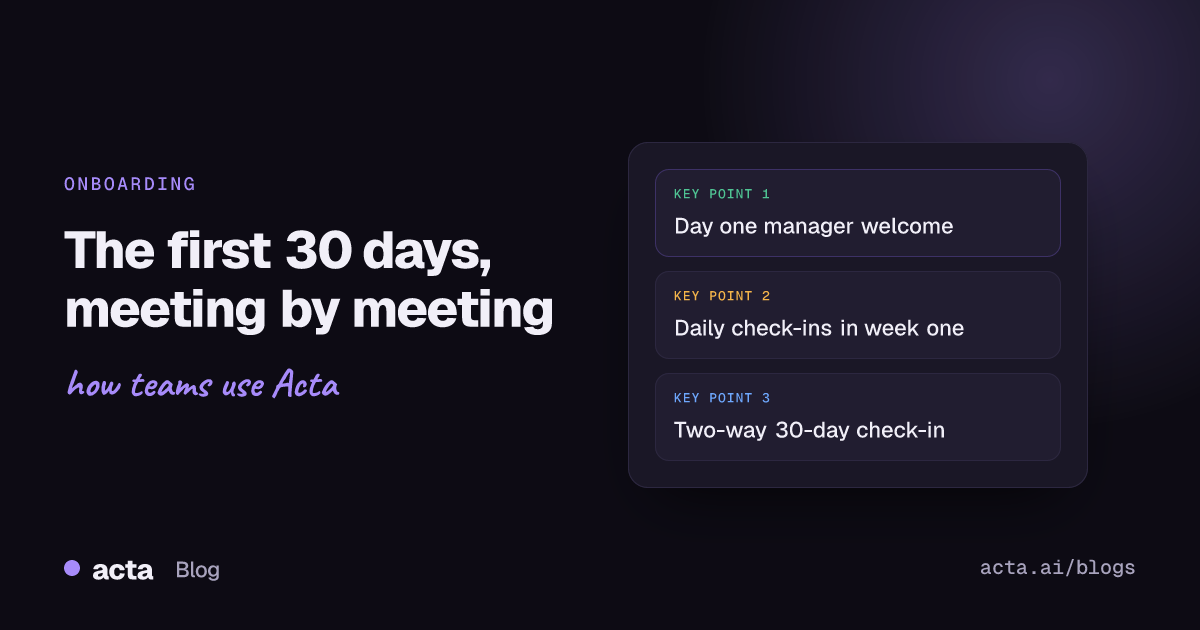
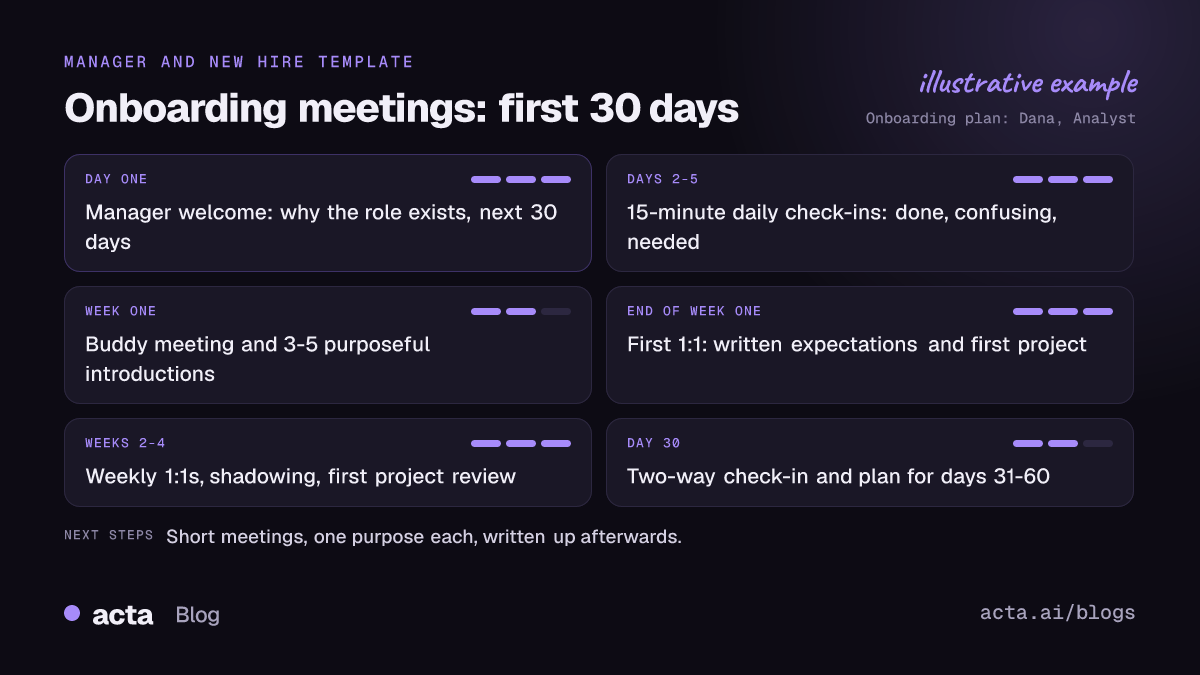
Quick answer: In the first 30 days, new hire onboarding meetings should follow a simple rhythm: a manager welcome on day one, short daily check-ins in the first week, weekly one-to-ones after that, a handful of introductions to key colleagues, regular time with an onboarding buddy, and a two-way 30-day check-in. Keep each meeting short, with one clear purpose.
A new starter's calendar in week one tends to swing between two extremes. Either it's empty apart from IT setup and a pile of documents to read, or it's packed with back-to-back introductions where they meet 25 people and remember four. Neither helps them do the job.
I've onboarded people both ways, and the difference usually comes down to which meetings you hold and what each one is for. Below is the schedule I'd use for the first 30 days, with what to cover in each meeting and the mistakes that make onboarding feel like a waiting room.
Why do new hire onboarding meetings matter so much?
Because most organizations don't get onboarding right, and the manager is the biggest lever. Gallup has reported that only 12% of employees strongly agree their organization does a great job of onboarding new employees. The same Gallup article says that when managers take an active role in onboarding, employees are 3.4 times as likely to strongly agree their onboarding was exceptional.
Active doesn't mean hovering. It means a predictable set of conversations where the new person can ask questions, hear what good looks like and get feedback before small misunderstandings set. That's what the meetings below are for.
What should happen before day one?
One short call or a personal email from the manager in the week before. Not a formal meeting, just enough to settle nerves:
- What time to arrive or log on, and who'll meet them.
- What the first day looks like, roughly hour by hour.
- Who their onboarding buddy is.
- One thing they could read if they want to, labeled clearly as optional.
Check that the laptop, accounts and access will be ready. Nothing deflates a first morning like three hours waiting for a password reset.
Which meetings belong in the first week?
Day one: the manager welcome (30 to 45 minutes)
Hold this first thing, before IT setup if you can. Cover why the role exists, what the team is working on this quarter, and what the next 30 days look like. Then ask them what they want to know. Write their questions down; they're a good test of how clear your onboarding material is.
Daily check-ins (15 minutes, days two to five)
Short and informal, at the same time each day. Three questions: what did you get done, what's confusing, what do you need. These feel like overkill to some managers. They aren't. A new hire who's stuck on day two often won't say so until day five unless there's a slot made for it.
Meet the onboarding buddy (30 minutes, day one or two)
A buddy is a peer, not the manager, who answers the questions people feel silly asking a boss: where things are, how the team actually works, who to ask about what. Microsoft has written about its own buddy program, reporting that 56% of new hires who met their onboarding buddy at least once in their first 90 days said they perceived faster productivity. SHRM's write-up of the same program notes that the share rose for people who met their buddy more often. Those are self-reported perceptions, but they match what most of us have seen: buddies work when the two people actually meet.
A few targeted introductions
Three to five in week one, not twenty. Pick the people the new hire will work with most in their first month, and tell each one why the meeting matters: "Dana will be handing over the reporting project; can you walk her through how the data gets pulled?"
What should the first one-to-one cover?
At the end of week one, hold a longer one-to-one (45 to 60 minutes) that sets the pattern for the rest. This is the meeting that turns "settling in" into a plan.
- Expectations, written down. What does success look like at 30 days? Make it concrete: "you've shipped one small fix," "you've run the Thursday client call with me listening."
- How you'll work together. How they prefer feedback, how fast you expect replies, when it's fine to interrupt you.
- The first real piece of work. Small, useful and finishable within two weeks. Early wins matter more than big ones.
- What they've noticed. New people see things the team stopped seeing years ago. Ask, and take it seriously.
Write a short summary afterwards and share it. If you want a format, our guide to one-on-one meeting notes has one that keeps decisions and owners visible.
What happens in weeks two to four?

The daily check-ins can drop to weekly one-to-ones of 30 minutes. Our guide to one-on-one follow-up for managers keeps those useful. Keep the buddy meeting going, once a week or so. Then add:
- Shadowing. Have the new hire sit in on the meetings they'll eventually run: client calls, planning sessions, the weekly team meeting. (Some weekly team meeting agenda ideas make that meeting worth sitting in on.) Brief them before and debrief after, even for five minutes.
- A first small project review around week two or three, where they show what they did and you give specific feedback.
- A team meeting slot. Let them share one observation or question with the wider team. It gets them speaking in the room early.
Shadowing is where a lot of context lives, and it's also where new hires quietly drown. They're hearing acronyms, history and names they don't know. If your team records and summarizes its meetings (with everyone's agreement; see what to tell participants before recording with AI), a new starter can reread past decisions instead of asking someone to explain them again. The same goes for meetings that happened before they joined. Our post on sharing meeting notes with absent colleagues covers the habits that make those notes worth reading.
How do you run the 30-day check-in?
This is the most important meeting of the month, and it should go both ways. Book 45 minutes and send the questions in advance so they can think.
Questions for the new hire:
- What's turned out differently from what you expected when you accepted the offer?
- What's been the most confusing part of the job so far?
- Is there anything you needed earlier that you didn't get?
- Who has been most helpful, and who do you still need to meet?
- What would you change about how we onboarded you?
Then your part: honest feedback on the first month, using specific examples, and a plan for days 31 to 60. If something isn't working, say so now, kindly and clearly. Waiting until the probation review makes it worse for everyone.
Write it up and agree it by email the same day. If action items from these meetings tend to slip, this post on meeting follow-through explains why. The "what would you change" answers are gold for improving the onboarding checklist for the next person.
Does remote onboarding need different meetings?
The same meetings, more deliberately. In an office, a new hire picks up a lot by overhearing. Remotely, nothing happens unless it's on the calendar.
- Keep the daily check-ins for two weeks instead of one.
- Put cameras on for the first few one-to-ones if both of you are comfortable. Faces help when you don't know someone yet.
- Schedule buddy time; don't leave it to "ping me anytime." People don't.
- Send a short written summary after every key meeting. Remote hires lean on written notes much more.
For notes from calls in Zoom or Teams, a desktop recorder like Acta's desktop app captures the meeting from your own computer without adding a bot, which some new starters find less intimidating in their first week.
What are the most common onboarding mistakes?
- Introductions with no purpose. Twenty "get to know you" calls in week one blur together. Five purposeful ones stick.
- No real work until week three. Reading documentation for two weeks is demoralizing. Give them something small to finish early.
- The manager disappearing after day one. HR runs the induction, the buddy answers questions, and the manager surfaces at the 90-day review. That's the pattern Gallup's numbers point to.
- Unwritten expectations. If success at 30 days only exists in your head, the new hire is guessing.
- Skipping the 30-day check-in because "it's going fine." You only know it's fine if you ask.
Where Acta fits
If your team already uses Acta, a new hire can read transcripts and summaries of past meetings and ask OneChat questions like "why did we change the pricing model?" with links to the meetings where it was discussed (more on that in asking questions across every meeting you've had). Their own onboarding one-to-ones get a summary and action items with owners, which makes the 30-day check-in easier to prepare.
Frequently asked questions
How many meetings should a new hire have in the first week?
Enough to give structure without filling the calendar: a manager welcome, daily 15-minute check-ins, a buddy meeting, three to five introductions and a longer one-to-one at the end of the week.
What is an onboarding buddy?
A colleague, usually a peer rather than the manager, who helps a new hire with everyday questions and how the team really works. They meet regularly during the first few months.
What questions should you ask at a 30-day check-in?
What's different from what you expected, what's confusing, what you needed earlier, who has helped and who you still need to meet, and what you'd change about onboarding.
Who should run new hire onboarding meetings: HR or the manager?
Both, for different things. HR covers policies, payroll and induction. The manager owns expectations, feedback and the first real work. A buddy fills in the day-to-day.
How long should onboarding last?
The meeting rhythm here covers 30 days, but most teams keep a lighter version going to 90 days. Many people take months to feel fully up to speed, so plan check-ins beyond the first month.
To set up meeting notes your next new hire can actually use, try Acta with a 15-day free trial.