Quick answer: Good meeting notes for real estate agents capture the client's must-haves and deal-breakers, budget and timeline, what you explained about your agreement and fees, every promise either side made, and the next step with a date. Write them the same day, keep them factual, leave out personal remarks about the client, and store them where your team and CRM can find them.
Real estate is a memory business. A seller tells you in the first meeting that the basement flooded in 2019. A buyer mentions, once, that their kid's school matters more than the commute. Three weeks later, at offer time, nobody remembers who said what, and the agent who does remember looks like a genius. That agent usually isn't a genius. They just wrote it down.
We've covered property walkthrough notes separately. This guide covers meeting notes for real estate agents across everything else: consultations, buyer agreements, offer calls and the dozens of small conversations in between.
Why do meeting notes matter so much for real estate agents?
Three reasons, in order of how often they bite.
- Clients change their minds and forget they did. "We never said we'd go above 600." You have a note from 12 March that says they would, for the right house. That ends the argument politely.
- Deals involve a lot of people. Lender, inspector, the other agent, a partner who wasn't at the first meeting. Notes are how a promise made on one call reaches the person who has to keep it.
- Disputes happen. When something goes wrong at closing, a dated record of what was disclosed and agreed protects you and your client far better than "I'm sure I mentioned it".
What should you capture in a listing consultation?
The listing appointment is where sellers tell you the most, often before they've decided to trust you. Capture:
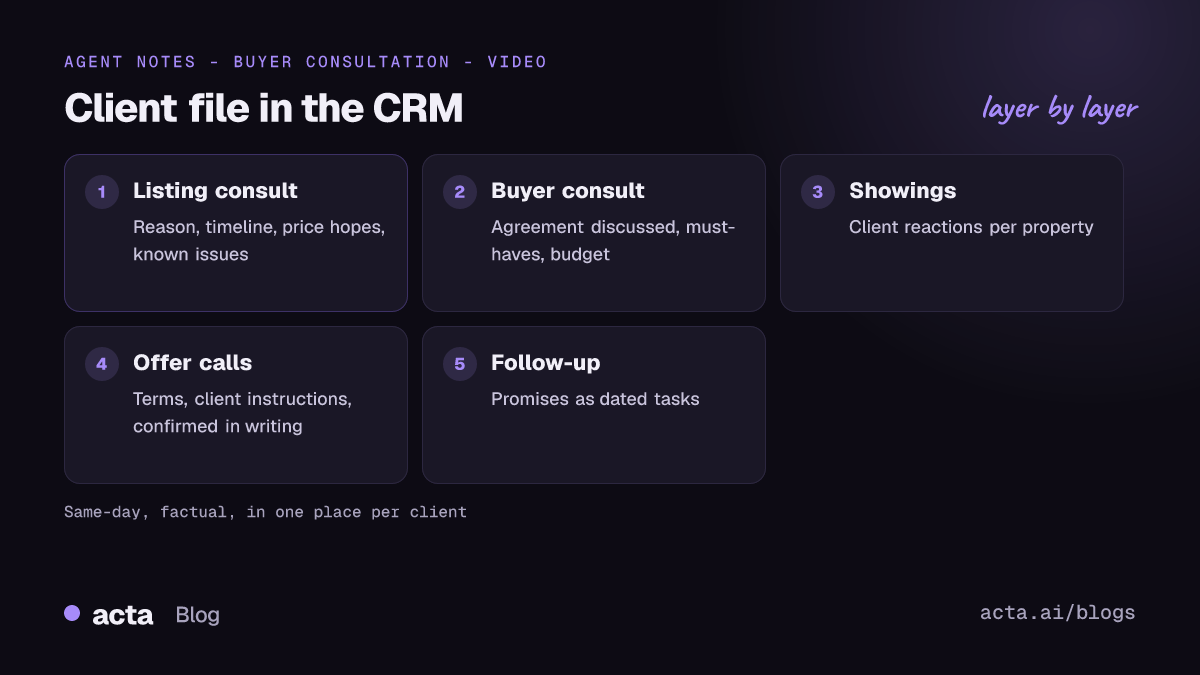
- Their reason for selling and their timeline. Job move in September is a different plan from "testing the market".
- Price expectations, in their words. Write what they said, not what you thought of it. "Hoping for 750, neighbour got 720 last spring."
- Known issues with the property. Repairs, past water or roof problems, permits, anything they mentioned. This feeds your disclosure conversation later.
- What you recommended. Pricing range, prep work, staging, photography, listing date.
- Questions you promised to answer. "Will check whether the loft conversion was permitted." These are the promises that slip.
- Next step and date. Agreement sent Thursday, photographer booked for the 20th.
What should buyer consultation notes include?
Buyer consultations matter more than they used to. NAR's guidance on written buyer agreements says that since August 17, 2024, an MLS participant working with a buyer must have a written agreement with them before touring a home, and that includes live virtual tours. Requirements can differ where state law sets an earlier point, so check your own state's rules as of November 2026.
That makes the first buyer meeting partly a paperwork meeting, and your notes should show the conversation behind the signature:
- The agreement you discussed. Which type, its length, and the questions the buyer asked. Some regulators point out that the settlement asks for a written agreement, not necessarily an exclusive agency agreement; the North Carolina Real Estate Commission's bulletin is one example of state-level guidance.
- How compensation was explained. What you said, in plain words, and what the buyer understood. If they asked "what happens if the seller won't pay", note your answer.
- Must-haves and deal-breakers. Bedrooms, school catchment, parking, no busy roads. Rank them if the buyer did.
- Budget and financing. Pre-approval status, lender, deposit, any gift or sale-dependent funds.
- Timeline pressures. Lease ending, a baby due, a job start date.
Not every contact counts as a tour. The Wisconsin REALTORS Association's legal hotline, for example, says an open house isn't "touring a home", so an agent hosting one doesn't need written agreements with visitors. Even so, jot down the name and what they're looking for. Open house visitors often become clients later.
This is general information, not legal advice. Your broker and your state's rules decide the details.
How should you take notes during offer and negotiation calls?
Negotiation calls move fast, numbers change several times, and the final position is often agreed verbally before anyone writes it up. That's where notes save deals.
For every offer or counter, write down:
- Date, time and who was on the call.
- Price, deposit, contingencies, closing date and anything included or excluded (the fridge, the shed, the curtains).
- Your client's instructions, in their words: "Go to 640 if they drop the inspection contingency, not otherwise."
- What the other side said they'd do, and by when.
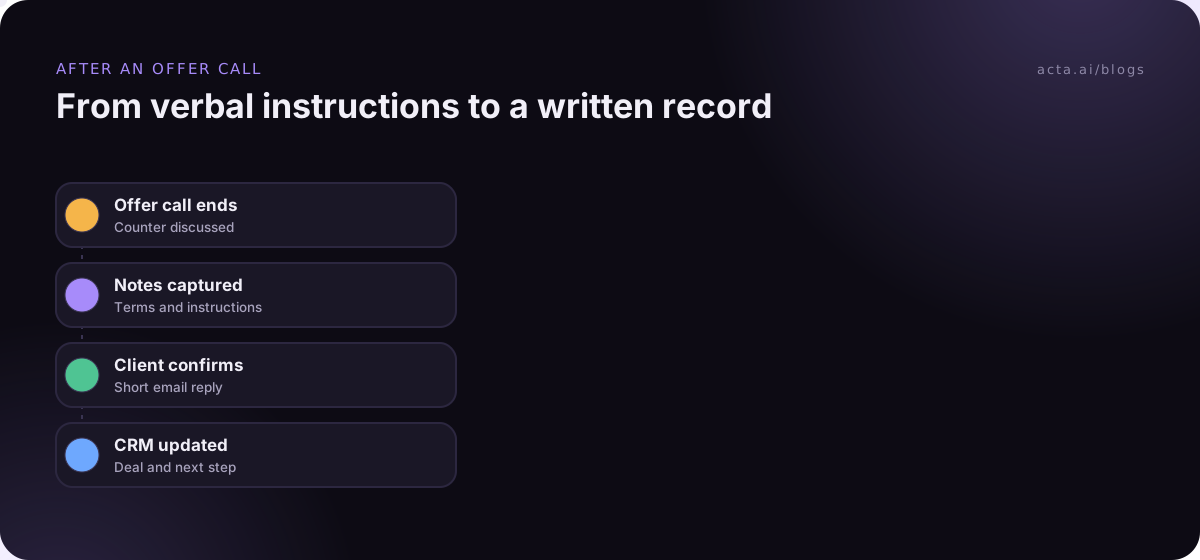
Read the final position back to your client before you hang up. Then send it in a short text or email: "To confirm, you've asked me to counter at 640 with a 21-day close." That message is your best protection if the client later remembers it differently.
What should real estate agents leave out of their notes?
Notes can be requested in a dispute, shared with a colleague or read by the client. Write as if any of those might happen.
- Personal remarks. "Difficult", "cheap", "clueless". Write the facts behind your impression instead: "Asked for three more viewings of the same house."
- Anything touching protected characteristics. The federal Fair Housing Act prohibits discrimination based on things like religion, national origin, disability and familial status, and many states add more. Comments about a buyer's family plans or background have no place in a client file, even as context.
- Your guesses about the other side. "Seller's desperate, divorce" is gossip, and it can come back to haunt you.
- Bank details and ID numbers. Those go in your secure transaction system, not in meeting notes.
Can real estate agents record client calls and meetings?
Often, yes, but the rules depend on where you and the other person are. Some places only need one person's consent; others need everyone's. Read our guide to recording consent and what to tell participants, and check your brokerage's policy. The simplest habit is to ask every time: "Mind if I record this so I don't miss anything? I'll send you a summary."
Most clients say yes, and the summary you send afterwards becomes the shared record. For a listing appointment at a kitchen table, a phone app is the practical choice. If you already use Voice Memos, here's how to transcribe voice memos on iPhone. For Zoom calls with out-of-town buyers or remote sellers, a desktop app can record the call from your own computer, without a bot appearing in the participant list, which some clients find off-putting. For phone calls on your mobile, our guide to iPhone call recording walks through the options.
Where should you keep meeting notes for real estate agents and teams?
Wherever your team will actually look. For most agents that means the CRM, attached to the contact and the deal, not a notebook in the car. A few rules that keep it usable:
- One place per client. If notes live in your phone, your email drafts and a spiral pad, they might as well not exist.
- Same-day entry. After back-to-back showings, details blur by evening. The first 10 minutes after a meeting are when to get them down. Two minutes in the car between appointments beats twenty at night.
- Promises as tasks. Anything you said you'd do goes on a list with a date. Our piece on tracking customer promises shows how to catch the ones that slip.
- A short template. Client, date, attendees, what they want, what was agreed, next step. Five lines is enough most of the time.
A simple note template for client meetings
Here's a filled-in example from a buyer consultation:
- Client: Priya and Marco S. | 14 March | buyer consultation (video)
- Wants: 3 bed, garden, within catchment for Hillside Primary. No main roads.
- Budget: pre-approved to 620, deposit from savings. Will stretch to 640 for the right house.
- Agreement: discussed written buyer agreement and compensation; signed, 90 days.
- Next: send 4 listings by Friday; first viewings Saturday 10am.
Short, factual and easy to scan in the car before the next appointment. The template is the whole trick with meeting notes for real estate agents: if it takes longer than two minutes to fill in, you'll stop doing it by the third busy weekend. Keep the headings fixed and let the content be rough. A note with typos written at 4pm is worth far more than a polished one you meant to write and never did.
How Acta fits into an agent's day
We make Acta, which records Zoom, Google Meet and Teams calls, in-person meetings through its mobile apps, or recordings you upload, then writes a transcript, summary and action items with owners. It can also draft the follow-up email and connect to CRMs such as HubSpot, Salesforce and Zoho. Our real estate page shows how agents set it up.
Frequently asked questions
How detailed should real estate meeting notes be?
Detailed enough that a colleague could pick up the client tomorrow. That usually means the client's goals, numbers, promises and next step, not a word-for-word account of the conversation.
Should I send clients a copy of my notes?
Send a short summary of what was agreed and the next steps, not your private working notes. It confirms understanding and gives the client a chance to correct anything before it matters.
How long should agents keep client notes?
Your brokerage and state usually set record-keeping periods for transaction files. Ask your managing broker and follow that policy rather than deleting notes when a deal closes.
Do I need notes for open house visitors?
Not formal ones, but a name, contact details if offered and one line on what they're looking for will help if they get in touch later.
What's the most common note-taking mistake agents make?
Writing notes days later from memory. By then, numbers have shifted and the client's exact words are gone. Same-day notes, even rough ones, are far more reliable.
If you'd like summaries and follow-up drafts after every client call, try Acta free for 15 days.