Quick answer: A good candidate follow up email from a hiring manager says when the candidate will hear back, what the next step is, and who to contact, and it goes out within a day or two of the interview. Send one at every stage, including delays and rejections, because silence is what candidates remember. Templates for each situation are below.
Most advice about follow-up emails after an interview is written for candidates: how to thank the interviewer, how long to wait before chasing. Far less is written for the other side of the table, even though the hiring team sends more of these emails and has more riding on them.
This post is for hiring managers and recruiters. It covers when to write, what to say at each stage, and the wording to be careful with, with templates you can copy and adapt.
Why does the follow-up after an interview matter so much?
Because from the candidate's side, the hours after an interview are mostly waiting. They've taken time off, prepared, maybe turned down another conversation. If they hear nothing for two weeks, they assume the worst, tell their friends, and sometimes accept another offer while you're still collecting feedback.
Feedback matters too. LinkedIn has reported, on its talent solutions blog, that 94% of candidates want feedback after an interview, and that candidates offered constructive feedback are four times more likely to consider a future opportunity with the company. Those figures come from LinkedIn's own research, but they match what most recruiters hear in person: people can take a no. What they resent is being ignored.
Good candidate experience is also cheap. A clear, honest email costs five minutes. Losing your second-choice candidate because they gave up on you costs a lot more.
When should a hiring manager send a candidate follow up email?
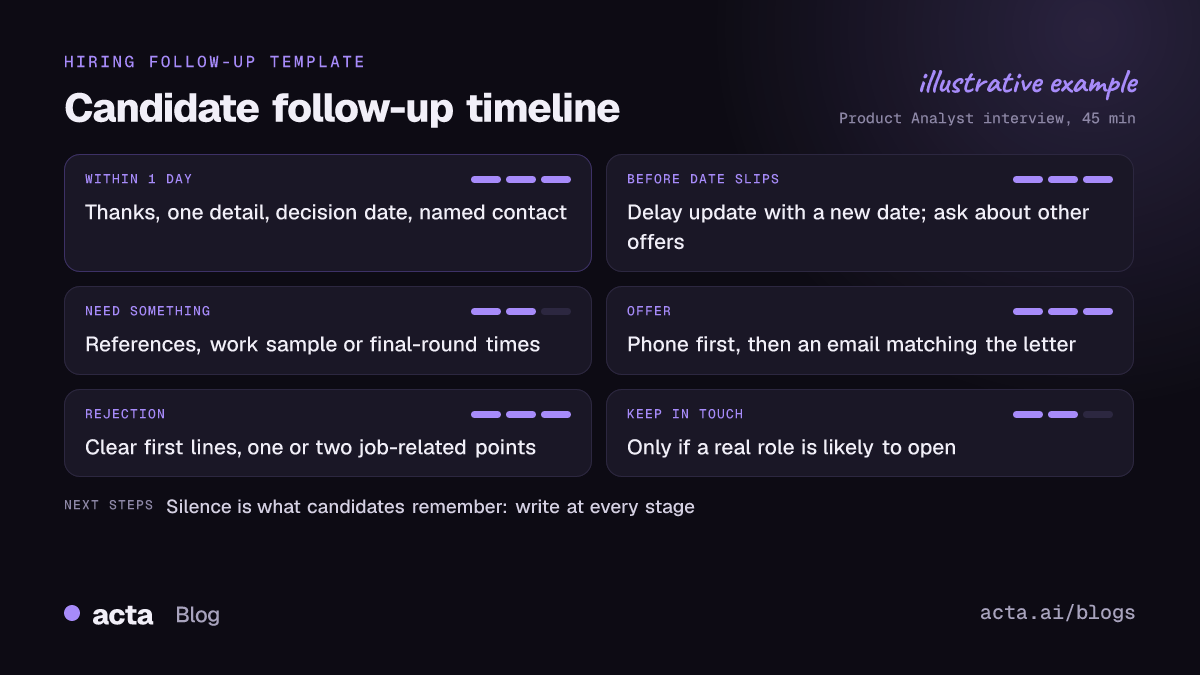
At every point where the candidate would otherwise be guessing. In practice that's:
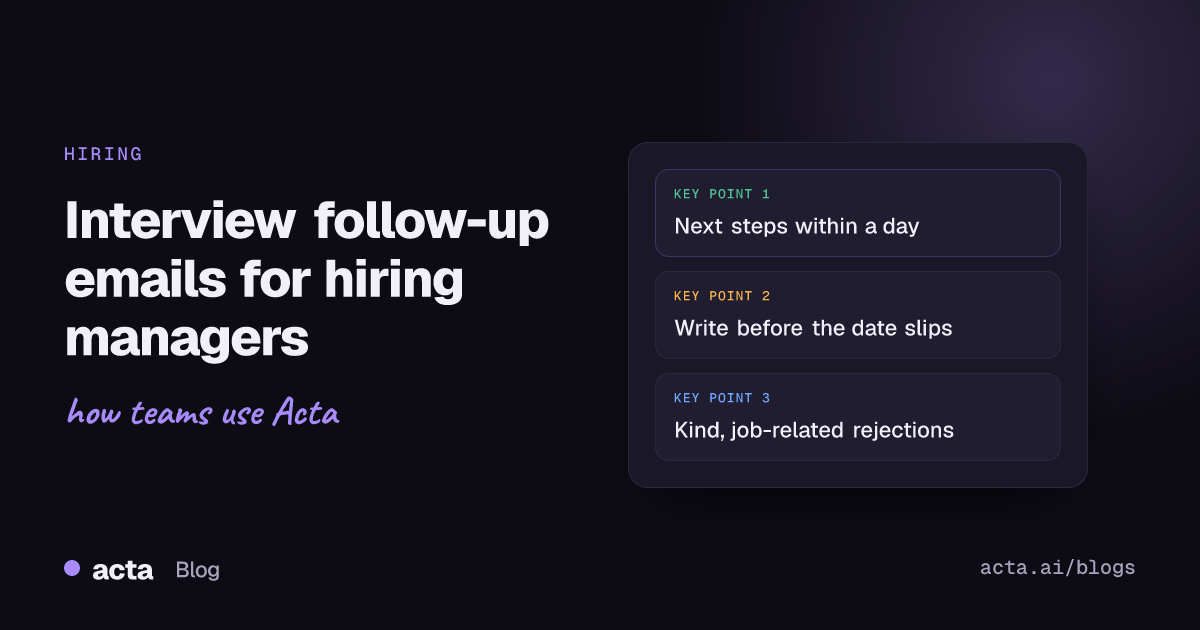
- Within one working day of the interview: a short thank-you with the timeline for a decision.
- Whenever that timeline slips: before the date you gave, not after.
- When you need something: references, a work sample, availability for the next round.
- When you've decided: offer or rejection, as soon as the decision is final.
- Later, for strong candidates you didn't hire: a keep-in-touch note if you mean it.
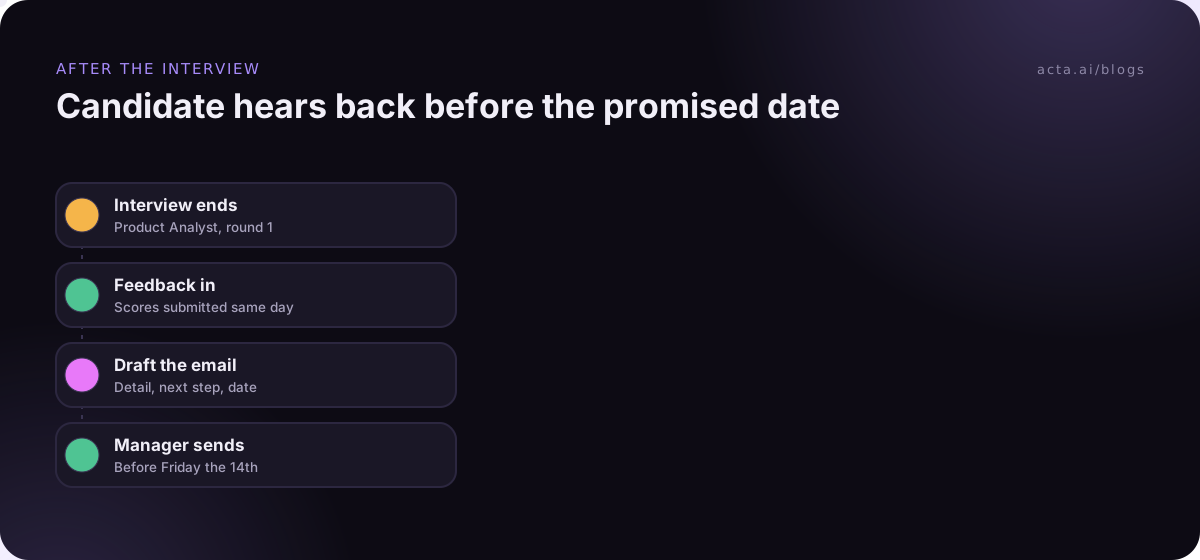
If you change one thing, make it this: give a date at the end of the interview, then write before that date passes. "You'll hear from us by Friday the 14th" and then hearing nothing until the 21st is worse than saying "within two weeks" and keeping to it.
Next steps email after an interview
This is the routine one. Send it the same day or the next morning.
Subject: Thanks for today, and what happens next
Hi Sam,
Thanks for talking with Priya and me today about the Product Analyst role. I enjoyed hearing how you rebuilt the churn dashboard at your last job.
Next step: we're finishing first interviews this week and will let you know by Friday the 14th whether we'd like you to come in for the final round, which is a 90-minute session with the team.
If you have any questions in the meantime, reply here or contact Marco in recruiting.
Dana
One specific detail from the conversation (the churn dashboard) makes it clear this isn't a mass email. A date, a description of the next step and a named contact cover the three things candidates actually want to know.
What should you send when the process is delayed?
Delays happen: an interviewer gets sick, budget gets re-approved, another candidate needs rescheduling. The mistake is to wait until you have news. Send an update before the date you promised, even if the update is "no news yet."
Subject: Update on the Product Analyst role
Hi Sam,
I said you'd hear from us by Friday, and I want to be upfront that we need more time. Two final interviews were moved to next week, so we now expect to decide by Wednesday the 19th.
You're still very much in the process. If your timeline has changed, for example if you have another offer, please tell me and I'll see what we can do.
Dana
That last line matters. Inviting candidates to tell you about competing offers stops you losing someone silently.
How do you write the offer email?
Most teams make the offer by phone first and follow with an offer email that puts the details in writing. Keep the email warm but precise, and make sure it matches what you said on the call.
Subject: Your offer for the Product Analyst role
Hi Sam,
It was great to speak earlier. As I said on the phone, we'd love you to join the team.
The formal offer letter is attached, with the salary, start date and benefits we discussed. Marco in recruiting will take you through the paperwork and can answer any questions about the contract.
We'd appreciate an answer by Monday the 24th. If you need more time or want to talk anything through, call me directly.
Dana
Don't put figures in the email that aren't in the formal letter, and get the letter checked by whoever owns contracts in your company. The email is a cover note, not the contract.
How do you write an interview rejection email?
This is the email hiring managers put off, and it's the one candidates remember most. A good interview rejection email is prompt, clear in the first two lines, and kind without being vague.
Template: rejection after an interview
Subject: Your application for the Product Analyst role
Hi Sam,
Thank you for the time you put into the interviews. I'm sorry to say we've decided to offer the role to another candidate.
It was a close decision. The panel was impressed by your SQL exercise; the deciding factor was that the role needs more experience running pricing experiments, which the other candidate had.
If you'd like to talk it through, I'm happy to have a 15-minute call. And if a role comes up that fits your background better, I'd like to get in touch.
Dana
What feedback is safe to give?
This section is general information, not legal advice. Rules differ by country, and your HR or legal team may have a policy on written feedback, so check it first.
- Keep feedback tied to the job. Mention skills, experience and how the candidate did on the interview tasks, compared against the criteria you set for the role.
- Never mention protected characteristics. In the US, the EEOC explains that it's illegal to discriminate against job applicants because of race, color, religion, sex, national origin, age (40 or older), disability or genetic information. Comments about "culture fit," energy or age-coded phrases like "digital native" can read as exactly that.
- Be specific but brief. One or two concrete points are more useful, and safer, than a long critique.
- Don't contradict your records. The feedback in the email should match the scorecards. If your notes say one thing and the email says another, that's a problem if the decision is ever questioned. Running a proper interview debrief meeting first gives the email something solid to draw on.
For written examples of standard wording, SHRM keeps sample HR letters, including an interview rejection letter for a filled position.
Keep-in-touch email for strong candidates you didn't hire
Sometimes your second choice was very good. A short, honest note keeps the door open.
Subject: Staying in touch
Hi Sam,
I know the news last week wasn't what you hoped for. I meant what I said: you were a strong candidate, and we're likely to hire another analyst in the spring. Would you be happy for me to contact you when that role opens?
Dana
Only send this if you'll actually follow through. A keep-in-touch promise that never turns into a call is just a slower rejection.
How do you keep follow-ups fast when you're interviewing a lot?
The emails above are short. What slows them down is everything around them: chasing interviewers for feedback, remembering what the candidate said, finding the right date. A few habits help:
- Collect feedback the same day. Ask interviewers to submit scores before they leave the room or call. With structured interviews and a shared scoring guide, that takes minutes. Our post on interview scorecard automation shows one way to make that easier.
- Note one specific detail per candidate. It's what makes the next-steps email personal, and it's easy to forget by the end of a day of interviews.
- Put follow-up dates in your calendar at the moment you promise them.
- Record interviews if your policy allows it, so details and quotes are accurate. Tell candidates first and get consent where required; our guide on recording consent and what to tell participants covers the basics. If your company doesn't allow meeting bots, a desktop recorder captures the call from your own computer, and Acta's desktop app has a Copy notice button that pastes a recording notice into the chat.
For structured write-ups from each interview, see candidate assessment reports from interviews.
Where Acta fits
Acta records interviews on Zoom, Google Meet and Microsoft Teams, with a bot or bot-free from your computer, and writes the transcript with speaker names, a summary and action items, plus a draft follow-up email you can edit. It doesn't use your data to train AI models. The hiring page shows how recruiting teams use it.
Frequently asked questions
How long should a hiring manager wait to follow up after an interview?
Send a short thank-you with the timeline within one working day. After that, write at least by the date you promised, even if it's only to say you need more time.
Should rejection emails come from the hiring manager or the recruiter?
Either works. For candidates who reached the final round, a note or call from the hiring manager is a nice touch. Early-stage rejections usually come from recruiting.
Is it fine to reject candidates by email instead of phone?
For most stages, yes. For final-round candidates who invested a lot of time, many teams call first and follow with an email, but a prompt, kind email is far better than a delayed call.
Should I give feedback in a rejection email?
Brief, job-related feedback helps candidates and is often appreciated. Check your company's policy first, keep it tied to the role's criteria, and never mention anything related to protected characteristics.
Can I use one candidate follow up email template for everyone?
Use templates for structure and timing, then add one specific detail from the interview. A fully generic candidate follow up email reads as automated, which undoes the goodwill you're trying to build.
If you'd like interview notes and follow-up drafts ready after each call, you can try Acta with a 15-day free trial.