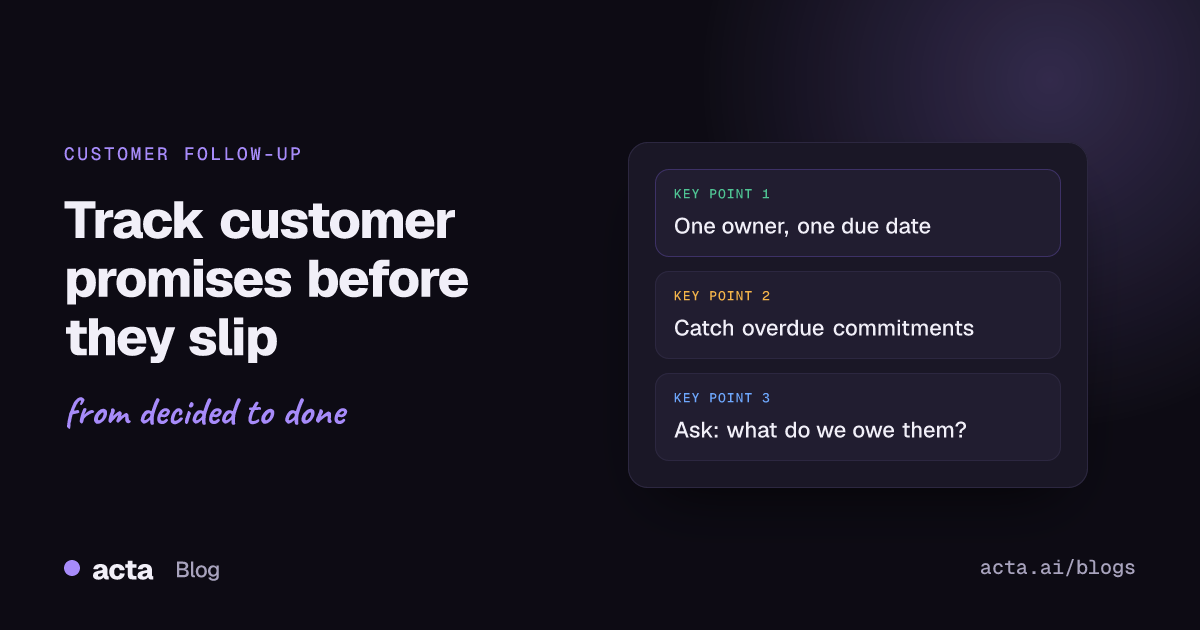
Quick answer: To track customer promises, write down every commitment made on a customer call as it happens, give each one a single owner, a due date and the customer's name, and keep them in one shared list that you review every week. Anything past its date is an overdue commitment and needs a decision: deliver it, renegotiate it, or tell the customer why.
Every customer call ends with a few small promises. "I'll send the security questionnaire by Friday." "We'll check whether the export can include custom fields." "Let me get you a revised quote." Each one sounds minor. Together they decide whether the customer thinks you are reliable.
Most teams are good at making these promises and bad at keeping track of them. This guide covers why promises made to customers get lost, what it costs, a simple way to track them, and how Acta builds the list for you from the calls themselves.
Why do promises made to customers get lost?
Promises rarely get lost because someone decided to ignore a customer. They get lost because of how calls work.
- They are said, not written. A promise is a sentence in the middle of a conversation. If nobody types it into a shared place before the call ends, it lives only in the memory of whoever said it.
- The owner is vague. "We'll look into it" has no owner. The account manager assumes product will follow up; product assumes the account manager will.
- There is no date. "Soon" and "next week" drift. Without a date, nothing is ever late, so nothing is ever chased.
- They are spread across people. Sales, solutions engineers, support and leadership all talk to the same customer. Each keeps their own notes, so nobody sees the full list of what the company owes.
- Handoffs drop them. When a deal closes and moves from sales to onboarding, or an account changes hands, the promises from earlier calls often stay behind in someone's notebook.
The result is familiar: a customer opens the next call with "Did you get a chance to look at that thing?" and nobody on your side remembers what "that thing" was.
What does a broken customer promise cost?
The direct cost is trust. A missed promise tells the customer that what your team says on a call may not happen, which makes every later commitment worth less.
Research backs up how lopsided this is. A study by Ayelet Gneezy and Nicholas Epley, summarised in Chicago Booth Review's write-up on keeping promises, found that people penalised broken promises heavily but gave little extra credit when a promise was exceeded. In other words, the reliable move is not to over-deliver on a few things; it is to keep every promise you make.
For account management, the cost shows up at renewal time. Small misses add up into a story the customer tells their own team: "They're slow to follow up." That story shapes renewal and expansion conversations long after the individual promises are forgotten. Keeping the customers you already have also matters financially; Forrester's post on post-sale marketing repeats the widely cited estimate that winning a new customer costs several times more than keeping an existing one.
There is an internal cost too. When nobody can see open promises, managers find out about problems from an escalation instead of from a list, and the team spends time reconstructing what was said instead of doing the work.
How do you track customer promises?
You do not need a complicated system. You need every promise captured in the same shape, in one place, and a habit of looking at it. Here is a workable method.
1. Capture the promise in the customer's words
Write down what was promised, close to how it was said. "Send revised quote with 3-year term" is better than "pricing follow-up". Specific wording makes it obvious when the promise is done.
2. Give it one owner
One named person, not a team. If two people are involved, one of them owns delivering it and the other helps.
3. Give it a due date
If the customer was given a date, use it. If not, agree an internal date before the call ends. A promise without a date cannot become overdue, which means nobody will chase it.
4. Tag the customer
Every promise should carry the customer or company name. That lets you answer the most useful question in account management: what do we currently owe this account?
5. Review overdue commitments every week
Pick a fixed slot, such as the weekly account review or pipeline meeting, and go through anything past its date. For each one, decide: deliver it now, agree a new date with the customer, or close it with an explanation. The worst outcome is a promise that is late and silent.
6. Close the loop with the customer
When a promise is delivered, say so in your customer follow-up email. It shows the customer you remembered, and it gives you a written record that it was done.
Where should you keep the promise list?
Teams usually try one of three places, each with trade-offs.
- A spreadsheet. Easy to start, but it depends on someone copying promises in after every call. It is usually current for a few weeks and then stops being trusted.
- CRM tasks. Better, because tasks sit next to the account. But someone still has to type them in, and promises made by people outside sales often never reach the CRM.
- Your meeting notes. The promises are already there, but scattered across dozens of documents with no owner field and no way to see what is overdue.
The common weak point is the manual step between "said on the call" and "written in the tracker". That is the step worth removing.
How does Acta track customer promises from your calls?
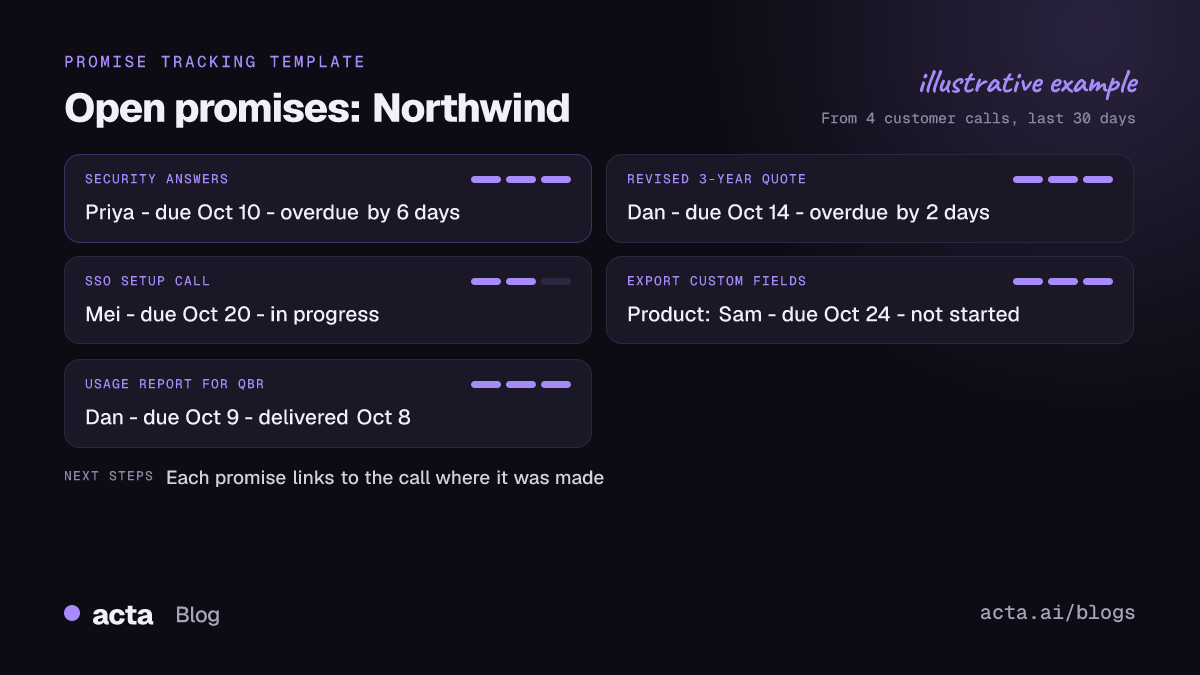
Acta records your customer calls and turns what was said into structured notes, including action items with owners and due dates. Promises are the action items made in meetings, tracked whether they are still open or already delivered. Because they come from the transcript, nobody has to copy them across, and the list includes promises made by anyone in the meeting.
Acta can join Zoom, Google Meet and Microsoft Teams calls through a meeting bot that joins from your calendar, or record without a bot using the desktop app for Windows and Mac or the Chrome extension. Recording a customer needs their consent where the law requires it, so tell people at the start of the call; our guide on recording consent and what to tell participants covers the details.
In the promises view you can see:
- Each promise with its owner and due date, taken from the conversation.
- How late it is, so overdue commitments stand out instead of hiding in a long list.
- Open and delivered promises, so you can see what was kept as well as what is pending.
- Filters by customer or company, by person, or just your own, so an account manager can check one account and a rep can check their own list before a call.
Every promise links back to the meeting it came from, so if someone asks "did we really say that?", you can check the transcript moment rather than argue from memory. Acta also flags overdue promises as warning signs in its risk view, alongside risks customers raised on calls. You can read more about the wider set of tools on the Acta features page.
Can you ask an assistant "what do we owe Northwind?"
Yes. Besides searching in the app, you can ask questions in plain language. Acta's OneChat answers questions across all your meetings with links to the sources. And through Acta's MCP connector, assistants such as Claude and ChatGPT can read your meetings too; see how to ask Claude about your meetings with Acta's MCP server.
A question like "What do we owe Northwind, and what is overdue?" returns the open promises for that customer with owners, due dates and how late each one is, each linked to the call where it was made. Useful variations:
- "What did I promise customers this week?"
- "Which promises to Northwind are more than a week late?"
- "What did we commit to on the last three calls with this account?"
- "Draft a follow-up email to Northwind covering everything we've delivered since the QBR."
People only see meetings they have access to, so the answer reflects the calls you are allowed to open.
How do you build a customer follow-up habit around promises?
Tooling captures the list; habits make it work. A few routines that fit most teams:
- Before every customer call, check open promises for that account. Opening with "Here's what we said we'd do, and where each item is" builds trust quickly.
- Right after every call, send a customer follow-up email listing what each side agreed to do. Acta drafts this for you from the meeting.
- Every week, review overdue commitments across all accounts in your team meeting. Renegotiate rather than ignore.
- Before every renewal or QBR, pull the delivered and open promises for the account. It is concrete evidence of what you have done for them; our post on the customer QBR report shows how to put that together.
- At every handoff, pass on the open promise list along with the account, so nothing stays with the previous owner.
Customer success teams in particular get value from this; see how Acta supports customer success teams.
What should you do when a promise is already overdue?
Late promises happen. What matters is how you handle them.
- Tell the customer before they ask. A short message with a new date costs far less trust than silence.
- Give a real new date, not "soon". Then put that date on the promise so it is tracked again.
- Find the blocker. If it is waiting on another team, escalate it with the customer name attached; that usually moves it.
- Stop making promises you cannot keep. If the same kind of promise keeps slipping, such as custom reports or roadmap dates, change what your team is allowed to promise on calls.
If you also want to check what your team says on calls for promises that should not have been made in the first place, our post on compliance checks for client calls covers that side.
Frequently asked questions
What counts as a customer promise?
Any commitment your team makes to a customer that the customer would reasonably expect to happen: sending a document, checking a question, fixing an issue, setting up a meeting or delivering a feature by a date. If the customer would notice it not happening, track it.
Who should own promises made to customers?
The person who made the promise owns it by default, even if someone else does the work. That person is responsible for delivering it or for telling the customer about a new date.
How often should we review overdue commitments?
Weekly works for most teams, plus a check before every call with that customer. Reviewing less often means customers usually notice late promises before you do.
Does Acta add promises to my CRM?
On a paid plan, Acta can push meeting reports to Salesforce, HubSpot or Zoho, so the notes from each call sit next to the account. The promises view itself lives in Acta, where you can filter it by customer, person or your own promises.
Can I use Acta for in-person customer meetings?
Yes. Acta's mobile apps record in-person meetings, and you can also upload a recording. Get the other people's consent first where the law requires it.
Want a promise list that builds itself from your customer calls? Start a free 15-day trial of Acta.