Quick answer: Executives use meeting notes to decide faster by reading them instead of attending, and by asking for notes in a decision-ready shape: the question, the options, a recommendation, who decides and by when. Good executive meeting notes also show what's stuck, so a leader can unblock one decision in five minutes instead of sitting through another hour of discussion.
Most senior people I've worked with don't have a note-taking problem. They have a reading problem. Their calendar is full of meetings they half need to be in, and the notes that come out of those meetings are written for the people who were there, not for the person who has to make the call. So they keep attending, just in case.
This post is about the other way of working: fewer seats at the table, better notes, and a habit of reading them for decisions. None of it needs special software, though recordings and AI summaries make it much cheaper to keep up.
Why do executive meeting notes matter for decision speed?
Because a lot of executive time goes into decisions, and much of it is wasted. In McKinsey's 2019 survey Decision making in the age of urgency, just over half of respondents said they spend more than 30 percent of their working time on decision making, and 61 percent said most of that time is used ineffectively. Only 20 percent said their organisation excels at decisions.
A lot of that ineffective time is spent re-learning context. The VP who missed Tuesday's pricing call asks for the background on Thursday. The team re-explains it. Someone remembers a different version of what the customer said. A decision that needed ten minutes of judgment takes a week of calendar. When a decision really does need everyone in a room, run it as a proper decision meeting with one question and one decider.
Notes fix the context part. If the person who decides can read a clean account of what was discussed, what the options are and what the team recommends, the decision itself is often quick. The slow part was never the thinking. It was getting the information into the right head.
What do executives actually want from meeting notes?
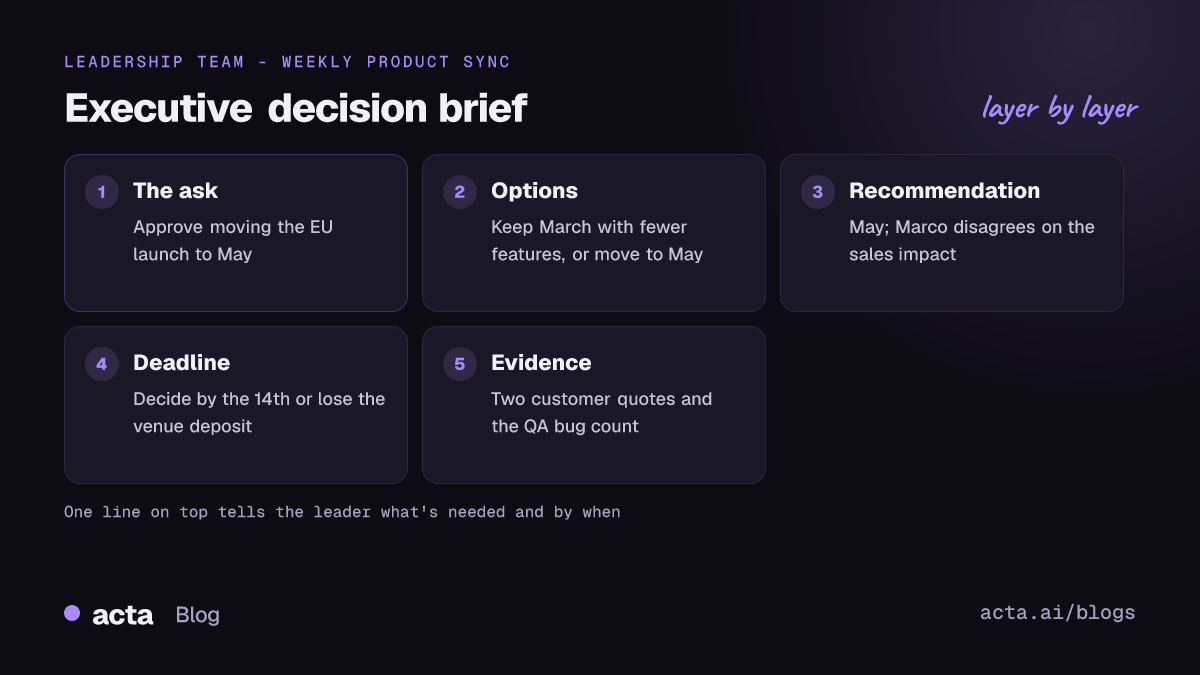
Not minutes. Minutes are a record of what happened in order, which is useful for audits and board files and close to useless for someone with eight minutes between calls. What a leader wants is closer to a briefing:
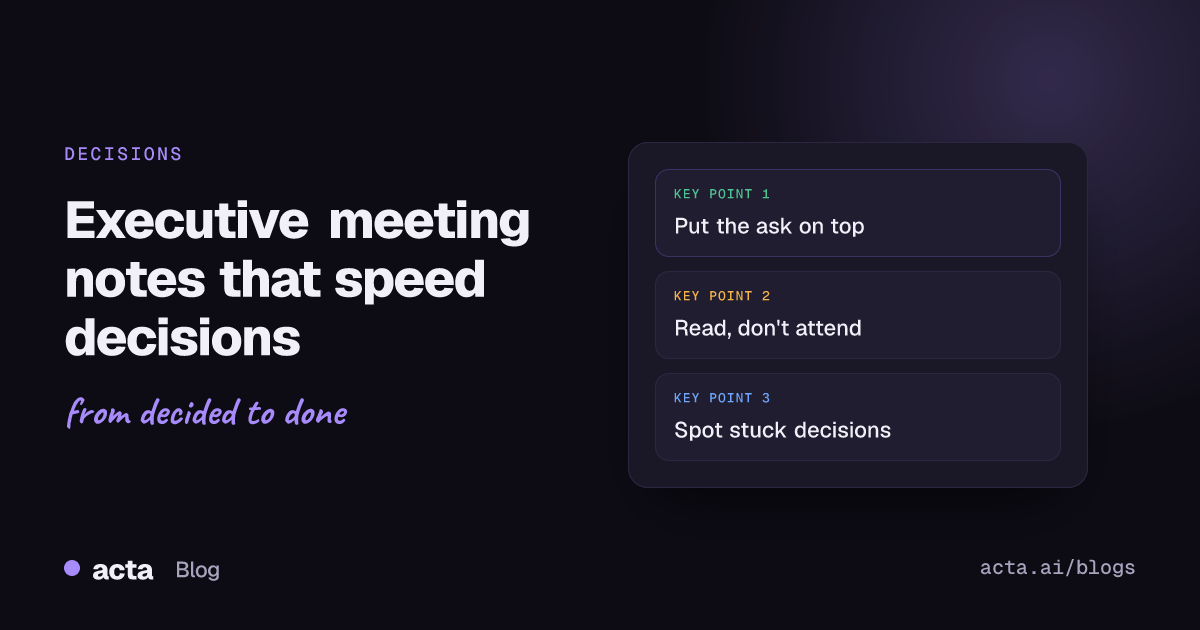
- The ask. One line: what do you need from me? "Approve moving the EU launch to May" beats "Discussion of launch timeline."
- The options. Two or three, each with its main cost. If there's only one option, say so, and say why the others were dropped.
- The recommendation. What the team would do, and who disagrees. Dissent is the part executives most want and most rarely get.
- The deadline. When the decision stops being free. "If we don't decide by the 14th, we lose the venue deposit."
- The evidence. A link or a short quote, not a paragraph of paraphrase. A customer saying "we'll churn if the API isn't fixed by Q2" in their own words carries more weight than a summary of it.
Everything else from the meeting can live below a line, for the people who want detail. If your notes don't start with the ask, the executive reading them has to dig for it, and they'll usually give up and schedule a call.
Write the decision line first
One habit makes the biggest difference: whoever owns the notes writes the decision line before anything else. Either "Decided: X, owner Y, by Z" or "Needs a decision: X, from whom, by when." If you can't write that line, the meeting didn't produce anything a leader can act on, and that's worth knowing too. It's the same principle behind meeting minutes people actually read.
How do executives read notes instead of attending?
The leaders who do this well treat notes as the default and attendance as the exception. A pattern I've seen work:
- Audit the calendar. For two weeks, mark every recurring meeting as "I decide here", "I'm consulted here" or "I'm informed here." The informed ones are candidates for notes only.
- Send a delegate, or nobody. For consulted meetings, a direct report attends and brings back the decision line plus anything that needs you.
- Agree the format once. Tell the teams what you want to see at the top of their notes (the briefing list above). Do it once, in writing, and stop asking for "a quick update."
- Read at fixed times. Twice a day, not continuously. Most decisions can wait four hours; very few can wait a week.
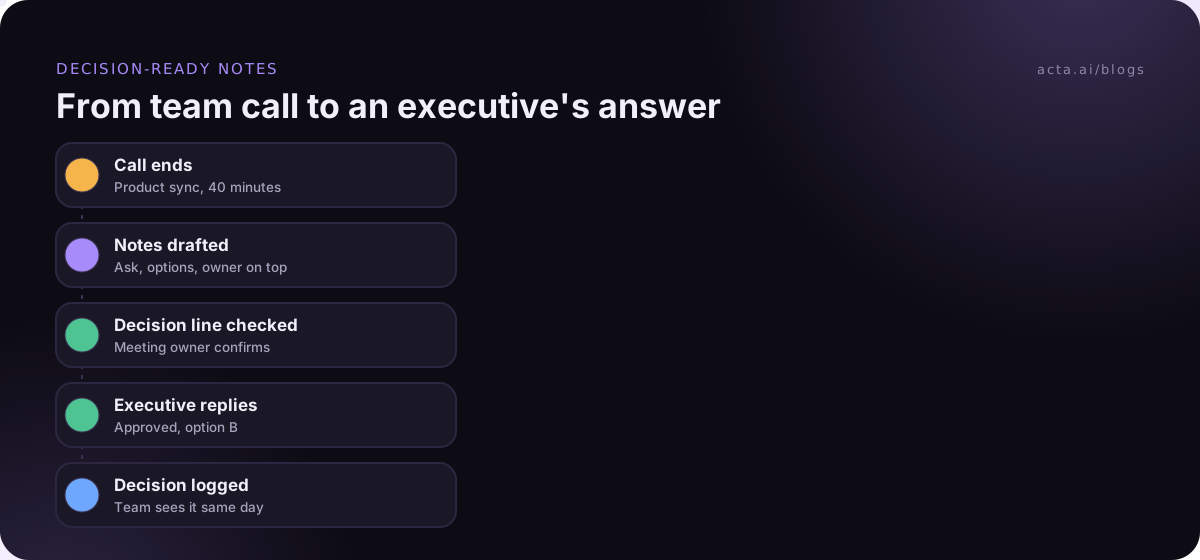
- Reply in the notes. "Approved", "No, option B", or "I need to hear from finance first." Your reply is the decision, so it should sit next to the context that justified it.
The memo culture at Amazon is the extreme version. Jeff Bezos has described meetings that start with everyone silently reading a six-page narrative memo, which CNBC reported as a deliberate replacement for slide decks. You don't need six pages. The point that transfers is that writing forces the team to think before the leader's time is spent.
Which decisions should go to an executive at all?
Faster decisions often mean fewer decisions reaching the top. If every note ends with "needs VP sign-off", the executive becomes the bottleneck and reading notes just moves the queue from the calendar to the inbox.
Bain's work on decision roles, popularised in the article Decisions: who does what, makes the case that every important decision needs exactly one person who "has the D". For most operational calls, that person shouldn't be the CEO. A useful test when you're reading notes: if this goes wrong, can we undo it next month at modest cost? If yes, push it back down with "your call" and move on.
What should come up: things that commit money or people for a long time, things that cross two teams who disagree, and anything with legal or reputational exposure. That list is usually short. If yours isn't, the notes are telling you something about how decision rights are set up.
What signals should executives look for in meeting notes?
Reading notes for decisions is half the value. The other half is reading them for patterns nobody will put in a status report.
The same topic, three meetings running
If "API rate limits" appears in the product sync, the customer escalation call and the sales forecast, it isn't three problems. It's one decision nobody has made. That's usually the highest-value thing an executive can pick up from notes.
Decisions that keep getting reopened
A decision made on the 3rd and discussed again on the 17th either wasn't really made, or the people affected weren't told. Both are fixable, but only if someone notices. Keeping a simple decision log makes reopened decisions visible.
Action items with no owner or no date
"We should look into the churn numbers" is not a task. When executives see a lot of these, follow-through is going to be weak, and our post on why action items don't get done covers what to change.
Quiet disagreement
Notes that say "some concerns were raised" are hiding something. Ask who raised them and what exactly they said. The person closest to the customer is often the one being summarised away.
How do AI notes change executive meeting notes?
The hard part of everything above used to be the cost of writing it. Someone had to take notes, restructure them into a briefing, and send them within the hour. In practice that person was a chief of staff, and only the biggest meetings got that treatment.
AI notetakers change the cost. A recording becomes a transcript with speaker names, and a summary with decisions and action items comes out minutes after the call. That means executive meeting notes can exist for the Tuesday product sync as well as the board meeting. You still need a human to check the decision line, because a summary can flatten a "maybe" into a "yes", but the first draft is free.
Two cautions from experience. First, a tool that dumps a 2,000-word summary into your inbox hasn't helped; push for the short format. Second, recording has consent rules that vary by country and state, so read up on what to tell participants before you switch it on for every call. If a team doesn't want a bot joining, a recorder that runs on the attendee's own computer, like the Acta desktop app, captures the meeting's audio without anything appearing in the participant list.
A weekly routine for faster decisions
Here's a routine that works for a leader with five or six teams reporting in. It takes about 45 minutes a week.
- Monday, 15 minutes: scan last week's notes for open "needs a decision" lines. Decide the ones you can, delegate the ones you shouldn't own, and ask for the missing piece on the rest.
- Wednesday, 15 minutes: look for repeated topics across teams. Pick one and book a single 30-minute call with the people who disagree.
- Friday, 15 minutes: read the decision log. Anything reopened? Anything decided but not done? A weekly decision digest makes this a five-minute read.
It won't feel like much. But when I've looked back at decisions that took a month, the delay was rarely in the thinking. The question usually sat in somebody's unread notes for a week or two before anyone with authority saw it.
Common mistakes with executive meeting notes
- Asking for everything. If you ask every team for full notes, you'll get full notes, and you won't read them. Ask for the top three lines and a link.
- Deciding in a side channel. A "yes" in a hallway or DM never reaches the people who need it. Reply where the notes live.
- Treating notes as surveillance. If teams feel notes are being read for blame, they'll write vaguer ones. Read them for decisions and say thanks for good ones.
- No owner for the notes. Rotating note-takers produce rotating formats. One person per meeting, or a tool that produces the same structure every time.
Where Acta fits
Acta records Zoom, Google Meet and Teams calls and writes up the transcript, summary, decisions and action items with owners. Its report templates can produce a briefing in the shape described above, and a CTO or COO can get a brief from engineering meetings without sitting in them. OneChat answers questions across past meetings with links back to the source, which helps when you need the context behind a decision someone else made.
Frequently asked questions
What should be at the top of executive meeting notes?
The ask or the decision, in one line, with an owner and a date. Then options, recommendation and dissent. Background goes last.
How long should notes for an executive be?
Short enough to read in two minutes. If the decision needs more, link the full notes or recording underneath instead of making the summary longer.
Should executives stop attending meetings?
Not all of them. Stay in meetings where you're the decider and the issue is hard to reverse. For meetings where you're only informed, notes are usually enough.
How do you make faster decisions without making worse ones?
Separate reversible from irreversible decisions. Push the reversible ones down to the team, and spend your time on the few that are expensive to undo, with the full context in front of you.
Can AI write executive meeting notes?
It can write a good first draft, including decisions and action items. Have the meeting owner check the decision line before it goes to the executive, since summaries can miss hedging.
If you want to try decision-ready notes on your own meetings, Acta has a 15-day free trial.