Bank syncs and oversight calls set the fintech's to-do list
A lending fintech that originates through a partner bank lives on a steady cadence of meetings. There is a weekly sync between the fintech's bank partnerships lead and the bank's fintech program manager. There is a monthly oversight meeting where the bank's compliance and third-party risk staff go through complaints, marketing reviews, credit policy changes and any open findings. There is a quarterly business review with volumes, losses and the pipeline of new products. Internally, the fintech has its own compliance standup and credit committee.
The bank has reasons to ask a lot. In June 2023 the Federal Reserve, FDIC and OCC issued final interagency guidance on third-party relationships, setting out principles for how banks manage risk in relationships with third parties, including fintech partnerships. The FDIC's financial institution letter on the guidance notes it replaced earlier guidance. As of November 2026 the agencies have also proposed an update, so check the current text with your counsel. The practical effect for a fintech is simple: the bank will ask for evidence, and asks arrive on calls.
Without a record, those asks scatter. The partnerships lead remembers half, compliance hears about a quarter in the monthly meeting, and growth and engineering hear about them when something has already gone wrong.
A month of small slips put one bank partnership on notice
An illustrative case. Kestrel Credit (a made-up company) has 110 staff and makes working-capital loans to small businesses through Cedar Valley Bank, a made-up community bank. Daniel Cho leads bank partnerships, Aisha Karim runs compliance operations, and Meera Pillai is head of credit. At the bank, Linda Park manages the fintech program.
- Weekly sync, 3 October. Linda asks for September's complaint log by 10 October. She also says the bank wants to review the new email campaign that mentions loan terms before it goes out. Daniel answers, "We'll hold the campaign until you sign off."
- 8 October. The growth team, which was not on the call, launches the campaign on schedule.
- 10 October. The complaint log does not go out. The analyst who prepares it is on leave, and nobody else knew it was due.
- Weekly sync, 17 October. Linda notes this is the second late log this year. In passing, she mentions the bank's internal audit will sample 25 loan files in November.
- Monthly oversight meeting, 24 October. The bank's third-party risk lead asks why the campaign launched without review and requests a written remediation plan within two weeks.
No single item was serious. Together they told the bank that Kestrel's promises on calls do not reliably turn into action. Every one of them was said aloud in a meeting first.
A fintech partner bank meeting risk log works best as a living registry
A spreadsheet risk register goes stale because someone has to remember to update it after every call. Acta's Risk Registry tab (under My meetings) is built from the meetings themselves and updated after each new one; the badge shows the last meeting it read. A risk raised again later stays one row with the newest details, and each row has a history of how it changed.
The registry is per person. Aisha's is built from the meetings she recorded plus those teammates shared with her in the workspace, so Daniel shares every bank sync with the workspace and Aisha's registry covers the whole relationship. There is no company-wide register; decide whose registry is the one you review, usually the compliance operations lead's.
A risk register example from the Cedar Valley meetings
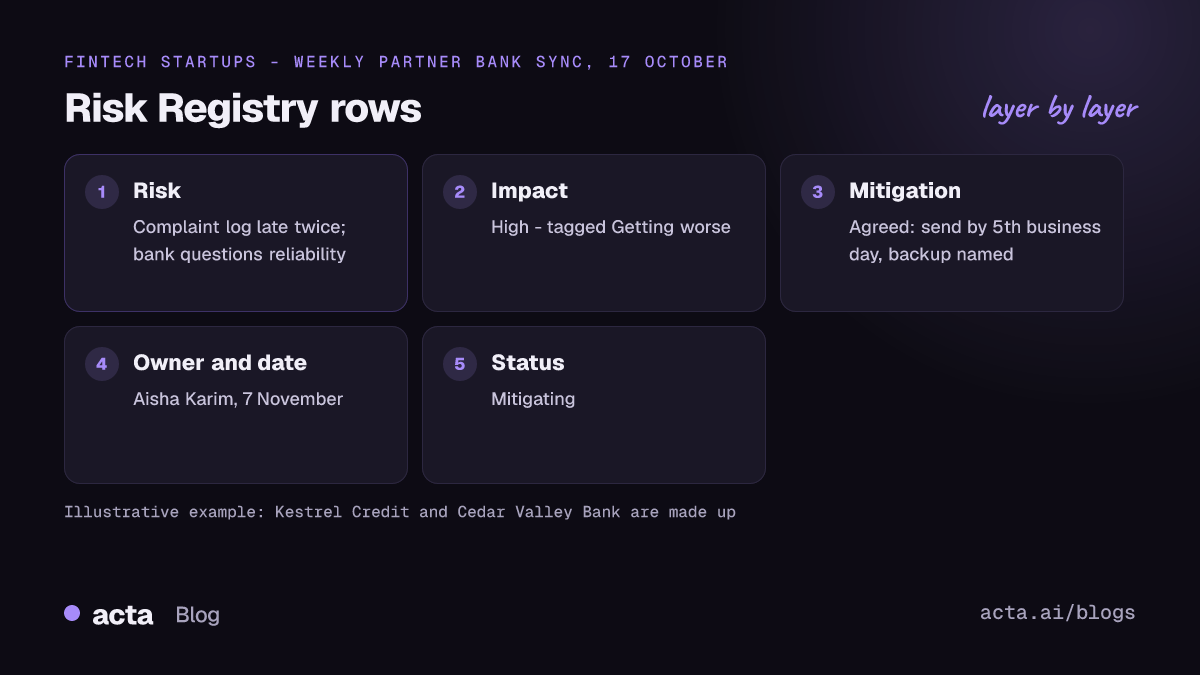
Here is what Aisha's table, "Risks · all meetings", might show after the 24 October meeting:
| Risk | Mitigation | Owner | Date | Impact | Status |
|---|
| Complaint log late twice; bank questions reliability | Agreed: send by 5th business day, backup preparer named | Aisha Karim | 7 Nov | High (Getting worse) | Mitigating |
| Email campaign launched before bank review | Suggested: add bank sign-off step to campaign checklist | No owner | None | High | Open |
| Bank audit samples 25 loan files in November; file completeness unknown | None yet | Meera Pillai (suggested) | 15 Nov | Medium | Open |
| Minimum time-in-business change awaits bank approval | Agreed: no change until written approval | Meera Pillai | 30 Nov | Medium | Open |
Read the three attention cards first
Above the table, up to three cards flag what needs you now. "High · no owner" would show the campaign risk: click Assign owner and give it to Daniel. "Fix is overdue" catches a mitigation whose date has passed. "Getting worse" flags the complaint log, because Linda's tone hardened between the two calls. Each card has Show in table, Change date, Mark closed and See history.
Agreed versus Suggested matters
A mitigation tagged Agreed was decided in a meeting, and the play button opens that moment. One tagged Suggested is Acta's idea, not yet agreed. Treat Suggested as a draft: if the team likes it, agree it on the next call so the bank hears it too. Use the "N high" and "N no owner" chips to filter, and group by Project / customer if you work with more than one bank. Owner and date edits happen in the "Owner and date" window, and closed risks move to "Closed", whether solved in a meeting or closed by you.
For the kinds of risks that hide in ordinary conversation, see seven project risks hiding in everyday conversations.
Decisions, action items and OneChat fill in the rest
The registry holds risks. The commitments that fix them live in the other Outcomes views, which are also per person.
Decision log (My meetings > Outcomes > Decision log): "Campaigns that mention loan terms go to Cedar Valley for review before launch", decided by Linda Park and Daniel Cho on 3 October, owner Daniel, status Active, banner "No action items yet". That banner was the warning nobody saw: a decision with no task attached. Credit decisions get the same treatment; the guide to credit committee minutes and decision records covers that meeting.
Action items (Outcomes > Action items): "Send September complaint log to Linda Park", owner Aisha Karim (reassigned from the analyst), status "Overdue 4 days", department tag Compliance, with a comment: "Backup preparer is Sam from 1 Nov." Group by Person before each sync and every owner sees their bank items together. Turn on Auto follow-up with "Each owner, their own items" and "Due or overdue" so nobody needs reminding by hand.
OneChat answers the question a bank partnerships lead asks most:
Question: What has Cedar Valley asked us for in the last 60 days, and what is still open?
Answer: Four requests. September complaint log by 10 October (sent 14 October, late). Review of the loan-terms email campaign before launch (campaign launched 8 October without review). A written remediation plan within two weeks of 24 October (open, owner Daniel Cho). Notice of the November audit sample of 25 files (no preparation task yet). Found in: Weekly sync, 3 Oct; Weekly sync, 17 Oct; Monthly oversight, 24 Oct.
There is no separate promises screen; what the team owes the bank is a OneChat question, answered with sources. The OneChat guide shows how to scope a question to certain meetings.
A weekly agent drafts the open-items list before each bank sync
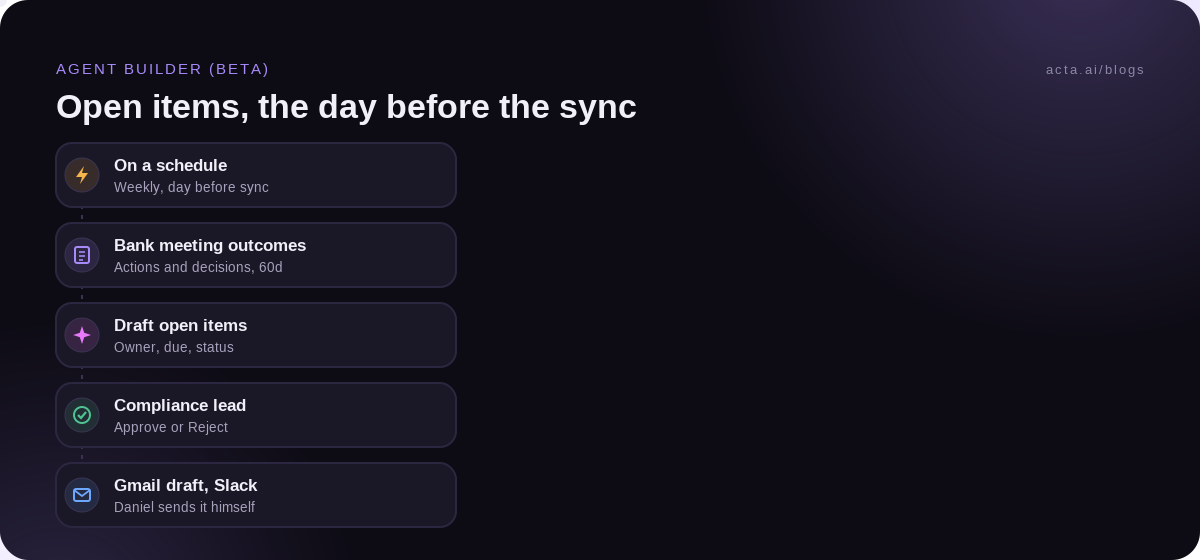
Daniel's best habit would be sending Linda an open-items list the day before every sync. Agent Builder (beta) can prepare it. A recipe for an afternoon:
- Click New agent: "The day before each Cedar Valley sync, draft the open-items list for the bank."
- Trigger: On a schedule, weekly, the afternoon before the sync.
- Acta data: action items and decisions from meetings whose titles contain "Cedar Valley", last 60 days.
- AI: "Make a table: item, what the bank asked, owner, due date, status, and what we will deliver before the next sync. Flag anything overdue. Neutral tone. Do not promise dates not already agreed."
- Human approval: Aisha reviews; tick "Also email me Approve and Reject buttons". Without an answer in 24 hours, nothing goes out.
- Gmail: create a draft to Linda (a draft, so Daniel sends it himself). Slack: post the same list in #bank-partnership for the internal owners.
- Test and Run test; nothing is sent in a test. Then Turn on.
The steps guide explains each step type. Keep the approval step and the Gmail draft: anything addressed to your bank should leave with a person's judgement on it.
Ask the bank before recording, and plan for a no
Some partner banks are comfortable with recorded calls; others are not, and that is their call. Ask once, in writing, at the start of the relationship, and say how recordings are stored and who can open them. The guide on recording consent and what to tell participants covers the general rules. If the bank uses Teams or Zoom desktop, the Acta desktop app records from your laptop without a bot joining, and its "Copy notice" button pastes a recording notice into the chat.
If the bank declines, record a two-minute internal debrief straight after the call instead: Daniel says what was asked, by when and who owns it. Acta's in-browser audio recording handles that, and the debrief feeds the same registry. A bank may also ask how a new tool handles meeting content; Acta's security page describes its practices, and your own vendor review should decide whether it fits.
A two-week rollout across partnerships, compliance and credit
Who records which meetings
- Bank partnerships lead: weekly syncs and quarterly business reviews.
- Compliance operations lead: monthly oversight meetings and the internal compliance standup.
- Head of credit: credit committee and policy discussions with the bank.
- Growth lead: campaign reviews, so bank conditions reach the people who launch.
The two weeks
- Days 1-2: Create the workspace and invite the four leads (Settings > Workspace; free for up to 10 people in the trial). See the team setup guide.
- Days 3-5: Ask the bank about recording. Record internal meetings either way and share them with Everyone in the workspace.
- Week 2, Monday: Aisha opens the Risk Registry, assigns an owner to every High risk and sets dates.
- Week 2, Wednesday: Build the open-items agent and test it on the last sync.
- Day 14: Before the next sync, compare the agent's list with Aisha's own; fix the instructions where they differ.
Mistakes to avoid
- Keeping bank syncs private. The compliance lead's registry cannot see what was not shared.
- Treating Suggested mitigations as agreed. The bank has not heard them yet.
- Letting growth and engineering skip the record. Bank conditions on launches must reach the people who launch.
The Acta page for fintech startups covers other meetings worth capturing. The Risk Registry, Outcomes views and OneChat are included in the 15-day trial and in Pro; after a trial without Pro, the registry stays readable but changes need Pro.
Frequently asked questions
What goes in a fintech partner bank meeting risk log?
Each concern or request the bank raises, with how serious it is, the agreed fix, an owner, a due date and a status. Include casual mentions like an upcoming audit sample, plus internal risks that affect the bank, such as a staffing gap on a recurring report. Keep a history so you can show how each item changed.
How is a risk log different from an issues list the bank keeps?
The bank's list reflects what it has formally raised. Your log should be wider: it captures early mentions, internal causes and your own mitigations before they become findings. Compare the two at the monthly oversight meeting, and treat any item on the bank's list that is missing from yours as a gap in your process.
Does recording bank calls help with third-party risk management?
A recording gives you an accurate record of what was asked and agreed, which makes follow-up easier. Whether it helps your bank's third-party risk management depends on the bank's own process, which you should ask about. Always get the bank's agreement before recording, and follow your counsel's advice on retention.
Who should own compliance action items from bank meetings?
A named person on your side for each item, not a team. The compliance operations lead usually owns the risk list and checks it weekly, while individual action items sit with whoever does the work: the partnerships lead for remediation plans, credit for policy changes, growth for campaign reviews.
Can two partner banks share one risk log?
Keep them apart in practice. In Acta's Risk Registry, group by Project / customer so each bank's risks show together, and title meetings with the bank's name so agents and OneChat questions can be scoped to one relationship. Never send one bank's items to another.
Walk into the next bank sync with the list already built
A bank partnership rarely fails on one big issue. It erodes when small requests go quiet. Start here:
- Ask about recording: once, in writing, with a debrief plan if the answer is no.
- Share every bank meeting: so the compliance lead's Risk Registry sees the whole relationship.
- Own every High risk: no "High · no owner" card older than 48 hours.
- Pair decisions with tasks: a bank condition with no action item is a future finding.
- Send the open-items list: drafted by an agent, approved by a person, the day before each sync.
Get the desktop app for your internal bank-prep calls and try the registry on a 15-day free trial.