Use Cases 5 min read
Credit Committee Minutes and Decision Records From the Recording
A credit decision is only as defensible as its record. Acta turns the credit committee discussion into minutes with risks, mitigants, conditions and each vote.
Quick answer: Credit committee minutes are the formal record of a lending decision: who the borrower is, what they asked for (amount, purpose and tenor), the strengths weighed against the risks and their mitigants, the decision, the conditions attached and how each member voted. Acta writes this record automatically from the recorded committee meeting, so the secretary reviews minutes instead of drafting them.
Credit committees make some of the most consequential decisions in a bank, credit union or private lender. A credit paper goes in, a discussion follows, and the outcome is often more nuanced than yes or no: approved subject to a guarantee, approved at a lower amount, deferred pending updated accounts.
The nuance is what gets lost. Minutes are typically written afterwards by a credit officer who was also presenting, from notes taken while answering questions. The decision is recorded, but the reasoning, the dissent and the exact wording of conditions are often thinner than an auditor or examiner would like.
What is a credit committee, and what do its minutes record?
A credit committee is a group of senior credit, risk and business managers who review lending requests above an individual officer's delegated authority, or that need extra scrutiny. This explainer on the credit committee in banking describes how committees test a request against lending policy and risk appetite and often set the terms, including collateral and guarantees, rather than simply approving or declining.
Because the committee is where credit risk is accepted, its record matters for governance. Supervisors expect lenders to document how credit decisions are made; the OCC's Comptroller's Handbook booklet on lending and loan portfolio risk management is one regulator's reference on how lending risk should be managed across a loan's life.
Good minutes let someone who was not in the room understand what was approved, on what basis, under which conditions, and who disagreed. That is the structure Acta follows.
What does Acta's credit committee report include?
Acta reads the committee's discussion and writes the record in three parts:
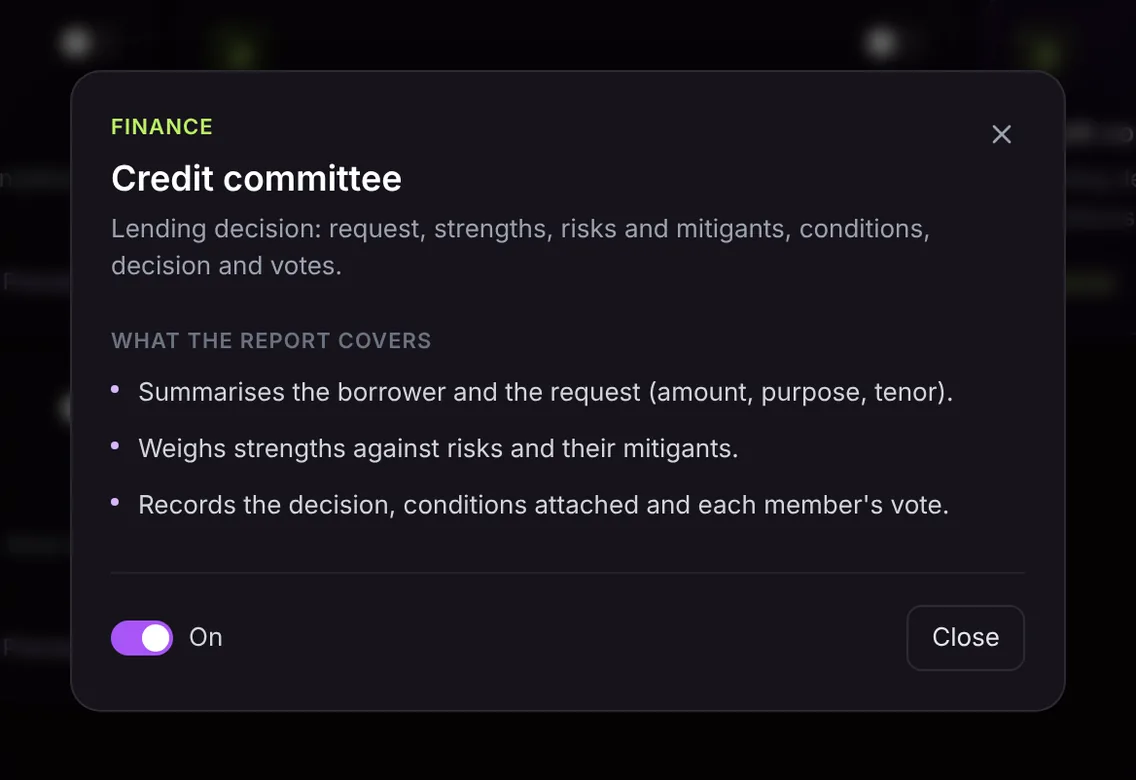
- Borrower and request. A summary of the borrower and the request: amount, purpose and tenor, as presented to the committee.
- Strengths against risks and mitigants. The strengths members cited, such as repayment history, cash flow or collateral cover, weighed against the risks they raised, with the mitigant offered for each risk where one was discussed.
- Decision, conditions and votes. The outcome, every condition attached (covenants, security, documentation, pre-drawdown requirements) and each member's vote.
Here is the template in Acta's Templates page, with the preview of what the report covers:
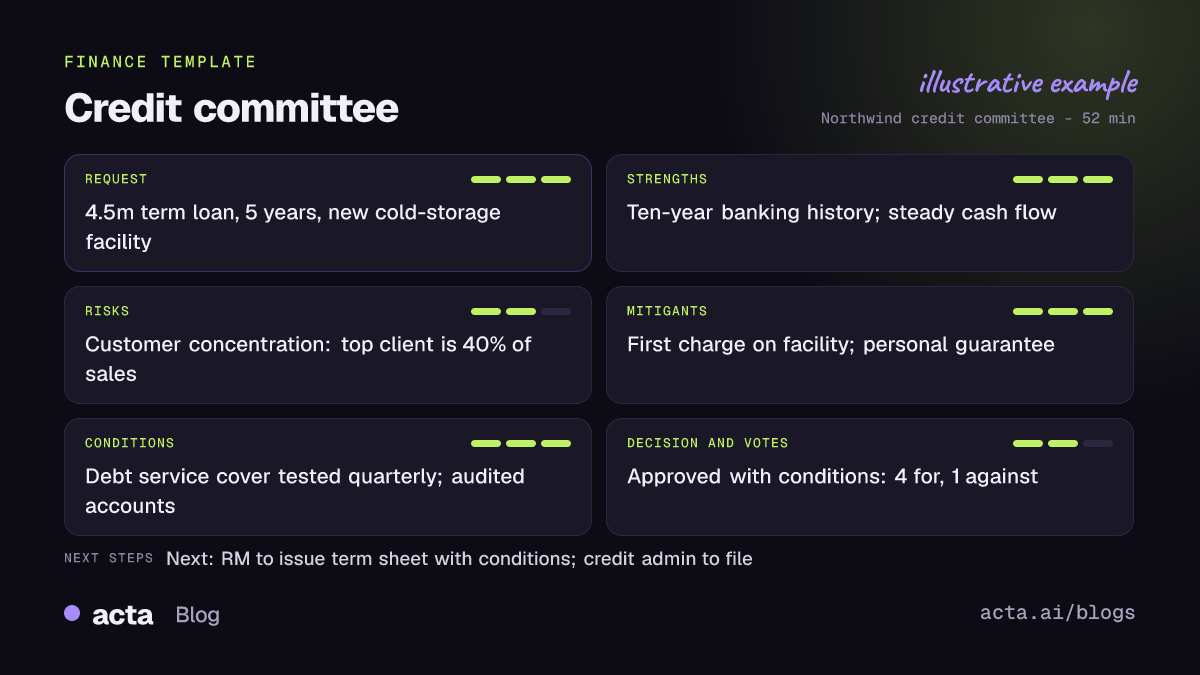
And an illustrative example of a finished report:
Why is a credit committee record useful, and who is it for?
The report is for committee secretaries, credit officers and analysts, chief credit officers, relationship managers and the credit administration team that books the loan. It is also useful to internal audit and credit risk review, who read minutes long after the meeting.
- Conditions that reach the term sheet intact. When the committee approves "subject to quarterly debt service cover testing and a personal guarantee from the founder", the relationship manager and credit administration need exactly that wording. A recorded list of conditions reduces the chance of one being dropped.
- Dissent on the record. If one member voted against because of customer concentration, the reason is captured. Should the loan later run into trouble, the file shows the risk was identified and how it was weighed.
- Faster minutes. The secretary starts from a structured draft and checks it against the credit paper, instead of reconstructing the debate from handwritten notes.
- Annual reviews. When the facility comes up for renewal, the original reasoning, mitigants and conditions are easy to find and compare against how the borrower has performed.
The Acta for financial services page covers how lenders and advisers use Acta more broadly, and this guide to tracking decisions made in meetings explains why a decision without its reasoning is hard to defend later.
How does Acta pick the credit committee template automatically?
Acta reads every recorded conversation and picks a fitting template even if you have not turned it on. For the credit committee report, the signals are a borrower and a lending request discussed by several members: amount, tenor and purpose, repayment capacity, collateral and guarantees, covenants, risk ratings and, above all, a decision put to the members.
A report Acta picks this way is labelled "Auto", and Acta explains why, for instance that the meeting reviewed a term loan request, discussed security and recorded a vote. Click "Turn on for future meetings" to keep it on for future committee sessions.
Once it is on, the template checks each meeting before writing. A relationship manager's internal pipeline call will not get forced credit minutes with an empty votes section; it is listed under "Not relevant" with the reason.

How do you use the credit committee report?
- Record the committee meeting. Acta records Zoom, Google Meet and Microsoft Teams meetings through a meeting bot, the bot-free desktop app, the Chrome extension or the mobile apps. For a committee held in a boardroom, record on the desktop app or a phone, or upload the recording.
- Turn on the template. In Acta's Templates page, preview the credit committee report and switch it on, or let Acta pick it.
- Review the record. Open the meeting's Templates tab. The secretary checks the draft against the credit paper and corrects names, figures and condition wording before the minutes are approved.
- File it. Copy the record into your credit file or download it as PDF, Word or Markdown for the minute book.

Tips for complete credit committee minutes
- Restate the request at the start. Have the presenter say the amount, purpose and tenor out loud so the first section is exact.
- Read the conditions back. Before the vote, the chair can read the proposed conditions aloud. That gives the record the agreed wording.
- Take votes by name. A roll-call vote, even a quick one, lets the report show each member's position and any reasons for dissent.
Other Finance templates include KYC onboarding call notes for the client onboarding stage and the compliance check for client conversations. For board-level governance meetings, see board meeting minutes from the recording.
Frequently asked questions
What should credit committee minutes include?
At minimum: the borrower, the request (amount, purpose, tenor), the main strengths and risks discussed, mitigants, the decision, any conditions, and how each member voted, including reasons for dissent.
Does Acta assess the credit risk itself?
No. The report only contains what was said in the meeting. It records the committee's own analysis and decision; it does not rate the borrower or add risks nobody raised.
Can the report replace the formal approved minutes?
It is a draft for the committee secretary to check and finalise under your institution's own approval process. It saves the drafting, not the review.
Does it work when the committee meets in person?
Yes. Record the meeting on the desktop app or a phone, or upload a recording afterwards, and the report is written the same way.
To try it on your next committee, start a free 15-day Acta trial.


