Family council, board and management meetings do different jobs
The most common governance problem in a family business isn't a bad decision; it's a decision made in the wrong room. A dividend agreed over Friday lunch or a job promised to a nephew at a wedding feels reasonable at the time. Two years later nobody agrees on what was decided, or who had the right to decide it.
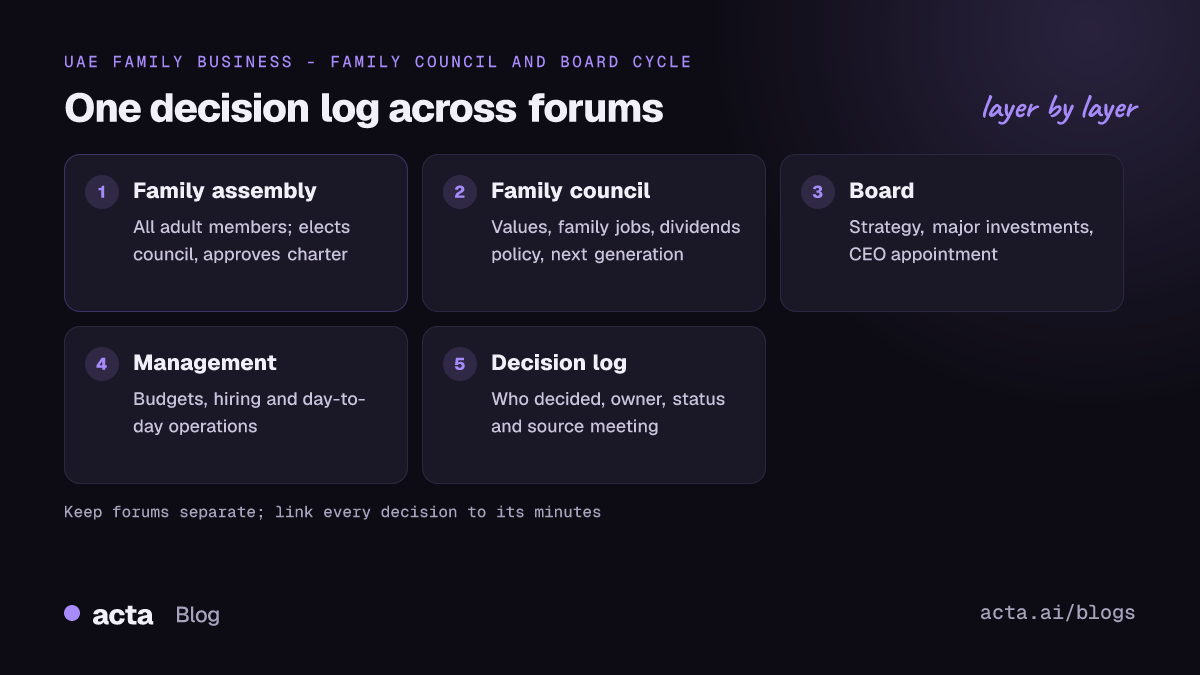
The fix is to separate forums and give each a clear remit. A family council meeting deals with the family as owners: values, the employment policy for family members, education of the next generation, dividends policy and the charter itself. The board deals with the company: strategy, major investments, senior appointments and oversight of management. Management meetings deal with running the business. Some larger families add a family assembly, an annual gathering of all adult members, and a family office that manages shared wealth.
| Forum | Who attends | Typical decisions | What to record |
|---|
| Family assembly | All adult family members | Elect council members, approve charter changes | Attendance, votes, charter amendments |
| Family council | Elected or appointed family representatives | Employment policy, dividends policy, next-gen programmes | Decisions, owners, open family issues |
| Board of directors | Family and independent directors | Strategy, major capex, CEO appointment | Resolutions, votes, conflicts declared |
| Management meeting | CEO and executives, family or not | Budgets, hiring, operations | Action items, owners, deadlines |
Write the remit of each forum down, even if only on one page. When an item comes up in the wrong forum, the chair's job is to say "That's a council matter; let's put it on the next agenda," not to decide it on the spot. For the company-law side of board minutes, see our guide to board meeting minutes in the UAE.
Dubai Law No. 9 of 2020 lets families hold assets under one contract
The Dubai family business law, Law No. 9 of 2020 Regulating Family Property in the Emirate of Dubai, was issued in August 2020. It lets family members sign a Family Property Contract, notarised in Dubai, to own and manage family assets together. Commentaries on the law describe the covered property as including shares in commercial and civil companies and the assets of sole establishments (but not shares in public joint stock companies), as well as other movable and immovable property.
Three points matter most for governance. First, the partners agree the term of the contract, but it can't exceed 15 years under the official text; commentators note it can be renewed for a similar period if all partners agree. Second, the property is run by a manager, who is appointed by partners holding at least two-thirds of the family property and may be a family member or an outside party. Third, the contract itself becomes a governance document: it sets out who manages, how decisions are made and how a partner can leave.
What the law doesn't do is run your meetings. If the contract says the manager reports to the partners twice a year, someone has to hold, minute and file those meetings. Families that do have a much easier time when the 15-year term comes up for renewal.
Federal Decree-Law No. 37 of 2022 adds a voluntary register and charters
At federal level, Federal Decree-Law No. 37 of 2022 on Family Businesses came into force in January 2023. It's opt-in: a family business chooses to register. According to the Ministry of Economy, the request to register in the unified family business registry goes to the licensing authority that issued the company's economic licence, which forwards it to the Ministry for a decision.
Legal commentary, such as Al Tamimi & Company's summary, highlights several features relevant to governance:
- Eligible forms: a family company can take any form recognised under the Commercial Companies Law except public joint stock companies and general partnerships, and free-zone companies can also qualify.
- Family majority: a majority of the shares must be held by members of the same family.
- Share classes and buy-backs: the law allows different classes of shares, such as voting and profit-bearing shares, and lets the company buy back its own shares up to 30%.
- Transfers: family members get a pre-emption right when shares are transferred, with exceptions for transfers to a spouse or first-degree relatives.
- Charter and bodies: the family business may deposit a copy of its charter in the register, and families can set up governance bodies such as a family council.
Registration won't suit every family, and the decision is itself a council matter worth minuting carefully: who proposed it, what advice was taken and who voted.
A family charter turns unwritten rules into agreed ones
A family charter, sometimes called a family constitution or protocol, is a written agreement on how the family relates to the business. It usually covers the family's values, who counts as a family member for ownership, rules for family members working in the company, how dividends are decided, how the family council is formed and how disputes are resolved. Depending on how it's drafted and registered, parts of it may be binding and parts simply a statement of intent; that's a question for your lawyer.
Dubai has local support for this work. The Dubai Centre for Family Businesses, set up under Dubai Chambers in 2023, issued governance guidelines for family-owned companies in July 2023 that cover the role of a family constitution, and in January 2024 it launched a Family Business Governance Assessment Tool to help families build a governance roadmap.
A family charter UAE families actually use is one that gets reread. Practical habits that help:
- Draft it through a series of family council meetings, not in a lawyer's office alone. The discussions are the point.
- Minute each drafting meeting, including the options rejected and why. Future readers need the reasoning, not just the clause.
- Agree a review cycle, for example every three years, and put it on the council calendar.
- Keep a short plain-language summary, in Arabic and English if the family uses both (see these Arabic meeting minutes formats), for younger members.
- Link every later council decision back to the charter clause it relies on.
Decision records are what survive a change of generation
Minutes tell you what happened at one meeting; a decision log tells you what is currently true. The dividend policy agreed in 2019 may have been changed in 2022 and partly reversed in 2024, across three different forums. If those decisions only live in three sets of minutes, a new director needs a week and two aunts to reconstruct them.
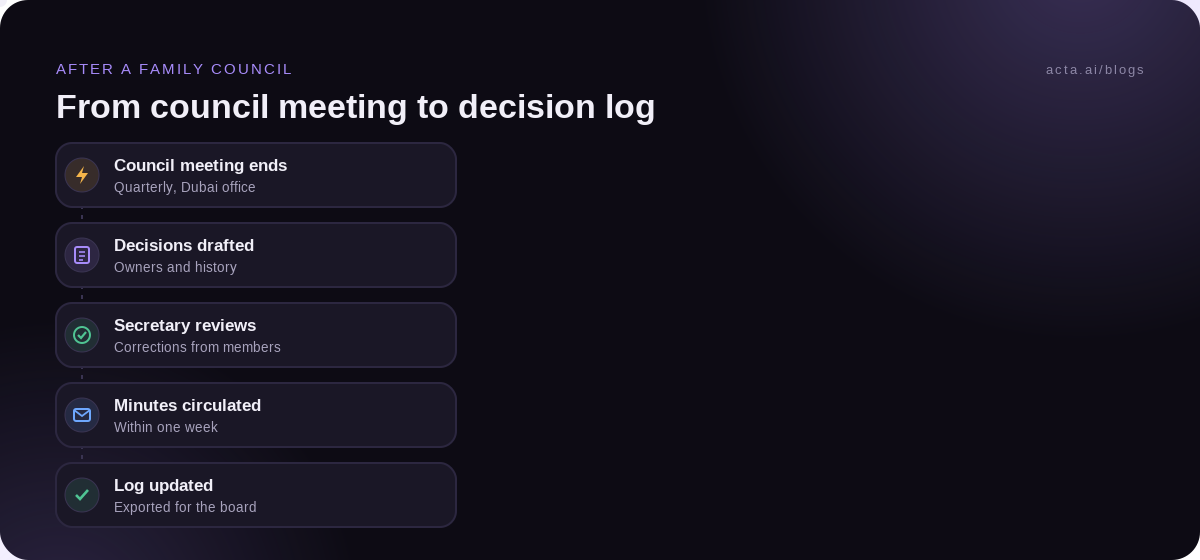
A good decision log for a family business has one row per decision, with: the decision in one sentence, the forum and date, who decided, who owns carrying it out, its status, and a link to the source minutes. Statuses can be simple: active, changed, reversed or done. When a decision is changed, keep the old wording visible ("Was: ...") so nobody later claims the original was never agreed. Our guide on how to track decisions made in meetings goes deeper on the format.
Here's an illustrative example from a fictional third-generation trading family in Dubai. Names are invented.
Decision log, Family council and board, 2026
1. Family members joining the company need a degree and two years' experience elsewhere. Forum: family council, 14 Jan 2026. Decided by: council vote. Owner: Fatima (council chair). Status: active.
2. Annual dividend set at a fixed share of net profit, reviewed each year. Forum: board, 3 Mar 2026. Decided by: board resolution. Owner: Hamad (CFO). Status: changed. Was: fixed amount per share, agreed 2023.
3. Independent director to join the board. Forum: family council recommendation, board approval, May 2026. Owner: Rashid (chairman). Status: done.
4. Next-generation summer internship programme. Forum: family council, 14 Jan 2026. Owner: Aisha. Status: active, two action items open.
Notice what makes it work: each row names a single owner, says which forum had the authority, and shows history. Group the log by person before each council meeting and every owner can see at a glance what they still owe the family. The same approach is described in our post on a decision log and RACI from meetings.
A family council minutes template keeps meetings honest
Family council meetings are often more emotional than board meetings, so keep their minutes plain: record decisions and actions rather than every opinion, and circulate the draft within a week. A starting template:
Family council meeting minutes
Date, place and chair:
Present (and apologies):
Advisers present (lawyer, family office, facilitator):
1. Matters arising from the last meeting: status of each open action
2. Ownership and charter items: proposals, discussion summary, decision
3. Family employment and next-generation items
4. Dividends and distributions: recommendation to the board, if any
5. Items referred to the board or management (with the reason)
Decisions taken: one sentence each, with who decided and the vote if any
Action items: task, owner, due date
Items deferred: what, and to which meeting
Next meeting date:
Approved by the chair on:
A filled-in fragment, from the same fictional family: "Item 3. Aisha presented the internship proposal for family members aged 18 to 24. Discussion covered whether placements should be in the family's own companies or with partners. Decision: placements with partner companies in year one, family companies from year two. Action: Aisha to contact three partner companies by 15 February. Item referred to the board: budget for the programme, with reason 'spending above the council's limit'."
Item 5 is the one families most often skip. Writing down what was sent to the board, and why, is how you stop the council quietly making board decisions.
Succession conversations need a record everyone trusts
Family business succession planning in the UAE involves more than naming the next chairman. It includes who will own what, how inheritance rules interact with company shares, who is ready to lead which business, and what role the senior generation keeps. These talks run over years, and each family member can end up remembering a different version.
Three habits help. Hold succession discussions in a defined forum, usually the family council with an adviser present, rather than in private one-to-ones that nobody else hears about. Summarise each session in writing with the points agreed and the points still open, and let every participant correct the summary before it's filed. And keep the language plain: "Rashid will step back as CEO by the end of 2027 and remain chairman" is far more useful than a paragraph of intentions.
Recording these meetings can help, but only with everyone's clear agreement, and some families will rightly prefer not to. Ask before every session, explain who will hear the recording, and agree how long it's kept; our explainer on UAE PDPL and meeting recording covers consent and notices. Our guides on recording sensitive meetings such as board calls and on whether it's legal to record meetings with AI set out what to say. For a majlis-style family meeting in person, a phone on the table running the Acta mobile app is less intrusive than a laptop; for a video call with relatives abroad, the desktop app records Zoom and Teams calls from your own computer without a bot joining.
Where Acta fits, honestly: it writes the transcript, summary, decisions and action items with owners, and its Decision log (My meetings, then Outcomes, then Decision log) merges repeated decisions into one row with statuses Active, Changed, Reversed or Done, can be grouped by person and exported as CSV. The log belongs to each user's own meetings rather than being a shared family register, so the secretary or family office usually keeps it and circulates the export. Arabic is supported in beta and must be chosen in settings; see the AI note taker for UAE teams page.
Frequently asked questions
What is family business governance in the UAE?
Family business governance in the UAE is the set of forums, rules and records a family uses to run its business and its ownership: usually a family council, a board and management meetings, guided by a family charter. Dubai Law No. 9 of 2020 and Federal Decree-Law No. 37 of 2022 provide legal frameworks families can choose to use.
Is registering a family business in the UAE mandatory?
No. Under Federal Decree-Law No. 37 of 2022, registration in the UAE's unified family business registry is voluntary. According to the Ministry of Economy, the request goes to the licensing authority that issued the company's economic licence, which forwards it to the Ministry. Whether registering suits your family is a question to take to a UAE-qualified lawyer.
How long can a Family Property Contract last in Dubai?
Under Dubai Law No. 9 of 2020, the partners agree the term of a Family Property Contract, but it cannot exceed 15 years. Legal commentaries note it can be renewed for a similar period with the agreement of all partners. The contract is notarised in Dubai, and the manager is appointed by partners holding at least two-thirds of the property.
What is the difference between a family council and a board in the UAE?
In a UAE family business, the family council represents the family as owners and handles values, family employment, dividends policy and the charter. The board oversees the company itself: strategy, major investments and senior appointments. The council can recommend to the board, but keeping their minutes and decisions separate avoids disputes about who had the authority to decide.
Should family council meetings in the UAE be recorded?
Only if every participant agrees. Recording a UAE family council meeting can make minutes more accurate, especially for long succession discussions, but these are private conversations. Ask before each session, explain who can access the recording and for how long, and fall back to written minutes if anyone prefers. Either way, circulate the minutes for correction.
Start your family business governance UAE checklist this quarter
You don't need a finished charter to start governing well. Pick the items below that fit your family's stage and put them on the next council agenda.
- Define the forums: write one page on what the family council, board and management each decide.
- Check the legal options: ask your lawyer whether a Dubai Family Property Contract or federal registration fits your assets and companies.
- Start the decision log: list the ten decisions that matter most today, each with an owner and status.
- Use one minutes template: the same headings for every council meeting, with items referred to the board shown separately.
- Agree the recording rule: when recording is allowed, who keeps it and for how long.
To get minutes, decisions and owners written for you after each council or board call, try the Acta desktop app with a 15-day free trial, and compare plans on the pricing page.