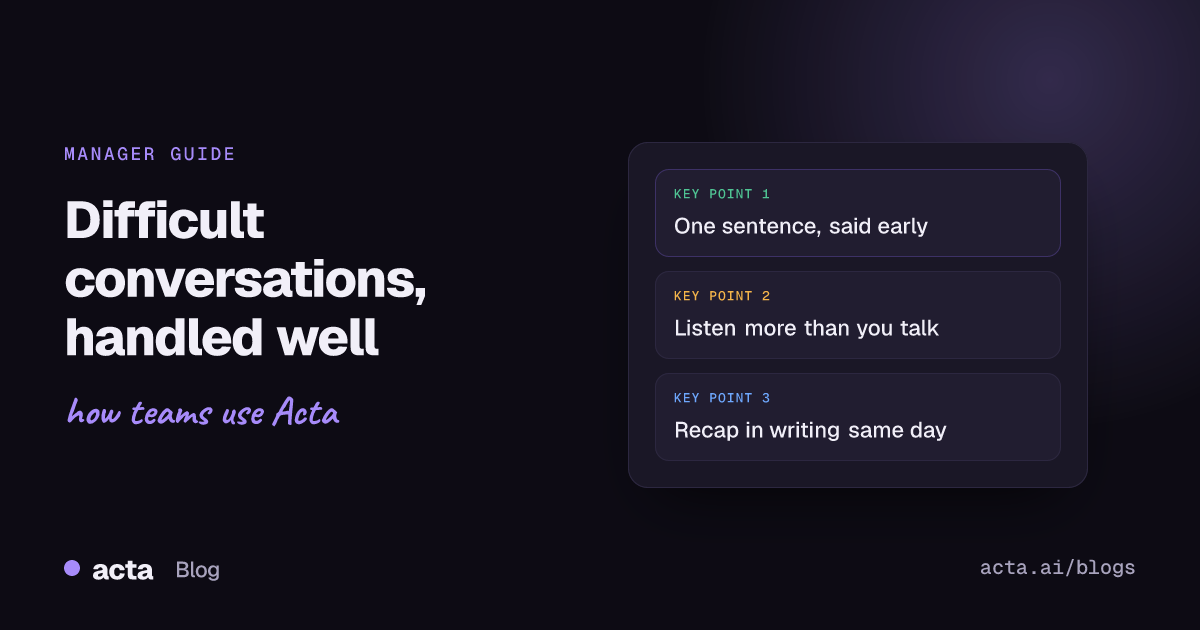
Quick answer: To handle difficult conversations as a manager, decide the one thing the person must hear and say it in the first two minutes, with a specific example. Then stop talking and listen. Agree on what changes and by when, send a short written recap the same day, and put a check-in on the calendar before you leave the room.
Most managers I've worked with don't fail these talks because they say the wrong thing. They fail because they wait three months, then say six things at once, wrapped in so much padding that the employee walks out thinking the meeting was about something else. This guide is about difficult conversations as a manager, from your side of the table: getting ready, getting the words out, staying steady when it goes sideways, and making sure the agreement survives the week.
What counts as a difficult conversation for a manager?
Anything where you expect the other person to be upset, defensive or surprised. The usual ones:
- Performance that has slipped below what the role needs (if a formal review is coming, our performance review preparation checklist helps).
- Behaviour: lateness, how someone speaks to colleagues, a client complaint.
- Bad news you didn't choose: no promotion this cycle, a reorg, a project cancelled.
- Personal matters that affect work, such as hygiene, or a pattern of absences.
- Conflict between two people on your team.
They feel different, but the structure that works is close to identical. The trap is treating the emotional weight as a reason to delay. A small problem raised in week two is a ten-minute chat. The same problem raised in month four is a formal process and a damaged relationship.
How do you prepare for a difficult conversation with an employee?
Preparation is where most of the result is decided. You don't need a script. You need clarity on a few things.
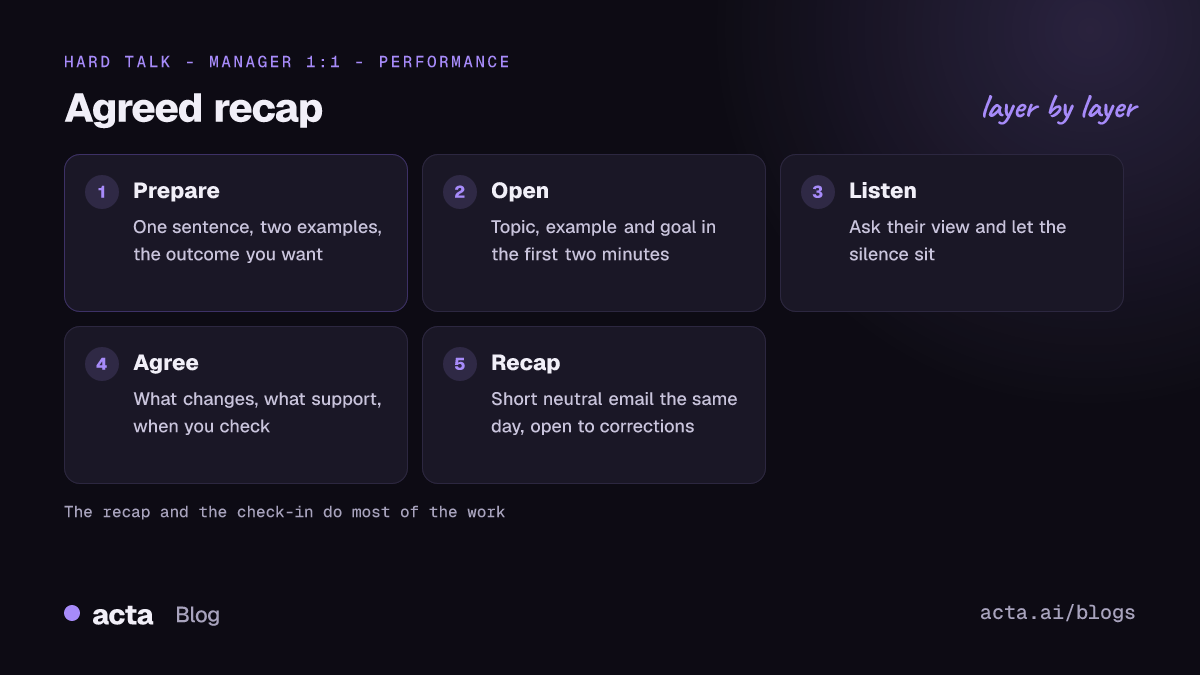
- Write the one sentence. If the person remembers only one line, what is it? "Your code reviews are landing two to three days late and it's blocking the release." If you can't write that sentence, you aren't ready.
- Collect two or three specific examples. Dates, what happened, who was affected. "On the 14th the Henderson report went out with last quarter's numbers" beats "your work has been sloppy lately."
- Decide what you want to happen next. A change in behaviour? A plan? Just awareness? Know whether this is a first conversation or a step in a formal process, because that changes what you write down afterwards.
- Check what you don't know. Is there a reason you haven't heard? Workload, a health issue, a teammate dropping things on them? Go in curious, not with a verdict.
- Talk to HR first if it's serious. Anything that could end in a warning, or that touches health, discrimination or harassment, should go past HR before you open your mouth.
One practical habit: write your opening two sentences on a sticky note. Not the whole talk. Just the start, because the start is where nerves make people ramble.
What should you say in the first two minutes?
Skip the compliment sandwich. People can hear the "but" coming, and the praise gets discounted anyway. A plain opening respects the other person more:
"I want to talk about the client calls this month. Twice the follow-up didn't go out, and on the Rossi account the client chased us for it. I'd like to understand what's happening and agree how we fix it."
That's it. Name the topic, give the example, say what you want from the meeting. Then ask a real question: "What's your view of it?" and let the silence sit. It'll feel long. It's usually about five seconds.
A few things to keep out of the opening:
- "This is really hard for me." It turns the conversation toward your feelings.
- "People have been saying..." Unnamed sources make people defensive and send them hunting for who complained.
- Words like "always", "never" and "attitude". They invite an argument about the label instead of the work.
How do you handle the reaction when difficult conversations as a manager go off track?
Expect one of a few reactions, and decide ahead of time how you'll respond.
They get defensive or argue the facts
Don't debate every detail. Acknowledge the part they're right about, then return to the impact: "You're right that the brief changed late. The report still went out with the wrong numbers, and that's the part I need us to fix."
They get upset or cry
Pause. Offer water, offer a few minutes. Don't rush to take back what you said to make the discomfort stop. If they need to end the meeting, agree a time to pick it up within a day or two, not "sometime".
They go quiet
Silence often means they're processing, not agreeing. Ask something open: "What would make this easier to get right?" If you still get nothing, tell them you'd like their thoughts by tomorrow, in person or in writing.
They raise something about you
Sometimes the real issue is a vague brief or a priority you changed twice. If it's fair, say so. You can own your part and still hold them to theirs.
When you're new to difficult conversations as a manager, it's easy to swing between too soft and too hard. The steady middle is boring on purpose: same calm tone, same specific facts, same request.
How do you close the conversation with a clear agreement?
The end of the meeting is where most of these talks quietly fall apart. Both people leave relieved, nobody says exactly what changes, and four weeks later you're having the same conversation with less goodwill.
Before anyone stands up, get three things said out loud:
- What changes. "Client follow-ups go out within one working day of the call."
- What support you'll give. "I'll move the Thursday reporting task to Sam for the next month."
- When you'll check. "Let's look at it together in our 1:1 on the 28th."
Ask them to say back what they heard. It sounds a bit formal, but it catches misunderstandings while you're both still in the room.
What should you write down after a difficult conversation?
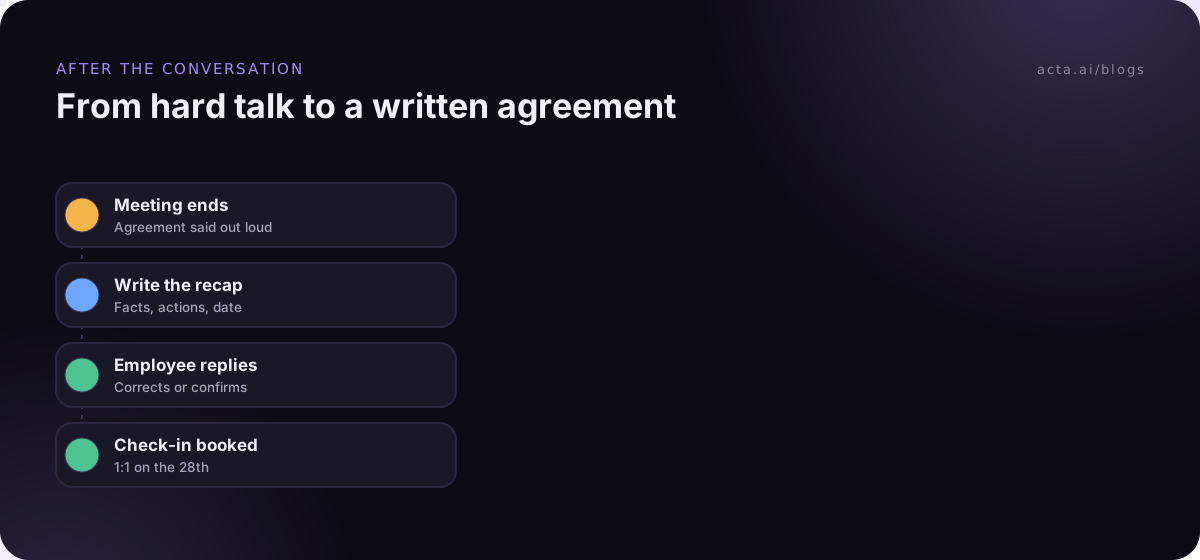
Write a short recap and send it the same day. University HR teams give managers the same advice: the University of Toledo's HR guidance suggests writing the documentation as though a third party will read it, and Boston University's guidance on performance conversations recommends a follow-up memo or email that recaps the expectations, timeline and next steps.
A recap that works is short and neutral:
- Date and who was there.
- The issue in one or two sentences, with the examples you discussed.
- What was agreed, including any support you promised.
- The check-in date.
- A line inviting them to reply if anything doesn't match their memory.
Leave out adjectives, guesses about motives, and anything you'd be uncomfortable seeing read aloud. "You seemed unmotivated" doesn't belong. "The report due on the 14th was sent on the 17th" does.
If you keep a running doc for your 1:1s, link the recap there too, so it doesn't vanish in an inbox. Our post on one-on-one follow-up for managers covers that habit. Our guide to one-on-one meeting notes as a running record shows a simple format.
Should you record a difficult conversation?
Usually no, and never secretly. A recorder on the table changes how people talk, and a hidden one, if found out, wrecks trust and may break the law depending on where you are. If you're thinking about it, read up on recording consent and what to tell participants first, and check your company's policy with HR. This is general information, not legal advice.
There are exceptions. Some formal hearings are recorded by agreement, and some employees ask for a record because they don't trust their own memory under stress. If both of you agree openly, that's a different situation. For the conversation itself, a written recap that the employee has read and can correct is often fairer than a recording, because it captures what was agreed rather than every awkward pause.
Where recording does help is the routine meetings around the hard one. If your regular 1:1s are recorded with the person's knowledge, you have an accurate record of what was asked and promised before the problem got serious. For calls on Zoom or Teams, a desktop recorder captures the call from your own computer without a bot joining, which feels less intrusive in a one-to-one setting.
How do you follow up so the conversation sticks?
The University of Wolverhampton's guide for managers lists the follow-up steps plainly: summarise the key points, confirm expectations, agree actions, identify support and schedule further discussion. The last one is the one people skip.
At the check-in:
- Start with the agreement, not small talk. "We said follow-ups within a day. How has it gone?"
- Bring evidence both ways. If they've improved, say so specifically. People rarely hear that the change was noticed.
- Check your own promises. If you said you'd move the reporting task and didn't, own it first.
- If nothing has changed, the next conversation is more formal, and you'll have the recap to point to.
It's also worth watching your own follow-through pattern across the team. Our piece on why action items don't get done covers the common reasons agreements fade, and most of them apply to manager promises too.
Common mistakes managers make
- Doing it by email or chat. Hard news needs a voice and, ideally, a face. Use writing for the recap, not the message.
- Booking it for Friday at 5pm. The person then stews all weekend with no chance to ask follow-up questions. Earlier in the week and earlier in the day is kinder.
- Bundling. Raising every grievance you've saved up makes the person feel ambushed. Pick the one that matters most.
- Taking it back. "It's honestly not a big deal" at the end undoes the whole meeting.
- Letting the check-in slip. If you cancel it, you've told them it didn't really matter.
Where meeting notes fit in
We build Acta, which records Zoom, Google Meet and Teams calls (with a bot or bot-free from your computer) and turns them into transcripts, summaries and action items with owners. For difficult conversations, we'd still suggest the hand-written recap above. Where Acta helps is the regular 1:1s and team meetings, where promises pile up and nobody remembers who said what. There's more on that in our page on one-on-one meeting notes.
Frequently asked questions
How long should a difficult conversation with an employee take?
Book 30 to 45 minutes, and expect the core message to take two. The rest is listening, clarifying and agreeing next steps. If it runs much longer, it's often turned into a debate, and it's fine to pause and pick it up the next day.
Should HR be in the room?
For a first, informal conversation about performance, usually not; it makes it feel like a disciplinary meeting. For anything formal, or anything involving misconduct, health or discrimination, talk to HR first and follow their process.
What if the employee disagrees with the recap?
Good, that's why you sent it. Read their reply, correct anything that's genuinely wrong, and note where you still see it differently. A record that both sides had a chance to correct is worth far more than one they never saw.
How do I deliver bad news I don't agree with?
Be honest that it was a decision made above you, without blaming leadership or apologising for it endlessly. Explain what you know, say what you don't, and focus on what happens next for the person.
How soon after a problem should I raise it?
As soon as you've seen a pattern, often after the second occurrence. A single bad day may not need a meeting. A repeat usually does, and it's easier to talk about while the examples are fresh.
If you'd like your regular 1:1s and team meetings to come with notes and owners already written up, try Acta with a 15-day free trial.