Use Cases 6 min read
Financial Adviser Client Review Notes, Written From the Meeting
Acta turns each client review into a file note: goals and life changes in the client's words, recommendations with rationale, and suitability and disclosures.
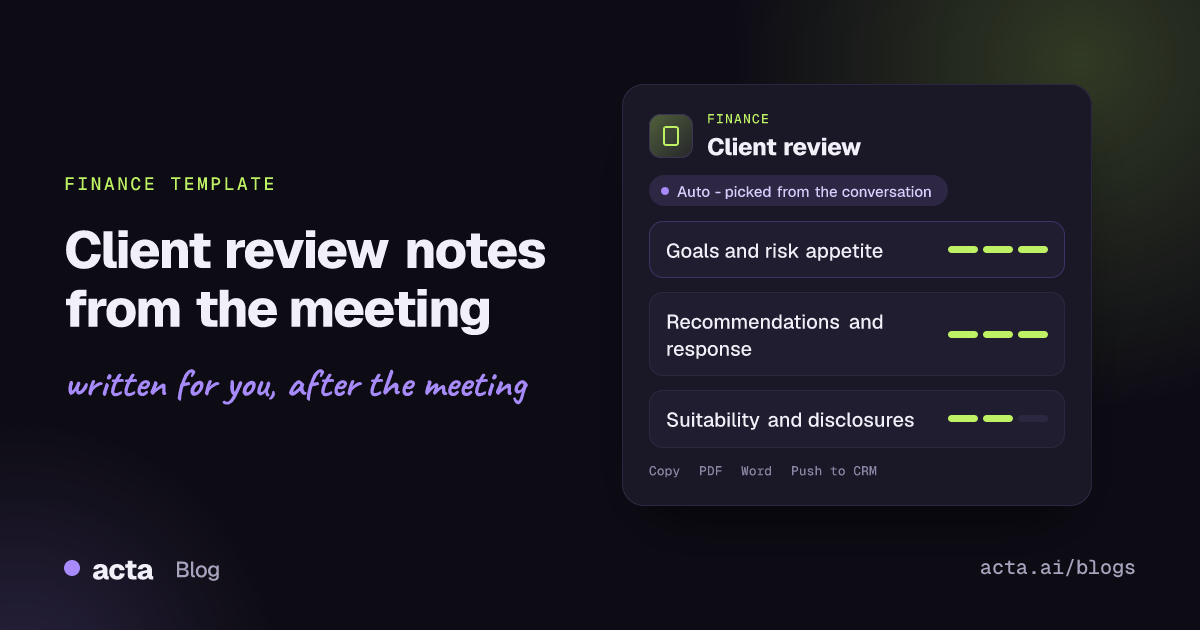
Quick answer: Financial adviser client review notes are the written record of a periodic review meeting: the client's goals, life changes and risk appetite, each recommendation with its rationale and the client's response, and the suitability points and disclosures covered. Acta writes them automatically from the recorded meeting, keeping the client's own words where they matter.
The annual or semi-annual review is the core of an advice relationship. It is where you learn that a client is retiring two years early, that a daughter is starting university, or that last year's market fall shook their confidence more than they let on.
It is also where the paperwork piles up. The file note has to show what the client told you, what you recommended, why, and what they decided, in enough detail to stand up to a compliance review. Written from memory at the end of a day of back-to-back meetings, those notes are often thinner than the conversation deserved.
What are client review notes, and why do suitability records matter?
A client review note documents an ongoing advice meeting rather than an initial fact-find. It updates the client's circumstances, checks that existing holdings and strategy still fit, and records any new recommendation. In most advice firms it forms part of the client file that compliance teams sample.
The idea that sits behind it is suitability: a recommendation should fit the client's profile. FINRA's Rule 2111 suitability FAQ for broker-dealers lists the kind of factors that make up an investment profile, including age, financial situation and needs, tax status, investment objectives, experience, time horizon, liquidity needs and risk tolerance. Advisers working under fiduciary or best-interest standards, or under other regulators' rules, document a very similar picture.
Whatever regime you work under, the practical test is the same: could someone who was not in the room read the note and understand what the client wanted, what you advised and why it was right for them?
What does Acta's Client review report include?
The template is organised around those questions:
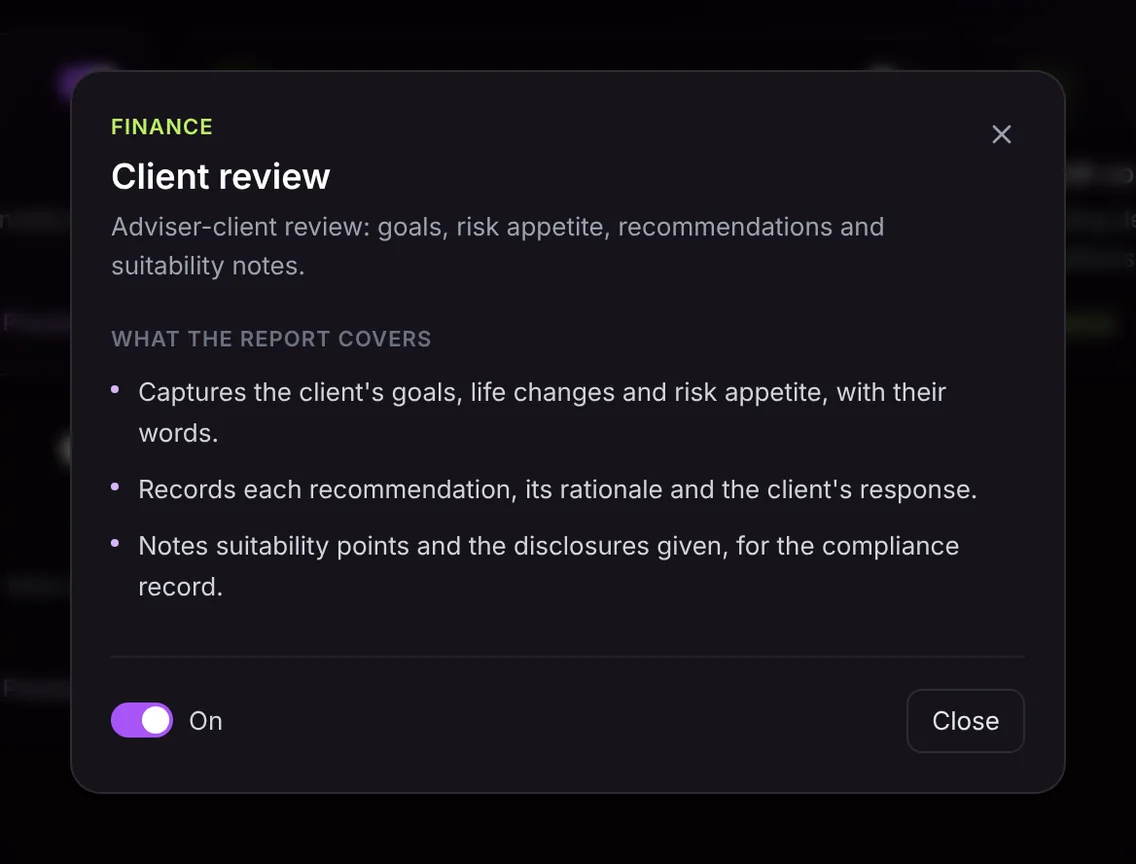
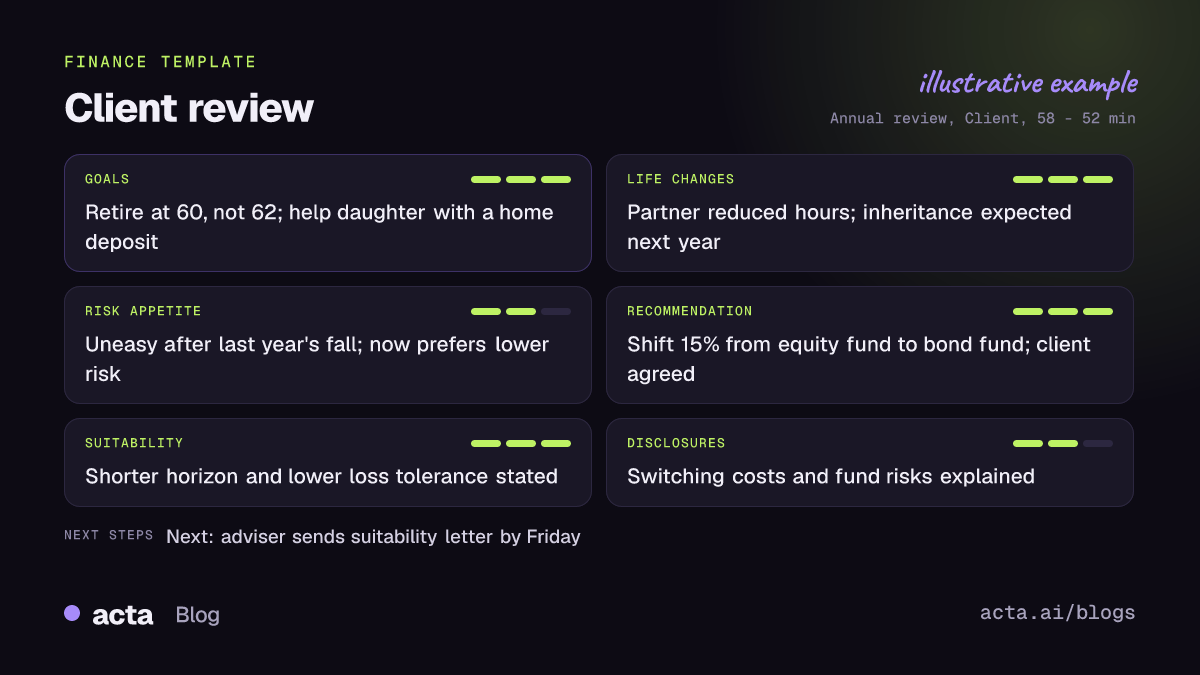
- Goals, life changes and risk appetite, in the client's words. Updated objectives ("we'd like to stop working at 60, not 62"), changes in circumstances such as a new job, an inheritance, a divorce or a health issue, and how the client describes their attitude to risk and loss. Where the client's own phrasing is telling, such as "I couldn't sleep when it dropped last year", it is kept.
- Each recommendation, its rationale and the response. What you recommended, the reasons you gave and how the client responded: accepted, declined, or wants time to think.
- Suitability points and disclosures. The points that link the recommendation to the client's circumstances, and the disclosures you gave during the meeting, such as costs, risks or conflicts, recorded for the compliance file.
The report only contains what was said. If you did not discuss charges, the disclosures section will not claim you did, which makes it easy to spot what still needs to be covered or sent in writing.
Here is the template in Acta's Templates page, with the preview of what the report covers:
And an illustrative example of a finished report:
Who is it for, and why does it help?
The template is built for financial advisers, wealth managers, financial planners, paraplanners and the compliance teams who review their files.
- Annual review season. When a large share of the client bank is reviewed in the same few months, a structured note per meeting removes hours of evening write-ups.
- A change in circumstances. A client calls to say they have been made redundant. The note captures the new situation, the options you discussed and their decision, the same day.
- Paraplanner handover. The paraplanner preparing the suitability report works from a detailed record of the meeting, not a few bullet points.
- File checks. Compliance can see the client's goals, the recommendation and the disclosures in one place, with the transcript behind it.
There is a relationship benefit too. When the client's words are on file, the next review can start from what they actually said last time.
How does Acta pick the Client review template automatically?
After each recorded meeting, Acta reads the conversation and picks a fitting template, even if you have not switched it on. For this template, the signals are an adviser and client talking through goals and circumstances, questions about attitude to risk or capacity for loss, discussion of portfolio performance, and a recommendation with reasons and a client decision.
Reports picked this way are labelled "Auto", and Acta says why, for example that the meeting reviewed the client's goals and risk appetite and included a recommendation. If it fits your practice, "Turn on for future meetings" keeps it on.
The relevance check works the other way. With the template turned on, an internal investment committee or a team meeting will not produce a forced client note; the template is listed under "Not relevant" with the reason.

How do you use the Client review template?
- Record the review. Acta can join Zoom, Google Meet and Microsoft Teams calls, or record without a visible bot through the bot-free desktop app. For face-to-face reviews, use the mobile app or upload the recording. Tell your client you are recording, in line with your firm's policy.
- Turn the template on. On the Templates page, preview Client review in the Finance group and switch it on, or let Acta pick it.
- Open the meeting's Templates tab. The client review note appears next to the summary, transcript, action items and decisions.
- File it. Copy it, download it as PDF, Word or Markdown for the client file, or use Push to CRM to add it as a note on the client's contact in Salesforce, HubSpot or Zoho (paid plan, with that CRM connected).

Tips for a fuller client review note
- Ask about changes explicitly. "Has anything changed in your health, work or family since we last met?" gives the report a clear life-changes entry.
- Say your rationale out loud. Explaining why a recommendation fits ("given your shorter time horizon...") is what fills the suitability section.
- Confirm the client's decision. End each recommendation with their answer, even if it is "let me think about it".
- Verbalise disclosures. If costs and risks are covered in the meeting, say so plainly so they are recorded.
Related finance templates include KYC onboarding call notes for new clients and the compliance check for client calls, which flags points for compliance review. See more on the Acta for financial services page.
Frequently asked questions
What should a financial adviser record in a client review meeting?
The client's current goals, any life changes, their risk appetite, each recommendation with its rationale and the client's response, and the suitability points and disclosures covered. Acta's Client review report captures each of these from the conversation.
Does the report replace a suitability report?
No. It is a record of what was said in the meeting, which you and your paraplanner can use as the basis for any formal suitability letter your firm requires.
Can I send the notes to my CRM?
Yes. On a paid plan with Salesforce, HubSpot or Zoho connected, Push to CRM adds the report as a note on the client's contact.
Will Acta add advice that was not given?
No. The report only contains what was said in the meeting, so it will not invent recommendations or disclosures.
Try Acta free for 15 days and let your next review write its own file note.


