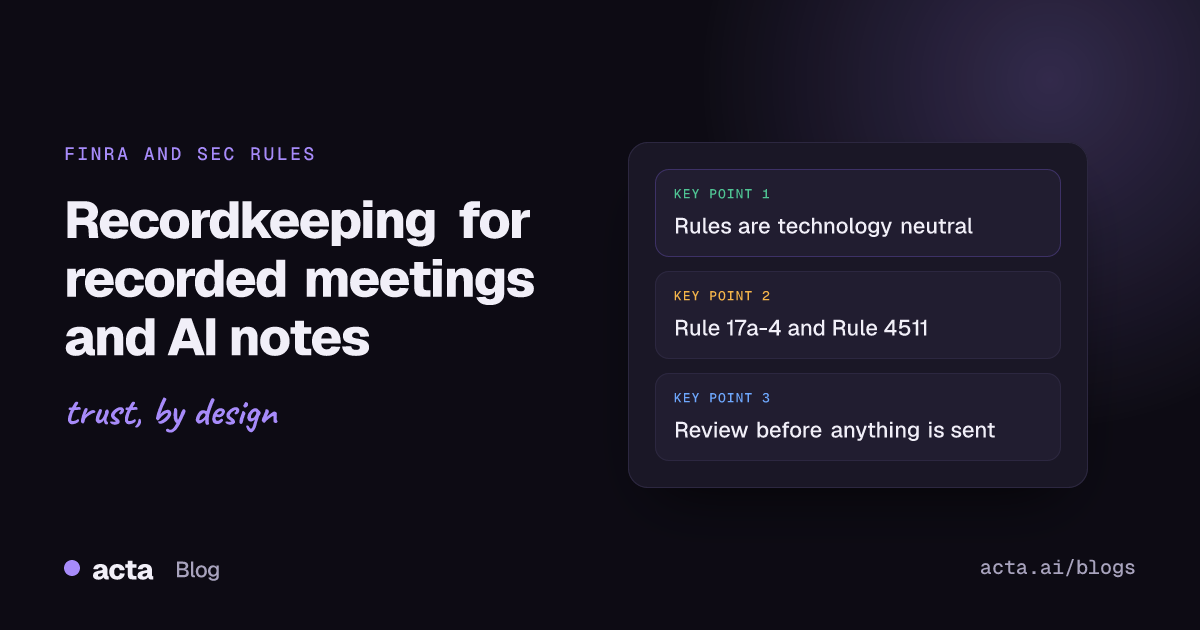
FINRA meeting recording questions come down to one point: FINRA and SEC recordkeeping rules are technology neutral, so a recording, transcript or AI summary of a client meeting can be a business record or communication the firm must keep, supervise and produce. Broker-dealers look first at SEC Rule 17a-4, which sets a three-year minimum for business communications, and FINRA Rule 4511, which sets a six-year default where no other period applies.
Privacy & Security 10 min read
FINRA Meeting Recording Rules: Recordkeeping for AI Meeting Notes
How SEC Rule 17a-4, FINRA Rule 4511 and FINRA's AI guidance apply to recorded client meetings, transcripts and AI summaries, with a worked example and checklist.
By Sarma BKP, Founder & CEO, Acta · Updated
This guide is for compliance officers, supervising principals and advisers at broker-dealers and RIAs who are weighing an AI note taker for financial advisors. It explains what the rule texts and FINRA's own guidance say, as of November 2026, and where questions are still open. It's general information, not legal or compliance advice; your firm's written supervisory procedures and counsel decide how the rules apply to you.
Key takeaways
- SEC Rule 17a-4(b)(4) requires broker-dealers to keep communications relating to the business "as such" for at least three years, the first two in an easily accessible place.
- FINRA Rule 4511 requires a six-year retention for records with no period set elsewhere, kept in a format that meets SEC Rule 17a-4.
- FINRA's Regulatory Notice 24-09 says its rules apply to generative AI the same way they apply to any technology, including vendor tools: supervision (Rule 3110) and communications content standards (Rule 2210) still apply.
- Anything an AI notetaker sends to a client, such as a follow-up email drafted from the meeting, should go through the same review and archiving as any other correspondence.
- Decide before rollout where each artifact (audio, transcript, summary, follow-up) is archived, who reviews it, and how long it's kept.
Table of contents
- FINRA and SEC rules are technology neutral, so AI notes are covered
- Retention periods come from Rule 17a-4, Rule 4511 and Rule 204-2
- The type of record matters more than the tool that made it
- FINRA's AI guidance adds supervision, accuracy and logs
- One client meeting can produce five artifacts
- Off-channel cases show the cost of records in the wrong place
- Five mistakes firms make when adding an AI notetaker
- Where Acta fits
- Frequently asked questions
- Set your firm's FINRA meeting recording rules
FINRA and SEC rules are technology neutral, so AI notes are covered
There's no special FINRA rule for AI notetakers. That's the point. In Regulatory Notice 24-09, published in June 2024, FINRA said its rules are intended to be technology neutral and continue to apply when firms use generative AI, whether they build tools themselves or use a third party's. The notice also says it doesn't create new requirements; it reminds firms that existing ones apply.
For meeting notes, three sets of obligations do most of the work. Books and records rules decide what must be kept and for how long. Supervision under FINRA Rule 3110 requires a supervisory system reasonably designed for the firm's business, which includes how AI tools are used. And the content standards for communications with the public under Rule 2210 apply whether a person or a technology tool wrote the communication.
So the practical question isn't "is the AI notetaker allowed?" It's "what records does it create, and does our process treat them correctly?" A tool that quietly produces transcripts and summaries outside the firm's archive creates the same problem as an adviser texting clients from a personal phone.
Retention periods come from Rule 17a-4, Rule 4511 and Rule 204-2
Here is what the rule texts say about the periods most relevant to meeting content. Read the current text yourself before relying on it; the links go to the official versions.
- SEC Rule 17a-4(b)(4), broker-dealers: the rule covers originals of all communications received and copies of all communications sent relating to the firm's business as such, including inter-office memoranda and communications. Records under paragraph (b) must be kept for at least three years, the first two in an easily accessible place.
- FINRA Rule 4511, broker-dealers: Rule 4511 requires members to make and preserve the books and records required by FINRA rules, the Exchange Act and its rules. Where no other period is specified, records must be kept for at least six years. Records must be kept in a format and media that complies with SEC Rule 17a-4.
- SEC Rule 204-2, registered investment advisers: the advisers' books and records rule covers written communications received and sent relating to advice and certain other subjects, generally kept for five years from the end of the fiscal year of the last entry, the first two in an appropriate office of the adviser.
Notice what these rules talk about: communications and records. An oral conversation isn't automatically something the rules require you to record. But once a firm creates a recording, a transcript or a written summary of a business conversation, and especially once something is sent to a client, that written or electronic artifact may fall within these rules. Whether a specific artifact does is a question for your compliance team, and it's the question this article is designed to help you ask well.
The recording retention policy templates post has a "regulated communications" clause you can adapt so your general meeting rules don't override these periods.
The type of record matters more than the tool that made it
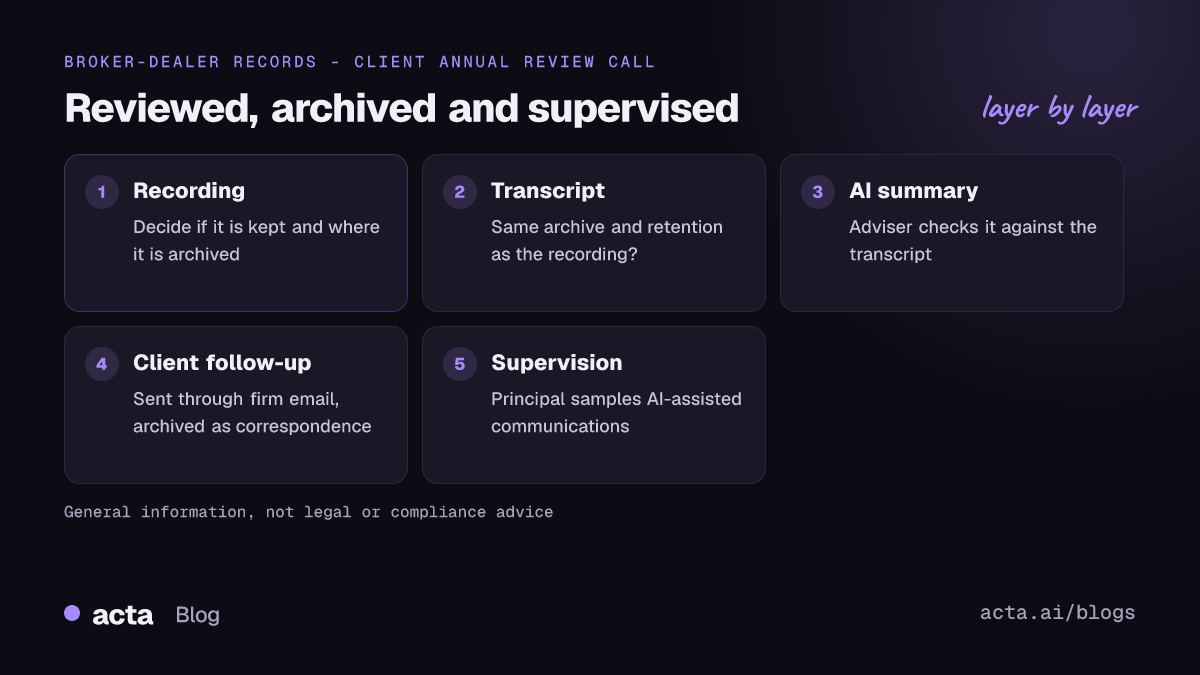
A single AI-recorded meeting can produce several different things. Sort them before deciding what to keep. The table below lists the questions to settle for each; it isn't a ruling on how any rule applies.
| Artifact | Questions to settle with compliance |
|---|---|
| Audio or video recording | Is it a business communication? Where is it archived, and for how long? |
| Full transcript | Is it a record in its own right, or a copy of the recording? Same retention? |
| AI summary kept internally | Is it an inter-office communication? Who reviews it for accuracy? |
| Follow-up email to the client | Treated as correspondence: reviewed, archived, supervised like any other |
| Notes pushed to the CRM | Is the CRM an approved archive, or a working copy? |
The follow-up email is usually the clearest case. It's a written communication sent to a client relating to the business, so it belongs in your normal correspondence flow. Many firms already have that settled for email; the new risk is a notetaker that sends or shares content from its own system instead of through the firm's mail, where it may never reach the archive.
For the content side, the guide on financial adviser client review notes covers what good meeting notes should capture, and compliance checks for client calls covers flagging promises and missing risk disclosures before anything goes out.
FINRA's AI guidance adds supervision, accuracy and logs
FINRA has kept returning to generative AI. Its 2026 Annual Regulatory Oversight Report section on GenAI repeats that firm use of these tools can touch rules on supervision, communications, recordkeeping and fair dealing. Among the practices it describes for monitoring GenAI use are keeping prompt and output logs, tracking which model version was used and when, and having humans review outputs.
Notice 24-09 also says that firms using these tools should address technology governance in their policies, including model risk management, data privacy and integrity, and the reliability and accuracy of the model. For a notetaker, that translates into a few concrete controls:
- Human review before anything leaves the firm. An AI summary that misstates a client's risk tolerance, or invents a recommendation, becomes a problem the moment it's sent. Require the adviser to read and approve.
- Accuracy checks on what matters. Numbers, product names, risk disclosures and any recommendation should be checked against the transcript, not trusted from the summary.
- Vendor due diligence. Use the same third-party review you'd apply to any vendor handling client data; the AI note taker vendor checklist covers audit reports and AI subprocessors.
- Logs that tie output to a person. Keep a record of who approved each summary or follow-up, when, and what changed.
FINRA has said it may give further guidance or propose rule changes. Until it does, firms are making risk-based judgments, so write yours down.
One client meeting can produce five artifacts
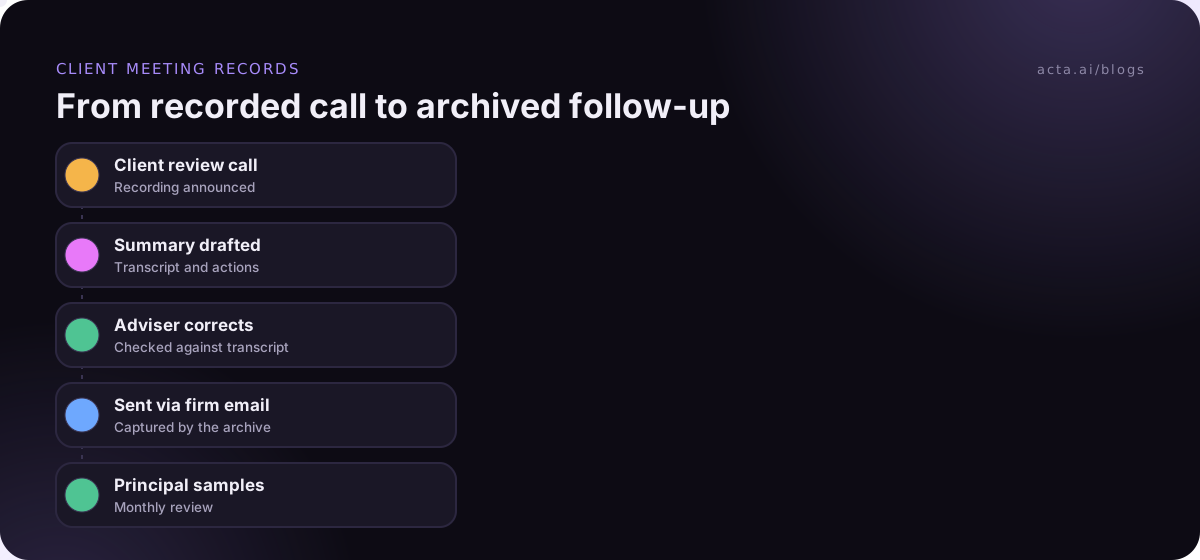
Here's a fictional example to show how this plays out. Priya, a registered representative at a mid-sized broker-dealer, holds a 40-minute annual review with a client over Zoom. The firm has approved an AI notetaker, with a written procedure.
- Before the call: the meeting invite says the call will be recorded and transcribed, and Priya repeats that at the start. Consent rules vary by state and country; see is it legal to record meetings with AI for the general picture.
- After the call: the notetaker produces a recording, a transcript and a summary with action items. All three are captured into the firm's approved archive under the procedure.
- Review: Priya checks the summary against the transcript. The draft says the client "agreed to move 20% into the growth fund"; the transcript shows the client said they'd think about it. She corrects it.
- Follow-up: Priya sends the corrected recap through the firm's email system, so it's archived and subject to the normal correspondence review.
- Supervision: her supervising principal, Marco, reviews a sample of AI-assisted recaps each month as part of the firm's procedures.
The error in the draft is the reason the review step exists. A summary that turned "I'll think about it" into "agreed" would have become a written record that the client hadn't said.
Off-channel cases show the cost of records in the wrong place
The SEC's off-channel communications cases weren't about AI, but they show how regulators react when business communications live outside the firm's systems. In a 2022 action, the SEC charged 15 broker-dealers and one affiliated investment adviser for widespread failures to maintain and preserve electronic communications, including messages sent on personal devices. More actions followed in later years.
The lesson for notetakers is direct. If an AI tool records client meetings and stores transcripts in a place your archive doesn't capture, or lets advisers share summaries from inside the tool, you may have created a new off-channel route without anyone sending a single text message. Map where the data goes before you approve the tool, not after.
Five mistakes firms make when adding an AI notetaker
- Letting advisers pick their own tool. Personal accounts on consumer notetakers put client content outside the firm's archive and supervision.
- Archiving the email but not the source. The follow-up is archived, but the transcript it came from lives only in the vendor's app. Decide explicitly what's kept.
- Auto-sending summaries. Anything sent to a client without review skips the human check FINRA's guidance keeps pointing to.
- Applying a general retention rule. A company-wide "delete recordings after 90 days" setting can conflict with regulatory periods. Regulated meetings need their own rule.
- No written procedure. Supervision under Rule 3110 depends on procedures. Write down how the tool is used, reviewed and archived, and train people on it. An audit trail of who decided what helps when examiners ask.
Where Acta fits
Acta produces the transcript with speaker names, a summary, action items with owners and a follow-up email draft for each meeting, so an adviser has something to review rather than write from scratch. The desktop app records Zoom and Teams calls from the adviser's computer with no bot joining, and the financial services page covers adviser use. Whether and how Acta's output is archived and supervised is your firm's decision under its own procedures; check that before rollout.
Frequently asked questions
Does FINRA require firms to record client meetings?
Generally no; the books and records rules focus on communications and records, not on recording every conversation. But if the firm does record or transcribe a meeting, or sends a written summary, those artifacts may be records the rules cover. Ask compliance how your procedures treat each one before you start recording.
How long must a broker-dealer keep communications?
SEC Rule 17a-4(b)(4) requires broker-dealers to keep communications relating to the business as such for at least three years, the first two in an easily accessible place. FINRA Rule 4511 sets a six-year default for records with no other specified period. Check the current rule texts and your procedures.
Is an AI-generated meeting summary a business record?
It can be. FINRA and SEC rules are technology neutral, so how a document was made doesn't decide the question; what it is and how it's used does. A summary sent to a client is a communication. Regulators haven't issued a notetaker-specific rule, so firms make documented, risk-based decisions.
Do the same rules apply to investment advisers?
Registered investment advisers follow SEC Rule 204-2 rather than FINRA Rule 4511. It covers written communications relating to advice and other listed subjects, generally kept for five years, the first two in an appropriate office. Dual registrants need procedures that satisfy both sets of rules.
What did FINRA Regulatory Notice 24-09 say about AI?
Notice 24-09, from June 2024, reminded firms that FINRA's rules are technology neutral and apply to generative AI, including third-party tools. It pointed to supervision, communications and recordkeeping, and said policies should cover model risk, data privacy and integrity, and the reliability and accuracy of AI output.
Set your firm's FINRA meeting recording rules
Before the first recorded client meeting, settle these points in writing with compliance.
- List the artifacts: recording, transcript, summary, follow-up and CRM notes, with how each is classified.
- Route to the archive: confirm each required artifact reaches an archive that meets your recordkeeping obligations.
- Require review: no AI-drafted content goes to a client without the adviser's approval.
- Supervise: add AI-assisted communications to your sampling and review procedures under Rule 3110.
- Vet the vendor: data flows, subprocessors, retention controls and model training, answered in writing.
If you want to test how reviewed AI notes fit your procedures, try the Acta desktop app on internal meetings first during the 15-day free trial.
Found this useful? Share it with your team.