Greetings, titles and dress set the tone in the first minute
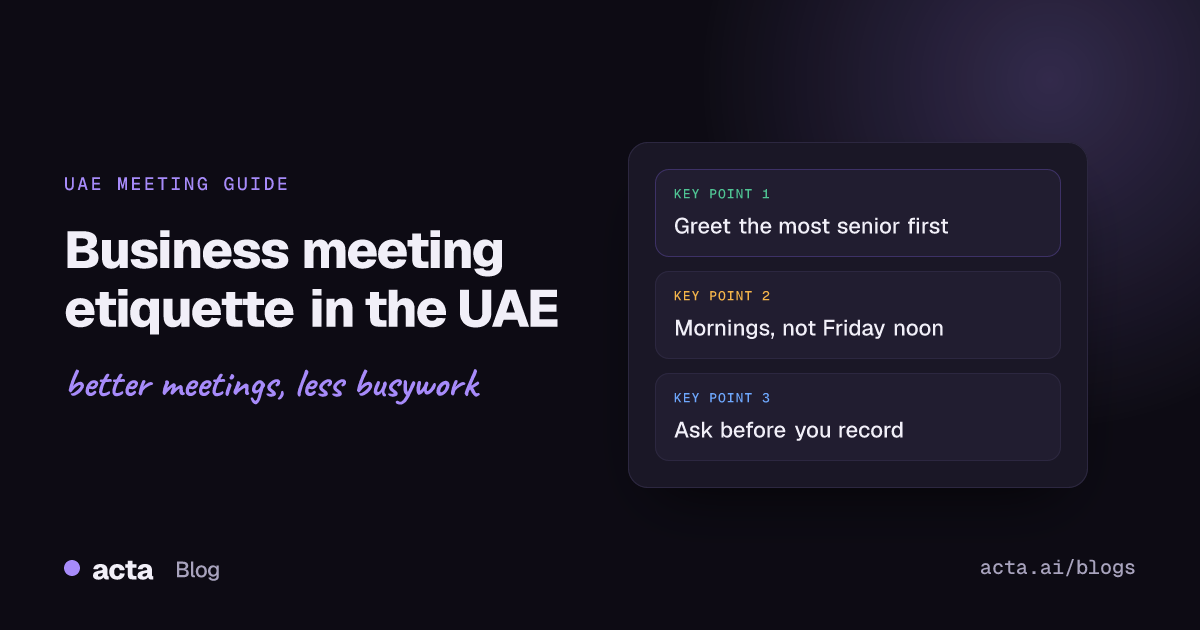
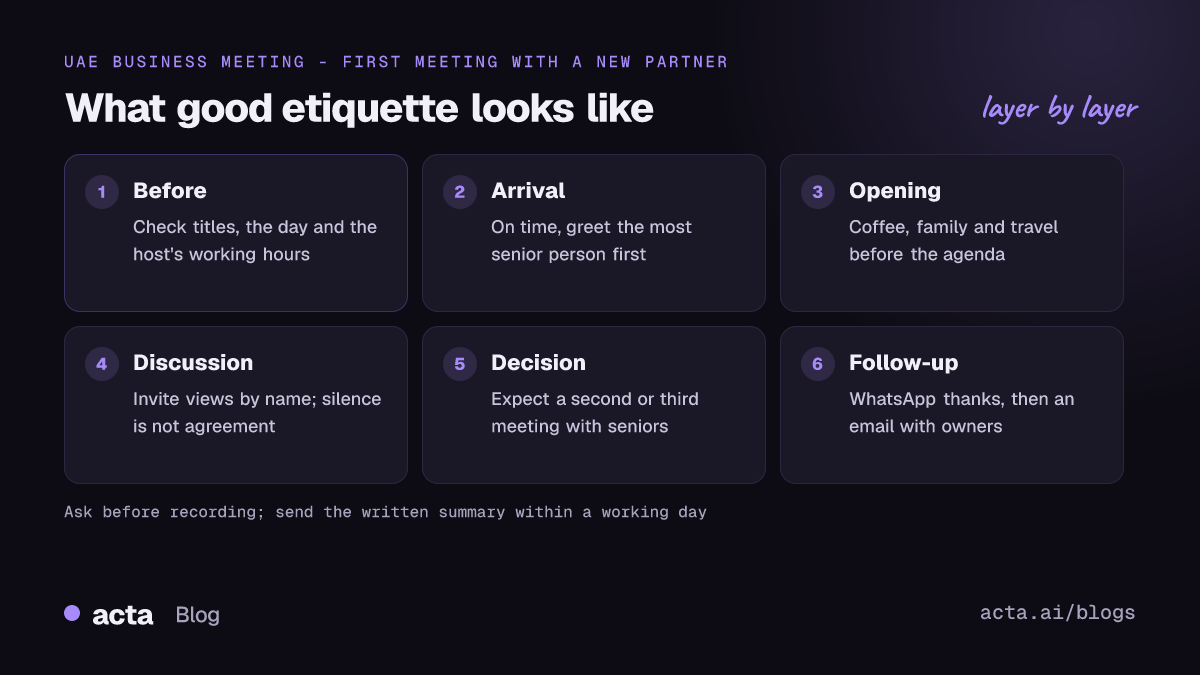
The first minute of a meeting in the UAE is mostly about who greets whom. A safe habit is to greet the most senior person in the room first, then work your way round. If you can't tell who's senior, watch who the host introduces first, or who everyone glances at before answering a question. From a non-Arabic speaker, a simple "As-salamu alaykum" is usually received warmly; "Good morning" is perfectly fine too. Don't force Arabic you're unsure of.
In business etiquette in Dubai and across the UAE, titles carry more weight than many visitors expect. Use Sheikh or Sheikha when someone is introduced that way, Dr for doctors and PhD holders, and Engineer where people use it, which you'll hear often in construction, utilities and government. "Mr Khalid" or "Ms Mariam", title plus first name, is a common and respectful form in UAE offices. Keep the title until you're explicitly invited to drop it. It reads as respect, not stiffness.
Handshakes between men are normal and often softer and longer than a firm European grip. Between a man and a woman, let the woman decide. If she offers her hand, shake it; if she places her hand on her chest, do the same and smile. Nobody is offended by a man who waits, but some people are uncomfortable with one who reaches first. Pass business cards, documents and coffee cups with your right hand.
The dress code for business meetings in Dubai and the other emirates is conservative business wear. For men, that's a suit or at least a jacket for first meetings. For women, clothing that covers the shoulders and knees, without anything sheer or tight. Tech offices can be relaxed, but for a first meeting with a government entity, a bank or a family group, dress one level more formally than you think you need.
Punctuality matters, but relationships set the pace
Arrive on time, or a few minutes early; "traffic on Sheikh Zayed Road" is an excuse people accept once. Don't be thrown if a senior person arrives late, takes a call partway through or brings an unexpected colleague. Their diaries move at short notice, and visible irritation costs you far more than ten minutes.
The opening few minutes of conversation aren't wasted time. They're how your host decides whether they want to work with you. Good topics: how long you've been in the UAE, your trip, a project you've noticed in the city, sport, food, and a general "How is your family?" Avoid politics and religion, and never open with criticism of the country, even as a joke.
Expect a first meeting with a new partner to be about trust, not signatures. A rule I'd give any visiting team: plan for three conversations before a significant decision. The first builds the relationship and explains the idea. The second answers questions, often with more people in the room. The third, or a follow-up video call, is where a yes tends to arrive. If your trip only allows one visit, book the second conversation as a call before you fly home, while the goodwill is fresh.
Many UAE meetings are hybrid, with head office dialling in from London, Mumbai or Riyadh. The basics of hybrid meeting etiquette still apply: one person runs the room, remote people get called on by name, and nobody holds side conversations the call can't hear.
The UAE working week decides when meetings happen
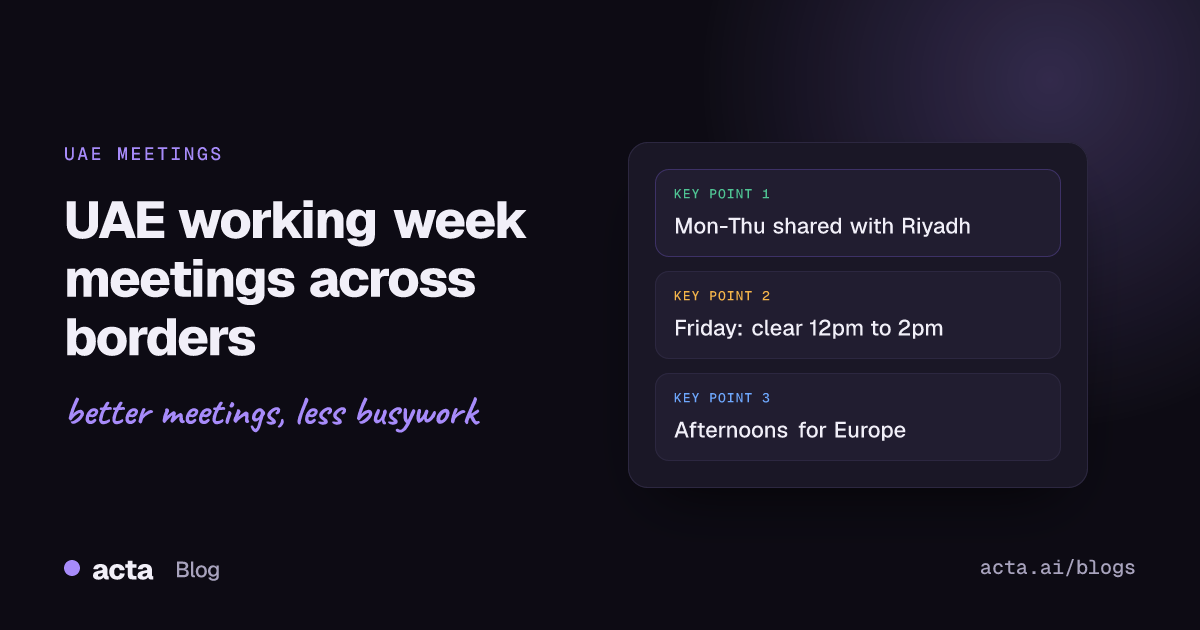
Since 1 January 2022, federal government entities have worked Monday to Friday, with Saturday and Sunday as the weekend. The UAE government portal on public-sector working hours lists federal hours as 7:30am to 3:30pm Monday to Thursday and 7:30am to 12pm on Friday (as of November 2026). Sharjah's government works a four-day week from Monday to Thursday. Private companies set their own hours, so a contractor may start at 7am and a free-zone startup at 9am. Ask rather than assume.
Friday needs the most care. Since 2 January 2026, Friday sermons and prayers in mosques across the UAE start at a unified 12:45pm, as The National reported when the new time took effect. Many colleagues leave the office or the call well before then. A practical rule: nothing important after 11:30am on a Friday, and no Friday afternoon meetings with government entities at all.
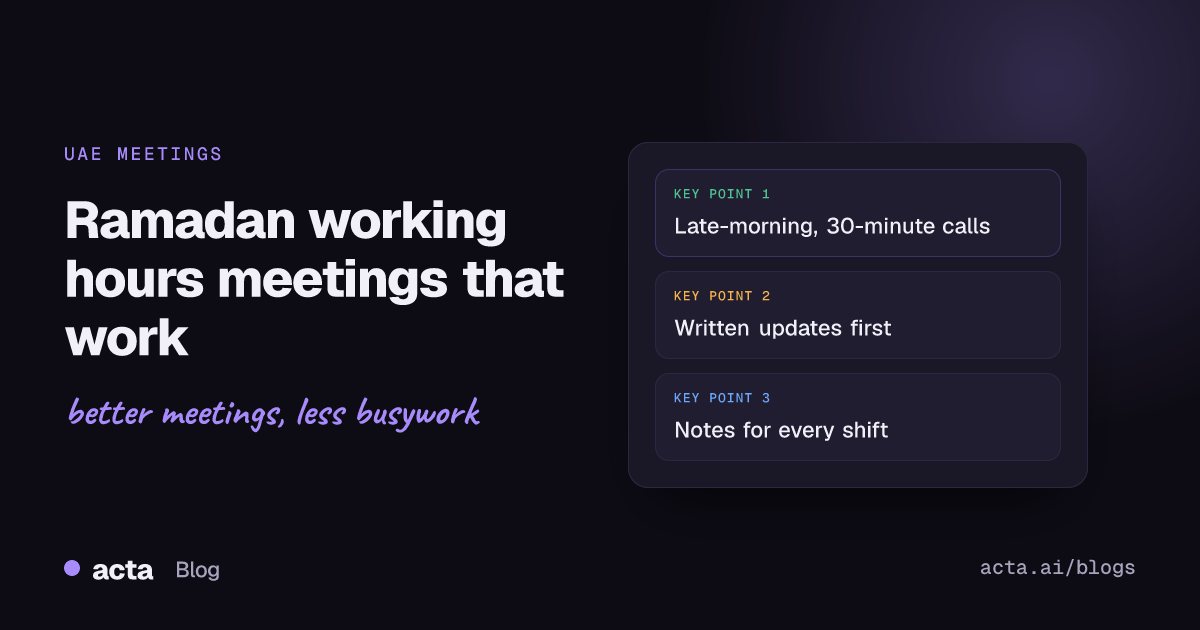
Ramadan changes the rhythm again, and the hours are announced every year. For Ramadan 2026, the Ministry of Human Resources and Emiratisation reduced private-sector working hours by two hours a day, and federal entities received their own announcement. During the holy month, book meetings in the morning, keep them shorter, don't eat or drink in front of colleagues who are fasting, and keep the hour before iftar free. A short "Ramadan Kareem" at the start of a meeting is a kind gesture from anyone.
Majlis meetings put hospitality before business
A majlis is a sitting room or reception space where guests are received and matters are discussed. UNESCO inscribed the majlis on its Representative List of the Intangible Cultural Heritage of Humanity in 2015, nominated jointly by the UAE, Saudi Arabia, Oman and Qatar, describing it as a place where the community gathers to resolve problems, pay condolences and hold wedding receptions. Arabic coffee was inscribed the same year, described by UNESCO as a ceremonial act of generosity.
You'll most likely meet majlis etiquette when visiting a senior Emirati executive or a family-business owner. Some headquarters keep a majlis room for guests, with sofas along the walls instead of a boardroom table.
- Seating: wait to be shown where to sit. Places near the host are for senior guests.
- Coffee and dates: accept with your right hand. When you've had enough coffee, a gentle side-to-side shake of the small cup is the traditional signal; otherwise it will be refilled.
- Posture: avoid pointing the soles of your feet at anyone, and don't stretch your legs out toward the host.
- Phones: keep yours away. Don't photograph the room or the people, and don't record.
- Business: let the host move the conversation to business. Your deck can wait.
A majlis conversation can feel unstructured: people come and go and the topic you came for may barely come up. That's normal. Write down names and any next step as soon as you're back in the car.
Senior decision-makers decide, so plan the route to them
In many UAE organisations, especially government entities, semi-government companies and family groups, final decisions sit with a small number of senior people. The manager you meet every week may be your champion rather than your approver. Ask early and politely: "Who else needs to be comfortable with this before we move ahead?" It's a normal question, and it saves weeks.
Disagreement is often expressed gently. "We will study it" can mean anything from a probable yes to a polite no. "Inshallah" ("God willing") is an everyday phrase used sincerely across the region; it tells you nothing about the timeline, so agree a date separately. Don't press a senior person for a yes or no in front of their team. Follow up privately, usually through your champion, with one specific question.
| Situation | What tends to work | What to avoid |
|---|
| First meeting with a senior executive | Short intro, listen more, leave a one-page summary | A 40-slide deck and a request for a decision |
| Meeting a government entity | Formal email request, agenda in advance, arrive early | Friday afternoon slots, casual dress |
| Family-group owner in a majlis | Hospitality first, let the host lead | Opening a laptop or recording |
| Multinational team meeting | Clear agenda, start on time, written actions | Treating silence as agreement |
| A stalled negotiation | A private call with your champion | Pushing for an answer in front of the room |
Silence in a multicultural room isn't agreement. In a typical Dubai team, with colleagues from India, Pakistan, the Philippines, Egypt, Lebanon and Europe, a junior engineer may not contradict a manager in front of a client. Invite input by name ("Joseph, does that timeline work for the site team?") and ask for written comments after the meeting, when people feel freer to raise a concern.
WhatsApp moves things along, email keeps the record
WhatsApp is how a lot of UAE business actually moves: quick confirmations, location pins, "on my way", a voice note from a site visit. It's fast and personal. The weakness is the record: a decision confirmed with a thumbs-up in a 40-person group is very hard to find three months later.
Use both. Send a short WhatsApp message the same day ("Thank you for your time today, Mr Khalid. I'll email a summary this afternoon."), then an email with decisions, owners and dates. Copy the decision-maker's executive assistant, who often schedules the next step. If the meeting was partly in Arabic, check the spelling of names and titles twice before you send; our Arabic-English meetings playbook has more on bilingual notes.
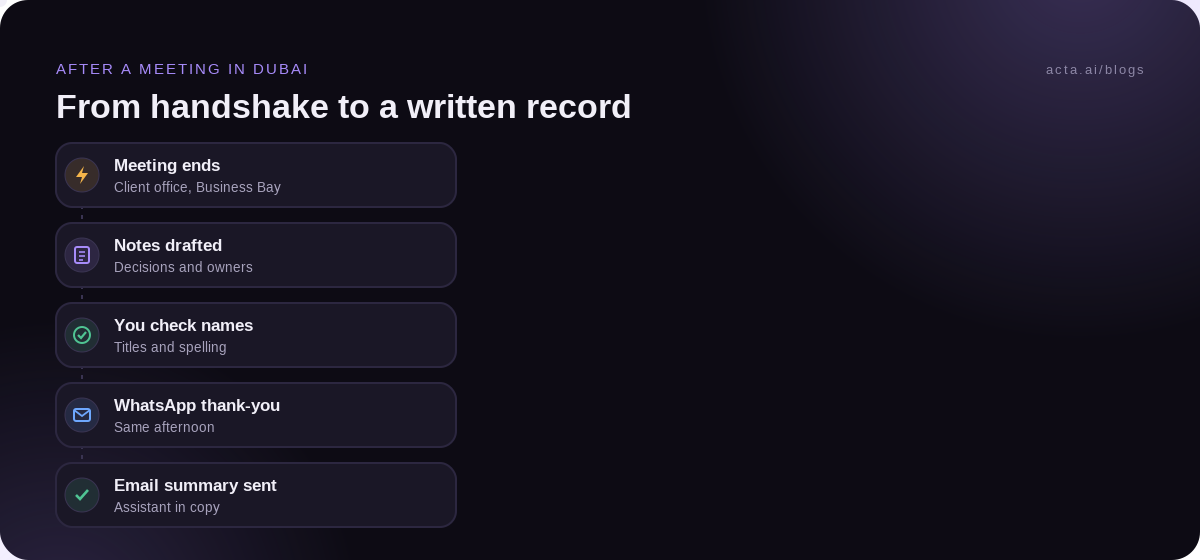
Here's a follow-up email you can adapt. It's short, polite and specific:
Dear Mr Khalid, thank you for receiving us at your office this morning. As discussed: (1) Priya Nair will send the revised quotation by Wednesday; (2) your team will confirm a site visit date with Joseph Mendoza; (3) we'll meet again once you've reviewed the quotation, at a time that suits you. Please let me know if I've missed or misunderstood anything. Kind regards, Sarah Whitfield
The last line invites correction without anyone admitting they disagreed in the room. For a routine, use our checklist on what to do in the first 10 minutes after a meeting, and if you write a lot of these, you can automate meeting follow-up emails so a draft is waiting when you're back at your desk.
Language shapes the follow-up too. Arabic is the UAE's official language, while English is the working language in most private companies, and you'll hear Hindi, Urdu, Malayalam and Tagalog in many offices. If you use a note taker, check what it really supports. Acta handles Arabic in beta (you choose it in Settings; it isn't auto-detected), detects Hindi and Hindi-English mixes automatically, can write notes in English for an Arabic meeting, and doesn't yet support Urdu, Malayalam or Tagalog. The meeting languages page and the language setup guide list all 15.
Ask before you record and say where the notes go
Recording without telling people loses trust quickly in the UAE and can raise legal questions. What follows is general information, not legal advice. The federal personal data law, Federal Decree-Law No. 45 of 2021, came into force on 2 January 2022, and the UAE government's data protection page lists it alongside the other data laws. Free zones such as DIFC and ADGM have their own data protection regimes, which our explainer on UAE PDPL and meeting recording walks through. Commentary on the federal law notes that processing personal data generally needs the person's consent unless an exception applies.
The practical rule is simple. Ask at the start, out loud, and give people a real choice: "Do you mind if I record so I can send accurate notes? It stays within our team." If anyone hesitates, don't record. Never record in a majlis, over a meal or in a corridor conversation. Our guide on whether it's legal to record meetings with AI covers what to tell participants and how to handle a no.
If you record from your own laptop rather than with a visible meeting bot, tell people anyway. Acta's desktop app has a Copy notice button that puts a short recording notice into the meeting chat, and the Chrome extension records Google Meet, Microsoft Teams in the browser and the Zoom web client without a bot joining.
Where Acta fits: it records Zoom, Google Meet and Teams calls, or in-person meetings through the mobile apps, then writes the transcript with speaker names, a summary, decisions, action items with owners and a follow-up email draft you edit before sending. The AI note taker for UAE teams page explains how it works for Arabic and English meetings.
Frequently asked questions
What is the most important business meeting etiquette in the UAE?
The most important habit in UAE business meetings is respect for seniority: greet the most senior person first, use titles until invited not to, and never put a senior person on the spot in front of others. Combine that with punctuality, modest dress and a written summary afterwards, and you'll handle most meetings in Dubai, Abu Dhabi or Sharjah well.
What should I wear to a business meeting in Dubai?
For a business meeting in Dubai or elsewhere in the UAE, wear conservative business clothing: a suit or jacket for men, and for women clothing that covers the shoulders and knees. Tech and creative offices can be more casual, but for government entities, banks and family groups, dress more formally than you think you need, especially at a first meeting.
Can I schedule business meetings on a Friday in the UAE?
You can, but keep them to the morning. Federal government hours end at 12pm on Friday, and Friday prayers in UAE mosques start at 12:45pm (as of November 2026), so many colleagues leave well before then. Avoid Friday afternoons with government entities, and check the host's own hours, since private companies set their own schedules.
Is it OK to follow up on WhatsApp after a meeting in the UAE?
Yes, a short WhatsApp thank-you is common and often welcome in the UAE, particularly once you've exchanged numbers in the meeting. Keep it brief and polite, then send the formal record by email: decisions, owners and dates. WhatsApp is good for speed and warmth; email is better for anything someone may need to find again months later.
Do I need permission to record a business meeting in the UAE?
Ask before recording any meeting in the UAE. It's basic courtesy, and the UAE's federal personal data law generally expects consent for processing personal data unless an exception applies, while DIFC and ADGM have their own rules. This is general information, not legal advice; for a specific situation, speak to a UAE-qualified lawyer.
Use this business meeting etiquette UAE checklist before your next meeting
Before a first meeting with a new partner, client or government entity, run through these five points. They take five minutes and prevent most of the awkward moments newcomers describe.
- Check the day and time: Monday to Thursday is safest; on Friday finish by 11:30am, and in Ramadan book mornings.
- Learn the names and titles: confirm who is most senior, how they're addressed and who their assistant is.
- Dress one level up: conservative business wear, covering shoulders and knees.
- Ask before recording: out loud, at the start, with a real option to say no.
- Send the summary: a WhatsApp thank-you the same day and an email with decisions, owners and dates within one working day.
If you'd like the notes and follow-up draft written for you while you focus on the people in the room, try Acta's desktop app on your next call, with a 15-day free trial on the pricing page.