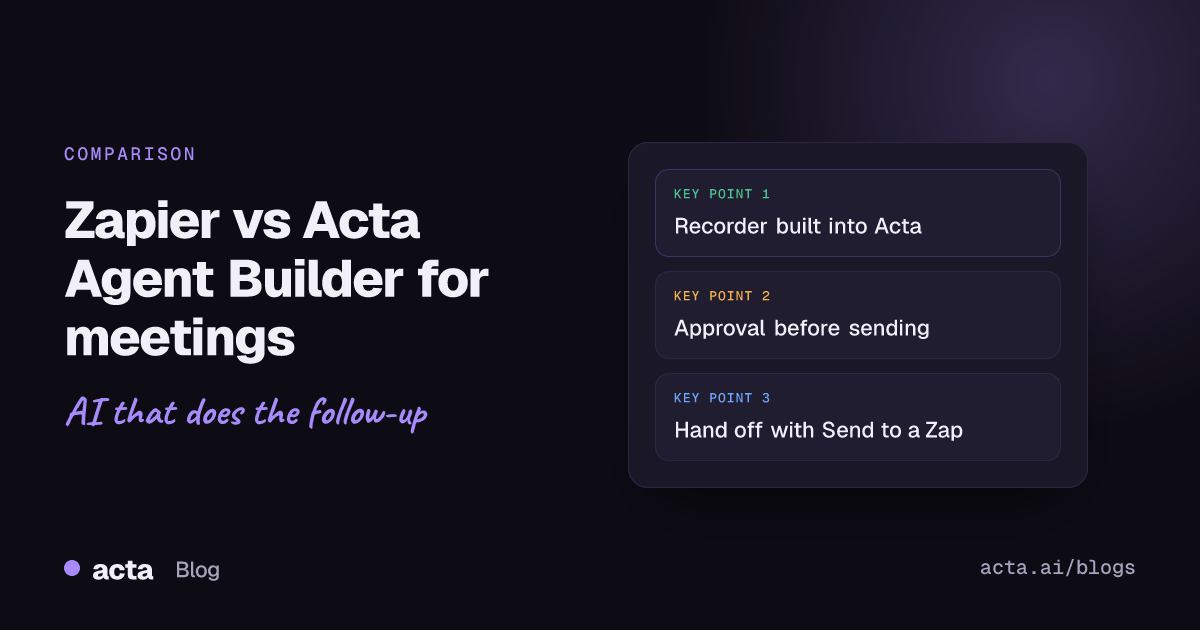
Quick answer: Zapier meeting automation works by connecting a separate recorder such as Fathom, Fireflies or Otter to your other apps, usually with an AI step in between. Acta Agent Builder starts one step earlier: Acta records and summarizes the meeting itself, and an agent acts on the result when the meeting ends. Many teams use both, because Agent Builder can hand data to a Zap.
If you searched for a way to make meetings trigger work in other tools, you have probably found dozens of Zapier templates: Fathom to Slack, Fireflies to monday.com, Circleback to Notion. They work. They also assume you already have a meeting recorder, and that you are comfortable stitching its output to an AI step and then to the apps your team uses.
This guide compares that approach with Acta Agent Builder, a new part of Acta that builds agents on top of your own meeting record. It covers what each tool is good at, where each one falls short, and when you should pick Zapier instead.
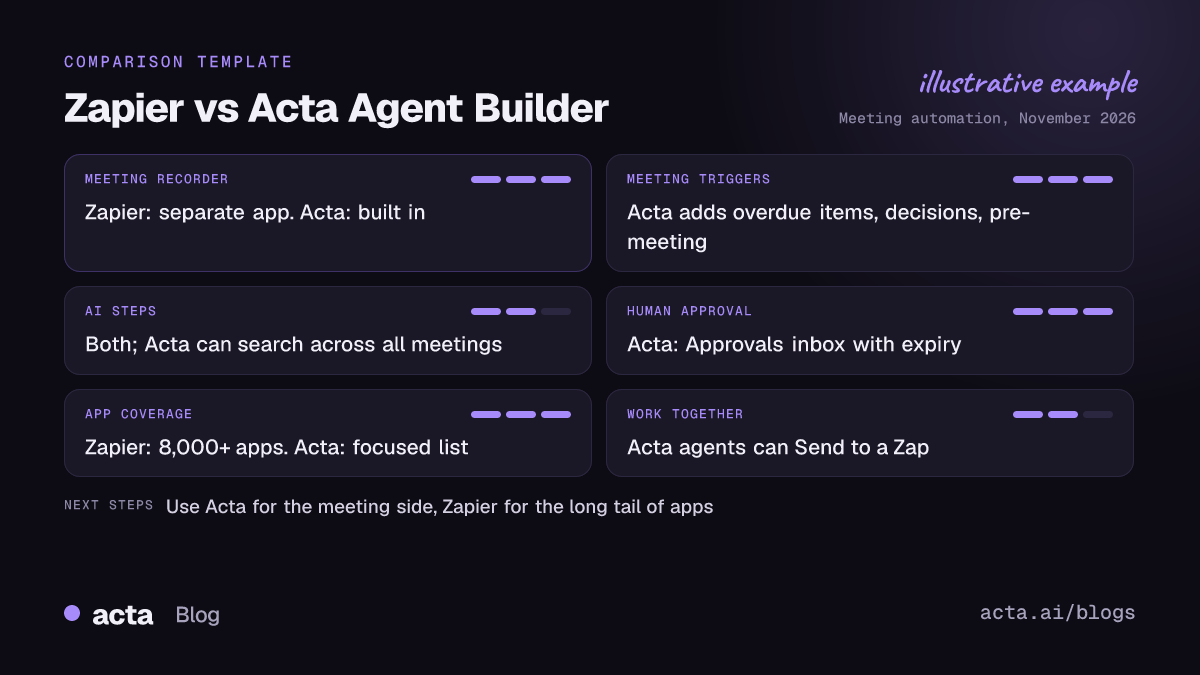
How does Zapier meeting automation work?
A typical Zap for meetings has three parts:
- A trigger from a recorder app. For example, "new meeting summary" in Fathom, Fireflies, Otter, Circleback or Fellow. Zapier does not record the call itself; the recorder does.
- An AI step. A prompt that pulls out decisions, action items, owners or a client name from the notes. Zapier's guide to adding AI by Zapier steps to workflows explains that the AI step returns structured output fields you can map into later steps.
- One or more actions. Post to Slack, create tasks in Asana or monday.com, add a row to Google Sheets, email stakeholders, update a CRM.
Zapier's template library has many ready-made versions. One example is the Fathom AI and Slack meeting notes template, which posts AI summaries to a channel, pulls out decisions, action items and blockers, and can filter by meeting title so 1:1s are skipped.
The strength here is reach. Zapier's help center says there are more than 8,000 apps on Zapier, so if your team uses an unusual project tool or a niche CRM, there is a good chance a connector exists.
What does Zapier cost for meeting workflows?
Zapier prices by tasks: roughly, each action a Zap performs. As of November 2026, the Zapier pricing page lists a Free plan with 100 tasks per month, Professional from $19.99 per month billed annually, Team from $69 per month billed annually, and custom Enterprise pricing. Higher task volumes cost more.
For meeting automation, remember the second bill: the recorder. Zapier is the glue; Fathom, Fireflies, Otter or another note taker is a separate subscription with its own plan limits. When you compare costs, add both together.
How is Acta Agent Builder different?
Acta is a meeting assistant first. It records Zoom, Google Meet and Microsoft Teams through a meeting bot that joins from your calendar, or without a bot through the Acta desktop app for Windows and Mac and the Chrome extension. You can also upload recordings or use the mobile apps for in-person meetings. Acta then produces transcripts with speakers, summaries, action items with owners and due dates, and a decisions log.
Recording people needs their consent where the law requires it. Tell participants, and read our guide on recording consent and what to tell participants before you turn on any automation that depends on recordings.
Acta Agent Builder is new. An agent is one trigger plus a series of steps. You can build from scratch, start from a template, or describe what you want in plain words and let the AI draft it, with a list of things you still need to fill in. Then you run "Check setup", test, and turn it on. Each time you turn it on, a version is saved that you can restore, and History shows what every step did on each run.
The key difference: the meeting data is already inside Acta. You do not connect a recorder, map its output fields or parse a transcript. See the Acta agents page for the team-specific agents built on the same record.
Triggers built around meetings
- Meeting ended: fires when the summary is ready, with an optional "title contains" filter.
- Before a meeting starts: 1 to 1,440 minutes before, with the attendee list.
- New action item and Action item overdue.
- Decision made and Decision changed or reversed.
- Meeting template result ready: for example when a MEDDPICC deal report or PRD draft is generated.
There are also general triggers: run manually, on a schedule, webhook received, form submitted, called by another agent, another agent finished, and events in connected apps such as Gmail, Slack, Google Calendar, Google Sheets, Jira, Asana, HubSpot, Zendesk, Freshdesk and RSS (checked about every 5 minutes).
Steps that read your meeting record
The Acta data step can search meetings, list meetings by title, person or date, pull open, overdue or done action items, read decisions, or fetch a meeting template's result such as a BANT report, Project status or 1:1 check-in. An AI step writes, summarizes, sorts or extracts fields. An AI agent step goes further and picks its own tools, such as meeting search, action items, decisions, web search, Jira search, app actions or MCP tools. Text that comes back from tools is treated as data, not as instructions.
Logic steps include If/else, Switch, Merge, For each (up to 100 items), Wait (up to 30 days), Run another agent, Memory and Edit values.
A human approval step
This is where Agent Builder is most different from a plain Zap. An approval step pauses the run in an Approvals inbox. The reviewer can edit the text, then approve or reject, optionally from an email with Approve and Reject buttons. If nobody answers before it expires (24 hours by default, up to 7 days), nothing is sent. That matters for customer follow-ups, where one wrong sentence can cost more than the time the automation saves.
Zapier meeting automation vs Agent Builder: side by side
- Where the meeting data comes from: Zapier needs a separate recorder app. Agent Builder uses meetings Acta already recorded and summarized.
- Meeting-specific triggers: Zapier offers whatever the recorder app exposes, often "new summary" or "new transcript". Agent Builder adds overdue action items, decision changes, pre-meeting triggers and template results.
- Cross-meeting context: In Zapier you usually work with one meeting at a time. Agent Builder's data and AI agent steps can look across all your meetings, decisions and open action items.
- App coverage: Zapier wins clearly, with thousands of apps. Agent Builder has a focused list: Slack, Gmail, Google Calendar, Google Sheets, Jira, Asana, HubSpot, Salesforce, Zoho, Zendesk, Freshdesk, webhooks, HTTP requests and MCP tools.
- Review before sending: Agent Builder has a built-in approval step with an inbox and expiry. In Zapier you would need to design your own review flow.
- Testing: Agent Builder test runs show what would be sent without sending it, let you test one step, send a test to your own Slack channel or email, and use a sample event from a connected app.
What can Acta Agent Builder do after a meeting?
Here are a few agents that fit the "Meeting ended" pattern, with the actions Agent Builder supports today:
- Customer follow-up with review: Meeting ended (title contains "Demo") → AI step drafts a follow-up email from the summary and action items → approval step → Gmail sends to up to 20 recipients, or saves a draft (where available). For more patterns, see how to automate meeting follow-up emails.
- Engineering tickets: Meeting template result ready (Ticket suggestions) → For each suggestion → Jira creates an issue → Slack posts the list to the team channel.
- CRM notes: Meeting ended → Acta data step fetches the MEDDPICC deal report → HubSpot, Salesforce or Zoho adds a note to the contact matched by email. Our guide to syncing meeting action items to Jira, HubSpot and Salesforce covers the setup choices.
- Overdue nudges: Action item overdue → Slack message to the owner, with the meeting and due date.
- Pre-meeting brief: Before a meeting starts (30 minutes) → AI agent step searches past meetings with the same attendees → Slack message with open promises and recent decisions.
If all you want is meeting notes in Slack, you may not need an agent at all. Acta's Slack integration (separate from Agent Builder) can post Summary, Decisions, Action items or Key takeaways to a channel automatically, with an optional title filter and an "Open in Acta" button.
Can Acta and Zapier work together?
Yes, and for many teams this is the best answer. Agent Builder has a "Send to a Zap" action. An agent can do the meeting-aware part (wait for the summary, read decisions, draft text, get approval) and then pass the result to a Zap that reaches an app Acta does not connect to.
A common split looks like this:
- Acta records the meeting and produces the summary and action items.
- An Acta agent filters for the meetings that matter, extracts fields with an AI step and pauses for approval.
- "Send to a Zap" hands the approved JSON to Zapier.
- The Zap writes to the tool your team already depends on, from a niche CRM to an internal database.
Agent Builder also has a generic Webhook action (JSON, optionally signed), an HTTP request step and an MCP tool step that can call any MCP server, for example Notion, Linear or GitHub. Between those and Zapier, most destinations are covered.
What Agent Builder does not do (yet)
To be clear about the limits:
- No Microsoft Teams chat, Google Chat or Outlook email actions.
- No Pipedrive connection.
- No built-in Notion action; Notion works only through an MCP tool step.
- No posting to social media. The "Drafts to copy" step makes LinkedIn, X, blog, newsletter, Instagram or Facebook drafts but never posts them.
- No code step yet; it is planned for later.
If any of these is central to your workflow, either route that part through "Send to a Zap" or use Zapier for the whole flow.
Who should pick Zapier instead?
Zapier is the better choice if:
- You are happy with your current recorder. If your team already uses Fathom, Fireflies or Otter and likes it, Zapier templates connect it to the rest of your stack without changing how you record.
- Meetings are a small part of your automation. If most of your Zaps are about forms, billing, marketing or ops, keeping everything in one Zapier account is simpler.
- You need an app Acta does not connect to, such as Outlook, Teams chat or Pipedrive, as the main destination.
- Your team already knows Zapier well and has an admin who maintains Zaps.
Acta Agent Builder makes more sense if meetings are where the work starts: sales calls, customer check-ins, product reviews, hiring loops. You get the recording, summary, action items, decisions and the agent in one place, with approvals before anything reaches a customer. And if you also use Make or n8n, our comparisons of Agent Builder and n8n for meeting workflows and Agent Builder and Make for meeting follow-up cover the same questions for those tools.
How to try a meeting agent in Acta
- Connect your calendar so Acta can record Zoom, Meet or Teams calls, or install the desktop app for bot-free recording.
- Open Agent Builder and describe the agent in plain words, for example "after every customer call, draft a follow-up email and wait for my approval".
- Fill in the items the draft lists as missing, such as which Slack channel or which Gmail account.
- Run "Check setup", then a test run. Nothing is sent in a test run.
- Turn it on. Check History after the first few real meetings.
Agent Builder is available in Acta; see Acta plans for what each plan includes.
Frequently asked questions
Does Zapier record meetings?
No. Zapier meeting automation relies on a recorder or note-taker app, such as Fathom, Fireflies or Otter, to capture the meeting and send its summary or transcript into a Zap.
Is Acta Agent Builder a Zapier alternative for meetings?
For meeting-driven workflows, yes: it records, summarizes and acts in one tool. For general automation across thousands of apps, Zapier is broader, and Agent Builder can send data to a Zap when you need that reach.
Can I send meeting notes to Slack without building an agent?
Yes. Acta's Slack integration posts the summary, decisions, action items or key takeaways to a channel after each meeting, with an optional title filter.
Can an agent send emails without me checking them?
It can, but you can add a human approval step so the run pauses until someone approves or edits the text. If nobody responds before it expires, nothing is sent.
Do Zapier AI steps cost extra?
Zapier counts work in tasks, and AI steps use tasks from your plan. Check the Zapier pricing page for how your plan counts them.
Want to see a meeting agent on your own calls? Start a free 15-day Acta trial.