Use Cases 5 min read
Compliance Check for Client Calls: Flags for Promises and Missing Risks
How Acta checks recorded client calls for guarantees, missing risk disclosures, misleading statements and pressure tactics, with exact quotes and ratings for review.
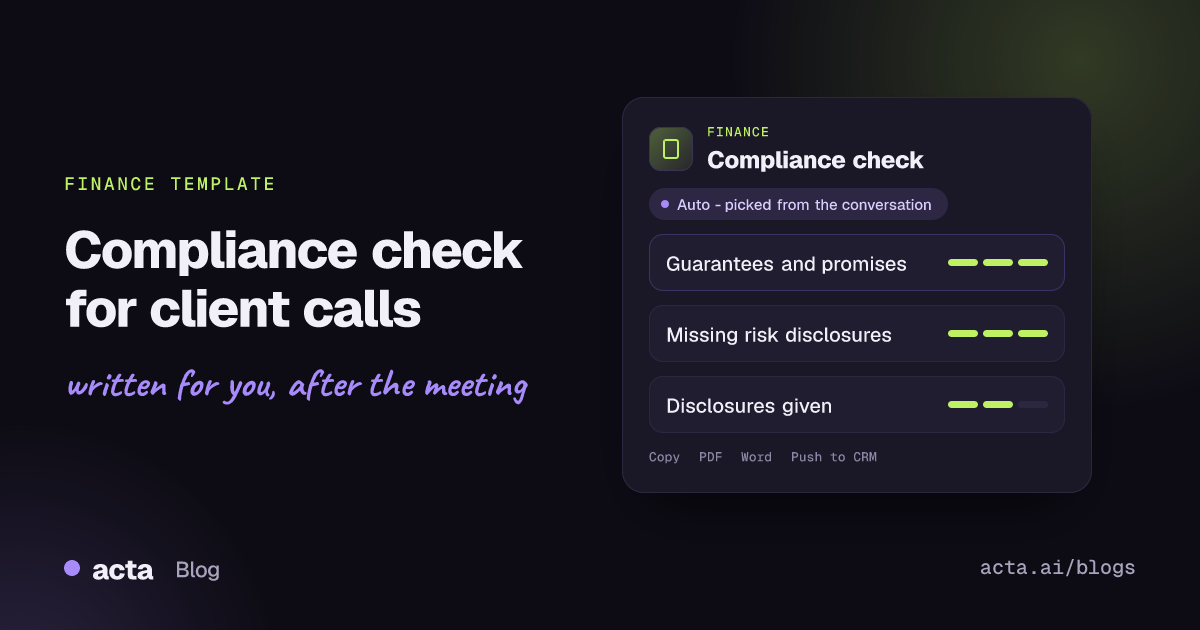
Quick answer: A compliance check for client calls reviews a recorded conversation between an adviser and a client and flags statements a compliance team should look at: guarantees, missing risk disclosures, misleading statements and pressure tactics. Acta quotes the exact words, rates each flag high, medium or low, explains why, and lists the disclosures that were given. Each flag is a prompt for review, not a finding that a rule was broken.
Firms that advise clients on investments, insurance or lending spend a lot of effort reviewing written communications. Spoken conversations are harder. A compliance officer cannot listen to every call, so supervision usually relies on sampling, adviser attestations and complaints after the fact.
Yet many of the riskiest moments happen out loud: "you can't lose money on this", a risk warning that never gets mentioned, a push to sign before Friday. Acta's compliance check template reads each recorded client call and surfaces those moments so reviewers can spend their time on the calls that need it.
What is a compliance check on a client call?
A compliance check is a review of a client interaction against the conduct standards a firm has to meet. The specific rules depend on the jurisdiction, the product and the firm's own policies, but the core expectations are similar across most regulators: communications should be fair and balanced, should not promise outcomes, should explain material risks, and should not pressure clients into decisions.
In the US, for example, FINRA Rule 2210 on communications with the public requires broker-dealer communications to be fair and balanced, prohibits false, exaggerated, unwarranted or promissory statements, and generally prohibits projections of investment performance. That rule applies to written communications, but firms commonly hold spoken client conversations to the same spirit through their supervisory procedures.
A typical review looks for four kinds of problem:
- Guarantees and promises: assurances of returns, safety of capital or outcomes nobody can guarantee.
- Missing risk disclosures: benefits described without the matching risks, fees or limitations.
- Misleading statements: claims that overstate performance, misdescribe a product or leave out material facts.
- Pressure tactics: artificial urgency, discouraging the client from taking time or advice, or dismissing concerns.
What does Acta's compliance check report include?
The template reads the call transcript and writes three parts:
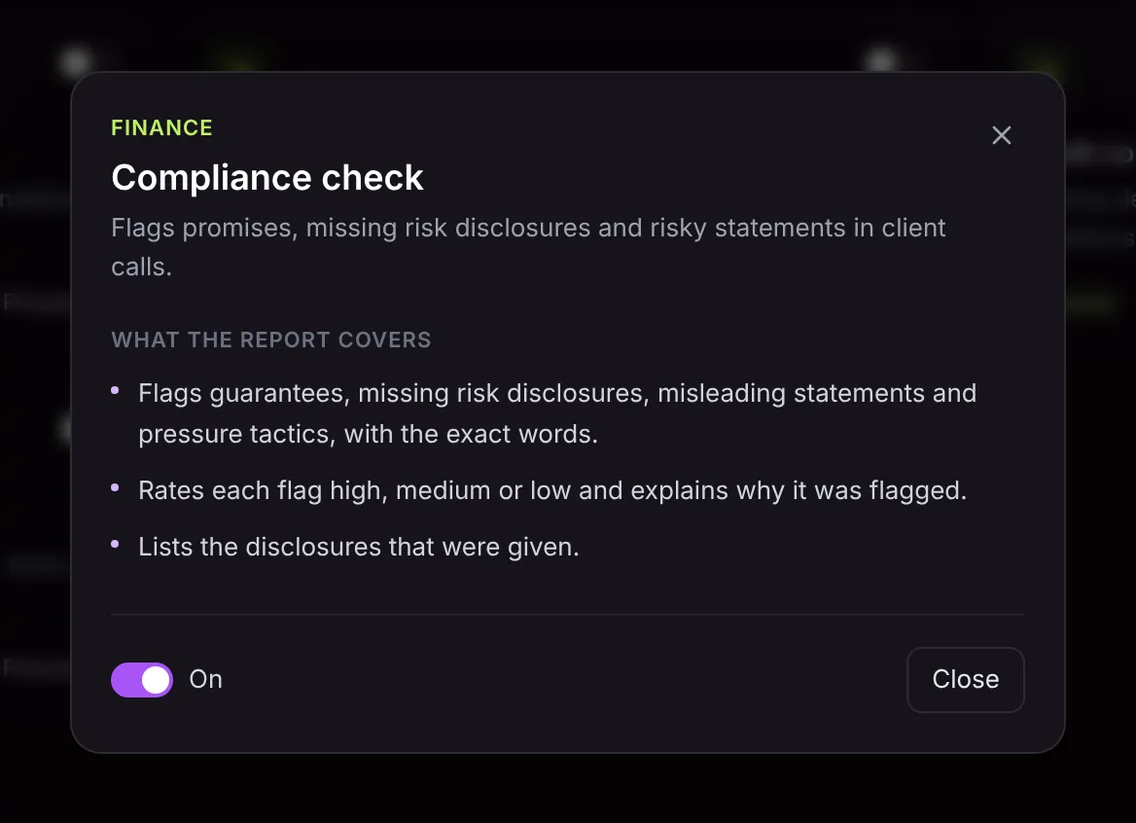
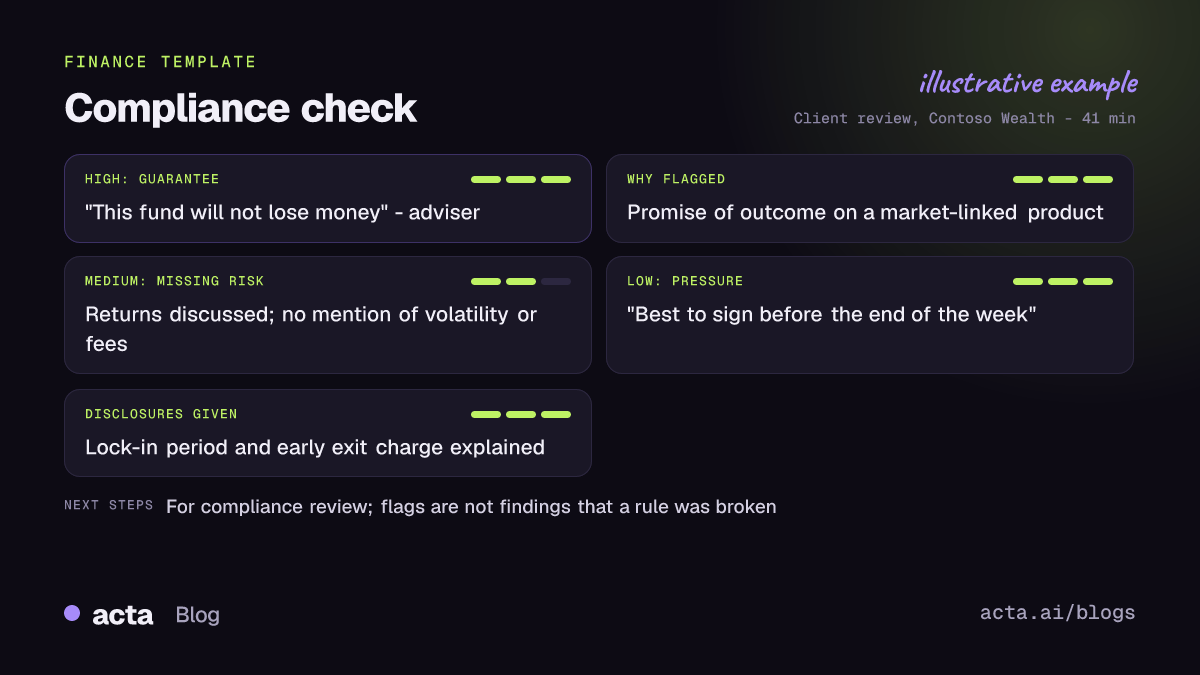
- Flags with the exact words: each guarantee, missing risk disclosure, misleading statement or pressure tactic, quoted as it was said, so the reviewer sees the evidence rather than a paraphrase.
- A rating and a reason for each flag: high, medium or low, with a short explanation of why it was flagged, so reviewers can triage.
- Disclosures given: the risk warnings, fee explanations and other disclosures the adviser did make, which matters as much as what was missed.
The template's notice is central to how it should be used. Flags are for compliance review; a flag is not a finding that a rule was broken. Context matters: an adviser might quote a guarantee that genuinely applies to an insured product, or give a risk disclosure in a document sent before the call. A trained reviewer decides. The report also only contains what was said in the recorded meeting.
Here is the template in Acta's Templates page, with the preview of what the report covers:
And an illustrative example of a finished report:
Why is it useful, and who is it for?
It is designed for compliance officers, supervising principals, branch managers and advisers who want to check their own calls. Some realistic uses:
- Prioritizing reviews. Instead of sampling calls at random, a reviewer starts with the calls carrying high flags.
- Self-review. An adviser reads the check after a client meeting and sends a follow-up with the risk disclosure they forgot to mention.
- Training. Supervisors use anonymized flags to show new advisers what promissory language sounds like in practice.
- Complaint handling. If a client later says they were promised a return, the list of disclosures given and the exact quotes help the firm look into what happened.
How does Acta pick the compliance check automatically?
Acta reads each recorded conversation and picks a template that fits, even if you have not turned it on. For the compliance check, the signals are an adviser and a client discussing products, returns, risk, fees and decisions to invest, buy or switch. The report is labelled "Auto", and Acta says why it chose it, for example that the call involved a product recommendation and a discussion of expected returns. "Turn on for future meetings" keeps it on with one click.
The relevance check stops it running where it does not belong. If the template is on and you record an internal team meeting about office moves, it is listed under "Not relevant" with the reason, rather than producing a report with no client in it.

How do you use it?
- Record the client call in line with your firm's recording and consent policies. Acta records Zoom, Google Meet and Microsoft Teams through a meeting bot, or without a bot through the desktop app, the Chrome extension or the mobile apps. Uploaded recordings work too.
- Turn on the template. On Acta's Templates page, find compliance check in the Finance group, preview it and toggle it on, or let Acta pick it.
- Open the Templates tab of the meeting to see the flags, ratings and disclosures next to the transcript, so you can read each quote in context.
- Route it. Copy the report into your review workflow, or download it as PDF, Word or Markdown for the file.

You can also use OneChat to ask questions across all your meetings, for example which calls this month mentioned a particular product.
Related finance templates
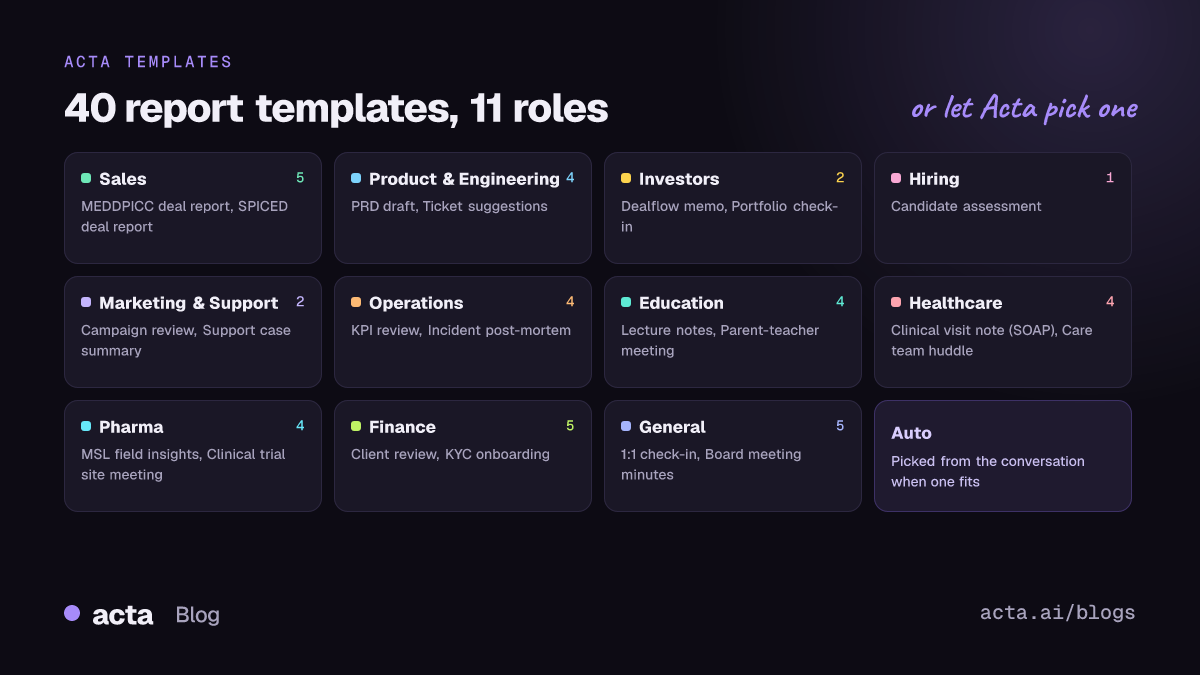
The compliance check pairs well with financial adviser client review notes, which capture goals and recommendations from the same call, and KYC onboarding call notes for new clients. More on Acta for financial services.
Frequently asked questions
Does a flag mean the adviser broke a rule?
No. A flag marks something for compliance review, not a finding that a rule was broken. A qualified reviewer decides with full context.
What does the high, medium or low rating mean?
It is a triage signal based on how serious the statement could be, with a short reason for each flag, so reviewers can look at the most important items first.
Does it check disclosures sent in writing?
No. The report only covers what was said in the recorded call. It lists the spoken disclosures; documents sent separately need to be checked in your usual way.
Which rules does it check against?
It looks for common conduct risks: guarantees, missing risk disclosures, misleading statements and pressure tactics. It does not apply a specific rulebook, so your compliance team interprets each flag under the rules that apply to your firm.
To try it on your own client calls, start a free 15-day trial.


