Business 21 min read
Why AI Meeting Notes Aren’t Enough for Enterprise Teams
AI meeting notes have quickly become part of the modern enterprise workflow. Across sales calls, customer success check-ins, executive reviews, product discussions, and internal operating meetings, teams use transcription and summarization tools to reduce manual note-taking and preserve what was said.
For busy leaders and distributed teams, that is a meaningful improvement. No one wants to rely on memory, scattered documents, or a rushed recap after a critical customer call.
But for enterprise organizations, documentation is only the first step.
The real problem is not just remembering the conversation. The real problem is ensuring that decisions are captured, owners are assigned, risks are surfaced, and follow-ups actually happen. Enterprise teams do not simply need AI meeting notes. They need a reliable way to turn meeting notes into accountable actions.
That distinction matters because conversations are where business momentum is created—or lost. A CEO may align the leadership team on a strategic priority. A sales leader may hear a buyer signal that could accelerate a deal. A customer success manager may receive an early warning about churn risk. An operations team may agree on process changes that affect multiple departments.
If those moments stay buried in a transcript or summary, the organization still has an execution gap.
That is why AI meeting notes for enterprise teams must evolve beyond passive documentation. A basic recap can tell you what happened. But it often cannot tell you what changed, who is responsible, what risk emerged, which commitment was made, or what needs to happen next.
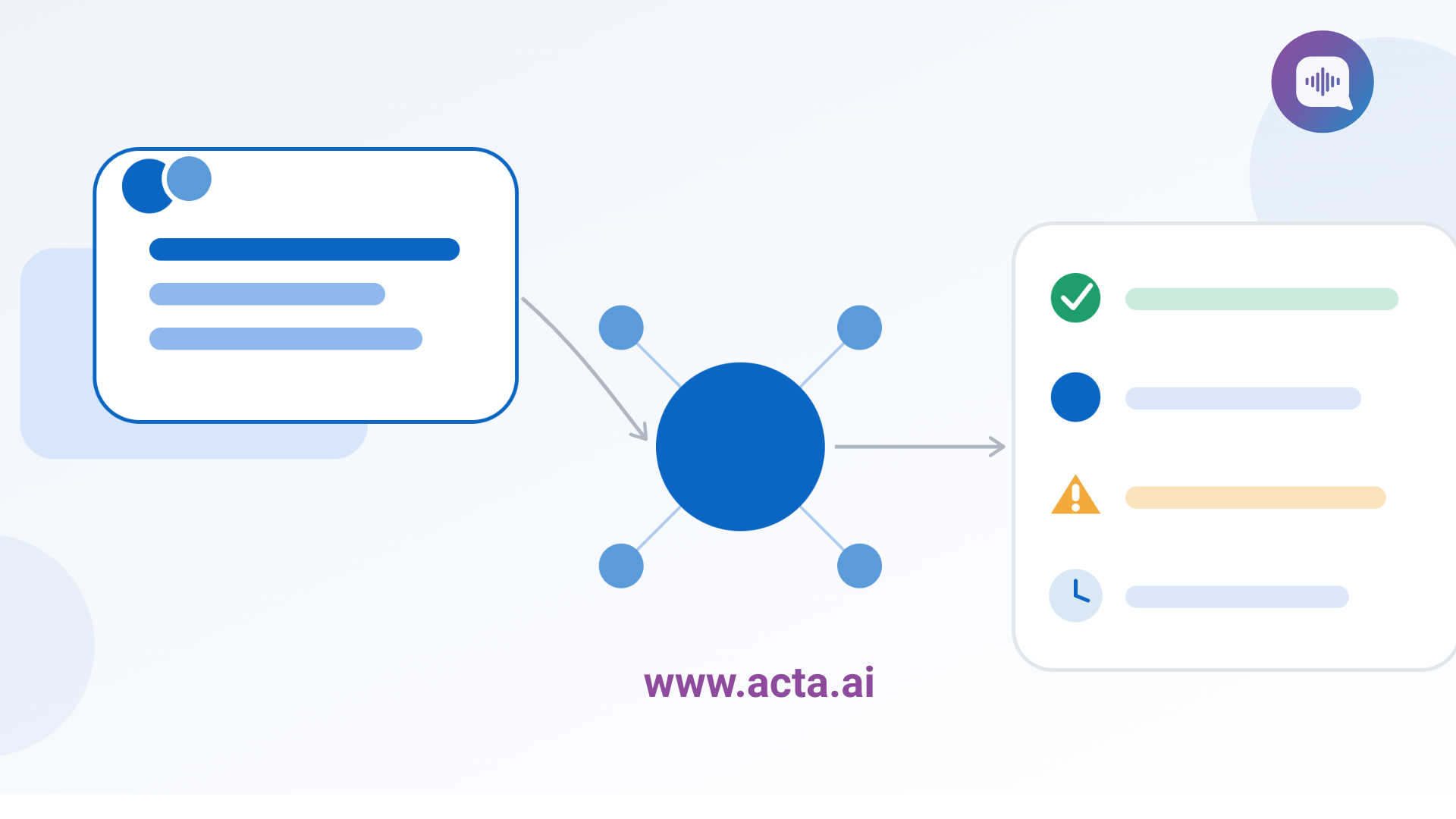
Acta.ai is built around this reality. Rather than acting only as a note-taking layer, Acta.ai functions as a conversation intelligence platform for business meetings. It helps teams convert meetings, customer calls, and internal discussions into structured, trackable business outcomes by identifying decisions, owners, risks, commitments, and follow-ups—not just recording words.
For CEOs, COOs, Chiefs of Staff, sales leaders, customer success leaders, and operations teams, the value of AI is not simply cleaner notes. The value is organizational accountability at scale.
The Enterprise Meeting Problem: Too Much Talk, Not Enough Accountability
Enterprise organizations run on conversations.
Strategy is shaped in leadership meetings. Revenue moves forward on sales calls. Retention depends on customer success conversations. Operational improvements emerge from cross-functional discussions.
Yet despite the importance of these meetings, many teams face the same recurring problem: too much is discussed, but not enough becomes accountable action.
The issue is rarely a lack of effort. Most teams are busy, engaged, and well-intentioned. The problem is that enterprise conversations produce a high volume of information, and much of it is difficult to manage after the meeting ends.
A decision might be made in minute thirty-seven of a leadership call. A customer may mention a renewal concern during a routine check-in. A sales prospect might commit to a next step after raising an objection that requires internal follow-up.
Without a system for capturing and structuring those moments, they can easily disappear.
Traditional meeting notes often make this worse. Even when notes are thorough, they can become long, unstructured records that require someone to reread and interpret them. Transcripts provide even more detail, but they are often too dense for busy leaders to review.
As a result:
Decisions get buried in transcripts.
Ownership remains unclear.
Follow-ups are missed.
Risk signals go unnoticed.
Leaders lack visibility across teams.
For enterprise teams, unclear ownership is especially costly. A meeting may end with everyone believing the next step is understood, but no one explicitly owns it. Or multiple people may assume someone else is responsible.
This creates execution drift: the conversation felt productive, but the business outcome never materialized.
Over time, these gaps delay projects, weaken customer trust, reduce forecast confidence, and create frustration across teams.
Another challenge is cross-team visibility. A sales leader may not know that customer success is hearing similar objections from existing accounts. A COO may not see repeated operational blockers discussed in department meetings. A Chief of Staff may struggle to track leadership commitments across multiple recurring forums.
Without a shared intelligence layer, valuable signals remain trapped inside individual meetings.
This is where basic AI meeting notes for enterprise teams fall short. Capturing the conversation is helpful, but enterprise leaders need an AI tool for tracking decisions, owners, and follow-ups. They need a system that clarifies what matters, who is accountable, and what should happen next.
The enterprise meeting problem is not that teams are failing to communicate. It is that communication is not consistently converted into execution.
What AI Meeting Notes and Transcription Tools Actually Do
AI meeting notes and transcription tools became popular because they solve a real problem: people cannot listen, participate, sell, lead, and take perfect notes at the same time.
By automatically recording, transcribing, and summarizing conversations, these tools reduce administrative burden and help teams preserve meeting content. For many organizations, this is a useful step forward.
Most AI meeting note tools include capabilities such as:
Meeting transcription
Speaker identification
Meeting summaries
Keyword highlights
Searchable recordings or transcripts
Basic task extraction
Transcription creates a written record of the conversation. This is especially useful for remote and hybrid teams where meetings happen across time zones and not everyone can attend live.
Speaker identification helps users understand who said what. Summaries condense longer conversations into a shorter recap. Keyword highlights may flag mentions of pricing, renewal, timelines, budget, blockers, competitors, or next steps.
Some AI meeting assistants also offer basic task extraction. For example, if someone says, “I’ll send the proposal by Friday,” the tool may identify that as a task.
These features improve productivity. They reduce the need for manual note-taking, help teams remember details, and create a searchable record of conversations.
But for enterprise organizations, the value of a meeting is rarely limited to documentation.
Many AI meeting notes for enterprise teams remain passive. They tell you what was discussed, but they do not always determine what was decided. They may summarize a conversation, but not distinguish between a casual comment and a business-critical commitment. They may identify a possible task, but not connect it to an owner, timeline, customer risk, deal stage, or operational priority.
That is the difference between an AI note-taking tool and an AI meeting assistant with action tracking.
A note-taking tool helps preserve information. An action-oriented assistant helps move work forward.
For example, a sales call summary might say that pricing was discussed and procurement is involved. That is useful. But a sales leader needs more:
Was a decision made?
Is the deal at risk?
Who owns the procurement follow-up?
What commitment was made to the buyer?
Is there a deadline?
Should this update appear in the CRM or a leadership dashboard?
Similarly, an internal operations meeting summary might capture that a process bottleneck was discussed. But the organization still needs to know who is resolving it, what dependencies exist, and whether the issue affects a broader initiative.
AI meeting notes are helpful for documentation. But documentation alone does not guarantee execution.
Why AI Meeting Notes Fall Short for Enterprise Teams
They Capture Conversations but Don’t Drive Execution
The biggest limitation of AI meeting notes is that they often stop at the moment when enterprise value should begin.
They capture what was said, organize it into a transcript or summary, and leave the burden of interpretation to the team. Someone still has to read the notes, identify what matters, assign owners, update systems, and make sure follow-ups happen.
That creates a gap between information and execution.
A meeting can be well documented and still fail to produce progress. In fact, many enterprise teams already have plenty of documentation. What they lack is a reliable operating layer that turns documentation into accountable work.
To turn meeting notes into accountable actions, teams need more than a recap. They need clarity on what changed as a result of the conversation:
Was a decision made?
Was a customer promised something?
Did an executive commit to a timeline?
Did a blocker emerge?
Did someone accept responsibility for a next step?
These are execution signals, not just note-taking details.
They Miss Business Context
Generic AI summaries often struggle with business context. They may identify that a topic was discussed, but not understand why it matters.
For example, if a customer says, “We are not seeing adoption from the regional teams yet,” a basic summary may record this as an adoption discussion. A business-aware system should recognize it as a potential churn risk, renewal blocker, or customer success priority.
The same problem appears in sales. A prospect may mention budget uncertainty, legal review, or competitor evaluation. A generic note-taking tool may capture those words without connecting them to deal momentum or forecast risk.
In leadership meetings, a decision may relate to a strategic priority, but a basic summary may not distinguish it from routine discussion.
Enterprise teams need an AI tool for tracking decisions, owners, and follow-ups within the context of the business. Without that context, AI notes can create a false sense of confidence. The conversation was captured, but the meaning was not.
They Don’t Create Cross-Team Visibility
Another limitation is that AI meeting notes often remain attached to individual meetings.
The transcript lives in one workspace. The summary is emailed to attendees. The action items may stay in a document or calendar invite. This does not create organizational intelligence.
For enterprise leaders, visibility across conversations is essential:
A COO needs to see operational blockers across functions.
A sales leader needs to identify repeated objections across deals.
A customer success leader needs to detect churn themes across accounts.
A Chief of Staff needs to track leadership commitments across recurring meetings.
If information remains trapped in separate meeting notes, leaders cannot identify patterns, risks, or accountability gaps.
A conversation intelligence platform for business meetings should help teams connect the dots across meetings—not simply archive each conversation separately.
They Don’t Enforce Ownership or Follow-Up
AI meeting notes often fail because they do not enforce ownership.
A task may appear in a summary, but if no one is clearly responsible, it may not get done. Even when an owner is mentioned, there may be no structured workflow for tracking progress, deadlines, or completion.
Enterprise execution depends on knowing who owns what, by when, and why it matters.
Follow-up is not an administrative detail. It is the mechanism through which meetings create business outcomes.
Without ownership, decisions lose momentum. Without visibility, commitments fade. Without tracking, risks escalate unnoticed.
That is why AI notes are not enough. Enterprise teams need systems designed to convert conversation into accountable action.
What Enterprise Teams Really Need: Conversation Intelligence
Enterprise teams do not simply need more notes. They need better intelligence from the conversations already happening across the business.
That is where conversation intelligence becomes essential.
In the context of business meetings, conversation intelligence is the ability to analyze meetings, calls, and discussions to identify meaningful business signals. It goes beyond transcription by understanding what matters inside the conversation, including:
Decisions
Owners
Commitments
Risks
Follow-ups
Customer signals
Internal blockers
Cross-functional dependencies
A conversation intelligence platform for business meetings does not treat every sentence equally. It helps teams separate noise from action.
A casual discussion point is different from a leadership decision. A vague next step is different from a customer commitment. A minor concern is different from a renewal risk.
Enterprise teams need AI that can make those distinctions.
For CEOs, conversation intelligence provides visibility into whether strategic decisions are turning into progress. Executive conversations often include priorities, tradeoffs, and commitments that shape the direction of the company. If those decisions are not captured and tracked, leadership alignment can weaken over time.
For COOs, conversation intelligence helps surface operational blockers. Many execution problems are discussed repeatedly before they are formally escalated. A recurring dependency issue, process gap, or resourcing concern may appear across team meetings long before it shows up in a dashboard.
For Chiefs of Staff, conversation intelligence creates a clearer view of leadership follow-through. Chiefs of Staff often turn executive discussions into operating cadence. They need to know which decisions were made, which commitments are open, and which teams need alignment.
Sales leaders need conversation intelligence to understand buyer intent, objections, next steps, and deal risk. A call summary can be useful, but revenue teams need to know whether the buyer committed to a timeline, whether procurement is blocking progress, and whether an executive sponsor is engaged.
Customer success teams need similar intelligence around customer health. A customer may express dissatisfaction, confusion, low adoption, or concern about value. If those signals are buried in notes, the team may miss an opportunity to prevent churn.
Operations teams benefit by turning internal meetings into structured workflows. Instead of relying on manual recaps, they can use an AI meeting assistant with action tracking to identify owners, deadlines, and dependencies.
The key difference is that conversation intelligence focuses on execution. It helps organizations understand not only what was said, but what needs to happen because of it.
From Passive Notes to Accountable Actions
Decision Tracking
In enterprise environments, decisions are made constantly—but they are not always preserved clearly.
A leadership team may approve a strategic shift. A customer team may agree to adjust an implementation plan. A sales team may decide to involve an executive sponsor.
If those decisions are only captured as part of a long meeting summary, they can become difficult to find later.
Decision tracking ensures that important choices are extracted from conversations and recorded in a structured way. This allows teams to understand:
What was decided
When it was decided
Who participated
What action should follow
Whether the decision affects other teams or priorities
To turn meeting notes into accountable actions, decision tracking is essential. Without it, meetings create ambiguity. People may leave with different interpretations of what was agreed. Structured decision capture creates alignment and helps teams move forward with confidence.
Owner Assignment
Every action item needs an owner.
This may sound simple, but it is one of the most common failure points in enterprise meetings. Teams often discuss next steps without explicitly assigning responsibility. The result is predictable: everyone assumes someone else is handling it.
Owner assignment closes that gap.
When an AI tool for tracking decisions, owners, and follow-ups identifies an action item, it should also help clarify who is responsible. Ownership turns an idea into an obligation. It gives leaders a way to inspect progress and gives team members clarity on expectations.
In complex organizations, ownership is especially important because work often crosses functions. A customer commitment may require input from product, legal, finance, and customer success teams. If no primary owner is assigned, the work can stall between departments.
Follow-Up Visibility
Follow-up visibility prevents commitments from disappearing after the meeting ends.
A customer may be promised an update. A sales prospect may expect a revised proposal. An executive may request a progress report. An operations leader may ask for a process change by the next meeting.
Without visibility, these follow-ups rely on individual memory or scattered task lists. That is not scalable for enterprise teams.
Follow-up tracking allows leaders to see what is open, what is overdue, and what has been completed. It also helps teams prioritize work based on business importance.
An AI meeting assistant with action tracking should make follow-ups visible beyond the meeting attendees. If a commitment affects a customer, revenue forecast, or strategic initiative, the right stakeholders should be able to see it.
Risk and Commitment Detection
Risks and commitments are two of the most valuable signals inside business conversations.
Risks indicate where attention is needed. Commitments indicate where follow-through is required. Both can directly affect customer trust, revenue, and execution.
Risk detection can surface issues such as:
Churn concerns
Deal blockers
Implementation delays
Customer dissatisfaction
Internal dependencies
Resourcing constraints
Missed deadlines
Commitment detection can identify promises made to customers, executives, prospects, or cross-functional teams.
When these signals are captured automatically, organizations can respond faster. Sales teams can protect deals. Customer success teams can intervene before renewal risk grows. Operations teams can resolve blockers earlier. Leadership teams can ensure commitments are not forgotten.
The shift from passive notes to accountable actions is the shift from remembering conversations to operationalizing them.
That is where enterprise value is created.
How Acta.ai Helps Enterprise Teams Turn Conversations Into Execution
Acta.ai is designed for enterprise teams that need more than automated meeting notes.
While transcription and summaries are useful, they do not fully solve the accountability problem. Acta.ai helps organizations convert meetings, customer calls, and internal discussions into structured business action.
At its core, Acta.ai acts as a conversation intelligence platform for business meetings. It identifies the parts of a conversation that matter most for execution:
Decisions
Owners
Risks
Commitments
Follow-ups
Instead of leaving teams with a passive transcript, Acta.ai helps create a clear record of what needs to happen next.
This matters because enterprise teams operate at scale. A sales leader may oversee dozens or hundreds of customer conversations every week. A customer success leader may need visibility into renewal risks across multiple accounts. A COO may need to monitor operational commitments across functions. A Chief of Staff may need to track executive follow-through across leadership meetings.
Manual note review is not realistic in these environments.
Acta.ai helps by creating structure from unstructured conversations. When a meeting ends, the goal is not simply to have a summary. The goal is to know what was decided, who owns each next step, which commitments were made, and whether any risks need attention.
As an AI meeting assistant with action tracking, Acta.ai supports stronger follow-through. When action items are identified and connected to owners, teams are less likely to lose momentum after the meeting. Leaders can inspect open commitments, understand accountability, and intervene when follow-up is at risk.
Acta.ai also helps create visibility across customer calls and internal discussions. This is important because enterprise signals rarely live in one meeting. A customer risk may appear across several conversations. A deal blocker may show up in multiple buyer calls. An operational issue may be discussed in different forums before it becomes visible in reporting.
By turning conversations into structured intelligence, Acta.ai helps leaders see patterns that would otherwise remain hidden.
The business outcomes are practical:
Better follow-through
Faster alignment
Lower operational risk
Improved customer accountability
Stronger leadership visibility
Less time spent manually reviewing notes
More confidence that commitments are being tracked
For enterprise teams, the advantage is not just saving time on notes. It is improving the operating rhythm of the business.
Meetings become a source of reliable action rather than scattered information.
Use Cases Across Enterprise Teams
Executive Leadership
For executive teams, meetings often determine strategic direction.
Leadership discussions include decisions about priorities, investments, risks, hiring, market moves, and operational tradeoffs. Yet these decisions can become difficult to track when they are spread across recurring meetings, offsites, one-on-ones, and cross-functional reviews.
AI meeting notes for enterprise teams are helpful for preserving these conversations, but executive teams need more than records. They need visibility into strategic decisions, leadership commitments, and operational risks.
A conversation intelligence approach helps capture what was agreed, who owns the next step, and what needs to be revisited.
For CEOs and Chiefs of Staff, this creates a clearer operating cadence. Instead of relying on fragmented updates, they can track whether leadership commitments are moving forward and whether strategic priorities are translating into execution.
Sales Teams
Sales conversations are full of signals that affect revenue outcomes.
Buyers mention priorities, objections, competitors, timelines, budget concerns, procurement steps, and decision criteria. A basic meeting summary may capture some of these points, but sales teams need them translated into deal intelligence.
An AI tool for tracking decisions, owners, and follow-ups can help sales teams capture buyer commitments, next steps, objections, and deal risks.
For example, if a prospect asks for a security review, mentions a competing vendor, or commits to bringing in a finance stakeholder, those details should not be buried in a transcript.
Sales leaders can use this intelligence to improve forecasting, coach reps, and ensure follow-through. Reps can spend less time updating notes and more time advancing deals.
Most importantly, buyer commitments and seller promises become easier to track.
Customer Success Teams
Customer success teams depend on strong follow-through.
Customers expect promises to be remembered, concerns to be addressed, and renewal blockers to be resolved. But customer conversations often involve many stakeholders, multiple open issues, and subtle signals of dissatisfaction.
AI meeting notes for enterprise teams can document the call, but customer success leaders need to identify churn risks, customer promises, adoption concerns, renewal blockers, and follow-ups.
If a customer says they are not seeing value, struggling with adoption, or waiting on a promised deliverable, that signal needs to be visible.
Conversation intelligence helps customer success teams act earlier. It allows leaders to see where accounts may need attention and helps CSMs keep commitments organized.
This strengthens customer accountability and reduces the chance that important promises are missed.
Operations Teams
Operations teams are responsible for turning plans into systems, workflows, and outcomes.
Their meetings often include process decisions, cross-functional dependencies, resource constraints, and execution plans. When these details are not tracked clearly, projects slow down.
An AI meeting assistant with action tracking helps operations teams convert internal meetings into clear workflows. It identifies action items, owners, dependencies, and follow-ups so teams can move from discussion to execution.
For COOs and operations leaders, this creates better visibility into where work is stuck. Instead of waiting for issues to escalate, they can see blockers and commitments emerging from daily conversations.
That makes the operating system of the business more transparent and accountable.
Across executive, sales, customer success, and operations teams, the pattern is the same: enterprise conversations create value only when they lead to action.
What to Look for in an AI Meeting Assistant With Action Tracking
Choosing an AI meeting assistant with action tracking requires a different evaluation lens than choosing a simple transcription tool.
For enterprise buyers, the question should not be, “Can this tool summarize meetings?”
The better question is, “Can this platform help our teams execute?”
Here are the capabilities enterprise teams should prioritize.
Action-Item Extraction
The tool should identify next steps from meetings and calls without requiring manual review of the entire transcript.
However, extraction alone is not enough. The system should also connect action items to business context, owners, and follow-up requirements.
Decision and Owner Tracking
Enterprise meetings often include decisions that affect multiple teams.
A strong platform should preserve those decisions clearly and associate them with responsible owners where appropriate. This helps prevent ambiguity and creates a record teams can reference later.
Risk Detection
Risk detection is essential for both customer-facing and internal teams.
In customer conversations, risk may appear as dissatisfaction, delayed adoption, pricing concerns, procurement friction, or lack of stakeholder alignment.
In internal meetings, risk may appear as missed dependencies, resourcing constraints, unclear priorities, or delayed execution.
A conversation intelligence platform for business meetings should surface these signals before they become larger problems.
Workflow and CRM Integrations
Enterprise teams do not want another isolated workspace.
The assistant should fit into existing systems such as CRM platforms, project management tools, communication channels, and workflow systems.
If action items are captured but never reach the systems where teams work, follow-through may still break down.
Searchable Conversation History
Leaders and team members should be able to find past decisions, customer commitments, objections, risks, and follow-ups without digging through folders or recordings.
Searchable conversation history turns meetings into an accessible knowledge base rather than a scattered archive.
Leadership Dashboards and Reporting
Executives and department heads need visibility across many conversations, not just individual meeting summaries.
Dashboards can help surface open commitments, recurring risks, team follow-through, and patterns across customer or internal discussions.
Enterprise-Grade Security
Meeting conversations often include sensitive customer information, financial details, company strategy, personnel issues, and confidential decisions.
Any AI platform used across enterprise meetings should align with the organization’s security, privacy, and compliance expectations.
Ultimately, the best AI meeting assistant is not the one that produces the longest notes. It is the one that helps the organization act on what was discussed.
AI Notes Are the Starting Point — Not the End Goal
AI notes are valuable, but they should be viewed as the starting point rather than the final destination.
Capturing a meeting is useful. Summarizing a discussion saves time. Preserving a transcript creates a reference point.
But none of those outcomes automatically create accountability.
For enterprise teams, the real value comes from turning conversations into structured, trackable business outcomes. A meeting should not end with a document that people may or may not read. It should end with clarity:
What was decided?
Who owns the next step?
What commitments were made?
What risks emerged?
What needs to happen next?
This is the distinction between documentation and execution.
Documentation helps teams remember. Execution helps teams move.
AI meeting notes for enterprise teams provide a helpful layer of memory. They reduce the chance that details are forgotten and make it easier to revisit conversations. But if the notes do not create ownership, follow-up visibility, or risk awareness, they still leave teams with manual work.
Someone must interpret the notes, assign tasks, update systems, and monitor progress.
That manual handoff is where accountability often breaks down. A customer commitment may be noted but not tracked. A leadership decision may be summarized but not operationalized. A risk may be mentioned but not escalated. A follow-up may be captured but not assigned.
The organization technically has the information, but it does not have a reliable execution process.
To turn meeting notes into accountable actions, enterprise teams need AI that understands conversations as business events. Every meeting has the potential to create decisions, obligations, risks, and opportunities.
This is where Acta.ai differs from basic note-taking tools. Acta.ai is designed as a platform for accountability, not just transcription. It helps teams structure the output of meetings so leaders and operators can see what needs attention.
Instead of leaving insights trapped in transcripts, Acta.ai helps convert them into actions that can be tracked.
The evolution of AI in meetings is moving in this direction. The first wave focused on recording and summarizing. The next wave is about intelligence, accountability, and execution.
For enterprise companies, that evolution is necessary because meetings are too important to remain passive records.
AI notes help capture the past. Conversation intelligence helps shape what happens next.
Conclusion
AI meeting notes and transcription tools have earned their place in enterprise workflows. They reduce manual note-taking, create searchable records, and help teams remember what happened in meetings and calls.
But useful does not mean sufficient.
Enterprise teams need more than captured conversations. They need decisions identified, owners assigned, risks surfaced, commitments tracked, and follow-ups completed. They need visibility across customer calls, leadership discussions, sales conversations, and internal operating meetings.
Most importantly, they need a way to convert discussion into execution.
That is why conversation intelligence is the next evolution beyond transcription. A conversation intelligence platform for business meetings helps organizations understand not only what was said, but what needs to happen because of it.
For CEOs, COOs, Chiefs of Staff, sales leaders, customer success leaders, and operations teams, this shift can improve follow-through, alignment, customer accountability, and operational visibility.
Acta.ai is built for this new standard. As an AI tool for tracking decisions, owners, and follow-ups, Acta.ai helps enterprise teams turn meetings, customer calls, and internal discussions into accountable actions.
If your organization already uses AI notes, the next question is whether those notes are helping work get done.
Explore how Acta.ai helps enterprise teams move beyond transcription and build a more accountable operating rhythm from every conversation.