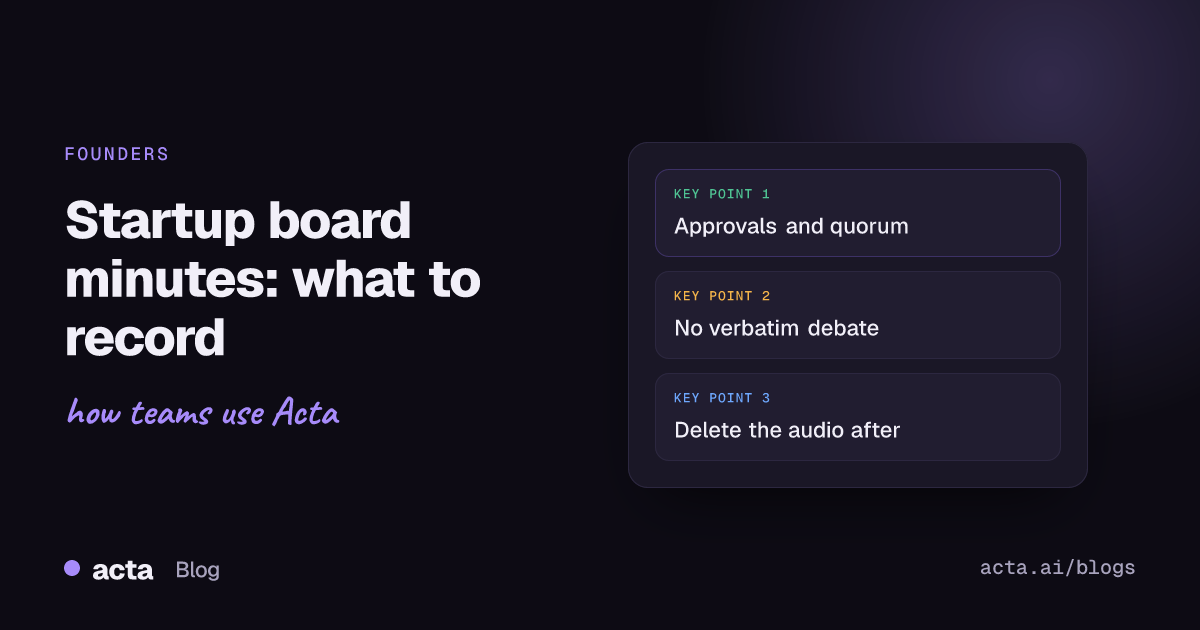
Quick answer: Startup board meeting minutes should record who attended, whether there was a quorum, every approval with the materials the board relied on, conflicts and recusals, and a short note that the board discussed each item. Leave out verbatim debate, the substance of legal advice and executive session talk. Treat any audio as a drafting aid you delete once the minutes are approved.
At a seed-stage company the first board meetings feel informal. Three people, one of them your lead investor, talking through the numbers over video. Somebody types a few notes. It's easy to treat the minutes as admin. Then a Series A lawyer asks for the minute book during diligence, or a departing co-founder starts asking questions, and those few notes become the official record of what the board knew and approved.
This post is about what a startup's board minutes should actually say, what they should leave out, and whether recording the meeting helps or hurts. It's general information, not legal advice. Your company counsel should set the house style, and most will happily review your first few sets of minutes.
Why do startup board meeting minutes matter so much?
Because they're the evidence. If the board approved an option grant, a financing, a new bank account or the CEO's raise, the minutes (or a signed written consent) are how anyone proves it later. Investors in your next round will read them, and your current investors are already keeping their own notes, as our post on portfolio check-in notes shows. Acquirers will read them. If there's ever a dispute, a judge might.
For Delaware companies, and plenty of US venture-backed startups are incorporated there, stockholders have a statutory right to inspect certain books and records. The 2025 amendments to Section 220 of the Delaware General Corporation Law spelled out what that includes, and board and committee minutes and the materials the board acted on are in the list. Goodwin's alert on what counts as books and records under the amended Section 220 is a clear summary. The practical point: write every set of minutes as if a skeptical stockholder will read it one day, because one might.
What should startup board meeting minutes include?
Here's what I'd expect to see in every set:
- The basics. Date, time, how the meeting was held (video counts), who chaired, who took minutes.
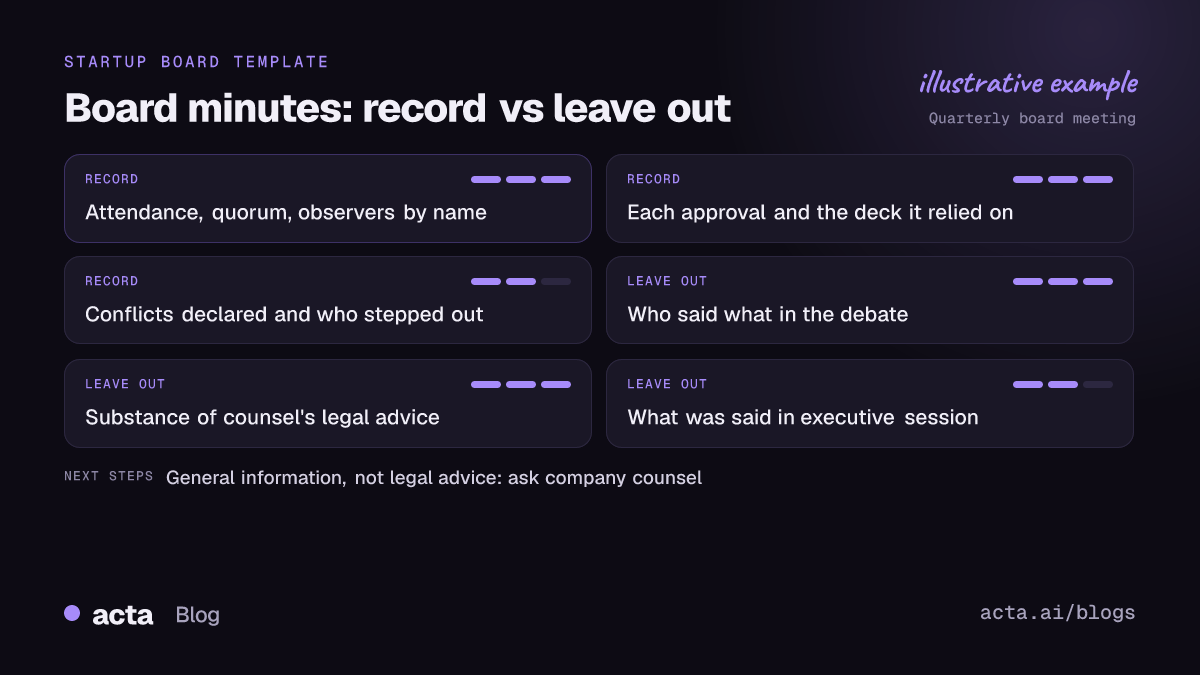
- Attendance and quorum. Each director present, plus observers and guests by name and role. Note when anyone joins late or leaves early, especially if it affects quorum for a vote.
- Each approval, precisely. The resolution, who moved it if your board works that way, and the result. For option grants, the grant list should be attached or referenced, and the minutes should note the valuation the board relied on for the exercise price, usually the latest 409A report.
- What the board reviewed. "The board reviewed the Q3 financials and the 2027 operating plan presented by the CFO." Attach or reference the deck. The minutes should show the board was informed before it acted. The same basics apply to nonprofit board minutes.
- That discussion happened. A sentence like "Following discussion, including questions from the directors about hiring timing and runway" shows deliberation without quoting anyone.
- Conflicts and recusals. If a director has an interest in a deal, say so, and record that they left the room or didn't vote.
- Executive session, as a fact. "The board met in executive session without management present." That's usually all.
For a deeper template on resolutions and vote wording, our post on board meeting minutes from the recording covers the format in detail, and your boardroom needs its own black box makes the case for keeping a decision record between meetings.
Approvals startups commonly forget to minute
- Option grants made between meetings that someone promised a new hire on a call
- Approving the 409A valuation itself
- Opening bank accounts and naming who can sign
- Executive compensation changes, including the founders' own
- Ratifying something management already did without approval
The last one is more common than anyone admits. Ratification is fine. Pretending it didn't need approval isn't.
What should you leave out of board minutes?
This is where founders get it wrong in the other direction. Long minutes feel thorough. They're often worse.
- Verbatim debate. "Director A said the plan was unrealistic; Director B disagreed" is the kind of line that gets quoted back years later out of context. Record that the board discussed it, and what it decided.
- The substance of legal advice. If counsel walks the board through litigation risk, the minutes should say that counsel gave legal advice on the matter, not what the advice was. The ABA's Business Law Today has a good list of tips for managing privilege in the boardroom, including marking clearly when legal advice was given versus business discussion.
- Executive session content. The point of an executive session is candour without management in the room. If you minute what was said, the candour goes.
- Jokes, speculation, side comments. Obvious, but people type what they hear.
- Personal opinions of the minute-taker. The minutes say what happened, not how the CFO felt about it.
Directors & Boards puts it well in its piece on board minute best practices: minutes are a record of the board's process and decisions, not a transcript.
Should you record startup board meetings?
This is the "what to record and what not to" question in its literal sense, and my honest view is: record only if you have a clear reason and a deletion rule.
The case for it: the person taking minutes is often the CEO or a busy founder who's also presenting. A recording lets them pay attention and write accurate minutes afterward. It also helps capture exact resolution wording and who voted.
The case against: a recording or a full transcript is far more detailed than minutes, and it's the kind of thing a court or an opposing party can ask for. We cover the wider question in recording sensitive HR, legal and board calls. A Cahill alert summarised on Columbia's CLS Blue Sky Blog, on AI note takers in corporate meetings, goes through the privilege, discovery and governance questions they raise. A verbatim transcript undoes most of the careful drafting choices in the previous section.
If you do record, a sensible rule set:
- Tell every director and attendee at the start, and note it in the minutes. Recording consent rules apply here too; see our guide on whether it's legal to record meetings with AI.
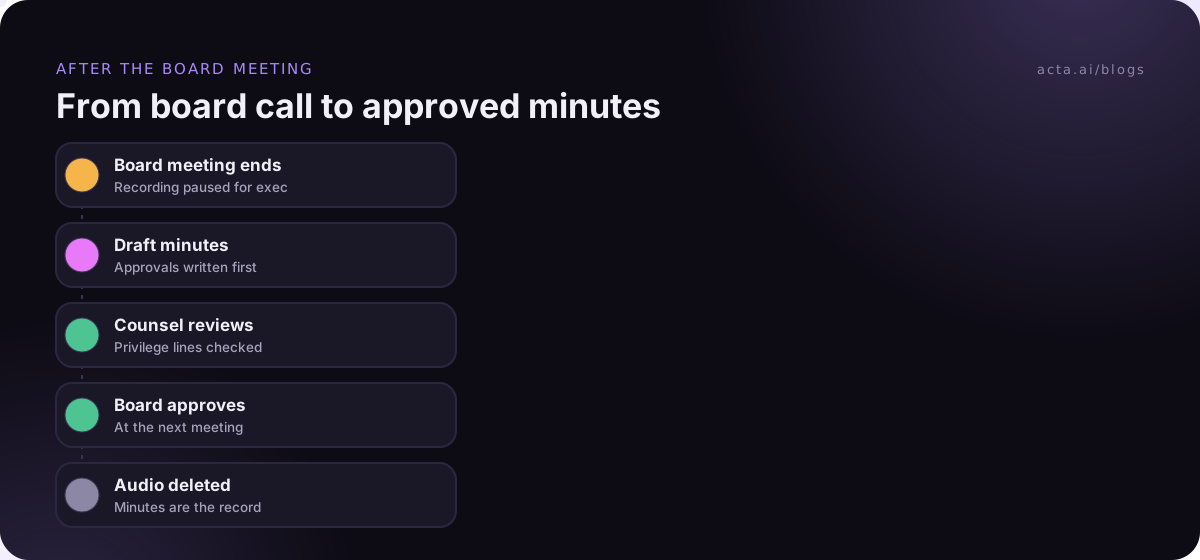
- Stop recording for executive session and for legal advice. Say so out loud, so the transcript shows the break.
- Use the transcript only to draft the minutes. Don't circulate it.
- Delete the audio and transcript once the minutes are approved, unless counsel tells you to keep them, for example because of a legal hold.
- Keep it out of shared workspaces. Board recordings shouldn't sit in a folder the whole company can browse.
If your directors aren't comfortable with a bot joining, a desktop recorder on the minute-taker's computer can capture the call without adding a participant. Bot-free still means telling everyone.
How do you turn a meeting into approved minutes?
- Draft within two or three days. Memory fades fast, and so does everyone's patience for reviewing minutes from five weeks ago.
- Write approvals first. Get the resolutions exactly right before you write any narrative.
- Send to counsel for a quick check, at least for the first year and for any meeting with a financing, a dispute or a conflict.
- Circulate the draft to directors with a deadline for comments.
- Approve at the next meeting or by written consent, and store the signed version in the minute book with the materials.
- Delete working copies, including any recording, once the final is in place.
Our post on building a meeting audit trail has more on linking decisions back to the meeting where they happened.
Written consents vs board meetings
Many startup approvals happen by unanimous written consent instead of at a meeting, particularly routine option grants. That's normal and fine, as long as your bylaws allow it and every director signs. The risk is that the company ends up with a pile of consents and no minutes showing the board ever discussed strategy, financials or risk. A board that only signs consents can look like a board that wasn't paying attention.
A reasonable mix: routine approvals by consent between meetings, and real meetings with proper startup board meeting minutes for anything that involves judgment.
A note on Acta
Acta can record a meeting with a bot or from your own computer and produces a transcript with speaker names, a summary, decisions and action items, which a minute-taker can use as a first draft. Acta doesn't use customer data to train AI models. For board meetings, you still decide what goes into the minutes and when the recording gets deleted.
Frequently asked questions
Are startup board meeting minutes legally required?
Corporate law generally expects a company to keep minutes of board proceedings, and investors will expect them in diligence. Check your state of incorporation and your bylaws with counsel.
Who should take minutes at a startup board meeting?
Often the company secretary, the CFO, a founder or company counsel. Whoever it is shouldn't be the person presenting most of the agenda, or the minutes suffer.
Can board observers see the minutes?
That depends on the observer's agreement. Observer rights are often limited, and counsel may exclude observers from privileged parts of the meeting and the related minutes.
Should we keep the recording after the minutes are approved?
Usually no. Once the board approves the minutes, those are the record. Keep a recording only if counsel advises it, for example under a legal hold.
How detailed should the discussion section be?
Detailed enough to show the board was informed and deliberated, short enough that nobody's quoted. A sentence or two per agenda item is typical.
If you want to see how a draft comes out of a real meeting, Acta has a 15-day free trial.