Use Cases 6 min read
Portfolio Check-In Notes for Investors, Written From Every Founder Call
How Acta writes a portfolio check-in report from each founder call, covering vitals, technology, hiring, business performance and financing for venture investors.
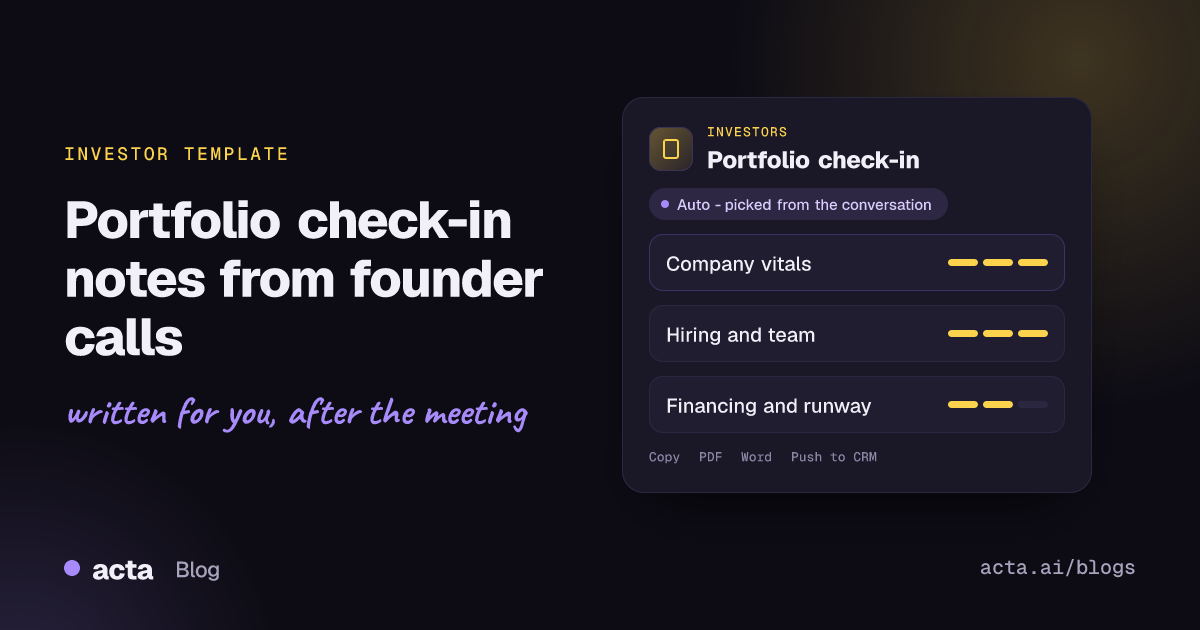
Quick answer: A portfolio check-in report is a structured record of a call between an investor and a portfolio company founder. Acta writes it from the recording, with a short overview up top and drill-down sections on company vitals, technology, hiring, business performance and financing, so partners can see how each company is doing without waiting for the next board pack.
Most venture investors hold far more check-ins than board seats. A partner might speak to a dozen founders a month: a quick call on runway, a catch-up after a key hire, a conversation about a bridge round. Each one produces useful signals, and most of them end up as a few lines in a notebook or nowhere at all.
That matters when the partnership meets to discuss reserves or follow-on decisions. The person who took the call remembers the tone; everyone else needs the facts. Acta's portfolio check-in template turns each call into a consistent record that sits alongside every other conversation with that company.
What is a portfolio check-in?
A portfolio check-in is a regular, usually informal conversation between an investor and the leadership of a company they have backed. It sits between the founder's written investor update and the formal board meeting. Board meetings have agendas, packs and minutes. Check-ins are where founders talk more openly about what is working, what is not, and where they need help.
Post-investment work is a large part of the job. Stanford GSB research on how venture capitalists make decisions, based on a survey of hundreds of VCs, looks at how investors add value to portfolio companies alongside how they source and select deals. Check-ins are one of the main ways that value gets delivered: spotting a hiring gap early, making an introduction, or preparing for a financing conversation before cash gets tight.
A useful check-in note usually covers the same ground each time, which is what makes notes comparable across companies and quarters:
- Cash, burn and runway, and any change in the plan.
- Revenue, growth and the metrics the company reports against.
- Product and technology progress or setbacks.
- Key hires, departures and team gaps.
- Fundraising plans and timing.
- Specific asks for the investor.
What does Acta's portfolio check-in report include?
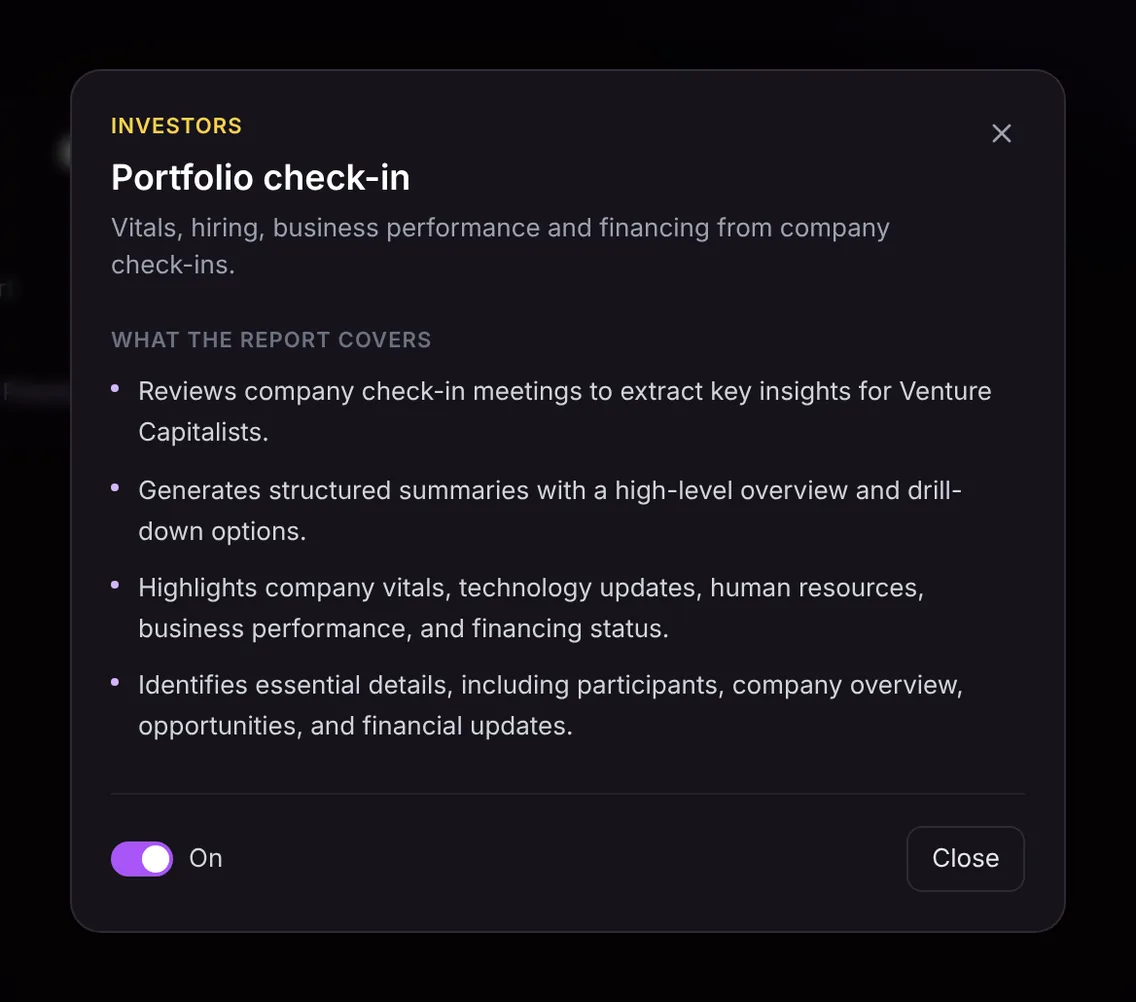
The template reviews a company check-in and organizes it for a venture investor:
- High-level overview: a short summary of where the company stands, with drill-down sections underneath for anyone who wants the detail.
- Participants and company overview: who was on the call and a brief description of the business and its stage.
- Company vitals: the headline numbers and health signals the founder shared.
- Technology updates: product launches, platform changes, technical risks or delays.
- Human resources: hiring, departures, open roles and leadership changes.
- Business performance: revenue, customers, pipeline and how results compare with plan, as described in the call.
- Financing status: runway, upcoming raises, bridge discussions and investor interest.
- Opportunities: introductions, partnerships or support the investor could provide.
Here is the template in Acta's Templates page, with the preview of what the report covers:
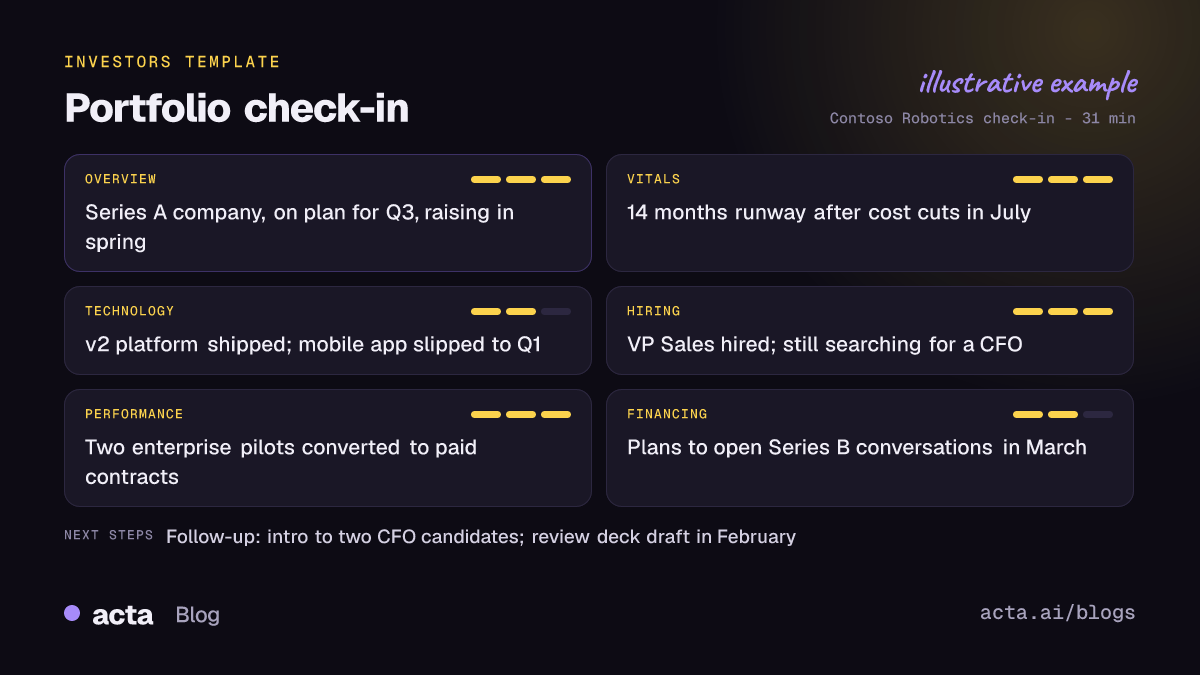
And an illustrative example of a finished report:
Why is it useful, and who is it for?
The template is aimed at partners, principals and platform teams at venture funds, as well as angels who follow a handful of companies closely. Some realistic uses:
- Partner meetings. Instead of a verbal recap, the partner shares a one-page check-in for each company being discussed, with the same sections in the same order.
- Reserve planning. When runway and financing sections are captured every time, it is easier to see which companies are approaching a raise and may need follow-on capital.
- Platform support. A hiring gap in the human resources section can go straight to the talent team, and an intro request can go to whoever owns that relationship.
- Coverage changes. When a partner leaves or a company changes hands internally, the new owner can read a year of check-ins rather than starting from zero.
Because every check-in is recorded, you can also ask OneChat questions across all of them, such as which companies mentioned extending runway last quarter, and get answers with sources. The report only reflects what was said on the call; it does not pull numbers from data rooms or financial statements.
How does Acta pick the portfolio check-in template automatically?
After the meeting, Acta reads the conversation and picks a fitting template even if you have not turned it on. For a portfolio check-in, the signals are an investor asking an existing company about runway and burn, recent hires, product progress, revenue against plan and fundraising timing. The report is labelled "Auto", and Acta explains its choice, for example that the call covered the company's financing status and team changes. One click on "Turn on for future meetings" keeps it on.
The relevance check works the other way. If the template is on and you record a first pitch from a new founder, the check-in report is listed under "Not relevant" with the reason, because there is no existing investment to report on. That conversation is a better fit for the dealflow memo template.

How do you use the portfolio check-in report?
- Record the check-in. Use the meeting bot on Zoom, Google Meet or Microsoft Teams, or record without a bot through the desktop app, the Chrome extension or the mobile apps for calls you take on the move. Uploaded recordings work too.
- Turn on the template. Go to Acta's Templates page, preview the portfolio check-in report and toggle it on, or let Acta pick it when a call fits.
- Open the Templates tab of the meeting. The report appears there next to the summary, transcript, action items and decisions.
- Share it. Copy it into your portfolio tracker, or download it as PDF, Word or Markdown for the partner meeting.

Tips for better check-in notes
- Ask for runway in months and cash on hand in the same breath, so the financing section has both.
- Ask about hires by role and timing, not just "how is hiring going".
- End by asking what the founder needs from you; that becomes the opportunities section and your follow-ups.
- Keep a similar order across calls so reports line up quarter to quarter.
For more on how funds use Acta, see Acta for investors and the article on the time VCs lose to writing memos.
Frequently asked questions
What should a portfolio check-in cover?
Cash and runway, key metrics against plan, product progress, hiring, fundraising plans and specific asks for the investor. Covering the same areas each time makes notes comparable across companies.
Is a check-in the same as a board meeting?
No. A board meeting is a formal governance meeting with minutes, while a check-in is a less formal conversation between an investor and the founder. Acta has a separate board minutes template for formal meetings.
Does the report include numbers the founder did not mention?
No. The report only contains what was said in the meeting. If runway never came up, the financing section will say so rather than guess.
Can I search across all my portfolio check-ins?
Yes. OneChat answers questions across all your recorded meetings and shows the sources it used.
To try it on your next founder call, start a free 15-day trial.


