Business 5 min read
Your Boardroom Needs Its Own Black Box.
A commercial flight logs everything.
Altitude, airspeed, cockpit conversation, every input a pilot makes — all of it recorded, timestamped, and preserved in a box built to survive the worst-case scenario. Not because most flights go wrong. Because when one does, "we're not sure what happened" is not an acceptable answer.
Now think about your last important meeting.
Somewhere in that hour, a real decision got made. A pricing call. A go/no-go on a vendor. A risk someone raised out loud, that everyone nodded at and then moved past. That decision was worth real money, real risk, or real reputation — and the moment the call ended, it started to disappear.
It lives on in a recording nobody will re-watch. A recap email that summarizes tone more than substance. Three or four individual memories, which will each remember it slightly differently by next quarter.
We've normalized this. We shouldn't.
The Hidden Cost of "We'll Remember This"
Every organization runs on a quiet assumption: that the important stuff will stick. That if it really mattered, someone would have written it down properly, or someone would remember when it counts.
In practice, two things go wrong on repeat:
Decisions vanish. What was actually agreed gets buried inside a transcript or recording that exists but is never revisited. It's technically "documented." It's practically unfindable.
Accountability disappears with it. "Who decided what" can't be reconstructed after the fact — and that's precisely the moment it matters most: when there's a dispute, an audit, a handoff, or a regulator asking questions.
Neither of these is a communication failure. They're an infrastructure failure. We built better ways to talk in meetings and never built an equivalent way to remember them.
Meetings Don't Fail. Documentation Does.
The last few years gave us a partial fix: AI-generated meeting notes. Faster transcripts, tidier summaries, less manual note-taking. Genuinely useful — and not enough.
A transcript tells you what was said. It doesn't tell you what was decided, who now owns it, or what happens next. That gap has a name: the difference between "we talked about it" and "we're accountable for it." Automated notes narrowed that gap. They didn't close it.
Two patterns keep showing up wherever this gap exists:
Notes ≠ outcomes. Summaries capture conversation, not conclusions. You can read a beautifully formatted recap and still not know what was actually decided.
Ownership drift. Action items without a clearly named owner have a short half-life. Within days, "someone should probably handle this" quietly becomes "did anyone handle this?"
What a Real Black Box Looks Like
This is the problem Acta.ai was built to solve — not better notes, but a genuine record of enterprise decision-making.
It works the way you'd expect a black box to work: quietly, automatically, and without asking anyone to change how they operate.
It joins your calls. Natively, on Zoom, Google Meet, and Microsoft Teams — no new workflow to learn or adopt.
It records and transcribes in real time, so the accuracy of the record no longer depends on someone's memory, or on whether anyone got around to writing proper notes.
It builds the ledger. Every conversation becomes a searchable, structured decision record — before the details have a chance to slip away.
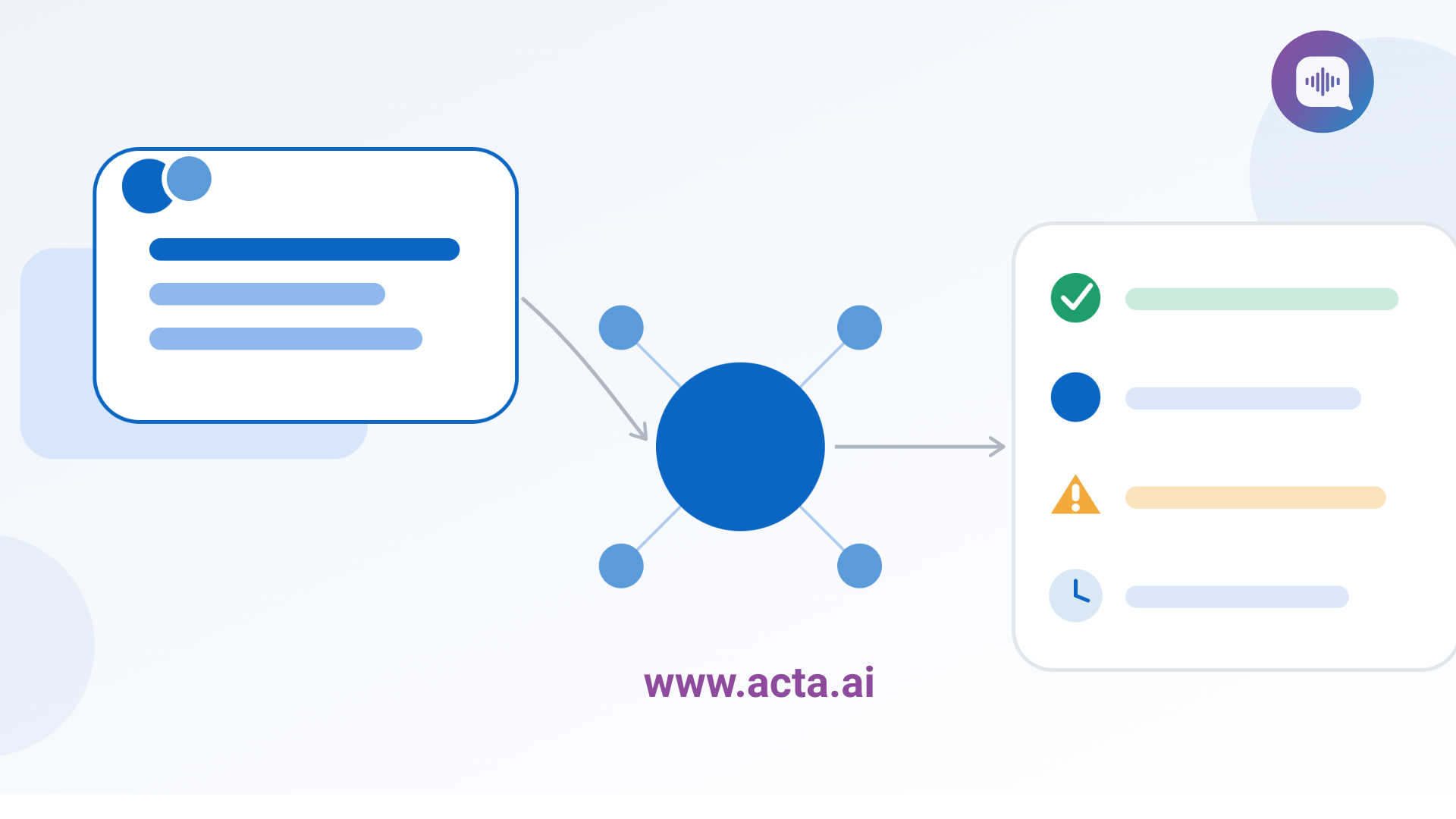
Underneath that simple description is a specific mechanism worth understanding, because it's the part that actually creates accountability: every meaningful decision is captured, timestamped, and attributed to a named owner, and linked forward to the next steps that follow from it. Follow-through stops being a matter of good intentions and becomes structural — built into the record itself, not dependent on someone remembering to chase it.
The same logic extends to the messier, harder-to-pin-down parts of a conversation: the risks people raise verbally and the commitments people make in passing. Acta surfaces risks explicitly flagged in discussion so they're preserved for review instead of lost in the noise, and captures verbal commitments as concrete, actionable items rather than letting them evaporate the moment the call ends. Zoom out across many meetings, and patterns emerge — recurring risks, decision quality trends, the kind of insight that's invisible when every meeting is a self-contained island.
Why Trust Matters More Than Smart Summaries
Here's a point worth sitting with: the real barrier to enterprise AI adoption was never summarization quality. It's trust.
Any organization considering this kind of tool asks the same underlying question — can we trust it with our most sensitive conversations? That's an infrastructure question as much as a product one: enterprise-grade data handling, audit-ready standards, and a system that treats a meeting not as an endpoint but as the start of a workflow that produces real execution momentum afterward.
Governance for the Age of AI Agents
There's a bigger shift happening underneath all of this, and it's easy to miss if you're only thinking about meeting notes.
As AI agents increasingly participate in — and influence — enterprise decisions, the old governance question stops being sufficient. "What did the model do?" used to be the whole conversation. It isn't anymore. The question that actually matters now is: who held decision authority, and can we trace it?
That's a shift from model-centric control to decision-centric governance. From black-box decisions to transparent authority. From no clear ownership to named owners on every decision. From "hard to audit" to fully traceable, by design. In regulated, high-stakes environments especially, explainability can't be an afterthought bolted on for compliance season — it has to be reviewable and traceable from the moment a decision is made.
Proof, Not Just Promise
DSP Mutual Fund put it about as plainly as it can be put, after putting this into practice:
"The goal wasn't AI-generated notes. It was execution momentum with a record teams could rely on."
That's the actual test for any tool in this category. Not "does it produce a nice summary," but "does it change what happens after the meeting ends." Decision owners now work from a living ledger instead of chasing follow-ups from memory — every conversation connected to business action, with accountability that survives long after the call itself is over.
The Real Question
Most companies aren't behind on AI adoption. They're behind on something more basic: the ability to answer, with confidence, what did we actually decide, who owns it, and can we prove it.
Planes don't carry black boxes because most flights crash. They carry them because when something does go wrong, "we're not sure" isn't good enough.
Your next high-stakes meeting deserves the same standard.
Start your audit trail at Acta.ai