Quick answer: To handle the status quo objection ("we're happy with our current tool"), don't argue or pitch harder. Agree, then get curious: ask what they like about it, what they'd change, and what it costs them when it falls short. If a real gap shows up, size it together. If it doesn't, leave politely and set a reason to check back later.
"We're happy with our current tool" is the most common thing a prospect says in the first two minutes of a cold call, and it's often true. People don't wake up wanting to replace software. Switching costs time, political capital and a few months of everybody complaining about the new screens.
So don't try to prove them wrong. Try to find out, quickly and honestly, whether "happy" means "this works well" or "I haven't thought about it". Those need very different responses.
What is the status quo objection?
The status quo objection is any version of "we're fine as we are": happy with our current tool, already have a vendor, not a priority this year, we built something in-house. It's less an objection to your product than a preference for not changing anything.
That preference is well documented. In 1988, William Samuelson and Richard Zeckhauser published a series of decision experiments, "Status Quo Bias in Decision Making", showing that people stick with the current option far more often than you'd expect if they were weighing choices neutrally. Label one option as "what you have now" and it becomes more popular, even when nothing else changes. That's status quo bias, and every buyer you call has it, including you when someone tries to sell you a new phone plan.
It also explains a lot of lost deals that never show up as losses to a competitor. A lost deal analysis of old sales calls often shows how many. Research by Matthew Dixon and Ted McKenna, summarised in this CustomerThink piece on "no decision" outcomes, split deals that ended in no decision into two groups: buyers who preferred the status quo, and buyers who couldn't make up their minds. Status quo accounted for a large share, a bit under half. The rest was indecision, which is a different problem with a different fix.
Why do buyers say "we're happy with our current tool"?
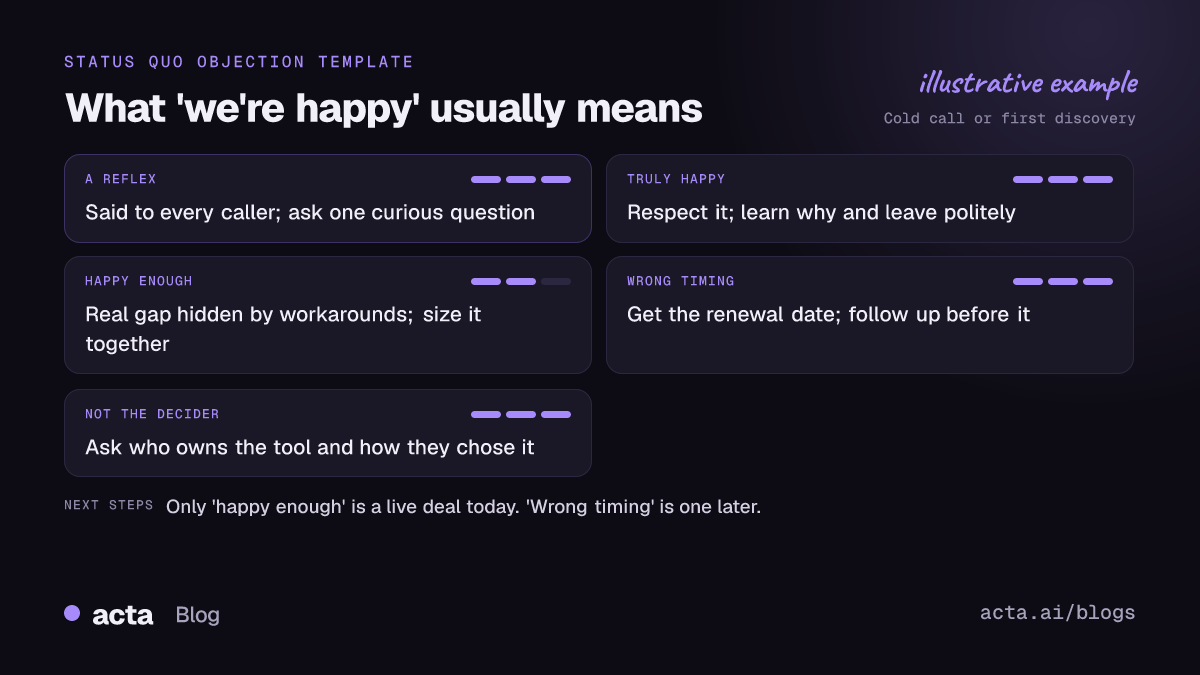
When someone says they're happy with their current tool, it usually means one of five things:
- It's a reflex. They say it to every cold caller. They may not even know what tool their team uses.
- They really are happy. The tool works, they chose it, and it would be awkward to admit otherwise.
- They're happy enough. There are annoyances, but the workarounds are familiar and nobody has added up what they cost.
- The timing is wrong. They signed a three-year contract last spring.
- They're not the person who'd decide. Saying "we're happy" is easier than saying "it's not my call". A few MEDDPICC questions help you find who does make the call.
Your first job is to work out which one you're dealing with. Only the third is a real opportunity right now; the fourth is an opportunity later.
How do you respond to the status quo objection without arguing?
Here's the sequence I teach. It works on the phone, in email replies and in the middle of a discovery call.
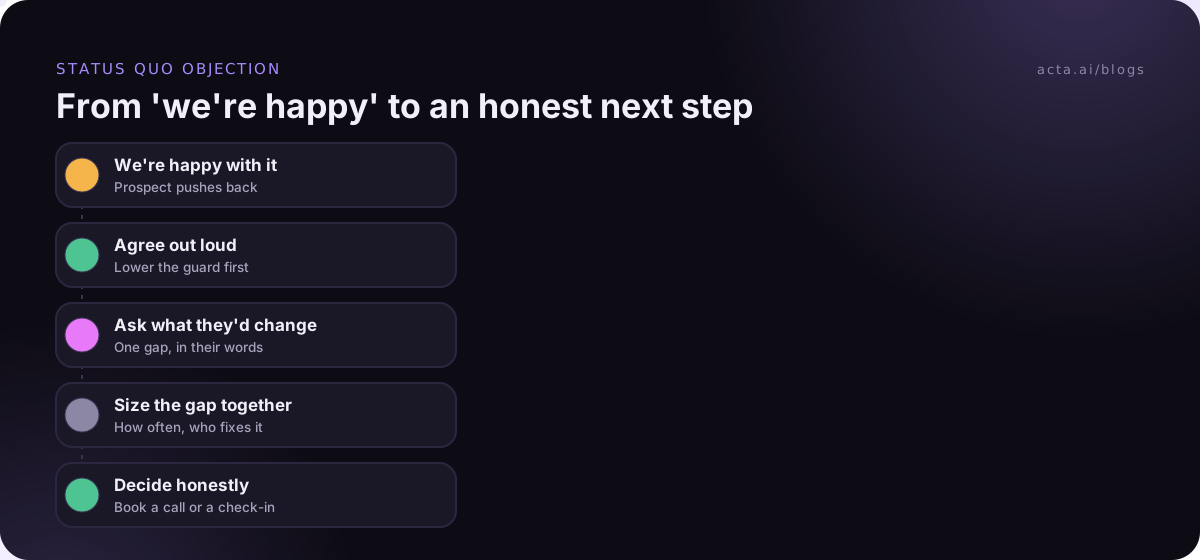
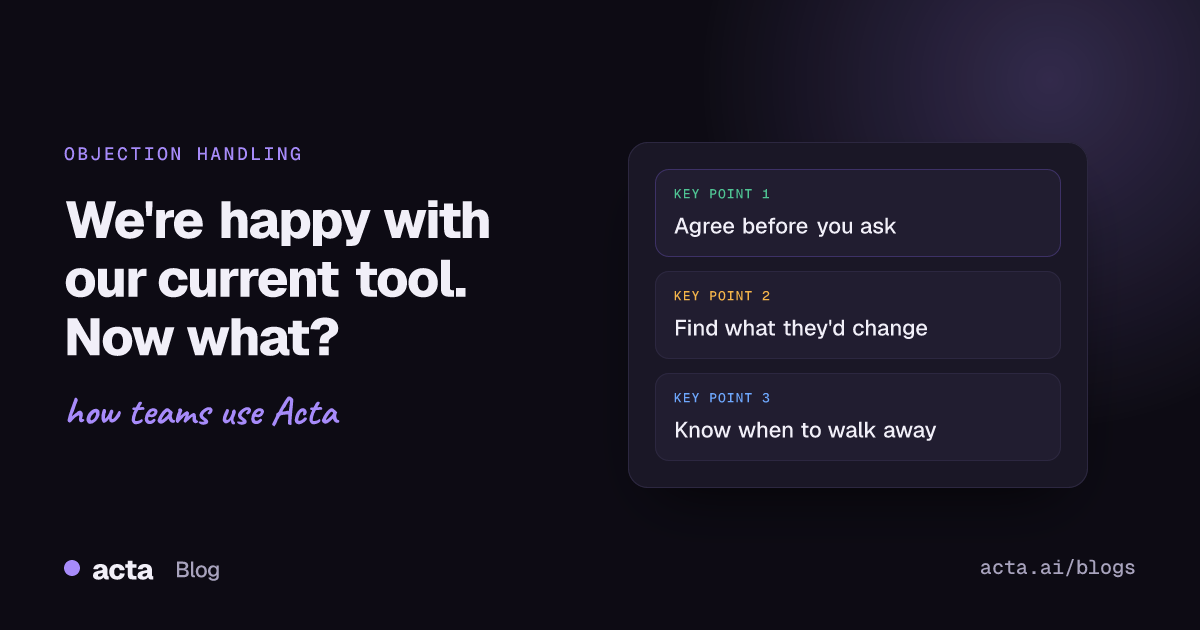
- Agree, out loud. "That makes sense, most teams we talk to already have something in place." This lowers their guard. Arguing raises it.
- Ask what they like. "What made you go with them?" or "What does it do really well for you?" People enjoy explaining a good decision, and you learn their buying criteria for free.
- Ask what they'd change. "If you could wave a wand and change one thing about how it works, what would it be?" This is the question that matters. A long pause and "nothing really" is a real answer. A quick, specific complaint is a door opening.
- Size the gap together. If they named something, ask how often it happens and what they do about it. "How many hours a week does the team spend on that workaround?" Let them do the maths.
- Decide honestly. If the gap is small, say so: "Sounds like you're in good shape. Mind if I check in after your renewal?" If it's big, ask for twenty minutes to show how others handle it.
Notice what's missing: any claim that your product is better. You haven't earned that yet.
What questions uncover the cost of doing nothing?
Buyers who stay put usually underestimate the cost of doing nothing. It's spread across many small moments, so nobody sees the total. Good questions make it visible without you having to say it:
- "When did that last cause a problem? What happened?"
- "Who has to fix it when it goes wrong?"
- "Is that getting better or worse as the team grows?"
- "What does your manager ask about that you can't easily answer today?"
- "If nothing changes, what does this look like a year from now?"
These are close cousins of SPIN's implication questions. If you use that method, our SPIN selling deal reports post shows how to capture the answers so they don't vanish after the call.
One caution: don't invent a crisis. If the cost really is small, a dramatic "what if your whole team quits because of this?" only makes you look desperate. Buyers can tell.
Objection handling talk tracks you can adapt
Good objection handling sounds like a conversation, not a script, so treat these as starting points and change the words until they sound like you.
On a cold call:
"Totally fair, and I'm not calling to talk you out of it. Quick question so I don't waste your time later: if you could change one thing about how your team handles renewals today, what would it be?"
In an email reply:
"Glad it's working. Out of curiosity, are you still pulling the weekly report by hand? A few teams using the same tool told us that was the part they'd fix first. If that's not an issue for you, no worries, I'll leave it there."
When it comes up mid-discovery:
"Makes sense. You took this call, though, so something must have prompted it. What was it?"
That last one is my favourite, and it's worth having ready before any first call (our discovery call template has more openers like it). People rarely take a meeting about a problem they don't have. The reason they said yes to the call is often the real pain, and they've half-forgotten it by the time you ask.
How is this different from a competitive displacement deal?
A competitive displacement deal is when you're actively trying to replace a named competitor that's already in place. The status quo objection is often the opening line of one, but the work afterwards is different.
In displacement, you need to understand the incumbent better than the buyer does: contract end date, who championed it, what was promised at purchase and what was delivered. You also need to make switching feel safe. That means a migration plan, a pilot with a small team, and someone on their side who's willing to put their name on the change. Without that internal champion, even a buyer who agrees your product is better will usually stay where they are.
A few things that help:
- Find the renewal date early. Then work backwards. Most teams need to start evaluating two or three months before renewal.
- Offer to run side by side. A small pilot is much easier to approve than a full switch.
- Don't trash the incumbent. Someone in the room chose it. Criticise it and you've criticised them.
When should you walk away?
Sometimes they really are happy, the tool really is fine, and the right move is to leave. Walk away (for now) when:
- They can't name a single thing they'd change, even after a couple of good questions.
- They're mid-contract with no exit, and the pain isn't big enough to justify paying twice.
- The person you're talking to can't introduce you to anyone who could decide.
Leaving well matters. Note what they told you, the contract end date if you got it, and a specific reason to reach out again: "You mentioned the reporting gets painful at quarter end. I'll check in at the end of March." That turns a no into a dated follow-up instead of a dead lead.
How to get better at this objection
The fastest way to improve is to hear yourself handle it. Most reps think they ask curious questions; on the recording they're explaining features within ten seconds. If you record calls for coaching, tell the other person first (our guide to recording consent covers what to say), and if a visible bot would make a cold call awkward, the Chrome extension or desktop app records from your own computer instead.
Then listen for three things: how fast you agreed, whether you asked what they'd change, and who talked more after the objection. Pick one call a week and review just that moment. It's ten minutes well spent.
Where Acta can help
For sales teams, Acta writes up each call with a summary, decisions and action items, and its report templates include sales formats such as BANT, SPIN and MEDDPICC deal reports. OneChat lets you ask across past calls, for example "which prospects mentioned their renewal date?", and it answers with the sources it used. It won't handle the objection for you, but it does keep the details from getting lost.
Frequently asked questions
What does status quo bias mean in sales?
Status quo bias is the tendency to stick with the current option even when an alternative might be better. In sales it shows up as "we're fine as we are", and it's why many deals end in no decision rather than a loss to a competitor.
What's the best first response to "we're happy with our current tool"?
Agree, then ask a curious question about what they'd change. Arguing or listing your features makes people defend their choice. A question gives them room to mention a problem on their own terms.
Should I ask which tool they use?
Yes, but casually, and after you've agreed with them. Knowing the incumbent helps you tailor your questions. Avoid comparing yourself to it in the same breath.
How many times should I follow up after a status quo objection?
Once, tied to something specific they told you, such as a renewal date or a busy season. Generic "just checking in" emails rarely work on a buyer who's already said they're happy.
Is the status quo objection the same as "no budget"?
Not quite. "No budget" can be real or a polite brush-off, and it often hides the same thing: they don't see enough value to change. The same questions about cost and impact help with both.
To see how your team's sales calls look when they're written up automatically, start the 15-day free trial.