Use Cases 5 min read
Care Team Huddle Notes: Issues, Plan and Handoffs From Every Huddle
Acta drafts notes from care team huddles and case conferences: each issue with the specialty that raised it, the agreed plan, handoffs and safety concerns.
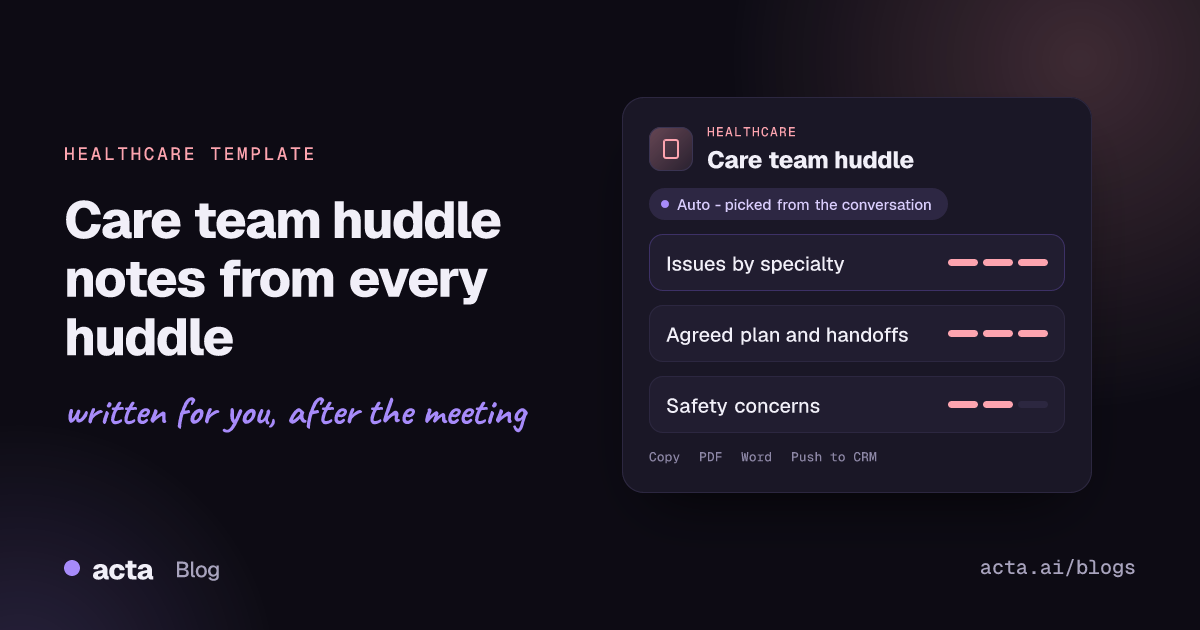
Quick answer: Care team huddle notes record what a multidisciplinary team discussed about a patient: the issues each specialty raised, the plan agreed, who is handing what to whom and any safety concerns. Acta drafts these notes from a recorded huddle or case conference. They are a draft written by AI from the conversation, and a clinician must check them before use in care.
Huddles and case conferences are where the pieces of a patient's care come together. The physiotherapist has a view on mobility, nursing has seen the overnight confusion, the social worker knows the home situation, and the doctor is weighing a medication review. In 15 minutes the team agrees a plan and splits the work.
Writing it up is the hard part. Whoever chairs is often also presenting, nobody has a free hand to take notes, and the record ends up as a few lines that leave out who raised what and who owns the next step. When a handoff is missed, it is usually because it was never written down.
What is a care team huddle or case conference?
A care team huddle is a short, structured meeting of the people caring for a patient or a unit, often nurses, physicians, therapists, pharmacists and social workers. Huddles tend to be brief and focused on what needs doing today and what could go wrong. A case conference (or multidisciplinary team meeting, MDT) is the longer version, where a complex case is discussed in depth and a shared plan is agreed.
The US Agency for Healthcare Research and Quality's primer on improving patient safety and team communication through daily huddles describes huddles as short interdisciplinary meetings for sharing information and flagging concerns for follow-up, rather than solving every problem in the room. That makes the written record matter: the follow-up only happens if someone captured it.
Good huddle notes usually answer four questions: what issues came up and from whom, what was decided, who is doing what next, and what the team is worried about.
What does Acta's Care team huddle report include?
The report follows the shape of a multidisciplinary discussion:
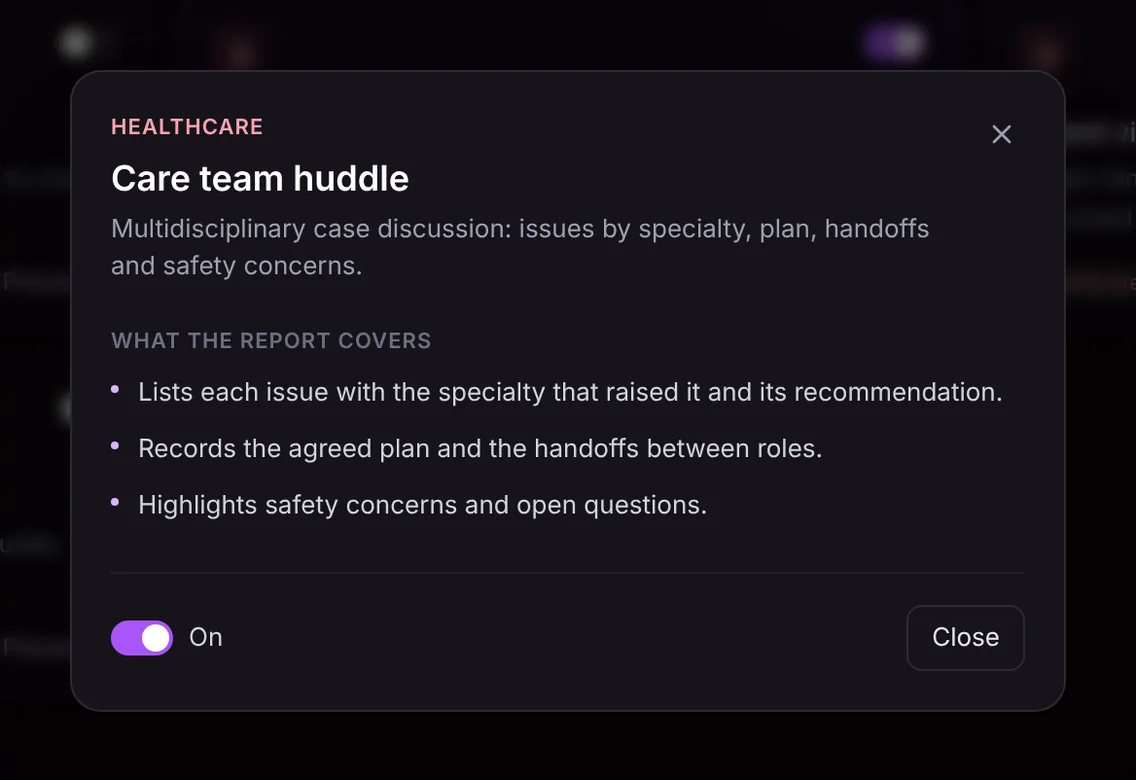
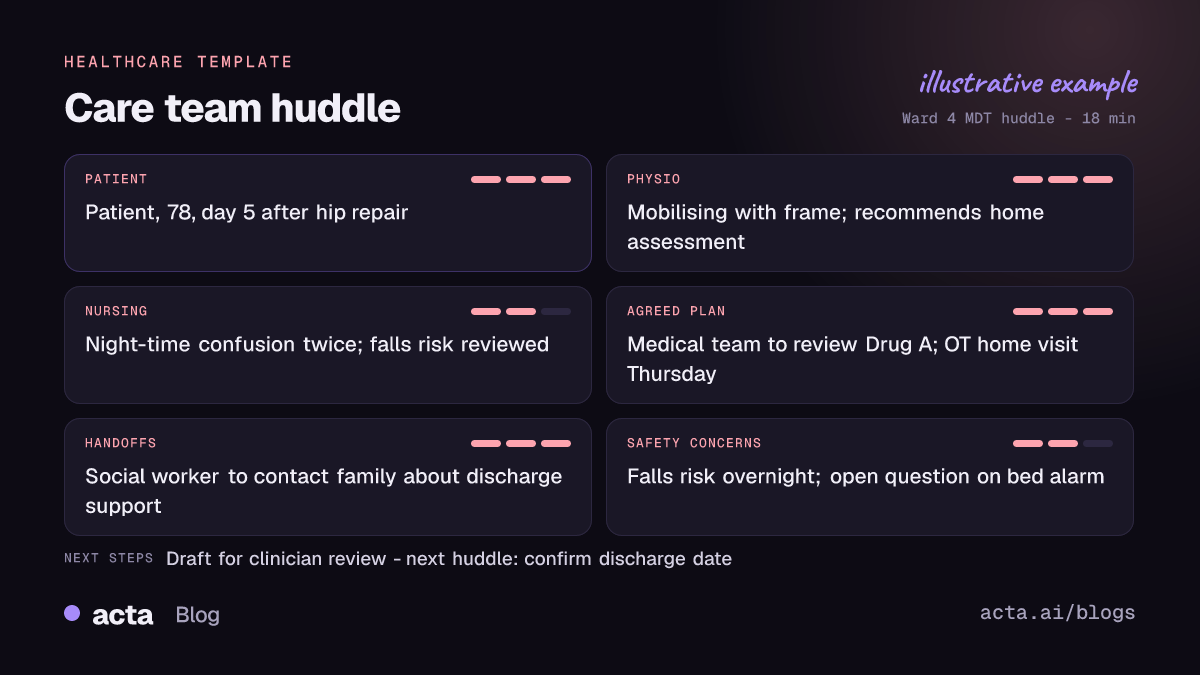
- Issues by specialty, with recommendations. Each issue raised is listed with the discipline that raised it and what they recommended, so the physiotherapy view and the nursing view stay distinct.
- The agreed plan and the handoffs between roles. What the team decided, and who takes each piece: the medical team, therapy, pharmacy, social work or nursing.
- Safety concerns and open questions. Falls risk, deterioration signs, unresolved questions and anything the team said needed watching.
Here is the template in Acta's Templates page, with the preview of what the report covers:
And an illustrative example of a finished report:
A draft for clinicians, not a clinical decision
Every Care team huddle report is a draft written by AI from the conversation. A clinician must check it before it is used in care or shared with the patient. The report records what the team said; it never adds a diagnosis, a dose or an instruction that was not discussed, and it does not fill gaps with clinical judgement. If the team said "review Drug A" without a dose, the note says exactly that.
Who is it for, and why does it help?
The template suits ward and unit teams, primary care practices running daily huddles, community and home care teams, oncology and other tumour boards, mental health teams, and rehabilitation units. See Acta for healthcare for the broader picture.
Where it helps:
- Morning ward huddles. Ten patients in 20 minutes. Each gets a short record of issues, plan and owners without anyone typing during the meeting.
- Complex case conferences. When five disciplines contribute, the note keeps each recommendation attributed, which helps when the plan is questioned later.
- Shift and service handovers. The incoming team can read the agreed plan and open questions rather than relying on a corridor summary.
- Discharge planning. Handoffs to social work, therapy and family contact are listed explicitly, so nothing waits on an assumption that someone else had it.
How does Acta pick this template automatically?
Acta reads the conversation and can pick the Care team huddle template even when you have not turned it on. The signals are a multidisciplinary discussion about one or more patients: different roles giving their view, recommendations, a plan being agreed, tasks being passed between disciplines and safety concerns being raised. The report is labelled "Auto" and Acta says why it picked it, for example that several specialties discussed a patient, agreed a plan and assigned handoffs.
Click "Turn on for future meetings" to keep it. When the template is on, each meeting is checked first. A budget meeting or a staff rota discussion will not produce forced huddle notes; it appears under "Not relevant" with the reason. For bed and staffing meetings, the hospital operations report is the better fit.

How do you use the Care team huddle template?
- Record the huddle. Acta works with Zoom, Google Meet and Microsoft Teams through a meeting bot, or without a bot through the desktop app, Chrome extension and mobile apps, which suits in-person huddles. You can also upload a recording. Follow your organisation's consent rules; our guide on recording meetings with AI and consent covers the basics.
- Turn on Care team huddle. In Templates, open the Healthcare group, preview the template and switch it on, or let Acta pick it.
- Open the meeting's Templates tab. The draft sits next to the summary and transcript.
- Review, then use. A clinician checks and corrects the draft. Then copy it into your record system or download it as PDF, Word or Markdown.

Tips for better huddle notes
- Introduce each patient clearly using the identifier your team normally uses, so issues are grouped correctly.
- Say your role when you speak: "From physio..." makes attribution reliable.
- Name the owner of each handoff and when it should happen.
- Say safety concerns explicitly, for example "safety concern: overnight falls risk".
Related Healthcare templates: SOAP note drafts from patient visits and the plain-language patient visit summary.
Frequently asked questions
Can the huddle notes go straight into the patient record?
No. They are a draft written by AI from the conversation. A clinician must check them before they are used in care or shared with the patient.
Does Acta add clinical recommendations of its own?
No. The report only contains what the team said. It never adds a diagnosis, dose or instruction.
Can one huddle cover several patients?
Yes. When a huddle runs through several patients, the report organises issues, plan and handoffs for each one discussed.
What is the difference between a huddle and a case conference?
A huddle is short and focused on today's tasks and risks; a case conference is a longer, in-depth discussion of a complex case. The template works for both.
Try it on your next huddle with a free 15-day Acta trial.


