Roadmap promises are made on customer calls, not in the roadmap tool
At a 40-person SaaS company, the roadmap tool says one thing and the customer calls say another. An account executive on a renewal call hears "we can't roll out to 400 staff without single sign-on" and answers "SSO is planned for Q1". A product manager at the customer advisory board says "it's on the roadmap". Neither person is lying. Both are paraphrasing a plan that was true that week.
Then the weekly roadmap review reshuffles priorities because a larger prospect needs payroll export. The decision is sound. The problem is that the people who repeated the old plan to customers were not in the room, and nothing connects the change to the calls where the date was given. Customer feedback tracking tools capture the request ("Harbourview wants SSO") but rarely the promise ("Tomás said March").
Engineering teams solved a similar problem years ago with architecture decision records. AWS's prescriptive guidance on the ADR process describes a decision log in which accepted records are not edited but superseded by new ones, so the history stays readable. Product commitments deserve the same discipline, and the AWS introduction to decision records explains why capturing the context behind a decision helps people who join later.
One slipped SSO date can cost a renewal
An illustrative case. Rotaly (a made-up company) sells staff scheduling software to care homes and clinics. It has 40 people, $3.1M in annual recurring revenue and one product manager per squad.
- 9 January, renewal call. Harbourview Care Group, 60 locations and $38,000 a year, wants to expand. Their IT lead says they will plan the rollout around Azure AD single sign-on. Account executive Tomás Reyes says, "SSO is planned for Q1, end of March."
- 16 January, customer advisory board. Two more customers ask about SSO. Head of product Nadia Okafor says it is "on the Q1 roadmap".
- 23 January, roadmap review. CEO Ben Hartley moves payroll export ahead of SSO to win a 200-location prospect. SSO slides to Q2. The notes say "Reprioritised: payroll export before SSO."
- 20 February, quarterly business review. Harbourview asks customer success manager Priya Raman how the March SSO launch is going. Priya has never heard of a March date. Harbourview's IT lead has already scheduled training for 400 staff.
The renewal survives, barely, with a discount and an apology. Nobody broke a rule. The decision changed in one meeting and the promise lived in three others.
A SaaS customer feedback decision log holds commitments, not wishes
The most common mistake is logging every feature request as a decision. A good decision log template for customer feedback separates three things:
- Requests: what customers asked for, in their words. These belong in your feature request tracking (see this feature request template for customer calls).
- Commitments: what someone at your company told a customer, with a date or a "yes". These are decisions made on the customer's behalf.
- Roadmap decisions: what product and leadership decided, including reprioritisations.
The log earns its keep where the second and third meet. When "SSO ships in Q1" changes to "SSO ships in Q2", every commitment that quoted Q1 is now wrong, and someone must tell those customers. Acta's built-in Customer QBR and Product demo review templates pull requests and next steps out of customer calls. For commitments, a custom template does better. Custom templates are on paid plans, up to 10 per person, and can be shared with the team:
Template: Customer asks and commitments (run on "Only matching meetings": renewal, expansion and advisory calls)
Requests heard (Table: Request | Customer | Their words | Business reason)
What we committed to (Table: Commitment | Who said it | Date or quarter given | Exact quote)
Roadmap items mentioned (Bullets)
Renewal or expansion risks (Paragraph)
Follow-ups (Checklist: task, owner, due date)
The "Exact quote" column matters. "Planned for Q1" and "we'll try for Q1" are different promises, and a quote settles arguments faster than memory.
The Decision log shows the change next to the customers who heard it
In Acta the Decision log lives at My meetings > Outcomes > Decision log. It is per person: Nadia's log is built from the meetings she recorded plus those teammates shared with her in the workspace. That is why sharing matters. Tomás records the renewal call and shares it with the workspace, Priya shares her QBRs, Nadia records the roadmap review, and Nadia's log now spans all three.
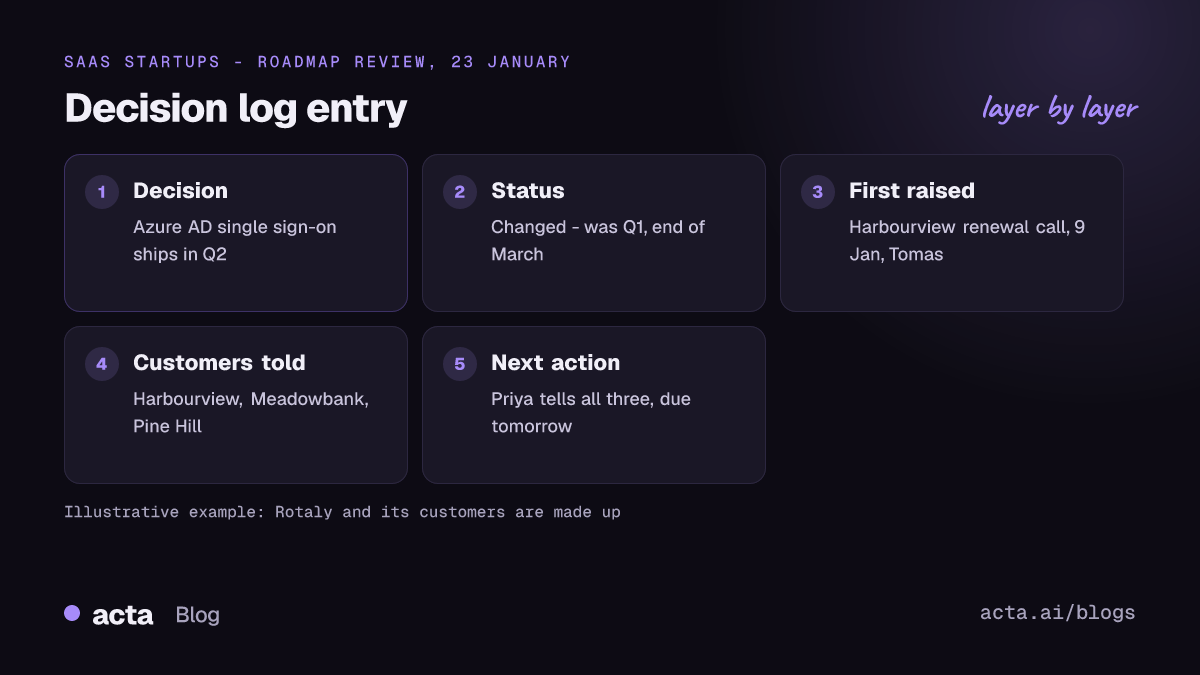
What the SSO decision looks like
Azure AD single sign-on ships in Q2
Status: Changed · Was: "SSO ships in Q1, end of March" · changed 23 Jan
Decided by: Ben Hartley · Owner: Nadia Okafor · Discussed in 3 meetings
Banner: "No action items yet"
History: 9 Jan, Harbourview renewal call, first raised ("SSO is planned for Q1, end of March"); 16 Jan, customer advisory board, confirmed; 23 Jan, roadmap review, updated ("payroll export goes first, SSO moves to Q2").
Two signals jump out: the status is Changed, and there are no action items. That combination means a promise is now wrong and nobody is fixing it. Click Assign owner, give it to Priya, and add the action item "Tell customers who heard Q1 that SSO moves to Q2".
How to read the tiles
The top of the tab shows Decisions, Need follow-through, Changed or reversed and Done. Statuses are Active, Changed, Reversed and Done; there is no "proposed" or "approved" state. Group by Topic to see all roadmap decisions together, or by Person to see what Nadia owns. If Acta merges two different decisions (SSO for Azure AD and SSO for Google Workspace, say), use "Not the same decision?" in the history to split them. If a note is not really a decision, choose "Not a decision" from the menu.
Use the export for the monthly roadmap review
Export CSV downloads acta-decision-log.csv with the decision, status, topic, decided by, owner, first and last discussed, meetings, actions and the previous wording. Filter it to Changed and bring it to the monthly roadmap review. It turns "did we tell anyone?" into a list you can work down. For the wider habit, see how to track decisions made in meetings.
Action items, risks and OneChat close the loop
The Decision log flags the change. Three other views make sure it turns into work. Like the log, they are per person and built from the meetings each person recorded or had shared with them.
Action items (My meetings > Outcomes > Action items): Priya's row reads "Tell Harbourview, Meadowbank and Pine Hill that SSO moves to Q2; offer early access to the beta", owner Priya Raman, status "Due tomorrow", from the Q2 roadmap follow-up. Group by Person and she sees it next to her other renewals.
Risk Registry: "Harbourview renewal ($38,000) at risk if SSO slips past their staff rollout", Impact High, owner Priya, Mitigation Suggested ("offer beta access and a firm Q2 date"), Status Open. Once the team agrees the plan on a call, the mitigation flips to Agreed. Churn signals like this are covered in churn risk alerts from customer calls.
OneChat answers the question that matters most when a date moves:
Question: Which customers did we tell that SSO would ship in Q1, and who told them?
Answer: Three customers. Harbourview Care Group heard it from Tomás Reyes on 9 January ("SSO is planned for Q1, end of March"). Meadowbank Clinics and Pine Hill Homes heard it from Nadia Okafor at the 16 January customer advisory board ("on the Q1 roadmap"). Found in: Harbourview renewal call, 9 Jan; Customer advisory board, 16 Jan.
There is no separate promises screen; questions about what was promised go to OneChat, which cites the calls. A good answer can be added to the Decision log from the chat.
An agent can warn customer-facing staff when a roadmap decision changes
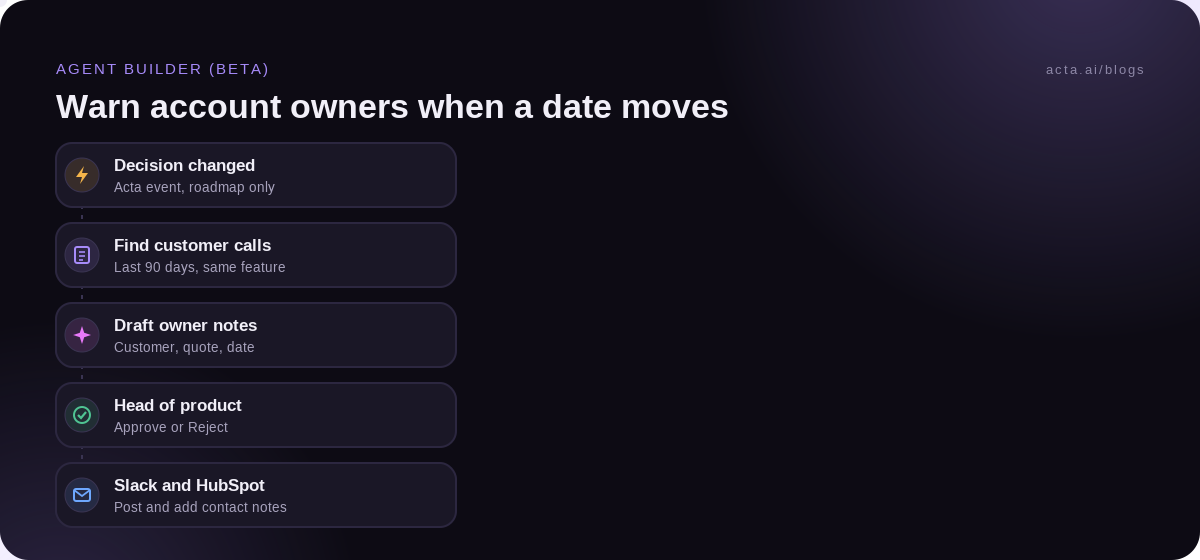
Checking the tile every Monday works if someone remembers. Agent Builder (beta) can do the checking for you. A head of product can build this in an afternoon:
- In Agent Builder, click New agent and describe it: "When a roadmap decision changes, find customers who heard the old version and tell account owners."
- Trigger: Event in a connected app, app Acta, event "decision made or changed". Under "Only when", require the decision text to mention roadmap, quarter or release.
- Step: Acta data, to fetch customer calls from the last 90 days that mention the feature.
- Step: AI, instructed: "List each customer told the old date, who told them, the exact quote and the meeting date. Draft a two-line Slack note for the account owner."
- Step: Human approval. The approval goes to the agent's owner; Approve or Reject in the Approvals tab or by email. No answer in 24 hours means nothing is sent.
- Actions: a Slack message to #customer-commitments, then For each customer, a HubSpot action to add a note to the contact.
- Test, then Run test on the SSO decision. Messages are only shown, not sent. Then Turn on.
The triggers guide lists the Acta events you can start from. Keep the approval step: a note to the wrong account owner is easy to send and awkward to retract.
Roll it out to a 40-person SaaS team in two weeks
Who records which meetings
- Account executives and CSMs: renewal, expansion and QBR calls. Most of these run in Google Meet, where the Chrome extension records without a bot joining.
- Head of product: the weekly roadmap review and the customer advisory board.
- Founder or CEO: strategic customer calls and any meeting where priorities change.
Announce recording at the start of customer calls; the guide on recording consent and what to tell participants covers the wording. Send reports to your CRM with Push to CRM if it helps your account owners (see sending reports to HubSpot, Salesforce or Zoho).
The two weeks
- Day 1: Create the workspace and invite the product, sales and success leads from Settings > Workspace. Invites are free for up to 10 people during the trial.
- Days 2-5: Every customer call and the roadmap review gets recorded and shared with Everyone in the workspace. Meetings are private until shared.
- Week 2, Monday: Nadia opens her Decision log, reads Changed or reversed, and assigns owners to anything without action items.
- Week 2, midweek: Priya asks OneChat, "What did we promise customers this month?" and checks every source.
- Day 14: Turn on the agent above, with approval, and agree that "on the roadmap" is never said without a quarter and a caveat.
Mistakes that undo the whole thing
- Assuming the Decision log is company-wide. It is per person; Nadia's log only sees meetings shared with her.
- Logging requests as decisions. The log fills with noise and nobody reads it.
- Fixing the roadmap tool but not the promise. Updating Jira does not tell Harbourview.
The Acta page for SaaS startups covers other meetings worth capturing. The Outcomes views, the Risk Registry and OneChat are included in the 15-day trial and in Pro.
Frequently asked questions
What is a SaaS customer feedback decision log?
It is a list of the decisions your company made about customer requests and the commitments staff gave customers on calls, each with who decided, the date, the current status and earlier versions. Unlike a feature request tracker, it records what you promised and how that promise changed, so customer-facing staff can correct it in time.
Should every feature request go into the decision log?
No. Requests belong in your feature request tracking or product feedback tool. Put an item in the decision log only when someone decides something (build it, defer it, decline it) or tells a customer a date or a yes. Keeping the log to commitments and roadmap calls makes it short enough that people actually check it weekly.
How do we stop sales promising roadmap dates?
You probably cannot stop it entirely, and you should not try to make sales sound vague. Agree a phrasing such as "planned for Q2, subject to change", record customer calls, and review changed decisions weekly so anyone who quoted the old date hears about the change before the customer asks at a QBR.
Is the Acta Decision log shared across the team?
Each person has their own Decision log, built from the meetings they recorded and those shared with them in the workspace. To give the head of product a full picture, account executives and success managers share their customer calls with the workspace. Teammates can then also ask OneChat about those shared meetings.
How is this different from an architecture decision record?
An architecture decision record documents one technical choice, its context and consequences, usually written by engineers. A customer feedback decision log covers product commitments made in conversation, often by people outside product. The idea is the same: keep the old version visible when a decision changes, so people who relied on it can be told.
Decide who owns your roadmap commitments
Pick one owner for product roadmap commitments, usually the head of product, and make their Decision log the one everyone feeds. Then:
- Record the right calls: renewals, expansions, the customer advisory board and the roadmap review.
- Share by default: customer calls go to Everyone in the workspace.
- Read one tile weekly: Changed or reversed, every Monday.
- Pair every change with a task: no Changed decision without an action item to tell customers.
- Automate the warning: an approved agent posts to Slack and notes HubSpot when a roadmap decision moves.
Add the Chrome extension before your next renewal call and start a 15-day free trial to build the log from real conversations.