Quick answer: Nonprofit board minutes need the date, attendance and quorum, each motion with who moved it and the result, any conflict of interest and recusal, and reports received. Use a fixed template, draft within a few days, circulate before the next meeting and approve them there. The Form 990 asks whether board meetings are documented contemporaneously, so speed matters as much as format.
Somebody on the board volunteered to be secretary. Maybe it was you, maybe because you were the one who said "I can take notes" at the first meeting. Now every month you sit in a church hall or on a video call, trying to follow a discussion about the summer fundraiser while writing down who seconded the motion on the budget. Then you go home and turn it into minutes after work.
It doesn't have to be that hard. Most of the effort in nonprofit minutes comes from two things: not knowing what actually needs to be in them, and writing them from memory a week late. Fix those and the job shrinks to an hour a month.
What do nonprofit board minutes need to include?
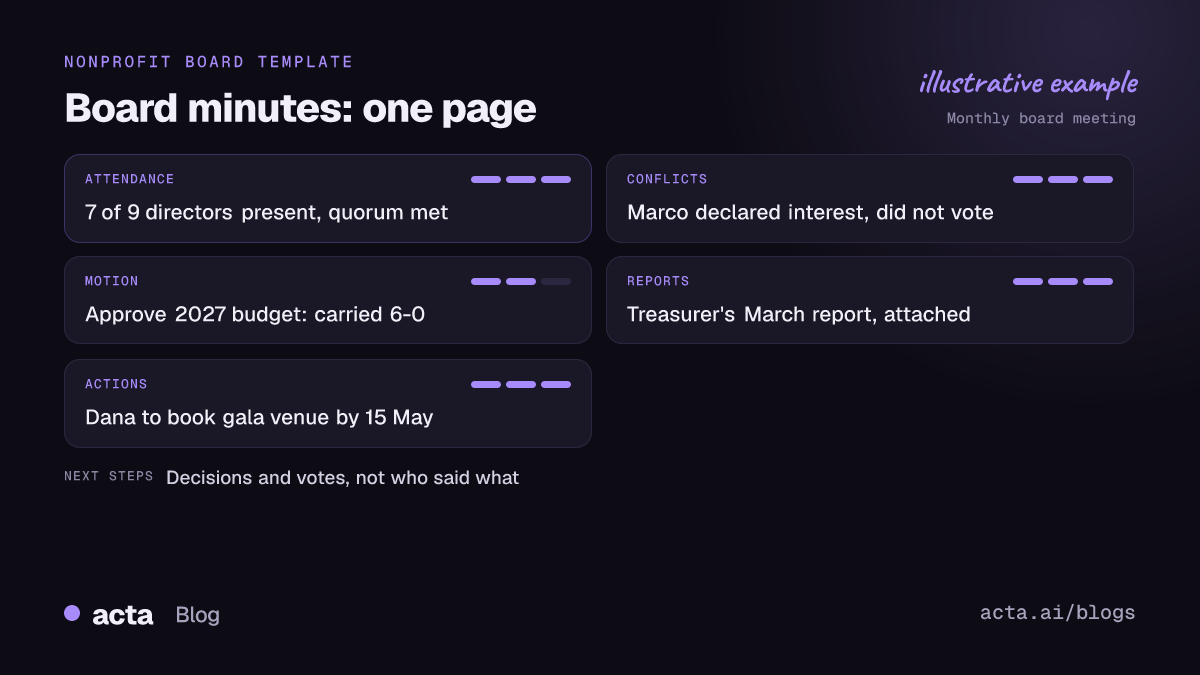
Keep it to what proves the board did its job. For each meeting:
- Name of the organization, date, time and place (or "by video").
- Who was there. Directors present and absent, staff and guests by name. Note anyone arriving late or leaving early.
- Quorum. One line: "A quorum was present." Your bylaws say what the number is.
- Approval of the last minutes, with any corrections.
- Conflicts of interest. Anyone who declared one, and that they left the room or didn't vote.
- Each motion. The exact wording, who moved it, who seconded if your board uses seconds, and the result. For a split vote, the count; some boards also note names.
- Reports received. "The treasurer presented the financial report for March (attached)." You don't need to summarise every number.
- Action items with a name and a date.
- Time of adjournment and the secretary's name.
That's it. Our free meeting minutes template has a version you can copy, and the post on board meeting minutes from the recording goes deeper into resolution wording.
What does the IRS expect from nonprofit board minutes?
If your organization files the full Form 990, Part VI asks a set of governance questions, and one of them is whether the organization contemporaneously documented the meetings held or written actions taken by its governing body and by committees with authority to act for it. The IRS explains the purpose of these questions on its page about governance reporting on Form 990, Part VI.
"Contemporaneously" has a specific meaning in the form's instructions. Minnesota Council of Nonprofits has a clear explainer on meeting documentation on the Form 990; in short, minutes count as contemporaneous if they're done by the later of the next meeting or 60 days after the meeting. As of November 2026 that's the reading most guidance repeats, but check the current instructions when you file.
Two practical points. The question isn't a legal requirement with a penalty attached, but it's a public answer on a public form, and donors and grant makers do read 990s. And answering it honestly is easy if you just have a habit of approving last month's minutes at this month's meeting.
Minutes when the board sets pay
If the board approves compensation for the executive director or another insider, the minutes carry extra weight. The tax rules on excess benefit transactions give boards a "rebuttable presumption" that pay was reasonable when it's approved by people without a conflict, based on comparable data, and documented at the time. So for those decisions, record who was present, who stepped out, what comparison data the board looked at and what it approved. Ask your accountant or counsel to check the wording the first time.
What should you leave out?
New secretaries tend to write too much, because it feels safer. It isn't.
- Who said what. "After discussion, the board approved..." is enough. Quoting a director's frustration about the gala budget serves nobody.
- Your opinions. "A lively debate" is commentary. Skip it.
- Personal details. If the board discusses a staff member's performance or a volunteer's health, record the decision, not the details. Consider handling it in executive session.
- Legal advice in detail. If a lawyer advises the board, note that legal advice was given, not what it was.
The Nonprofit Law Blog's series on board minutes makes the same argument from the lawyer's side: minutes are a record of actions, not a transcript.
How do you take nonprofit board minutes without missing the meeting?
The secretary is usually a voting director too. If you spend the whole meeting typing, the board loses one of its members for two hours. Some ways to take the pressure off:
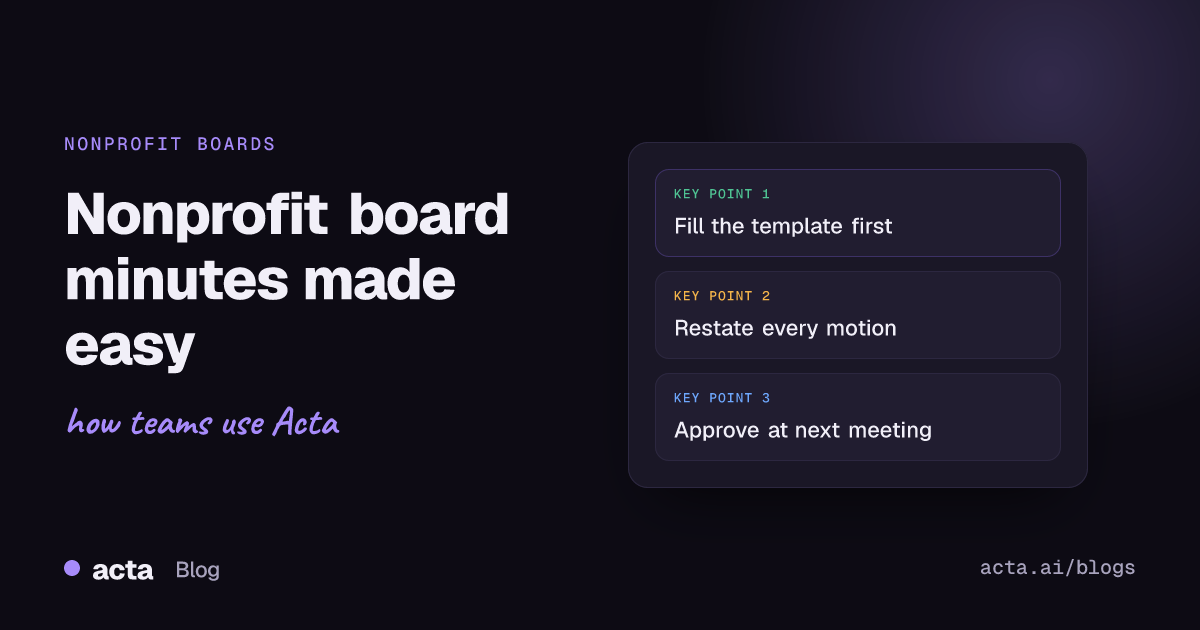
- Bring the template filled in before the meeting. Copy the agenda in, with the motions already written as they appear in the board packet. During the meeting you only fill in names and results.
- Ask the chair to restate every motion before the vote. "The motion is to approve the 2027 budget as presented. All in favour?" That one habit makes minutes far easier and decisions far clearer.
- Write down action items as they happen, with a name. "Someone should call the venue" becomes "Dana to call the venue by 15 May."
- Record the meeting, if the board agrees. Then you can listen, and check the wording later. Agree it as a board, tell guests at the start, and decide how long the recording is kept. Our guide on whether it's legal to record meetings with AI covers the consent basics. Plenty of nonprofit boards meet around a table rather than online, which is where a phone app built for recording in-person meetings is handy; for video calls, a desktop recorder on your laptop works without a bot joining.
A transcript or AI summary is a draft, not the minutes. The board approves minutes, and they should still follow your template and leave out the debate.
How do nonprofit board minutes get approved?
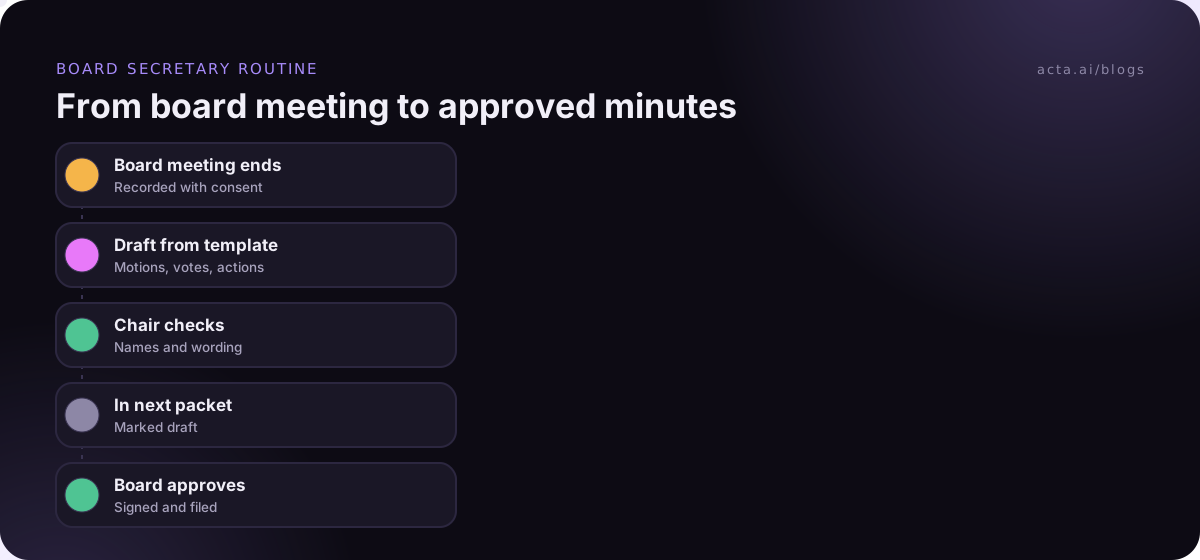
- Draft within a week, ideally within three days.
- Send the draft to the chair for a quick check of motions and names.
- Include the draft in the next board packet, marked "draft."
- Approve at the next meeting, with any corrections noted in that meeting's minutes.
- Sign and file the approved version in the minute book, whether that's a binder or a shared drive folder with the right permissions.
- Delete the recording once the minutes are approved, unless your policy says otherwise. Our post on meeting recording retention helps you set that policy.
Don't send the draft to the whole membership or post it publicly before approval. Draft minutes have a way of being quoted as final.
Who can see nonprofit board minutes?
It depends on where you are and how you're funded. Members of a membership organization often have rights to inspect records under state law, and some nonprofits that receive public money fall under open-meeting or public-records rules. Many private nonprofits have no duty to publish minutes at all, but plenty choose to share approved minutes with members as a matter of trust. Write them assuming they could be read by a donor, a regulator or a disgruntled former director. If they read fine to all three, you've written them well.
A monthly routine for the board secretary
Here's the rhythm that keeps the job to roughly an hour or two a month, based on a board that meets on the second Tuesday:
- The week before: get the agenda and board packet from the chair, paste them into your template, and write out each motion as proposed.
- Meeting night: fill in attendance, results and action owners. Nothing else. If you're recording, listen instead of typing.
- Within three days: finish the draft while you still remember who stepped out for the catering vote, and send it to the chair.
- With the next packet: the draft goes out marked "draft," along with a list of open action items so people see what they promised last month.
The open action list does more for a volunteer board than any reminder email. People tend to finish things when they know their name will be read out next month.
Common mistakes in nonprofit board minutes
- Minutes that never get approved. Three meetings go by, nobody remembers to put them on the agenda. Make "approve last minutes" a fixed first item.
- Motions without results. "The board discussed the new lease." Did it approve it or not?
- No record of conflicts. A board member's company bids on the catering contract, and the minutes don't say they stepped out. That's the line that matters most later.
- Action items without owners. They won't happen. Our post on tracking decisions made in meetings has a simple method for following them up.
- The secretary doing it all alone. Have a backup who knows the template, for the months you can't make it.
Where Acta can help
Acta records board meetings online with a bot or from your laptop, and in person with the mobile app. It writes a transcript with speaker names, a summary, decisions and action items with owners, and it has report templates you can use as a starting point for minutes. The secretary still edits the draft and the board still approves it.
Frequently asked questions
Are nonprofit board minutes required by law?
Most state nonprofit laws expect corporations to keep minutes of board proceedings, and the Form 990 asks about it. Check your state's rules and your bylaws.
How long should nonprofit board minutes be?
Usually one to three pages for a regular meeting. If yours run to ten, you're probably recording discussion instead of decisions.
Who signs nonprofit board minutes?
Typically the secretary, and sometimes the chair as well, after the board approves them. Your bylaws may say.
Can we use AI to write board minutes?
Yes, as a draft. Get the board's agreement to record, check every motion and vote against what happened, and remove anything that reads like a transcript before it goes to the board for approval.
How long should we keep board minutes?
Many organizations keep approved board minutes permanently, since they're the record of the organization's decisions. Your document retention policy should say so explicitly.
The secretary job gets easier with a good first draft; see the Acta features page for how meeting notes are put together.