Quick answer: A good first AI agent use case happens several times a week, starts from inputs you already capture, ends in a draft a person reviews, has a result you can measure, and has one named owner. Score your candidates on those five tests, pick the highest scorer, and run it for 30 days before adding anything else.
The hardest part of a first agent project usually isn't the technology. It's the meeting where twelve people each suggest a different thing the agent should do, and the team picks the most exciting one instead of the one most likely to work. I've watched that go wrong enough times to have opinions about it.
What follows is the method I'd use if you asked me to choose your first agent next week: five tests, a simple scorecard, a worked example and a 30-day pilot plan.
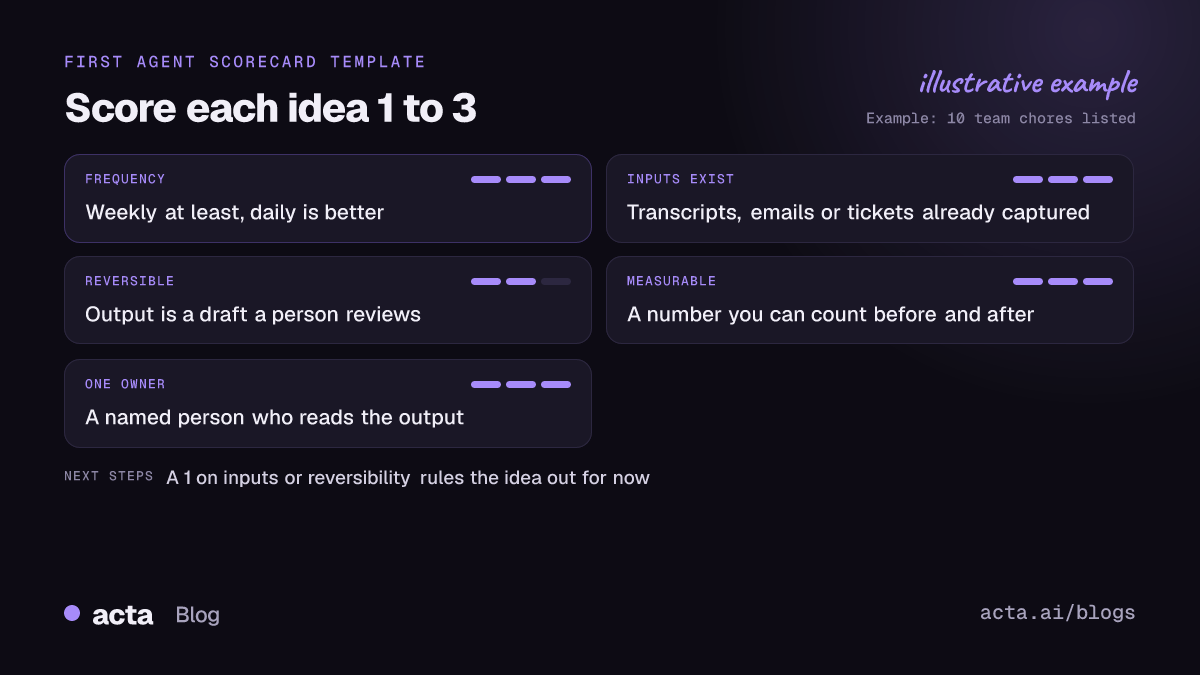
What makes a good first AI agent use case?
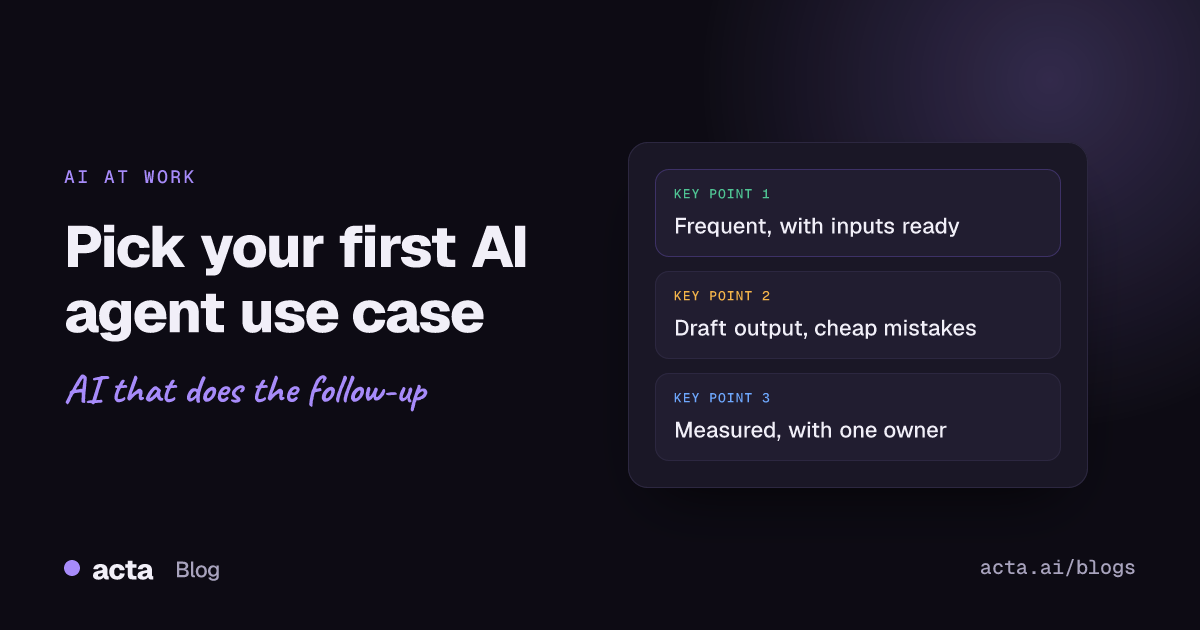
Run every idea through these five tests. A strong candidate passes all of them.
1. It happens often
Weekly at minimum, daily is better. An agent that runs twice a quarter never builds up enough runs for you to learn whether it works, and nobody remembers how to check its output.
2. The inputs already exist
The agent needs something to read: a transcript, an email thread, a form, a ticket. If step one of the project is "first we'll start capturing the data," pick something else for now.
3. The output is a draft, and mistakes are cheap
Your first agent should produce something a person reads before it goes anywhere: a follow-up email draft, a CRM note, a status summary. If it's wrong, someone fixes it in a minute and nothing bad has happened.
4. You can measure it
"Saves time" isn't a measure. "Recap emails go out the same day instead of two days later" is. Pick something you can count before and after.
5. One person owns it
Not a committee. One named person who reads the output, notices when it drifts, and decides whether it stays.
How do you score AI agent use case ideas?
Keep it simple enough to do on a whiteboard in half an hour.
- List ten repetitive chores. Ask the team: what do you type, copy or chase every week that you'd happily never do again?
- Score each from 1 to 3 on the five tests. 3 means it clearly passes, 1 means it clearly fails.
- Cross out anything with a 1 on inputs or reversibility. Those two are deal-breakers for a first project.
- Add up the rest and sort. The top two go to a quick sanity check with whoever would own them.
- Pick one. Just one. The runner-up is your second project, not a parallel one.
A worked example
Here's how this played out for an illustrative 40-person B2B software company. The scores are made up for the example, but the pattern is typical.
- Sales call follow-up emails. Daily, transcripts already exist, draft output, easy to measure send time, sales lead owns it. 15 out of 15.
- Weekly project status report. Weekly, inputs from meetings and Jira, draft output, PM owns it. (More on this in AI agents for project managers.) 13.
- Answering inbound support chats with no human. Very frequent, but customer-facing with no review. Fails reversibility, crossed out.
- Quarterly board pack. Four times a year, inputs scattered across six systems. Fails frequency and inputs, crossed out.
- Pricing approvals. Inputs are fine, but the output is a decision with money attached. Crossed out for now.
Notice that the crossed-out ideas weren't bad ideas. Support chat and pricing approvals might be great agent projects in a year. They're just poor first projects, because when they go wrong the damage reaches a customer or a margin before anyone can step in. Our post on the risks of AI agents at work goes through how that happens. The first project's real job is to teach your team how to review, measure and trust an agent. Everything after it goes faster because of that.
Follow-up emails win, which is why so many teams start there. Our tutorial on building your first AI agent in five minutes uses exactly this use case, and our list of meeting automation ideas ranked by effort and payoff is a good source of candidates for your own list.
Which first AI agent use cases should you skip?
Some ideas sound great in the brainstorm and reliably go badly as a first project:
- Anything that talks to customers without review. Save autonomous sending for when you have months of evidence.
- Anything spanning five or more systems. Each connection is a new way to break. Start with one or two.
- Rare, high-stakes work. Board packs, annual plans, legal reviews. Too few runs to learn from, too costly when wrong.
- Judgment calls dressed up as admin. "Prioritize the backlog" sounds like a chore. It's actually a decision about what the company does next.
- Anything where the data doesn't exist yet. If calls aren't recorded or tickets aren't written down, fix that first.
Why do so many first agent projects fail?
Gartner predicted in June 2025 that over 40% of agentic AI projects will be canceled by the end of 2027, pointing to rising costs, unclear business value and inadequate risk controls. Its advice was to pursue agentic AI only where it delivers clear value.
From the projects I've seen, "unclear value" usually means one of three things. The use case was picked for being impressive rather than frequent. Nobody measured the starting point, so nobody could prove it got better. Or the agent did five things moderately well instead of one thing reliably.
Anthropic's guide to building agents makes a related point from the engineering side: start with the simplest solution and add complexity only when it clearly improves results. A first project that's a little boring is a good sign.
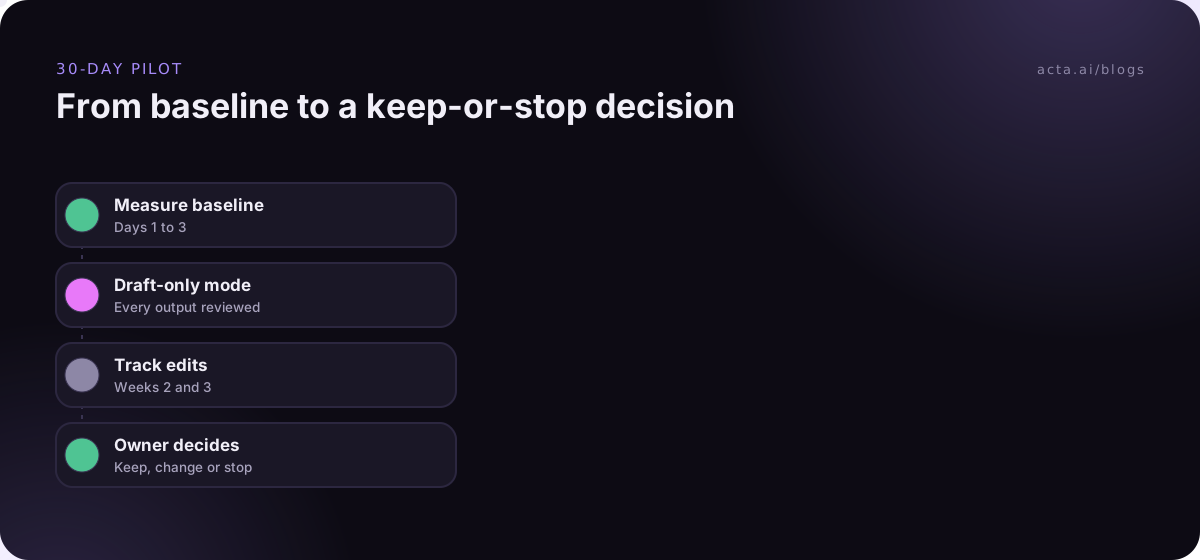
How do you run a 30-day AI agent pilot?
- Days 1 to 3: measure the baseline. How long does the task take now? How often is it late or skipped? Write the numbers down.
- Days 4 to 7: set it up in draft-only mode. The agent produces output, a person reviews every piece, nothing goes out on its own.
- Weeks 2 and 3: track edits. For each draft, note whether it was approved as is, lightly edited or rewritten. Keep a list of the mistakes.
- Week 4: decide. Compare against the baseline. Keep it, change it, or stop it. All three are fine outcomes.
Test without risk before you go live. Our checklist on testing automations without sending anything covers dry runs and sample data, and this post on human approval helps you decide which steps keep a reviewer for good.
If your use case starts from meetings, sort out capture before day one. A desktop recorder like Acta's desktop app records calls from your own computer without a bot joining, which helps when clients are wary of bots. Let participants know they're being recorded; our guide to recording consent covers what to say.
How do you know your AI agent use case is worth keeping?
At the end of the month, you want clear answers to four questions:
- Did the measure you picked actually move?
- Is the edit rate falling, or are people still rewriting most drafts?
- Does the owner want to keep it? Ask directly.
- Did anything go wrong that would have been serious without review?
If you want a more formal structure for the risk side, NIST's AI Risk Management Framework is voluntary and organizes the work into four functions: govern, map, measure and manage. You don't need to adopt all of it for a pilot, but its "map" and "measure" ideas line up well with the scorecard above.
For a wider look at measuring payoff, see how to measure the ROI of AI meeting tools.
What comes after your first AI agent?
Once the first one has run for a month and the owner trusts it, take the runner-up from your scorecard. Reuse what you learned: the same review habit, the same way of measuring, the same approval rules.
Resist the urge to make the first agent do more. "It's great at follow-up emails, let's have it update the forecast too" is how a working agent turns into a failed one. A second, separate agent with its own owner is easier to trust and easier to switch off.
Where Acta fits
A lot of first use cases start from meetings, and that's the part Acta covers. It records Zoom, Google Meet and Teams calls and writes summaries, decisions, action items with owners and follow-up email drafts. Its Agent Builder lets you set up the kind of single-purpose automation described here, and the Agent Builder examples show a few starting points.
Frequently asked questions
What are the most common AI agent use cases for business?
Meeting follow-ups, CRM notes after sales calls, weekly status reports, ticket drafts from engineering meetings, interview scorecards and support case summaries. They all turn messy conversation into a structured draft.
How long should a first AI agent pilot take?
About a month. Shorter and you don't have enough runs to judge; longer and the project loses momentum.
Should IT or the business team pick the first agent?
The business team picks the use case, because they know the chore. IT or ops checks access and permissions. The owner should be someone who does the task today.
Do we need a big budget for a first agent?
No. Many first projects run on tools with free trials or existing plans. Spend your effort on picking the right task and measuring it.
Is agentic AI ready for customer-facing work?
It can draft customer-facing work well. Letting it send without review is a later step, once you have weeks of evidence that its drafts hold up.
To test a meeting follow-up agent on your own calls, start Acta's 15-day free trial.