Hotel daily briefing notes need five blocks, not minutes
A daily briefing note is a short operational record of what each department needs to know and do in the next 24 hours. It isn't minutes. If your notes read like a story, the night manager won't open them.
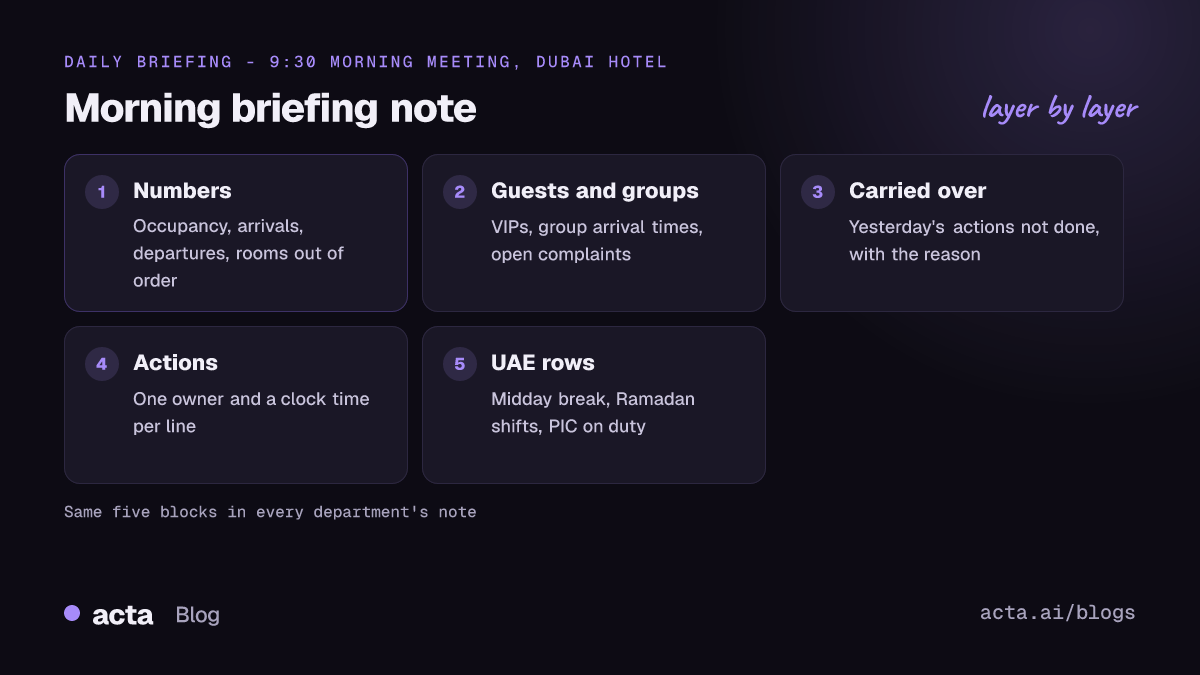
The five blocks that work across almost every property I've seen are:
- Header: date, shift, who chaired, who was missing.
- Today's numbers: occupancy, arrivals, departures, rooms out of order, covers booked in the main outlets.
- Named guests and groups: VIPs, repeat guests with preferences, groups with their arrival time and coach details, guests with an open complaint.
- Carried over: anything from yesterday's actions that isn't done, with the reason.
- Actions: one line each, with one owner and a clock time.
Use the same five blocks in every template below. The carried-over block then becomes your early warning that something keeps slipping.
UAE hotels need a few rows other markets don't
Hotels in Dubai and Abu Dhabi run seven days a week, so the government's Monday-to-Friday week matters less than shift patterns. What does change the briefing is the calendar and the climate.
Summer midday break. As of November 2026, MOHRE's midday break guidance says work under direct sunlight in open areas stops from 12:30 to 3:00 pm between 15 June and 15 September each year, with exemptions for work that can't be stopped for technical reasons. For a hotel, that touches pool and beach teams, gardeners, rooftop engineering jobs and outdoor event set-ups. Add a "midday break impact" row to the engineering and events templates from June so no one schedules a terrace build at 1 pm. This is general information, not legal advice; check MOHRE's page for the current rules and exemptions.
Ramadan hours. MOHRE announces private-sector Ramadan hours each year. For 2026, the ministry announced a two-hour daily reduction for private-sector employees on 12 February 2026. Shift times move and F&B often adds iftar and suhoor service. Use the Ramadan template below and confirm the year's announcement before you plan rosters.
Food safety owner. Dubai Municipality requires food establishments to have a trained Person in Charge (PIC) for food safety. Name the PIC on duty in every F&B pre-service briefing note, so a temperature log gap or supplier issue has an obvious owner.
Languages. English is the working language in most UAE hotels, but a housekeeping huddle may switch to Hindi, Tagalog, Arabic or Malayalam to explain a point. That's fine for the conversation (see notes for multilingual hotel staff), but the written record should be English so every department reads it.
Four front-of-house templates you can copy
These cover the meetings closest to the guest. Copy the block, paste it into your shared notes or your shift log, and delete any line you don't use. Each one starts with when to use it.
1. Hotel morning briefing template (GM or duty manager)
When to use it: the daily operations meeting, usually at 9:00 or 9:30, with all heads of department or their deputies.
Morning briefing, [date] | Chair: [name] | Absent: [names]
Numbers: occupancy [x]%, arrivals [x], departures [x], OOO rooms [x], covers tonight [outlet: x]
VIPs and groups: [name, room, arrival time, special set-up, who greets]
Open complaints: [guest, room, issue, owner, promised time]
Carried over from yesterday: [item, owner, status, reason if not done]
Actions: [action, owner, time]
2. Front office pre-shift briefing
When to use it: the five-minute line-up at the start of each front office shift, morning and evening.
Front office line-up, [shift] | Supervisor: [name]
Arrivals before 14:00 that need an early room: [names, rooms, status]
Late checkouts approved: [rooms, times]
Upsell focus today: [room type or package]
Watch list: [guest preference, complaint, payment issue]
Actions: [action, owner, time]
3. Housekeeping briefing
When to use it: the morning housekeeping line-up before room attendants collect their sections.
Housekeeping briefing, [date] | Executive housekeeper or supervisor: [name]
Priority rooms (early arrivals, VIPs): [rooms, ready-by time]
Rooms out of order and why: [room, issue, engineering ticket]
Lost and found to return: [item, guest, owner]
Supplies short: [item, quantity, who orders]
Actions: [action, owner, time]
4. Guest relations and concierge huddle
When to use it: after the morning meeting, when guest relations splits the VIP and complaint follow-ups.
Guest relations huddle, [date]
Courtesy calls today: [guest, room, reason, who calls]
Amenities and set-ups: [room, item, by when]
Recovery promised to guests: [guest, what was promised, by whom]
Actions: [action, owner, time]
The "recovery promised" line in the last template matters most. Most repeat complaints start with a promise one shift made and the next shift never heard about.
Four back-of-house and commercial templates
5. Engineering and maintenance huddle
When to use it: the engineering team's morning huddle, right after the morning meeting.
Engineering huddle, [date] | Chief engineer or duty engineer: [name]
Guest-room jobs, priority order: [room, fault, technician, target time]
Rooms out of order: [room, reason, expected back in service]
Public area and plant: [item, status]
Midday break impact (15 June to 15 September): [outdoor jobs moved, new time]
Contractors on site: [company, area, escort]
Actions: [action, owner, time]
6. F&B pre-service briefing
When to use it: before breakfast, lunch or dinner service in each outlet.
[Outlet] pre-service, [meal], [date] | Manager: [name] | PIC on duty: [name]
Covers booked, large tables, birthdays: [details]
Allergies and dietary requests: [table or room, requirement]
86 list and specials: [items]
Food safety notes: [temperature logs, deliveries, issues]
Actions: [action, owner, time]
7. Daily revenue meeting
When to use it: the short daily pick-up review with the revenue manager, front office manager and sales.
Daily revenue meeting, [date]
Pick-up since yesterday: [nights or segments, as your system shows them]
Next 14 days, dates that need action: [date, issue, idea]
Rate or restriction changes agreed: [what, channel, who updates, by when]
Groups and events pending: [name, decision needed, by when]
Actions: [action, owner, time]
Write rate decisions in full ("close the lowest rate on [date] on all channels, Sophie, by 12:00"), never as "closed out". The record should still make sense when the decision is questioned a week later.
8. Ramadan or event-day briefing
When to use it: during Ramadan, and on days with a major event, a long weekend or a national holiday.
Special-day briefing, [date]
Shift times today: [department, start, end, as per this year's announcement and your roster]
Iftar and suhoor service, or event timings: [outlet, time, covers]
Extra staff and transport: [who, where, pick-up time]
Guest communication: [what front office tells guests about outlet hours]
Actions: [action, owner, time]
Here's a quick summary of which template fits which meeting.
| Template | Who runs it | When | The line people skip |
|---|
| Morning briefing | GM or duty manager | Daily, before 10:00 | Carried over |
| Front office line-up | FO supervisor | Each shift | Watch list |
| Housekeeping briefing | Executive housekeeper | Before sections start | Ready-by times |
| Guest relations huddle | Guest relations manager | After morning meeting | Recovery promised |
| Engineering huddle | Chief or duty engineer | After morning meeting | Midday break impact |
| F&B pre-service | Outlet manager | Before each service | PIC on duty |
| Daily revenue meeting | Revenue manager | Daily | Who updates channels |
| Special-day briefing | Duty manager | Ramadan, events, holidays | Transport times |
A filled example from a Downtown Dubai morning meeting
Here's what the morning template looks like once it's filled in. The hotel and names are illustrative.
Morning briefing, Tuesday | Chair: Rashid Al Mansoori (hotel manager) | Absent: spa (Maria Kowalski on leave, deputy sent notes)
Numbers: occupancy high, 112 arrivals, 98 departures, 3 rooms out of order (1412 AC, 0907 bathroom leak, 1630 carpet), 240 covers booked for dinner across two outlets.
VIPs and groups: corporate group of 38 arriving 14:30 by coach, rooming list confirmed, welcome desk in the lobby (Priya Nair). Repeat guest in 2204, feather-free pillows (Joel Santos).
Open complaints: room 1118, noise from the terrace set-up last night; GM letter and late checkout promised (Priya, by 10:30).
Carried over: lobby restroom tap fixed (done). Minibar restock on floor 15 (not done, supplier late, Layla Haddad chasing).
Actions:
1. Ahmed Farouk: 1412 AC fixed or guest moved, 11:00.
2. Joel Santos: group rooms on floors 18 and 19 inspected and released, 13:30.
3. Layla Haddad: confirm minibar delivery time with supplier, update GM, 12:00.
4. Sophie Martin: close the lowest rate for Friday on all channels, 12:00.
5. Priya Nair: GM letter and late checkout to 1118, 10:30.
Notice what's missing: no paragraph on why the AC failed, no debate about the terrace. The morning note is today's to-do list with just enough context.
Capture in-person briefings on a phone and keep the record in English
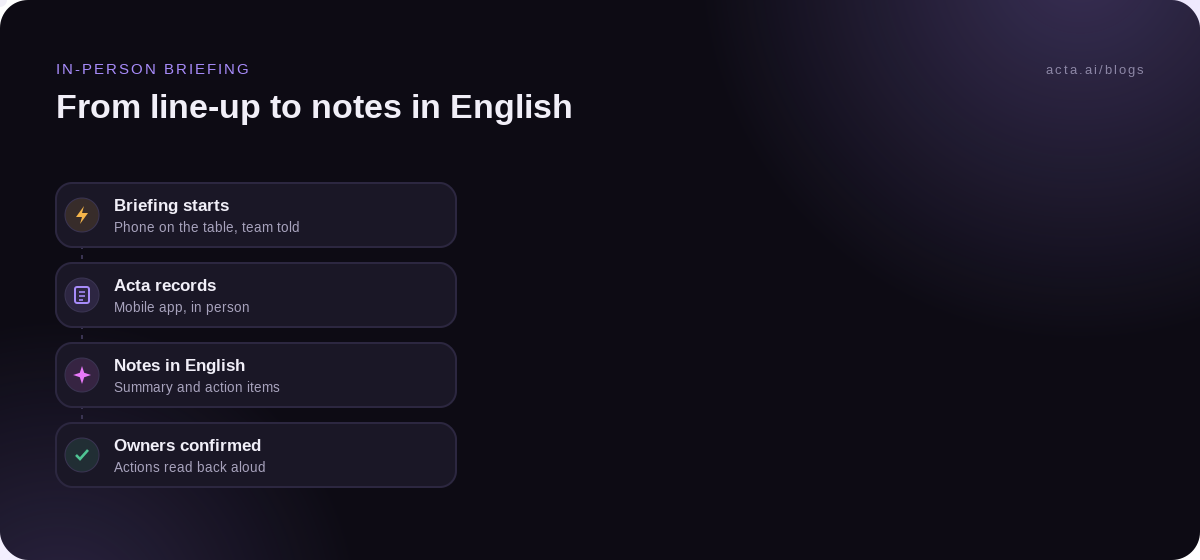
Most hotel briefings happen standing in the back office or the staff canteen, not on a video call. The simplest capture method is a phone on the table. Acta's mobile app for iPhone and Android records in-person meetings and turns them into a summary, decisions and action items with owners; the mobile apps guide shows the steps.
Before you record, tell the team, every time. Say "I'm recording this briefing for the notes" at the start. The UAE PDPL recording guide covers consent and notices, and recording consent basics covers the general rules.
Language is where UAE briefings get tricky, so be honest about the limits. Acta supports 15 meeting languages. English and Hindi (including Hindi-English mixes) are picked up on Auto. Arabic works in beta, and you have to choose it in Settings because Auto won't pick it. Urdu, Malayalam and Tagalog aren't supported yet, so a huddle held mostly in Tagalog won't transcribe well. The practical fix is to run the briefing in English and let people explain in their own language off the record. Then set "Language for my notes" to English so a Hindi-heavy housekeeping huddle still produces English notes. The meeting languages guide shows where the setting lives.
Two habits make recorded briefings far more useful. Say names with tasks ("Joel, floors 18 and 19 by half past one"), because the notes can only assign an owner who was named. And read the action list back at the end; that 30 seconds catches most mistakes before they reach the record.
Housekeeping and engineering actions close only with an owner and a time
The note is only as good as what happens at 11:00 when the AC in 1412 is or isn't fixed. A shared sheet, a WhatsApp group or the property system's task module all work if every action has one owner and a time, and someone checks the list before the evening shift.
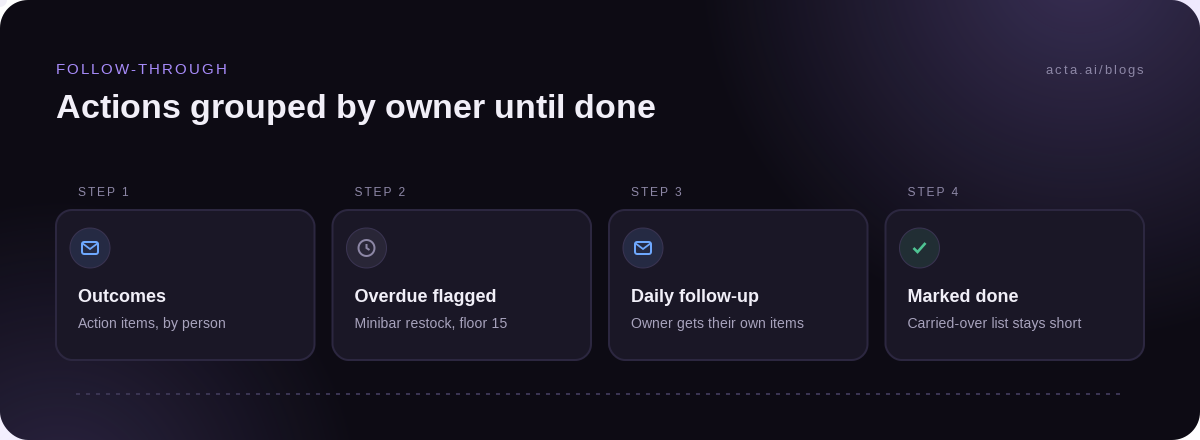
If you record briefings in Acta, the actions from every meeting land in one place: My meetings, then Outcomes, then Action items. Group by Person to see everything Joel or Ahmed owes across the morning meeting and the department huddles, and use the Overdue tile to see what slipped. You can also turn on a daily follow-up email so each owner gets a reminder of their own open items until they're done. Tick an item as done once it's fixed so tomorrow's carried-over block stays short.
For handing over between shifts, combine this with a proper handover note; the shift handover notes template post has seven examples, including night-to-morning formats that pair well with the morning briefing.
Four briefing note mistakes that cost you the next day
- Writing departments, not people. "Housekeeping to check" gives nobody the task. Write the supervisor's name.
- Dropping the carried-over block. Without it, the same leaking shower appears in three briefings and nobody notices the pattern.
- Keeping the record in a WhatsApp thread only. Chats are fine for quick replies, but a decision buried in 200 messages is hard to find when a guest disputes a promise. Copy the final note somewhere searchable.
- Ignoring the calendar. The midday break and Ramadan hours change who can do what and when. Put those rows in the templates before the season starts, not on the first hot day.
Where Acta fits in a hotel briefing routine
Acta records the briefing on a phone, or on a laptop for calls with owners and head office, and writes the summary, decisions and action items with owners afterwards. Its hotels page and the UAE page show how other teams set it up. It won't replace your property system or your shift log; it saves the person chairing from writing the note by hand.
Frequently asked questions
What should hotel daily briefing notes include in the UAE?
Hotel daily briefing notes in the UAE should include the date and shift, today's numbers, VIPs and groups, issues carried over from yesterday, and actions with one owner and a clock time each. Add UAE rows where they apply: the summer midday break for outdoor teams, Ramadan shift times, and the food safety Person in Charge on duty for F&B.
How long should a hotel morning briefing take?
Most hotel morning briefings in Dubai and Abu Dhabi work best at 10 to 15 minutes. Read only exceptions: VIPs, groups, rooms out of order, open complaints and anything carried over. Detailed discussions, such as why a fault keeps recurring, belong in the weekly department heads meeting, not the daily briefing.
Is a pre-shift briefing different from a handover?
Yes. A pre-shift briefing tells the incoming team what to focus on during the shift: arrivals, guests to watch, specials or priority rooms. A handover passes open issues from one shift to the next. Hotels in the UAE usually need both, and the handover's open items should feed the next morning's carried-over block.
Can I record a housekeeping briefing held in Hindi or Arabic?
With Acta, yes for Hindi, which is detected automatically, and Arabic, which is in beta and must be selected in Settings. Urdu, Malayalam and Tagalog aren't supported yet. For UAE hotel teams, set the notes language to English so the written record is readable by every department, while the transcript stays in the spoken language.
Who should own the daily revenue meeting notes?
The revenue manager should own the daily revenue meeting notes at a UAE hotel, because they track rate and restriction changes. Each change needs the channel, who updates it and by when. The front office manager should read the notes before the evening shift so desk staff quote the right rates.
The best template is the one your duty managers still use in August. Start small and add rows only when a real problem shows you need them.
- Pick two templates first: the morning briefing and the housekeeping briefing cover most daily problems.
- Fix the five blocks: header, numbers, named guests, carried over, actions with owner and time.
- Add the UAE rows: midday break impact from June, Ramadan shift times once MOHRE announces them, PIC on duty for F&B.
- Decide the language of record: English for the written note, whatever language people use to explain.
- Check actions twice a day: once at noon and once before the evening shift starts.
To try it on your own briefings, record the next one on the mobile app, or use the Acta desktop app for revenue calls with head office on Teams or Zoom; both are in the 15-day free trial.