European sales calls notes need one CRM language
A pan-European pipeline review falls apart quickly if half the deal notes are in French and the other half in German. The forecast call runs in English, the VP of sales reads English, and the CRM's reports group by fields that someone has to fill in consistently. So the record needs one language, even though the calls behind it can't have one.
The usual workaround is that reps translate from memory: they take the call in Italian, then type a short English note into the CRM that evening. That's where detail gets lost. "They're interested but need to check with procurement" might have been a polite brush-off, a real process step or a sign that the champion has no budget authority, and an English paraphrase written six hours later won't tell you which. Good European sales calls notes keep the original words alongside the English summary.
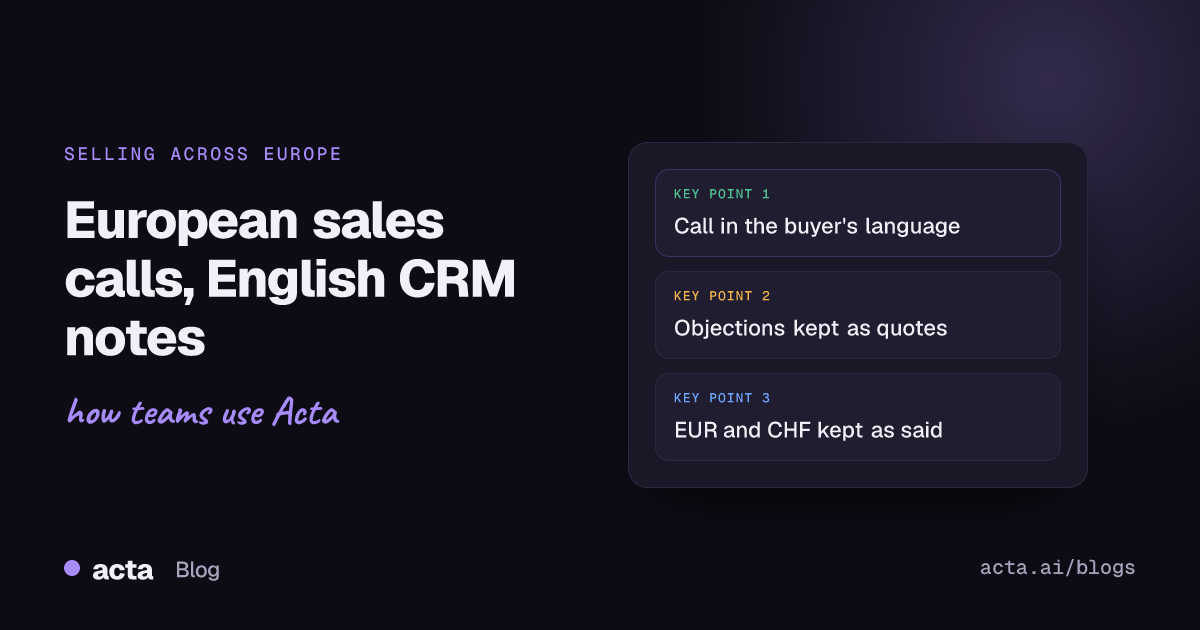
Acta separates the two jobs. The transcript records the call in its spoken language; the notes, meaning the summary, deal fields, action items and follow-up email draft, are written in English when the rep chooses English. Quotes stay in the language they were spoken in.
Each rep's language setting follows their territory
In a multilingual sales team, language lives in each person's settings (Settings > Meetings > Language), so set it up rep by rep, matched to their territory:
| Territory | Language spoken in meetings | Language for my notes |
|---|
| DACH (Germany, Austria, German-speaking Switzerland) | Auto or German | English |
| France, Wallonia, Romandy | Auto or French | English |
| Spain | Auto or Spanish | English |
| Italy, Ticino | Italian (beta) | English |
| Netherlands, Flanders | Dutch (beta) | English |
| Portugal (and Brazil) | Portuguese (beta) | English |
| Nordics, Poland, Czechia, Greece | English (calls in the local language aren't supported) | English |
Acta detects English, Hindi, French, Spanish and German automatically; ten more languages can be chosen in Settings. Auto suits reps whose calls move between English and one of the automatic languages. A Munich rep who does German calls with customers and English calls with the partner team can stay on Auto. A rep covering Italy can't: Auto never picks a beta language, so every Italian call on Auto comes back wrong. Beta means the language works and accuracy is still improving, so those reps should read their first few transcripts carefully.
The setting applies to new meetings. A rep who covers both France and the Netherlands needs to switch to Dutch before a Rotterdam call and back to Auto afterwards. The language chip on each meeting page, with its "Change language" link, makes a missed switch easy to spot. The full list of 15 languages is in the help article on meeting languages.
Write deal notes in English, quote the buyer in their language
English deal notes should carry the same fields as any good call record: pain, budget, timeline, decision process, competition and next step. What changes in Europe is how you treat objections and commitments. Keep the buyer's own sentence as a quote, then add an English line. Examples of the kind of thing buyers say, each with a gloss:
- German: "Das ist uns zu teuer." (That's too expensive for us.) Price, stated plainly.
- French: "Il faut que j'en parle à mon directeur financier." (I need to talk to my finance director about it.) A second decision maker you haven't met.
- Spanish: "Ahora mismo no es una prioridad." (Right now it isn't a priority.) A timing objection.
- Italian: "Ci dobbiamo pensare." (We need to think about it.) Often a soft no; probe it on the next call.
- Dutch: "We zitten nog vast aan een contract tot juni." (We're still tied to a contract until June.) A dated opening.
- Portuguese: "Precisamos da aprovação da direção." (We need management approval.) Another stakeholder.
The reason to keep the quote is that tone and directness differ. A German "zu teuer" and an Italian "ci dobbiamo pensare" can both get flattened into "pricing concern" in English, when one is a negotiating position and the other may be a polite exit. A manager who doesn't speak the language still benefits, because the rep's gloss sits next to the original and anyone who does speak it can check.
The guide to Hindi sales call notes for the CRM uses the same principle for lakh and crore budgets in India; the European version just has more languages and two currencies.
Amounts stay in euros or francs exactly as the buyer said them
Acta keeps names, numbers, dates, amounts and product names as they were said. It doesn't convert currencies or reformat figures. For European sales that's the right behaviour, because the amount the buyer said is evidence and the converted amount is your interpretation.
Two currencies come up constantly. Most of the EU's big markets are among the countries that use the euro (the ECB keeps a map of the euro area), but Switzerland prices in Swiss francs, and Polish, Swedish or Czech prospects may quote in their own currencies even when the call runs in English. If a Zurich buyer says "CHF 60'000 pro Jahr", that's what the notes keep. The rep converts it for the CRM amount field.
VAT wording matters just as much and is easy to lose in translation:
- French: "HT" (hors taxes, excluding tax) versus "TTC" (all taxes included).
- German: "netto" (excluding VAT) versus "brutto" (including VAT).
- Spanish and Portuguese: "IVA incluido" or "sem IVA" (VAT included, or without VAT).
- Italian: "IVA esclusa" (VAT excluded).
- Dutch: "excl. btw" (excluding VAT).
Because the notes keep "45.000 euros HT" as said, a finance reviewer can see the figure excludes tax. Make it a habit that every amount in a deal note carries a currency and, where it was mentioned, the tax basis.
A worked example: a French discovery call logged in Salesforce
An illustrative example, not a customer story. Daan is an account executive in Amsterdam who covers France and Benelux for a warehouse-software company. He has a 40-minute discovery call on Google Meet with Claire, head of operations at a logistics firm near Lyon, and her colleague Julien from IT. It's a sales call in French from start to finish, the easy case. Daan's settings: Auto (French is detected) and English notes.
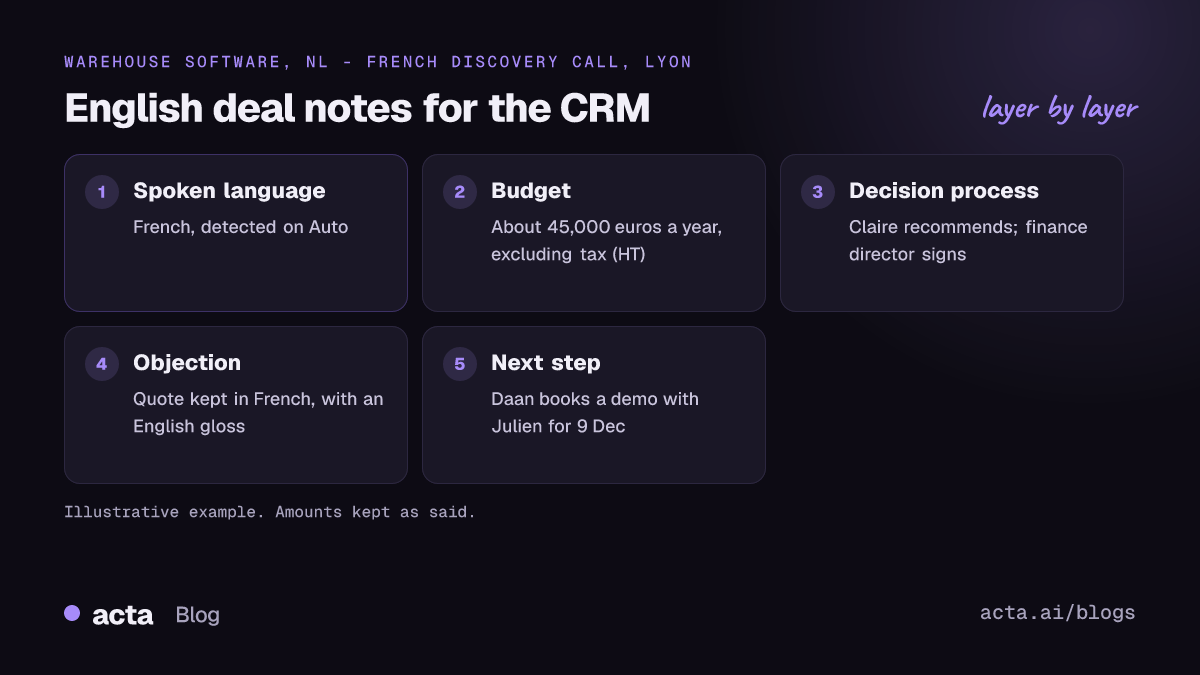
The English deal notes that come back look roughly like this:
Pain: picking errors at the Saint-Priest site during peak season; returns handled by hand.
Budget: "autour de 45 000 euros HT par an" (around 45,000 euros a year, excluding tax).
Decision process: Claire recommends; the finance director signs off. Quote: "Il faut que j'en parle à mon directeur financier."
Timeline: wants to go live before the February peak.
Next step: Daan sends a reference contact in the Netherlands and books a demo with Julien for 9 December.
Daan's English summary is ready for the CRM, and the French transcript is there if his manager or a French-speaking colleague wants to check what Claire actually said about the finance director. Daan fills the CRM amount field himself after confirming that the 45,000 excludes tax.
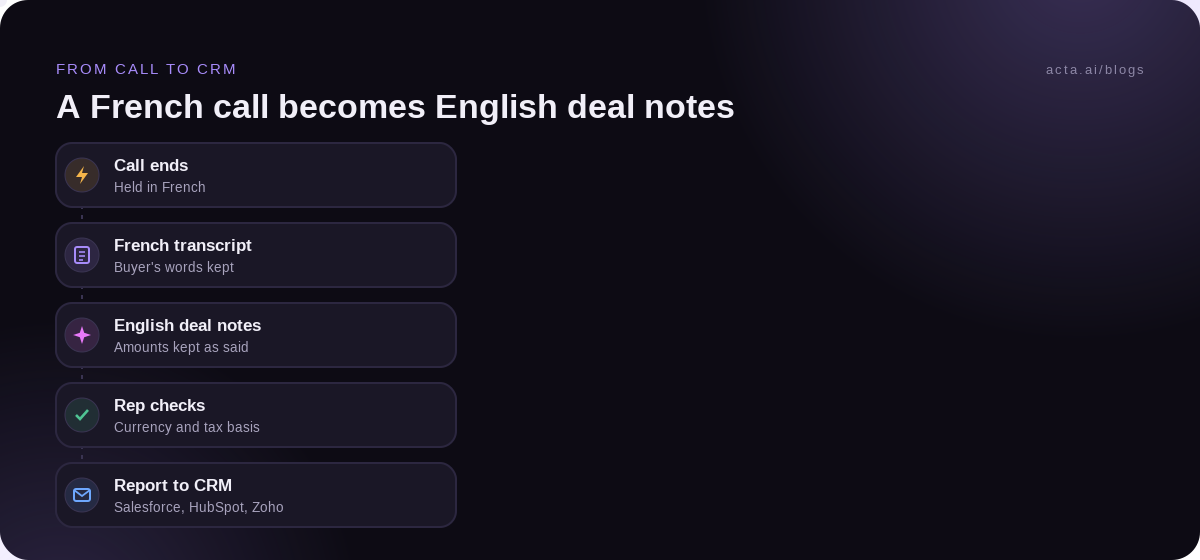
Send the notes to Salesforce, HubSpot or Zoho
Acta integrates with Salesforce, HubSpot and Zoho, and the CRM integration guide shows how meeting reports reach each one. The report goes in the notes language, so with notes set to English, every rep's calls arrive in English whichever language they were held in. Our walk-through on updating the CRM after a sales call covers the field mapping in more detail.
Sales teams that qualify with a framework can use a built-in report template such as MEDDPICC or BANT qualification, or build their own, and the template is filled in the notes language. That's useful in Europe because the template's structure stays fixed across reps: the Madrid rep's MEDDPICC report and the Munich rep's have the same sections in the same order, in English, even though one call was in Spanish and the other in German. The Acta sales page shows the MEDDPICC call notes.
One thing to check before go-live: field-level data that your CRM validates, such as amount or close date, still needs a rep to fill it from the notes. Treat the meeting report as the evidence attached to the opportunity, not as the field values themselves.
Managers can review calls they don't speak
A sales manager in London with reps in five countries can't listen to Italian and Dutch calls. English notes solve most of that, and OneChat covers the rest: it answers in the language you ask in, so a manager can ask in English "Which deals this month mentioned a competitor's contract ending?" across calls held in German, French and Spanish, and get an English answer with sources from the meetings.
For deeper coaching, the original language still matters. If a deal is stuck on a phrase like "ci dobbiamo pensare", ask a colleague who speaks Italian to read that part of the transcript. The quotes in the notes tell you where to look. Our guide on coaching from call recordings has a review routine that works in any language.
Ask for recording consent in the buyer's language
Tell buyers you're recording, at the start of the call and in their language. It's good practice and in many places the law; this isn't legal advice, and our guide on recording consent and what to tell participants covers the basics. One short sentence per language is enough for most calls:
- French: "Ça vous dérange si j'enregistre l'appel pour mes notes ?" (Do you mind if I record the call for my notes?)
- German: "Ist es in Ordnung, wenn ich das Gespräch für meine Notizen aufzeichne?" (Is it OK if I record the conversation for my notes?)
- Spanish: "¿Le parece bien si grabo la llamada para mis notas?" (Is it all right if I record the call for my notes?)
- Italian: "Le va bene se registro la chiamata per i miei appunti?" (Is it OK with you if I record the call for my notes?)
- Dutch: "Is het goed als ik het gesprek opneem voor mijn notities?" (Is it OK if I record the conversation for my notes?)
If a buyer's IT blocks meeting bots, a rep can record from their own computer with the Acta desktop app, which has a Copy notice button for pasting a recording notice into the meeting chat. For the data-protection side in the EU, the GDPR checklist for AI note takers is useful general reading for RevOps and legal.
Where Acta fits
Acta records sales calls on Zoom, Google Meet and Microsoft Teams with or without a bot, transcribes them in the language spoken, and writes English deal notes, action items with owners and a follow-up email draft. Reports go to Salesforce, HubSpot or Zoho, and Acta doesn't use customer data to train AI models.
Frequently asked questions
Can I get English CRM notes from a German or French sales call?
Yes. Set "Language for my notes" to English. German and French are detected automatically, so the rep can stay on Auto. The transcript stays in German or French, the deal notes and follow-up email draft are written in English, and buyer quotes stay in the original language. The report can then go to Salesforce, HubSpot or Zoho.
Which European languages work for sales call notes?
English, French, German and Spanish are detected automatically. Italian, Dutch and Portuguese are beta languages a rep chooses in Settings. Swedish, Danish, Finnish, Polish, Czech, Greek and other European languages aren't supported, so calls in those markets need to run in English or be noted by hand.
Does Acta convert euros or Swiss francs in the notes?
No. Amounts are kept exactly as the buyer said them, in euros, Swiss francs or any other currency, and words like "HT" or "netto" stay too. That keeps the notes accurate as evidence. The rep converts the figure and fills in the CRM amount field after checking the tax basis.
Can each rep use a different call language?
Yes. The language setting is in each person's account, so a Madrid rep can stay on Auto for Spanish while a Milan rep chooses Italian. All reps should set their notes to English so the CRM stays in one language. Reps who cover two languages switch the setting before each call, since it applies to new meetings only.
What happens if a call switches from French to English halfway through?
Acta handles one language per meeting, so choose the language most of the call will be in. A buyer who drops in a few English product terms is fine, but a long English section on a French setting won't come out well. If you know a call will run mostly in English, leave the setting on Auto or English.
How should European sales calls notes handle objections?
Keep the objection as a quote in the buyer's language, then add a one-line English gloss. Acta keeps quotes as spoken even in English notes, so the rep only has to add the interpretation. That way a manager sees both the original words and the rep's reading of them, and can ask a native speaker if a deal hinges on it.
Set up your European sales team
Roll this out in a sprint, not a quarter. The checklist:
- Map reps to languages: list each rep's territory and set their spoken language (Auto, or the beta language by name).
- Fix the notes language: English for every rep, so the CRM and the forecast read the same way.
- Agree the deal note fields: pick one template, such as MEDDPICC, and use it for every country.
- Set the money rule: every amount carries a currency and tax basis; reps convert for the CRM field.
- Script the consent line: one sentence per language, said at the start of every recorded call.
To test it on your own pipeline, add the Acta Chrome extension for calls in the browser and start the 15-day free trial.