For a DPDP Act meeting recording, the short version is this: a recording or transcript of a call is digital personal data, so the organisation that decides to record it needs a lawful ground (usually consent, sometimes a "legitimate use" such as employment), must give a clear notice, keep it secure, delete it when the purpose is done and report breaches. Most of these duties apply in full once the DPDP Rules 2025 finish phasing in.
Privacy & Security 13 min read
DPDP Act Meeting Recording: What Indian Teams Need to Know
What India's DPDP Act and the DPDP Rules 2025 mean when you record or transcribe meetings: lawful ground, notice, vendors, retention and breaches.
By Sarma BKP, Founder & CEO, Acta · Updated
This guide is for Indian companies, and companies with Indian clients or staff, that record Zoom, Teams or Google Meet calls or use an AI notetaker. It explains what the Digital Personal Data Protection Act, 2023 and the Rules say in plain English, gives you a notice you can copy and walks through one real-world setup. It's general information, not legal advice: if you handle health data, children's data or very large volumes, talk to a lawyer who works on the DPDP framework.
Key takeaways
- A meeting recording, its transcript and the AI summary are all personal data under the DPDP Act when people in them can be identified.
- Your company is the data fiduciary; the notetaker vendor is usually a data processor that acts on your instructions under a contract.
- Use consent for clients, candidates and vendors; for employees in internal meetings, check whether the Act's "employment purposes" legitimate use covers the recording.
- The DPDP Rules 2025 were notified in November 2025 with an 18-month phased timeline, so core notice, security and breach duties apply from May 2027.
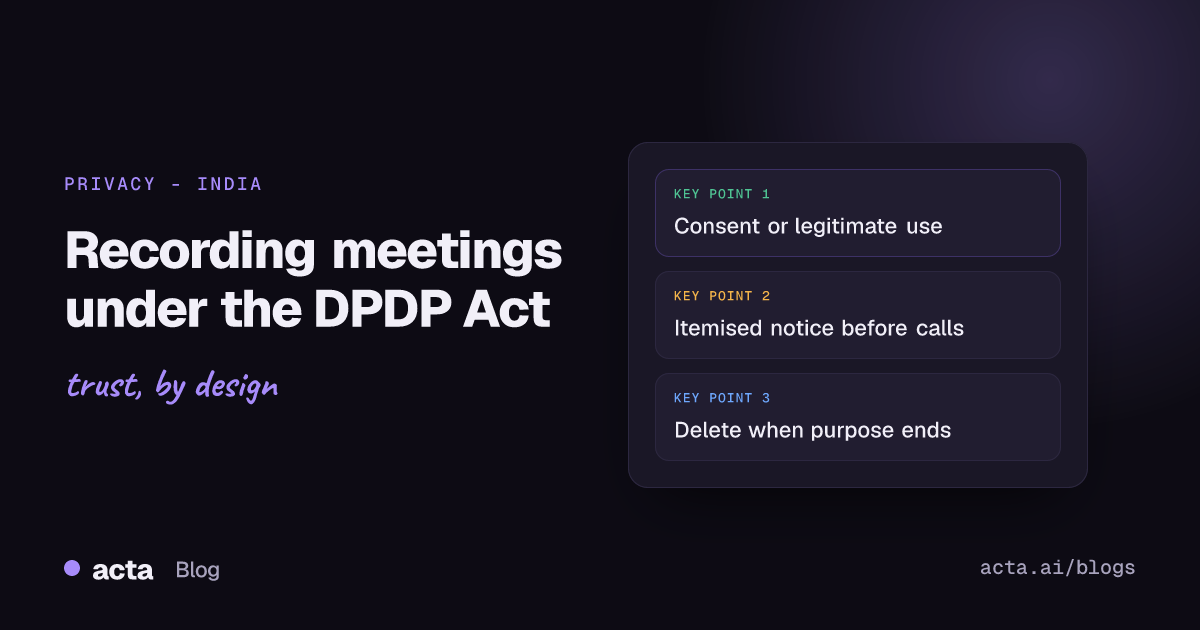
- Set a retention period for recordings now (for example 90 days for routine calls) and delete on schedule; keeping everything forever is the riskiest default.
Table of contents
- A meeting recording is personal data under the DPDP Act
- The DPDP Rules 2025 phase in over 18 months
- Every recording needs consent or a legitimate use
- A good consent notice is short, itemised and sent before the call
- Your AI notetaker vendor is a data processor you must control
- Retention, erasure and breach duties cover every stored file
- A worked example: a Bengaluru team's weekly client call
- Common mistakes with recordings under the DPDP Act
- Frequently asked questions
- Set up a DPDP-ready recording routine
A meeting recording is personal data under the DPDP Act
The Digital Personal Data Protection Act, 2023 (the DPDP Act) is India's general data protection law. It covers personal data in digital form, and personal data collected offline that is later digitised. Personal data is any data about an individual who can be identified by or in relation to that data. A video call recording ticks every box: it holds voices, often faces, names on screen, and whatever people say about themselves or others. The transcript and the AI-written summary carry the same information in text form, so they count too. You can read the full Act on the government's Law as Code page for the DPDP Act.
Three roles matter. The data principal is the person the data is about: each participant whose voice or name ends up in the file. The data fiduciary is whoever decides why and how the data is processed, which is normally the company that chooses to record. The data processor processes data on the fiduciary's behalf, which is where your transcription or notetaker vendor usually sits. Your company stays answerable for the recording even though the vendor stores it.
One exemption: the Act doesn't apply to data processed by an individual for a personal or domestic purpose, like a family video call. A client call recorded for your employer doesn't qualify, even on your own laptop.
The Act isn't a call-recording statute, though. It sets data protection duties that apply once the recording exists; for any DPDP Act meeting recording question, that's the lens. For the separate question of when recording a conversation is allowed at all, see our plain-English overview of meeting recording laws by country.
The DPDP Rules 2025 phase in over 18 months
The Act passed in August 2023 but most of it needed rules before it could work. The Ministry of Electronics and Information Technology (MeitY) notified the Digital Personal Data Protection Rules, 2025 in November 2025, and the PIB release on the notified DPDP Rules describes an 18-month phased compliance timeline. Legal commentary such as SCC Online's summary of the notified Rules breaks that into three stages.
| Stage | What starts | What it means for recordings |
|---|---|---|
| On notification (November 2025) | Definitions and the Data Protection Board provisions | The Board can be set up; your duties are not yet fully in force |
| One year later (November 2026) | Registration of consent managers | Little direct effect on meetings unless you use a consent manager |
| 18 months after notification (May 2027) | Notice, consent, security safeguards, breach intimation, retention and erasure | Your recording policy, notices and vendor contracts need to be ready |
As of November 2026, most obligations aren't yet enforceable, but you have roughly six months. Policies, invite templates and vendor contracts take longer to change than people expect. Check MeitY's notifications for any change to the timeline.
The PIB backgrounder on the Rules also covers penalties. The Schedule to the Act sets maximum penalties that the Data Protection Board can impose after an inquiry, with the highest band for failing to take reasonable security safeguards and a separate band for failing to report a breach. The PIB note on the DPDP Rules says any other violation by a data fiduciary may attract penalties up to Rs 50 crore. These are ceilings set by the Board case by case, not fixed fines.
Every recording needs consent or a legitimate use
Under the Act you can process personal data only for a lawful purpose, and only with consent or for one of the listed "legitimate uses". For meetings, those are the two doors you'll use.
Consent under section 6 has to be free, specific, informed, unconditional and unambiguous, given with a clear affirmative action, and limited to the data needed for the stated purpose. People must be able to withdraw it as easily as they gave it. Silence is a weak basis; an explicit "yes, go ahead" is much stronger. The fiduciary carries the burden of proving that a notice was given and consent obtained, so keep evidence.
Legitimate uses in section 7 let you process data without consent in specific situations. The one that matters most for meetings is processing for employment purposes. An internal training session, an incident review or a team stand-up may fit, depending on why you record it. A recording kept for a use that goes beyond employment, such as using staff interviews in marketing, needs its own basis. Commentators disagree on how wide the employment ground is, so be conservative.
Rule of thumb: clients, prospects, candidates, vendors and anyone outside your organisation: get consent. Employees in internal meetings: you may rely on the employment legitimate use where it genuinely applies, but still give notice. Children (anyone under 18 under the Act): verifiable consent of a parent or lawful guardian, which affects edtech classes and school meetings.
A good consent notice is short, itemised and sent before the call
When you ask for consent, the Act requires a notice that tells the person what personal data you'll process and why, how they can withdraw consent and exercise their rights, and how to complain to the Data Protection Board. According to legal summaries of Rule 3, the notice must stand on its own, be written in clear and plain language, and give an itemised description of the personal data and the specific purpose.
For meetings, put the notice in the calendar invite and repeat a short version at the start of the call. Here's a template you can adapt. Fill in the brackets, and have your counsel check the wording against your own policy.
Recording notice: [Company] would like to record and transcribe this meeting. We will process: the audio recording, a written transcript with speaker names, and an AI-generated summary with action items. Purpose: to keep an accurate record of decisions and follow-ups for [project or account]. We keep recordings for [90 days] and summaries for [the length of the engagement], then delete them. Our transcription provider [vendor name] processes the data for us under contract. You can say no, or withdraw consent at any time, by telling [name] or emailing [privacy contact]; we will stop recording and delete what we hold unless a law requires us to keep it. You can also contact our Grievance Officer at [email] or complain to the Data Protection Board of India.
At the start of the call, ask: "We record and transcribe these calls for our notes, details are in the invite. Okay with everyone?" If someone objects, stop recording and take manual notes. Our guide on AI notetaker disclosure emails for clients has more wording you can borrow, and the broader question of consent is covered in is it legal to record meetings with AI.
Your AI notetaker vendor is a data processor you must control
The Act lets a data fiduciary engage a data processor only under a valid contract, and your company stays responsible for what the vendor does on your behalf.
Before you roll a tool out, get written answers to these questions:
- Is there a data processing agreement, and does it say the vendor processes data only on your instructions?
- Does the vendor use your recordings or transcripts to train AI models? If yes, can you switch it off?
- Where is data stored and processed, and which sub-processors (cloud host, speech-to-text provider, language model provider) touch it?
- Can admins set retention periods and delete a single meeting, or a single person's data, on request?
- How fast will the vendor tell you about a breach, and what information will it give you?
- Who in your workspace can see a recording by default, and can that be narrowed?
On cross-border transfer, section 16 of the Act lets the Central Government restrict transfers to countries it notifies, and sector regulators can set stricter rules, so check both before assuming a foreign-hosted tool is fine. If your team also works with EU clients, our GDPR checklist for AI note takers covers the EU side, and what happens to meeting data inside AI tools explains the processing chain in more detail.
Retention, erasure and breach duties cover every stored file
A data fiduciary must erase personal data once the data principal withdraws consent or once it's reasonable to assume the purpose is no longer being served, unless a law requires you to keep it, and must make its processor erase it too. For meetings, that means a recording you made "for the notes" shouldn't sit on a server for five years. A sensible starting point: routine internal calls 30 to 90 days, client calls for the life of the contract, and anything tied to a dispute or regulation as long as that law says. Our guide on meeting recording retention helps you split audio, transcript and summary, which often deserve different periods.
Security safeguards are the other big duty. Summaries of Rule 6 list measures such as encryption or masking, access controls, logs that let you investigate unauthorised access, backups and contract terms with processors. Many summaries also say Rule 6 asks fiduciaries to keep logs for a year for investigation purposes. In practice, limit who can open recordings and remove leavers' access on their last day.
If a personal data breach happens, for example a shared recording link ends up public, the Act requires you to inform the Data Protection Board and each affected data principal. The PIB summary of the Rules says the notice to individuals should explain in plain language what happened, its likely consequences, the steps taken and whom to contact. Agree with your vendor now how they'll tell you, so you can meet your own duty.
A worked example: a Bengaluru team's weekly client call
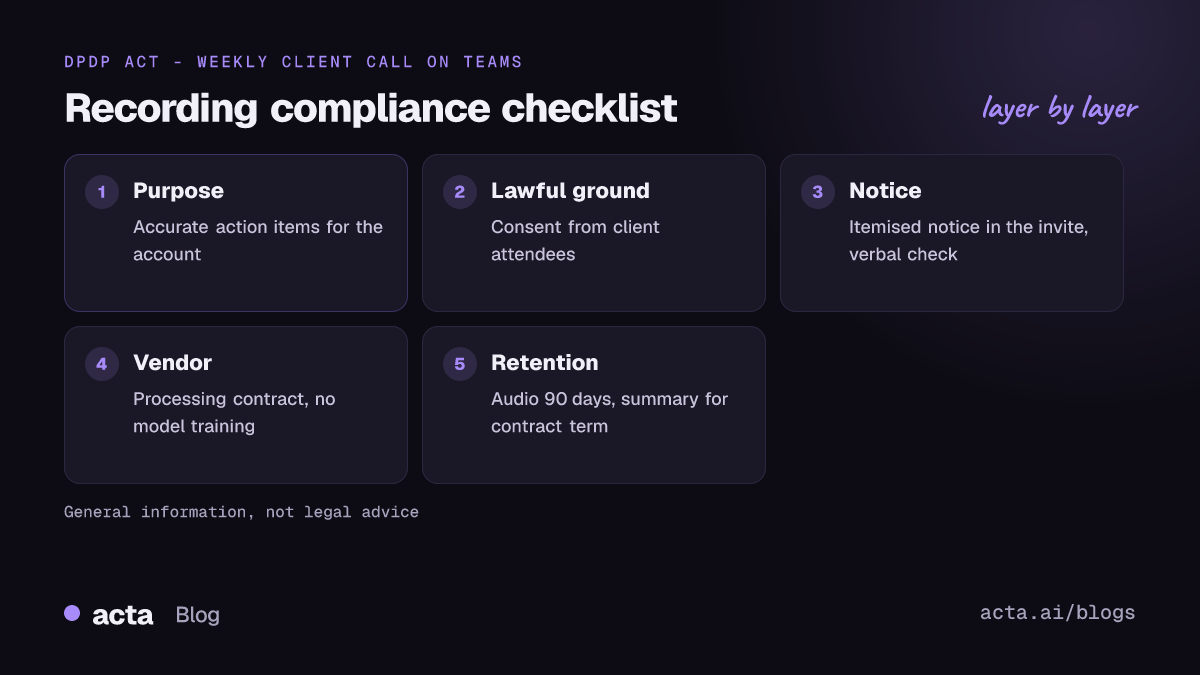
Here's how one setup could look. Take an illustrative eight-person customer success team in Bengaluru that runs a weekly Teams call with a client in Pune and uses an AI notetaker for summaries and action items.
- Purpose: the team writes down why it records: accurate action items and a searchable history of decisions for the account.
- Ground: the client's people are outsiders, so the team asks for consent. The calendar invite carries the notice above, and the account manager confirms verbally at the start of the first call and notes it in the CRM.
- Vendor: procurement signs a data processing agreement with the notetaker vendor, confirms customer data isn't used to train models and lists sub-processors.
- Retention: audio is deleted after 90 days; the written summary and action items stay until the contract ends plus six months.
- Rights: when a client contact leaves their company and asks for deletion, the team removes the recordings they appear in and asks the vendor to confirm. The PIB release says fiduciaries must respond to such requests within a maximum of 90 days.
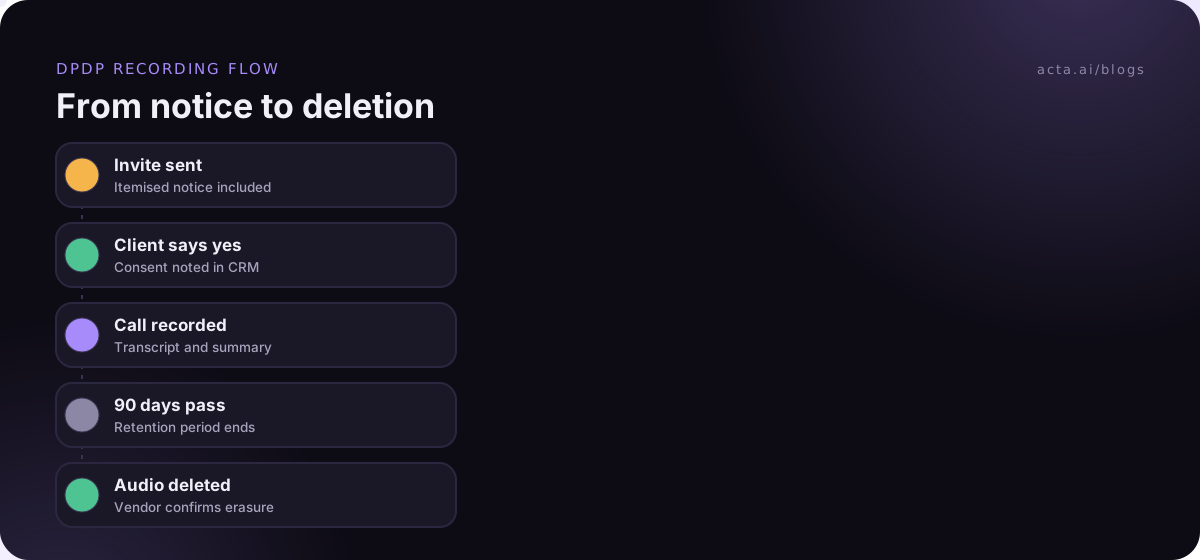
That's a DPDP Act meeting recording setup in practice: mostly calendar text, one contract and two settings.
Common mistakes with recordings under the DPDP Act
These come up again and again:
- Auto-recording everything. A blanket setting creates files you have no purpose for.
- Treating a bot's join message as consent. A notetaker appearing in the participant list tells people something is happening; it isn't an informed, specific yes to a stated purpose.
- Forgetting the summary. Teams delete the audio and keep AI summaries forever. The summary still names people and records what they said.
- No owner for deletion requests. Name one person who can find and delete a participant's data across your tools.
- Waiting for May 2027. Start with invite text and retention settings now.
Write the rules down in a short internal policy; our template for an AI notetaker policy is a good place to start. If you record from your own computer instead of sending a bot, for example with Acta's desktop app for the Zoom and Teams apps, the same notice and retention rules still apply. The desktop app has a Copy notice button that pastes a recording notice into the meeting chat, which helps with the "tell people" step. Acta does not use customer data to train AI models, and you can read how it handles data on the security page. No tool makes a setup compliant by itself.
Frequently asked questions
Does the DPDP Act require consent to record a meeting?
Not always. The Act requires a lawful ground for processing the recording: consent, or a listed legitimate use such as employment purposes. For external participants like clients and candidates, consent is the safe choice. For internal staff meetings, the employment ground may apply, but you should still give notice. Get advice for your specific situation.
When do the DPDP Rules 2025 come into force?
The Rules were notified in November 2025 with an 18-month phased timeline, according to the government's PIB release. Board-related provisions started on notification, consent manager registration after one year, and the main duties for data fiduciaries, such as notice, security and breach intimation, about 18 months after notification, in May 2027. Check MeitY for any amendments.
Is an AI notetaker company a data fiduciary or a data processor?
Usually a data processor, because it records and transcribes on your company's instructions. Your company decides why the meeting is recorded, so it's the data fiduciary and stays responsible. If the vendor uses recordings for its own purposes, such as training models, it may act as a fiduciary for that use, so ask and get it in writing.
What should a recording consent notice in India include?
List the personal data you'll process (audio, transcript, summary), the specific purpose, how long you keep it, who processes it for you, how to withdraw consent, and how to contact your grievance officer or complain to the Data Protection Board. Keep it short, standalone and in plain language, and send it before the meeting.
Can I keep meeting recordings forever under the DPDP Act?
No. The Act requires you to erase personal data once consent is withdrawn or the purpose is no longer served, unless another law requires you to keep it. Set retention periods per meeting type, delete on schedule, and make sure your notetaker vendor deletes its copies too.
Set up a DPDP-ready recording routine
Responsible recording comes down to a few decisions made once and applied every time. Use this checklist before May 2027:
- Define the purpose: write one line per meeting type saying why you record it and what the recording is used for.
- Pick the ground: consent for outsiders, the employment legitimate use only where it clearly fits, parental consent for minors.
- Fix the notice: add the itemised notice to calendar templates and train hosts to confirm verbally.
- Sign the contract: get a data processing agreement and written answers on training, sub-processors and breach reporting from your vendor.
- Set retention: configure deletion periods for audio, transcripts and summaries, and name an owner for deletion requests.
When the routine is in place, try a bot-free recorder such as the Acta desktop app on a few internal meetings during the 15-day free trial and see how it fits your notice and retention rules.
Found this useful? Share it with your team.