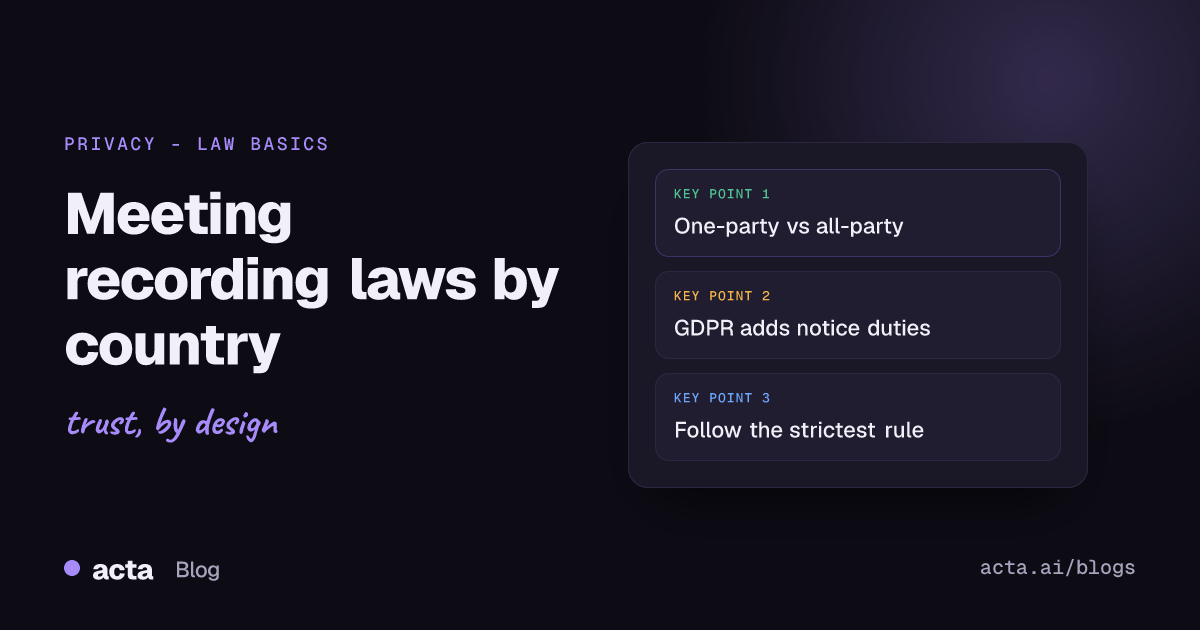
Quick answer: Meeting recording laws by country split into two camps. In some places, such as under US federal law and in Canada, a participant can record with only their own consent. Others, including Germany, France, California and several Australian states, expect everyone's agreement. On top of that, data protection laws like the GDPR require businesses to tell people why they're recording and what happens to it.
The awkward thing about an online meeting is that it takes place in several countries at once. You're in Toronto, your client is in Munich, and their lawyer has dialled in from Sydney. Which rules apply? Often all of them, which is why the safest habit is to follow the strictest one in the room.
Below is a plain summary of the main markets, as of November 2026. It's general information, not legal advice. If a recording might end up in a dispute, or you work in a regulated field, ask a local lawyer.
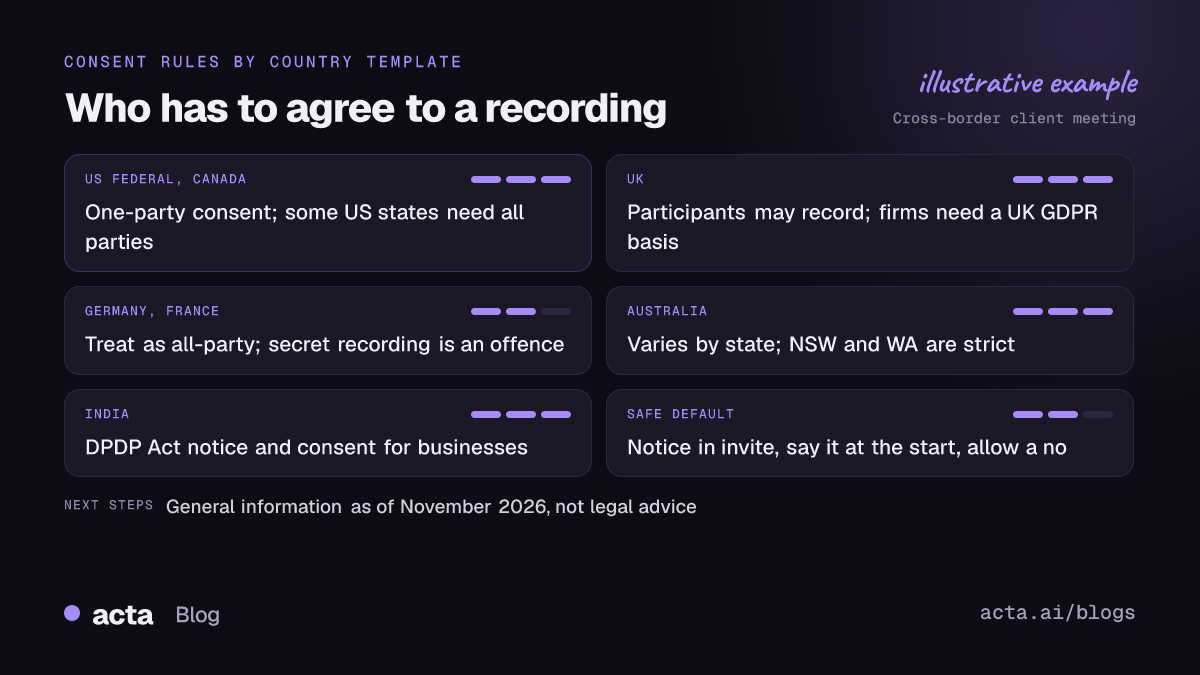
How do meeting recording laws by country differ?
Most countries regulate recording on two layers, and people tend to forget the second one.
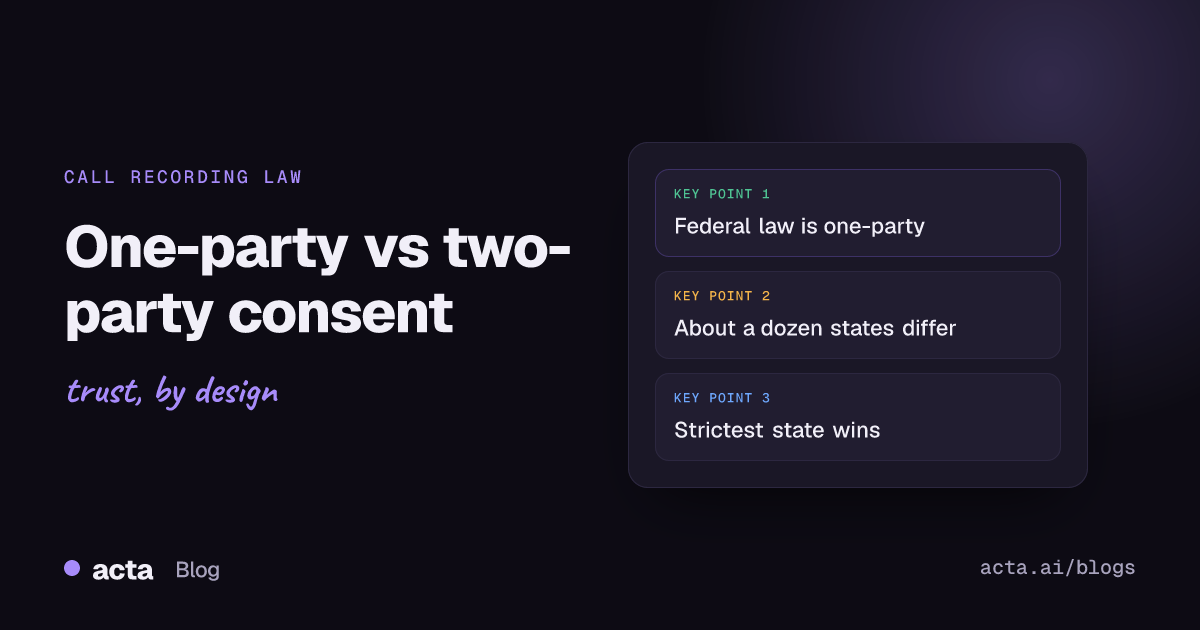
- Interception or eavesdropping law. This is usually criminal law, and it asks whose consent you need. Under one-party consent, a participant can record on their own say-so. Under all-party consent, everyone in the conversation has to agree. Our explainer on one-party vs two-party call recording consent goes deeper on the US states.
- Data protection law. Once a business records a meeting, it's handling personal data: voices, names, sometimes opinions about people. Laws like the GDPR want a lawful reason, a clear notice and sensible retention, even where the first layer would let one person record quietly.
So "it's a one-party consent country" doesn't mean you can skip telling anyone. For a company, it usually just means the recording isn't a crime.
United States: one-party federally, stricter in some states
Federal wiretap law, 18 U.S.C. § 2511, lets a person who's part of a conversation record it, or have it recorded, if one party consents, as long as the purpose isn't criminal or tortious. That one party can be you.
States can go further, and about a dozen do in at least some situations. Lists vary by source, but the states usually named as all-party are California, Delaware, Florida, Illinois, Maryland, Massachusetts, Montana, Nevada, New Hampshire, Pennsylvania and Washington, with Connecticut, Michigan and Oregon somewhere in between. California's rule (Penal Code 632) applies to "confidential communications", which covers most private business calls.
The cross-state point catches companies out. In Kearney v. Salomon Smith Barney (2006), California's Supreme Court applied California law to calls that a Georgia office recorded with clients in California, even though Georgia only requires one party. If anyone on your call might be in an all-party state, act as if the whole call is. We go through the state rules in more depth in is it illegal to record a conversation?
Canada: one-party consent in the Criminal Code
Canada's rule sits in section 184 of the Criminal Code. Intercepting a private communication is an offence with up to five years in prison, but there's an exception where one of the parties to the conversation consents, expressly or by implication. If you're in the meeting, you can generally record it.
Two limits are worth knowing. The exception is for participants: leaving a recorder running in a room you've walked out of is a different matter. And sharing what you recorded is a separate question, covered by its own section of the Code. For businesses, privacy law and plain good practice point the same way: tell people, and say why.
United Kingdom: participants can usually record, businesses have GDPR duties
In the UK, an individual recording their own call for their own use is generally not committing an offence. For businesses it's more layered. The Investigatory Powers Act 2016 makes unlawful interception a crime, and the 2018 regulations made under it set out when businesses may monitor and record communications for things like record-keeping and compliance.
Then there's UK GDPR. A business needs a lawful basis to record, has to tell people about it, and should keep recordings no longer than it needs to. For staff meetings, the ICO's guidance on monitoring workers, published in October 2023, is clear that consent is generally a poor basis between employer and employee, because staff aren't really free to say no. Most companies rely on legitimate interests instead and document why.
European Union: the GDPR everywhere, criminal law on top in some countries
Across the EU, the GDPR sets the baseline. You need a lawful basis under Article 6, and for meeting recordings that's often legitimate interests. The European Data Protection Board's Guidelines 1/2024 on legitimate interest describe a three-step test: a real, clearly stated interest, recording that's actually necessary for it (not just handy), and a balance against the rights of the people being recorded. Article 13 means people should be told, before the recording starts, why it's happening, who gets it and how long it's kept. Our GDPR checklist for AI note takers turns this into tasks.
Some member states add criminal law on top, and two big markets treat recording strictly.
Germany
Under § 201 of the German Criminal Code (StGB), recording someone's non-public spoken words without authorisation can bring up to three years in prison or a fine. So can using or passing on such a recording. In practice, treat Germany as all-party: get everyone's agreement, and ideally have it on the recording itself.
France
Article 226-1 of the French Penal Code punishes recording words spoken privately or in confidence without the speaker's consent, with up to one year in prison and a 45,000 euro fine. Consent is presumed where the recording was made openly and people knew about it and didn't object when they could have. A visible notice and a spoken heads-up at the start do a lot of work here.
Other EU countries
Rules differ from country to country, but the GDPR layer is the same everywhere. If you announce the recording, explain why, and let people object, you meet the strictest common standard in most places.
Australia: it depends on the state
Australia has no federal law that bans recording private conversations. Each state and territory has its own surveillance devices legislation, and they don't agree.
- New South Wales: under the Surveillance Devices Act 2007, a participant generally needs everyone's consent. There's a narrow exception where recording is reasonably necessary to protect the recorder's lawful interests.
- Victoria: a participant may record a private conversation, but publishing or sharing it is restricted.
- Queensland and the Northern Territory: also have participant exceptions, according to the Australian Law Reform Commission. The remaining jurisdictions don't.
- Western Australia and South Australia: WA is generally described as all-party. Sources disagree on South Australia, so take advice before relying on one reading.
For a national team, the simple rule is to treat every Australian meeting as all-party.
India: data protection is the layer to watch
India's Digital Personal Data Protection Act 2023 now has its operating rules: the DPDP Rules 2025 were notified on 13 November 2025, with obligations phasing in after that. For businesses, the main points are notice and consent. Tell people what you're collecting and why, and get consent that matches the purpose. Commentators suggest separate consent where a recording will also be used for analytics or AI training, rather than one bundled "by continuing you agree" line.
I haven't found a single statute that clearly settles whether a participant may privately record a call in India, so if that question matters to you, get local advice.
What should you do when people join from several countries?
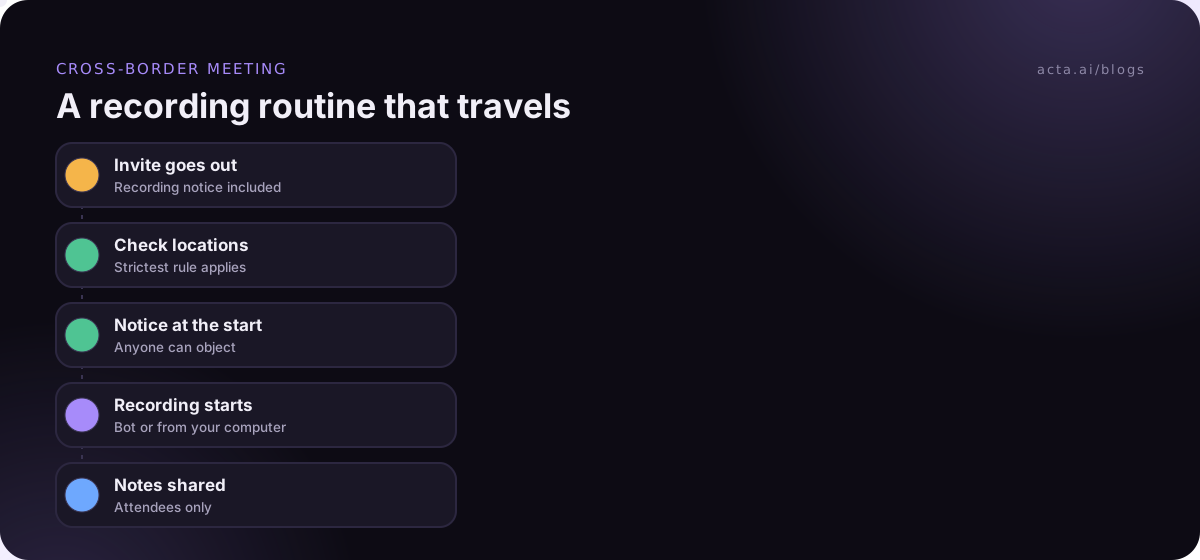
Since you rarely know where every attendee is sitting, use one default that holds up in the strictest place you deal with. This is the routine I'd suggest for cross-border meetings:
- Put a recording notice in the invite. One line: what's recorded, why, and who gets the notes.
- Say it at the start. "Quick note, we're recording this for the notes. Shout if that's a problem." That covers latecomers who never read the invite.
- Make it easy to say no. If someone objects, stop or pause, and take handwritten notes for that part.
- Keep it for a set time. Decide how long recordings and transcripts live, and delete on schedule. Our guide to what meeting recordings to keep suggests sensible periods.
- Limit sharing. Send the summary to attendees. Don't forward raw recordings around without a reason.
Bot-free recording makes step 2 matter more. If you record with a desktop app such as Acta's, nobody sees a bot join, so your spoken notice is the only signal. Acta's desktop app has a Copy notice button that puts a recording notice in the meeting chat in one click. Our post on recording meetings with AI and what to tell participants has wording you can borrow.
Meeting recording laws by country: quick reference
- US (federal): one-party consent. Several states require all parties, and the strictest state on the call wins.
- Canada: one-party consent under the Criminal Code. Sharing is a separate question.
- UK: participants can generally record. Businesses need a lawful basis and must be open about it under UK GDPR.
- Germany: treat as all-party. Unauthorised recording is a criminal offence.
- France: consent needed for private conversations. Open, announced recording is presumed consented.
- Rest of the EU: GDPR lawful basis and notice everywhere, national rules on top.
- Australia: state by state. NSW and WA are strict, Victoria and Queensland are more permissive.
- India: the DPDP Act notice and consent rules for businesses.
Where Acta fits
Acta records Zoom, Google Meet and Microsoft Teams with a meeting bot, from your own computer with the desktop app or Chrome extension, or from an uploaded file. Whichever way you record, telling people is still your job. The desktop app's Copy notice button makes that quicker, and Acta doesn't use customer data to train its AI models, which tends to come up in data protection reviews.
Frequently asked questions
Which countries require all-party consent to record a meeting?
Germany and France are the clearest examples in Europe. Several US states, including California, Florida, Illinois, Pennsylvania and Washington, require all parties in at least some situations, as do New South Wales and Western Australia. Rules change, so check before you rely on a list.
Is one-party consent enough for a business?
Often not on its own. Even where recording isn't a crime, data protection laws like the GDPR expect a business to have a lawful reason, tell people and keep recordings only as long as needed.
What if I don't know where attendees are?
Assume the strictest rule applies. Put a notice in the invite, say it at the start and let people object. That works in nearly every country covered here.
Does it matter if I record without a bot?
The law doesn't care how you record. It cares whether people knew and agreed. Without a bot there's no visible signal, so you need to announce it yourself.
Can I share a recording I was allowed to make?
Not automatically. Canada, Germany and several Australian states treat sharing or publishing as a separate question from recording. Share the summary with attendees and keep the raw file tight.
To see how recording, transcripts and notes work in practice, have a look at Acta's features.