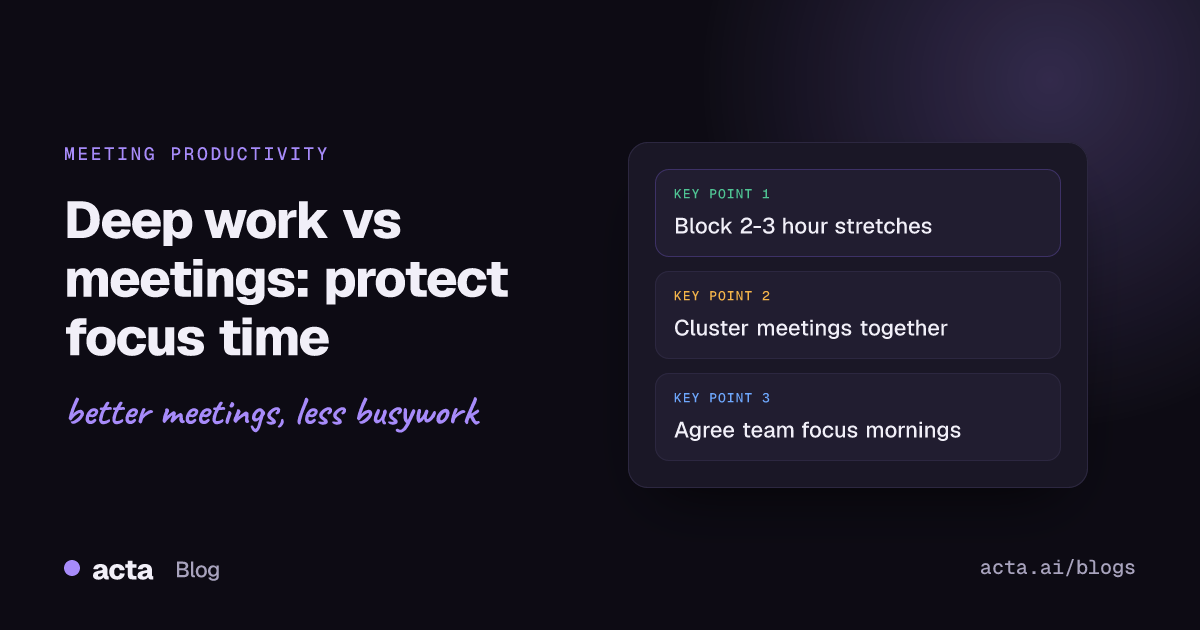
Quick answer: To protect focus time from meetings, block two- to three-hour stretches in your calendar before the week fills up, set them to decline invites automatically, and push meetings into clusters at one end of the day. Then agree a few team rules, such as meeting-free mornings and office hours, so deep work doesn't depend on willpower.
The meeting itself is rarely the problem. A 30-minute call at 10:30 looks harmless on the calendar. What it actually does is cut a three-hour morning into two pieces too short to start anything hard, and that's how a week with "only" twelve hours of meetings ends with nothing difficult finished.
This post is about the trade-off between deep work and meetings, and the practical setup that lets both happen without you having to fight for every hour.
Why do meetings wreck deep work?
Deep work, Cal Newport's term for long stretches of concentrated effort on something cognitively demanding, needs runway. Writing a spec, debugging an odd production issue, building a financial model: the first 20 or 30 minutes go on loading the problem into your head. If a meeting is due in 45 minutes, you either don't start or you start and get yanked out just as it gets going.
Paul Graham described this well back in 2009 in Maker's Schedule, Manager's Schedule. Managers run their day in one-hour slots, and a meeting is just one slot. Makers need units of half a day or more, and for them a single meeting can blow an entire afternoon, because it breaks the time into pieces too small to do anything substantial in. Neither schedule is wrong. The friction comes when the two meet and the manager's schedule wins by default because it controls the calendar.
There's also the anticipation cost. Knowing you have a call at 2pm changes how you use the hour before it. Plenty of people will tell you they "can't really start anything" before a meeting, and they're right.
How much focus time do you actually need?
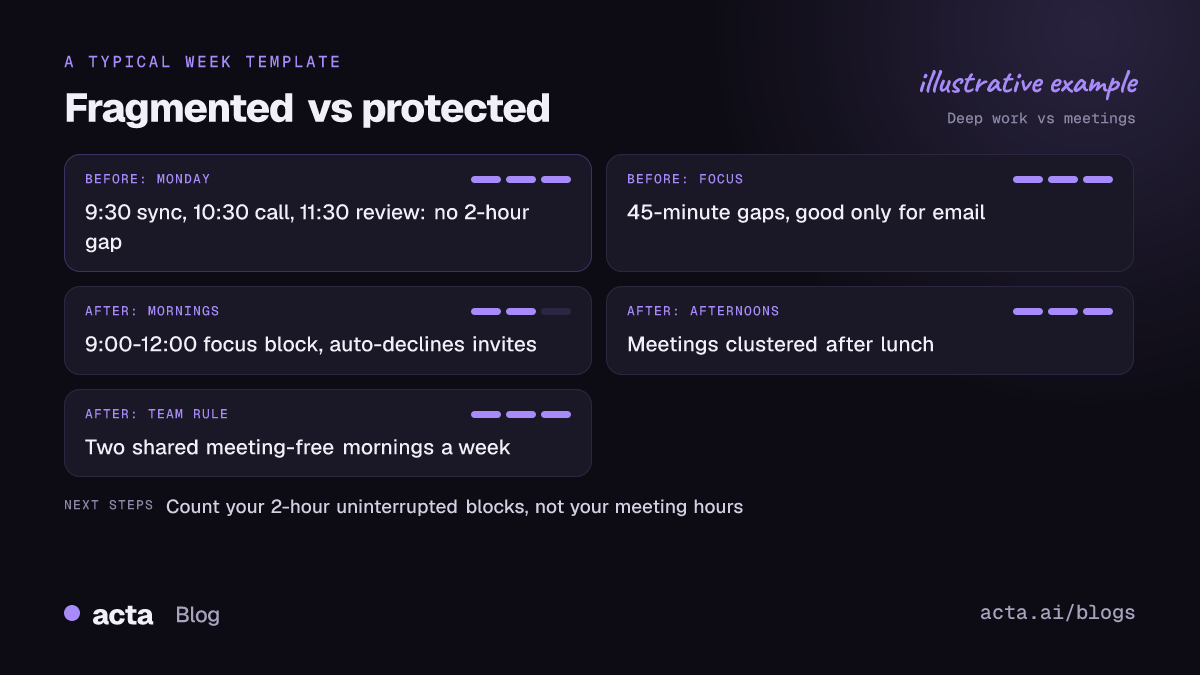
Less than you'd guess, as long as it's in the right shape. Four or five protected blocks of two to three hours a week is enough for most knowledge workers to make real progress on hard problems. Engineers and writers often want more. Managers might get by with two or three.
What doesn't work is a theoretical 40% focus time made of 45-minute gaps between calls. Those gaps are good for email and small tasks. They're not deep work, and counting them as focus time hides the problem.
A quick test: look at last week and count how many uninterrupted blocks of two hours or more you had. If the answer is one or zero, that's your problem, regardless of how many total hours of meetings there were.
How do you protect focus time in your calendar?
Here's the setup I'd use. It takes about 20 minutes once and then mostly runs itself.
- Pick your anchor blocks. Choose two to four recurring slots of two to three hours when you're sharpest. Some teams go further and protect a whole day; we looked at whether no-meeting Fridays work. For most people that's mornings. Book them as recurring events now, before the week fills up.
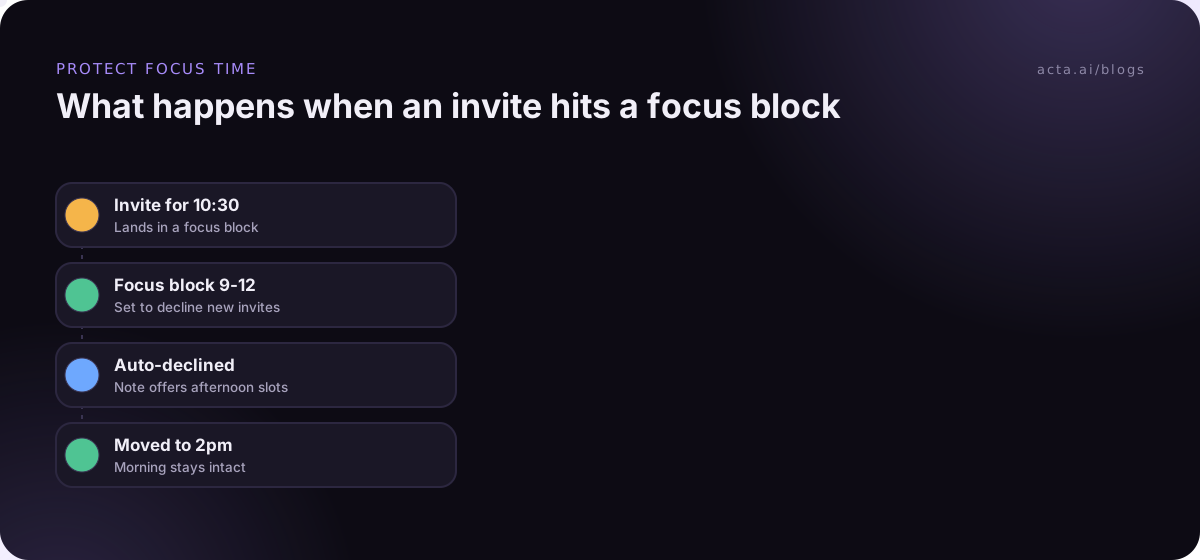
- Use the calendar's focus features. In Google Calendar, a focus time event can automatically decline meetings, either only new invitations or new and existing ones, and it can mute chat notifications while it runs. In Microsoft 365, a focus plan in Viva Insights books focus time for you each day based on your preferences, and during it your Teams status shows Focusing and notifications are muted except from priority contacts.
- Name the block after the work. "Focus: Q1 pricing model" gets more respect from colleagues than "Busy". It also reminds you what the block is for when you sit down.
- Cluster meetings at the other end of the day. If your focus blocks are mornings, offer afternoon slots when people ask to meet. Leave gaps between them too, since back-to-back calls are one of the main causes of meeting fatigue. Most scheduling links let you limit which hours are bookable.
- Leave some slack. Don't block every morning. If you do, people will book over your blocks because they have no other option, and you'll end up defending them one by one.
What team rules help with deep work vs meetings?
Personal calendar tricks only go so far when your team keeps scheduling over them. The bigger gains come from a few shared agreements.
Shared focus mornings
Pick two or three mornings a week with no internal meetings for the whole team. Customer calls are the usual exception. Because everyone's blocks line up, nobody's waiting on a colleague who's heads-down while they're free.
Office hours instead of ad-hoc calls
Graham's own workaround was office hours: a few chunks a week set aside for meeting the founders he worked with, so the rest of his time stayed whole. For a team lead, two hour-long office hours a week can replace a surprising number of "quick sync?" messages that would otherwise land in the middle of someone's focus block.
Written first, meeting second
Status updates, FYIs and most decisions that need input rather than debate can go in writing. A short standup template done async can replace a daily call for many teams.
Clear rules for interruptions
Agree what justifies breaking someone's focus block: a production incident, a customer escalation, a deadline at risk. Everything else waits. Writing it down stops people guessing.
Chat counts as a meeting too
A focus block with Slack or Teams pinging every few minutes isn't really a focus block. Agree that people can go quiet during their blocks, and that a reply within a couple of hours is fine for anything that isn't on the interruption list. The calendar features above help here: muting chat during a focus time event, or a Focusing status in Teams, tells colleagues why you're not answering without you having to explain each time.
One habit worth copying: when you come out of a focus block, clear your messages in one sitting rather than dipping in all morning. Most "urgent" pings turn out to have resolved themselves, or to need a two-line answer that takes a minute.
What if you're the manager stuck on both schedules?
Managers have it hardest, because their job genuinely is meetings and they still have their own deep work: planning, hiring decisions, writing the strategy doc nobody else can write.
A few things that help:
- Protect fewer blocks, but defend them harder. Two mornings a week is realistic. Five isn't.
- Batch one-to-ones on the same afternoon so the context switch happens once. Our post on one-on-one meeting notes covers keeping them useful when they're back to back.
- Protect your team's focus time more fiercely than your own. If you schedule a 10:30 meeting with four engineers, you've just cost four mornings.
- Delegate attendance. Send the person closest to the work and ask for the outcome.
When should meetings win over deep work?
Focus time isn't sacred. Some meetings are worth breaking it for, and pretending otherwise makes you the colleague nobody can get hold of.
Meetings should usually win when a decision is blocked and people are waiting, when there's real disagreement that writing won't settle, when a customer or candidate is involved, and when something's on fire. A good rule of thumb: if waiting until your next free slot costs other people more time than the meeting costs you, take the meeting.
What shouldn't win: recurring status meetings, FYIs, "quick syncs" with no agenda, and anything where you're one of ten people listening.
How do you stay informed if you skip meetings to protect focus time?
This is the part that makes people nervous. If you protect focus time and skip more meetings, you need a reliable way to find out what happened.
- Ask for decisions and action items in writing, every time. A meeting that doesn't produce them probably didn't need you anyway. Our guide on tracking decisions made in meetings describes a simple format.
- Read notes in batches, once a day, outside your focus blocks.
- For meetings you'd like to catch up on in more detail, a recording or transcript lets you skim the parts that matter. If you're the one recording, tell people first; here's what to tell participants. If the meeting runs in Google Meet or Teams in the browser and bots aren't welcome, the Acta Chrome extension records from your own browser instead of sending a bot.
Where Acta fits
Acta records meetings and turns them into a summary, decisions and action items with owners, and you can ask OneChat questions across past meetings later. That makes it easier to skip a meeting during a focus block and still know what was agreed. It won't guard your calendar for you; the blocks and team rules above do that.
Frequently asked questions
What's the difference between deep work and focus time?
Deep work is the kind of task: concentrated effort on something hard. Focus time is the calendar block you reserve for it. You can have focus time and fill it with email, which is why naming the block after a specific task helps.
How long should a focus block be?
Two to three hours suits most people. Shorter than about 90 minutes and the warm-up eats too much of it. Longer than four and most people's attention fades anyway.
Can Google Calendar decline meetings during focus time?
Yes. A focus time event in Google Calendar can automatically decline only new invitations or both new and existing meetings, and you choose which when you create or edit the event.
Is it rude to decline meetings to protect focus time?
Not if you offer an alternative. "I've got a focus block then. Could we do 2pm, or can I reply in writing?" is a reasonable answer to almost any internal invite.
How do I get my team to respect focus time?
Make it a team agreement, not a personal preference. Shared meeting-free mornings, office hours and a short list of what justifies an interruption work better than everyone defending their own calendar alone.
To see how meeting notes and action items can cover the meetings you skip, take a look at Acta's features.