Quick answer: No meeting Fridays can work, but mostly when they're part of a wider cut in meeting load, not a single quiet day. Research on meeting-free days found people reported more autonomy and less stress, with the best results at more than one day a week. Friday is often the weakest day to pick, because it's already light and work leaks into Monday.
Somebody in leadership reads an article, and by the next all-hands there's an announcement: no meetings on Fridays, starting next week. Six weeks later, half the team is quietly booking "quick syncs" on Friday afternoon and the other half has moved everything to Thursday, which is now unbearable. It's a familiar pattern.
So do no meeting Fridays work? Sometimes. It depends on what you were trying to fix, which day you pick, and whether anyone checks the result. Here's what the evidence says and how to run it so you actually find out.
Do no meeting Fridays actually work?
The most cited study on this is an MIT Sloan Management Review piece, The Surprising Impact of Meeting-Free Days, by Ben Laker and colleagues (2022). They surveyed 76 companies, each with more than 1,000 employees, that had recently brought in between one and five meeting-free days a week.
The headline finding: people reported more autonomy and better cooperation, and less stress and micromanagement, regardless of how many meeting-free days their company used. The strongest results showed up at companies with three meeting-free days a week. The authors also warn that removing meetings entirely backfires, since people still need some time together.
Two caveats before you forward that to your CEO. First, this is survey data from people at companies that chose to try it, so it shows an association, not proof that the policy caused the gains. Second, notice what the strong results are attached to: cutting a lot of meetings, not protecting one day. One meeting-free day out of five is a small change if the other four days stay packed.
My honest read: a single no meeting day is a decent signal that focus time matters, and a weak fix on its own. It works when it's the visible part of a bigger cleanup.
Why companies try a no meeting day in the first place
The usual complaint is fragmentation. A developer with meetings at 10, 1 and 3:30 doesn't have a free afternoon; they have three 90-minute gaps, none long enough for hard work. A meeting-free day promises one clean block.
There's also the calendar creep problem. Recurring meetings get created for a reason, the reason goes away, and the meeting stays. Shopify went after this directly in January 2023: according to Fortune's coverage, it removed recurring meetings with more than two people from calendars, put a two-week freeze on adding them back, made Wednesdays meeting-free and limited very large meetings to a window on Thursdays.
Notice two things about that example. They picked Wednesday, not Friday. And the meeting-free day was one piece of a purge, not the whole plan. By mid-2023, CNN reported that Shopify had added a meeting cost calculator to calendar invites because meetings had started creeping back. Which tells you the honest truth about all of this: the calendar refills unless something keeps pushing back.
Why Friday is often the wrong day for a no meeting day
Friday is the default choice because it feels like the least disruptive. That's exactly the problem.
Friday is already quiet
In a lot of teams, Friday afternoons are light anyway. People are wrapping up, some are off, nobody wants to start a new thread. Declaring Friday meeting-free often protects time that was mostly free already, while Tuesday through Thursday stay as crowded as ever. You get the announcement without the benefit.
Decisions slide into Monday
If Thursday becomes the last chance for a live conversation, anything that needs a quick decision on Friday waits until Monday. For a small team that's fine. For a team shipping weekly, it can quietly add a day to every blocker.
Global teams feel it differently
If you work with colleagues several hours ahead, Friday afternoon your time is already their evening or weekend. Microsoft's Work Trend Index report on the infinite workday found that roughly 30% of meetings now span multiple time zones, and that meetings starting after 8pm were up about 16% year over year (figures as of the 2025 report). For those teams, the real question isn't "which day has no meetings" but "who keeps taking the late calls".
When Friday does make sense
Friday can be the right pick when your team's crunch genuinely happens late in the week, when Fridays currently have real meetings on them (check, don't guess), or when the goal is mostly wellbeing and a softer end to the week. If the goal is deep work, a midweek day usually protects more of it. Our guide to protecting focus time from meetings covers the day-to-day side.
What should replace Friday meetings?
Most meetings that disappear on a no meeting day still had a job. If you don't give that job somewhere to go, people recreate the meeting under a different name. Here's where things usually move:
- Status updates go written. A short Thursday-afternoon post in the team channel: what shipped, what's blocked, what needs a decision. Our standup template works fine as a written format.
- Decisions get a written proposal and a deadline. "Here's the option I recommend, comment by Monday noon or it goes ahead." That one habit saves more meetings than any day-of-week rule.
- Weekly wrap-ups become a digest. If Friday used to have a "what did we decide this week" call, send a weekly decision digest instead.
- External meetings get an exception policy. Customers and candidates don't care about your internal rule. Decide up front whether client calls are allowed on the no meeting day, and say so.
The written stuff only works if it's easy to produce. When the meetings you do keep are recorded and summarized, the person who missed Thursday's discussion can catch up on Friday morning in five minutes. If bots aren't welcome in some of those calls, a desktop recorder like Acta's captures the meeting from your own computer. Either way, tell people you're recording; our guide on recording consent and what to tell participants covers the basics.
How to run a no meeting day trial that tells you something
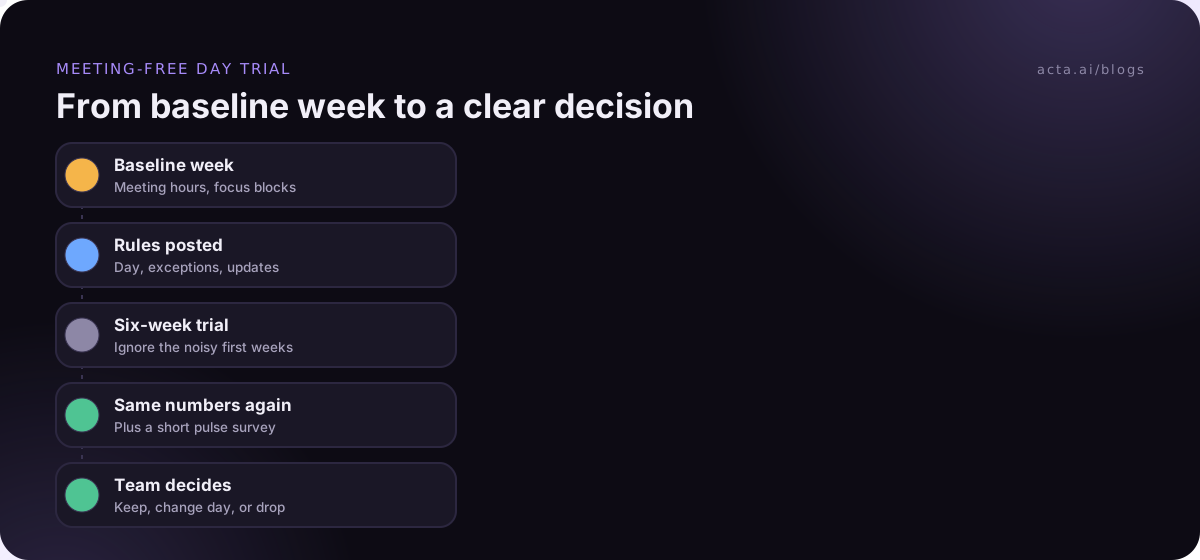
Most teams skip measurement, so after three months nobody can say whether no meeting Fridays helped. A simple six-week trial fixes that.
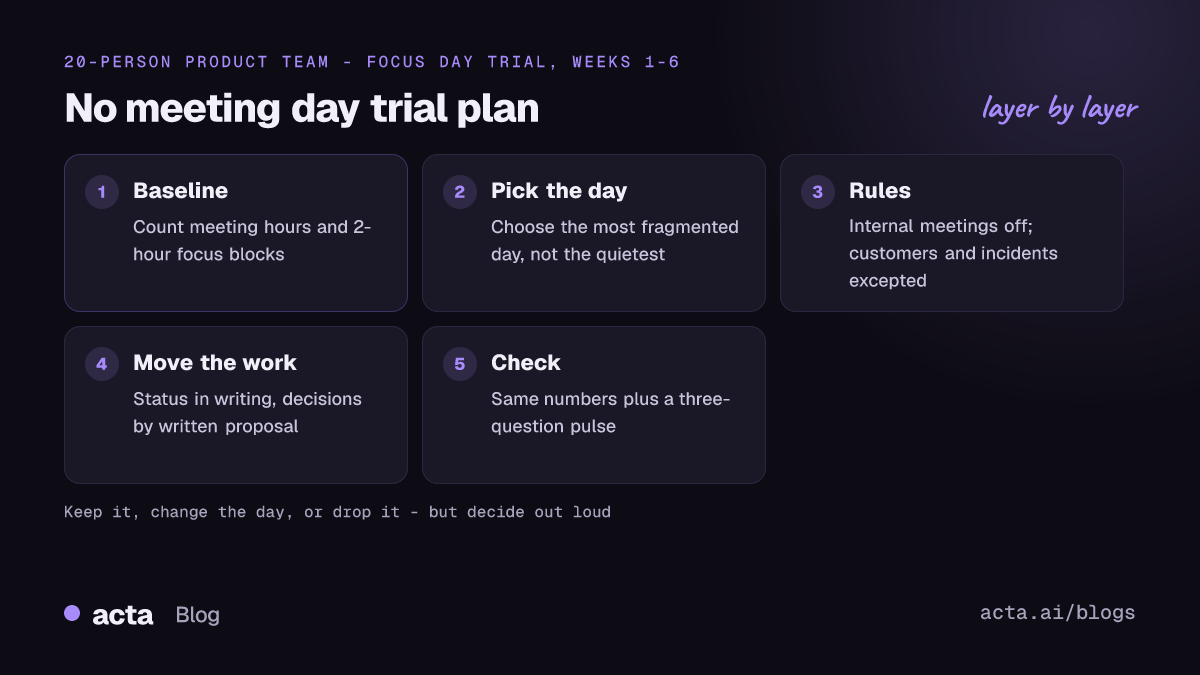
- Take a baseline week. Before anything changes, count hours in meetings per person and how many 2-hour-plus blocks people had free. Your calendar tool can export this, or people can tally their own week.
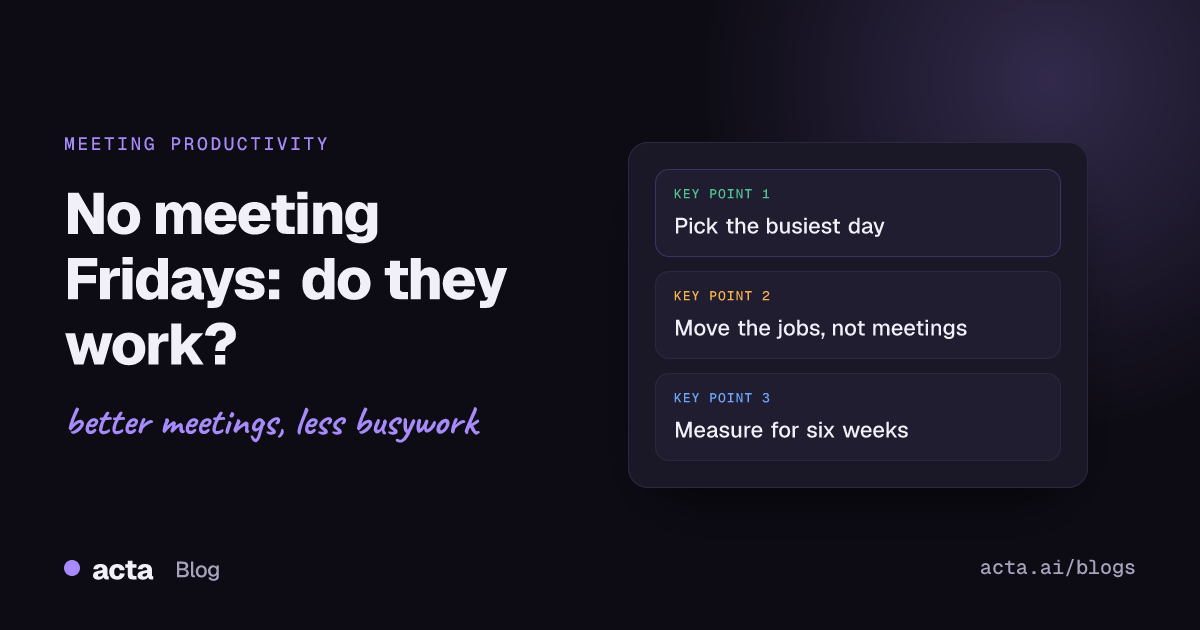
- Pick the day on purpose. Look at which day currently has the most meetings and the most fragmentation. That's the day where a rule changes the most.
- Write down the rules. Internal meetings only? What about 1:1s? Customer calls? Incidents? A half-page doc beats ten Slack arguments.
- Move the jobs, not just the meetings. For every recurring meeting that leaves the day, decide where its work goes: a written update, another day, or nowhere.
- Run it for six weeks. The first two weeks are noisy while people adjust. Don't judge it in week one.
- Check the same numbers again. Meeting hours, free focus blocks, and a three-question pulse: Did you get more hard work done? Did anything important slip? Do you want to keep it?
- Decide out loud. Keep it, change the day, add a second day, or drop it. Any of those is fine. Drifting is not.
Common mistakes that kill meeting-free days
Thursday becomes the new Friday
If all the displaced meetings land on Thursday, you've traded one decent day for one awful one. Watch Thursday's meeting count in the trial. If it jumps, you need to cut, not just move.
Managers quietly exempt themselves
The rule dies the first time a director books a "quick 15" on the protected day. Leaders have to follow it visibly, including declining their own boss's invite and suggesting a written alternative.
No exception path
Real emergencies happen. If there's no agreed way to call one (say, an incident or a customer escalation), people either break the rule constantly or freeze when something's on fire. Name the exceptions.
Nothing changes about how meetings run
A no meeting day doesn't fix meetings that end without owners or decisions. If people leave Thursday's calls unclear on who's doing what, the Friday focus block gets spent chasing that down. A habit of ending meetings with owners and deadlines fixes most of that. It's worth pairing the trial with better habits for tracking decisions made in meetings.
Are no meeting Fridays better than shorter meetings?
Honestly, for most teams, the boring fixes do more: 25-minute defaults instead of 30, 50 instead of 60, cancelling recurring meetings that have no agenda, and keeping status updates in writing. These shrink load across the whole week instead of protecting one day and crowding the rest.
Where a meeting-free day earns its place is as a signal. It tells people that uninterrupted time is legitimate and that declining an invite on that day is expected, not rude. That cultural permission is hard to get any other way. So I'd do both: cut the waste across the week, and protect one day so focus time has a home.
If you only have the energy for one change, cut recurring meetings first. A meeting-free day on top of a bloated calendar mostly moves the bloat around.
A sample no meeting day policy you can adapt
Here's a short version a 20-person team could paste into its handbook. Change the day and the exceptions to fit.
Focus Wednesdays. No internal meetings on Wednesdays, including recurring 1:1s, which move to Tuesday or Thursday. Customer calls and interviews are allowed if the other side can't do another day. Incidents and production issues override this rule. Status updates are posted in the team channel by Tuesday 4pm. Decisions that can't wait go to a written proposal with a reply-by time. We'll review this after six weeks using meeting hours, focus blocks and a short pulse survey.
It's short on purpose. If your policy needs a page of exceptions, the underlying problem is meeting volume, and the day-of-week rule won't solve it.
Where Acta fits
Acta records the meetings you do keep, on Zoom, Google Meet or Microsoft Teams, with a bot or bot-free through the desktop app or Chrome extension. It writes the transcript, summary, decisions and action items with owners, so someone protecting their focus day can catch up from the notes instead of another call. That makes cutting meetings less risky, but it won't decide which ones to cut for you.
Frequently asked questions
Do no meeting Fridays improve productivity?
They can, but the evidence is mostly self-reported. The MIT Sloan Management Review study of 76 companies found people reported more autonomy and less stress on meeting-free days, with the best results when companies had more than one such day. A single Friday rule on its own is a smaller change, so measure before and after.
What day is best for a no meeting day?
The day that currently has the most fragmented calendars, which is often midweek. Shopify chose Wednesday. Friday is popular but often already light, so protecting it can change very little.
Should 1:1 meetings be allowed on a meeting-free day?
Most teams move them, because a single 30-minute 1:1 at 11am splits the day in two. If a manager has many reports, spread 1:1s across the other four days instead.
How do you handle customers and other time zones?
Treat external meetings as an explicit exception and write that down. For colleagues in other time zones, check whether your no meeting day lands on their weekend or late evening before you choose it.
How long should a no meeting day trial last?
About six weeks. The first couple of weeks are noisy while people adjust, so compare the last few weeks against a baseline week taken before the change.
If you want notes from the meetings you keep without typing them up, try Acta with a 15-day free trial.