D2C teams decide in meetings and change their minds in huddles
Most D2C brands of this size run a weekly growth meeting on Monday: founder, growth lead, performance marketer, CRM and retention, someone from inventory and ops, and finance for the last ten minutes. A typical growth meeting agenda covers last week's revenue by channel, ROAS and CAC, repeat rate, stock cover for top SKUs, the offer calendar and upcoming launches. Many also hold a monthly launch review and a fortnightly marketplace and quick commerce call with account managers.
That is where decisions are supposed to live. In practice the real work happens in between: a Slack huddle on Wednesday because a SKU is overstocked, a call with the influencer agency, a five-minute "can we do 30% on bundles?" on a Google Meet link. These are good, fast calls. The problem is distribution. The three people on the huddle know; the CRM lead scheduling Thursday's email doesn't.
A Slack thread or a Notion page helps only if someone updates it. A decision log template in a spreadsheet works for a month, then the person keeping it goes on leave during the sale. What you need is a log that fills itself from what was said, keeps the history of each decision, and flags when one changes.
A 35% sunscreen deal became a sitewide email
An illustrative example. Dewlane (invented) is a Mumbai skincare brand with 42 people, about 60% of revenue from its own site and the rest from marketplaces and quick commerce. The festive sale runs 10 to 27 October.
Monday 6 October, growth meeting. Founder Aditi, growth lead Kunal, performance marketer Farhan, CRM lead Neha, inventory lead Joseph and finance lead Meera agree two things. The sale cap is 20% sitewide, with bundles allowed up to 25%. And the new vitamin C serum launches on 20 October with pre-orders capped at 600 units.
Thursday 9 October, Slack huddle. Joseph flags 1,100 units of SPF 50 sunscreen expiring in March. Aditi, Farhan and Joseph agree to take sunscreen bundles to 35% to clear them. Twelve minutes, sensible decision, nobody writes it down beyond "ok go" in a thread.
Sunday 12 October. Neha hears in passing that "we're going deeper on discounts". She sends an email and a WhatsApp campaign to 80,000 subscribers: "Up to 35% off sitewide". The site is configured for 35% on sunscreen bundles only. By Monday there are around 300 support tickets, and the team decides to honour 35% on about 2,000 orders. Meera later estimates the extra discount at 4.2 lakh rupees.
Monday 13 October. The packaging vendor slips, and on an ops call the serum launch moves to 3 November. The influencer agency isn't on the call. On 20 October, four creators post "out now" with a link to a page that says "coming soon".
Two good decisions, two good changes, two expensive misses. Both changes were spoken out loud by the right people. Neither reached the people executing.
A D2C weekly growth meeting decision log shows what changed
Acta's Decision log is under My meetings > Outcomes > Decision log. It reads your recorded meetings for decisions, merges duplicates into one decision, and keeps a history of every meeting it came up in. Each decision has a status: Active, Changed, Reversed or Done. A changed decision shows "Was:" with the old statement and the date it changed.
It is a personal view. Aditi's log is built from the meetings Aditi recorded plus any meetings teammates shared with her in the workspace. Neha's log is built from hers. So the fix for Dewlane isn't a magic company log; it is sharing every growth meeting and huddle with the workspace, so the same decisions appear in everyone's view.
Here is how the discount decision would look in Aditi's log after the huddle:
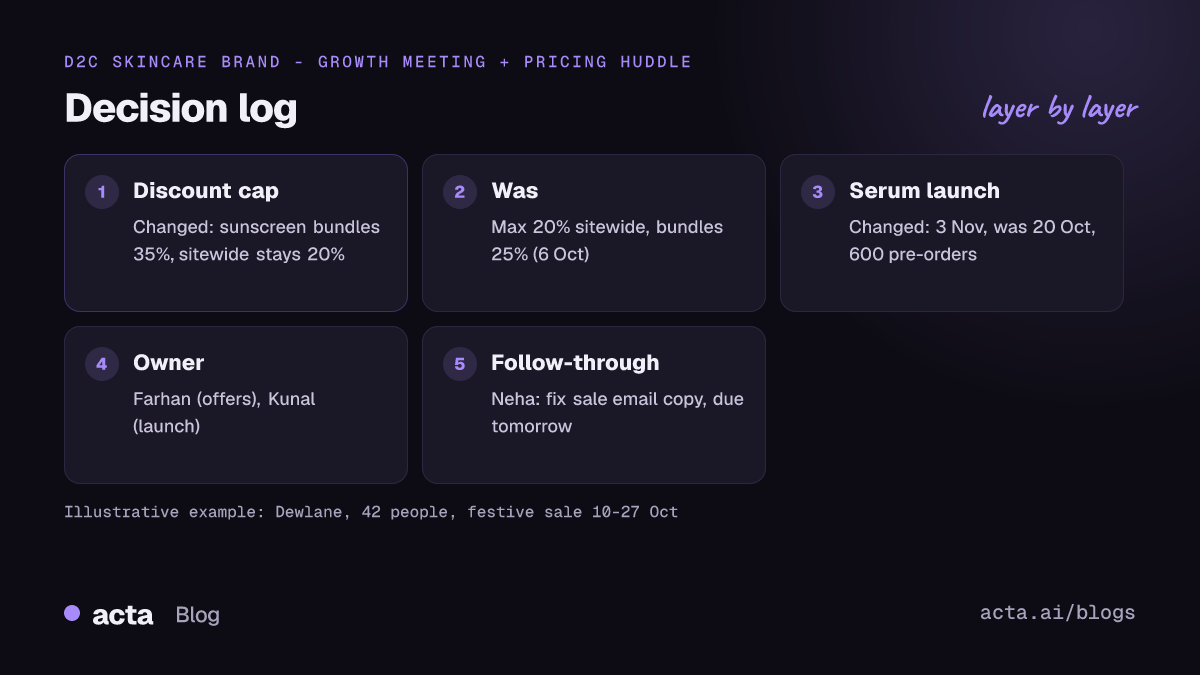
- Decision: Festive sale: max 20% sitewide; sunscreen bundles up to 35%; other bundles up to 25%.
- Status: Changed. Was: "max 20% sitewide, bundles up to 25%" · changed 9 Oct.
- Decided by: Aditi. Owner: Farhan. Discussed in 3 meetings.
- History: first raised 29 Sep (growth meeting), confirmed 6 Oct ("twenty is the ceiling, I don't want to train people to wait"), updated 9 Oct in the huddle ("only the sunscreen, only bundles, thirty-five").
- Actions: 1 of 3 done. The attention banner flags one overdue action item: Neha's sale email copy update.
The serum launch would show Changed too: "Was: launch 20 Oct · changed 13 Oct", now "launch 3 Nov, pre-orders capped at 600". Both land in the Changed or reversed tile at the top, which is the first thing anyone should check before sending a campaign. The Need follow-through tile catches decisions whose actions are slipping, like the email copy update.
Group by Topic to see all pricing decisions together, or by Person to see what Farhan owns. Fix mistakes from the card menu: "Mark as reversed", "Assign owner", or "Not a decision" for passing remarks. At month end, Export CSV gives finance a file with columns such as Decision, Status, Topic, Decided by, Owner, First discussed, Last discussed and Previously:
| Decision | Status | Decided by | Owner | Last discussed | Previously |
|---|
| Festive cap 20% sitewide; sunscreen bundles 35% | Changed | Aditi | Farhan | 9 Oct | Max 20% sitewide, bundles 25% |
| Vitamin C serum launch 3 Nov, 600 pre-orders | Changed | Aditi | Kunal | 13 Oct | Launch 20 Oct |
| Pause quick commerce ads on low-stock SKUs | Active | Kunal | Farhan | 6 Oct | None |
If you want the theory behind decision records, the existing guide on how to track decisions made in meetings covers formats; this post is about the D2C version.
Run a growth meeting template that writes offers as a table
Every recorded meeting gets standard notes: summary, decisions and action items with owners. Two built-in templates from the 40 templates by role suit D2C: Campaign review for post-sale reviews and Decisions & RACI when you want roles spelled out. For the Monday meeting, a custom template (paid plan, up to 12 sections) makes the offer calendar impossible to misread:
Template name: Weekly growth meeting
What should this report do? For a D2C brand's weekly growth meeting: channel numbers, every offer or discount decided or changed, launch dates, stock issues and owners.
1. Channel numbers discussed (Table: Channel | Spend | Revenue | ROAS | Comment)
2. Offers and discount limits (Table: Offer | Applies to | Max discount | Valid until | Changed from)
3. Launch calendar (Table: Product | Launch date | Pre-order cap | Who tells agencies)
4. Stock and expiry flags (Bullets)
5. Actions (Checklist: task, owner, due date)
Extra instructions: Write discounts as numbers with their scope. Never write "deeper discounts".
When should Acta use it? Only matching meetings.
The "Applies to" column is the one that would have stopped Neha. Test it with "Test on a past meeting" on a recent Monday before turning it on; the custom templates help explains each option.
Actions, risks and OneChat keep the log honest
Action items
Under Outcomes > Action items (filters Open, Overdue, Due this week, Done), the huddle's follow-ups appear next to the Monday ones. A filled row: "Update sale email and WhatsApp copy: sunscreen bundles only at 35%" · owner Neha · Due tomorrow · linked to the discount decision. Linked actions are what drive the "X of Y done" count on the decision card.
Risk Registry
The Risk Registry tab picks up risks said in meetings. Joseph's warning becomes a row: Risk: 1,100 SPF 50 units expire in March; unsold stock written off. Mitigation: 35% sunscreen bundles during the sale (Agreed, 9 Oct). Owner: Joseph. Impact: Medium. Status: Mitigating. A second, flagged "High · no owner": influencer agency not told about the launch move.
OneChat
OneChat answers across every meeting you can see and shows sources. On Sunday, Neha asks: "What is the current maximum discount for the festive sale, and has it changed since 6 October?" The answer: 20% sitewide, 35% on sunscreen bundles only, changed on 9 October in a huddle, with "Found in" links to both moments. That one question would have saved 4.2 lakh rupees, provided the huddle was shared with the workspace. You can also ask OneChat "Why did we take sunscreen to 35%? Then add it to the Decision log." The OneChat guide has more examples.
An agent can announce every changed decision in Slack
The fastest fix for Dewlane is making changes loud. With Agent Builder (beta), a growth lead can set this up in an afternoon:
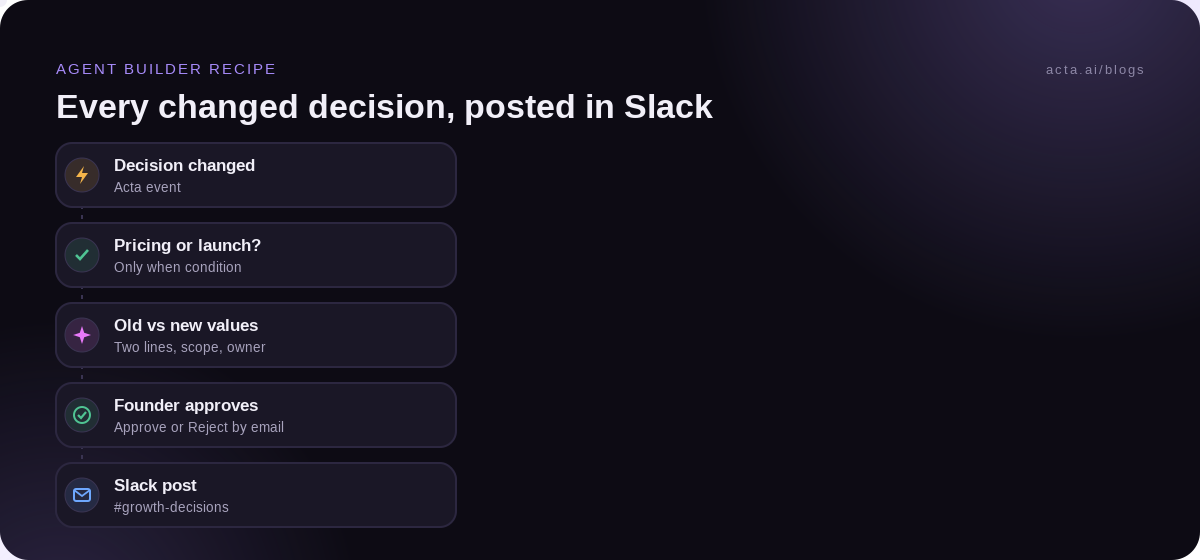
- Click "New agent". For the trigger, choose Event in a connected app, app Acta, event "decision made or changed".
- Add an "Only when" condition: the topic mentions discount, price, offer or launch.
- Add an AI step: "In two lines, say what changed, the old and new values, the scope, and who owns it. No adjectives."
- Add Human approval with "Also email me Approve and Reject buttons", so the founder confirms the wording. If nobody answers within 24 hours, nothing is sent.
- Add a Slack action posting to #growth-decisions, where CRM, support and the agency's shared channel can see it.
- Add a Google Sheets action that updates the matching row in your offer calendar sheet.
- Click Test, then Run test; nothing is posted during a test. Then Turn on.
The triggers guide lists the other app events, such as a new Gmail email or a new Google Sheets row.
Roll the log out to a 40-person brand in two weeks
Each person in the Acta workspace uses one seat, so start with the people who run the Monday meeting: in a 40-person brand that is the founder, growth lead, CRM lead and ops lead, perhaps six people. Pro costs $8 per seat a month or $72 a year, and the Decision log, the other Outcomes views, Risk Registry and OneChat are included in the 15-day trial and in Pro.
Who records what. The growth lead records the Monday meeting; on Google Meet the Chrome extension does it with no bot in the call. Whoever starts a Slack huddle about price or launches records it with the desktop app, which records any call when you press Record. Tell people they're being recorded; the recording consent guide covers what to say, including to agencies.
Sharing. Meetings are private by default; share growth meetings and pricing huddles with "Everyone in" the workspace so they feed every teammate's Decision log and OneChat. The workspace guide covers invites and roles.
- Days 1-2: Create the workspace, invite the four decision-makers, record Monday's growth meeting.
- Days 3-5: Record every pricing or launch huddle. Clean the log daily: merge, split, mark "Not a decision".
- Days 6-9: Write the weekly growth meeting template; agree the rule that nothing goes to customers without a log check.
- Days 10-14: Build and test the Slack agent; add support and the agency's channel; export the first CSV for finance.
Mistakes we've seen: recording Monday but not the huddles (the huddles are where changes happen), keeping meetings private, letting "No owner" decisions pile up, and writing vague decisions. Meeting overload is real too; Boston University's piece on the curse of meetings and Knowledge at Wharton on good and bad meetings are worth sharing before you add any new call. For weekly summaries, see the weekly decision digest email.
Frequently asked questions
What is a decision log for a D2C brand?
It is a record of every commercial decision (discount caps, offer scopes, launch dates, channel budgets) with who decided, who owns it, its status and what it replaced. Unlike meeting minutes, it stays current: a decision changed in a later meeting is updated in place, with the old version kept as history.
How do we set up a discount approval process?
Write one rule: any discount or offer change is decided by a named person, recorded, and logged with scope, maximum and end date before anyone builds it. Customer-facing teams check the log before sending. An Agent Builder step can post each changed decision to Slack after the founder approves the wording.
Can Acta record Slack huddles?
Yes, with the desktop app for Windows or Mac. It records the meeting's sound and your microphone for any call, including Slack huddles, WhatsApp and Webex, when you press Record. Zoom and Teams desktop meetings are detected on their own. It never records your screen.
Does everyone on the team see the same decision log?
Each person sees their own Decision log, built from meetings they recorded or that were shared with them in the workspace. If every growth meeting and pricing huddle is shared with the workspace, everyone's log shows the same decisions. Private meetings stay out of colleagues' views.
What happens when Acta gets a decision wrong?
Fix it on the card. You can mark it "Not a decision", split two merged decisions with "Not the same decision?", change the owner, or set the status yourself. Each decision's history shows the quotes and moments it came from, so you can check against what was actually said.
Set your discount approval rules before the next sale
The next sale will bring a stock problem and a quick huddle. Decide now how that change reaches everyone:
- Record the huddles: pricing and launch calls get recorded, not just Mondays.
- Write numbers, not moods: every offer as a percentage, a scope and an end date.
- Check before sending: CRM, support and agencies read the Changed or reversed tile first.
- Make changes loud: an approved Slack post for every changed decision.
- Close the month: export the CSV for finance and review what changed.
Add the Chrome extension before Monday's growth meeting and start a 15-day free trial for the team.