Use Cases 5 min read
KYC Onboarding Call Notes: Source of Funds, Documents and Red Flags
Acta turns a client onboarding call into KYC notes: verification topics with masked numbers, source of funds and wealth, expected activity and missing documents.
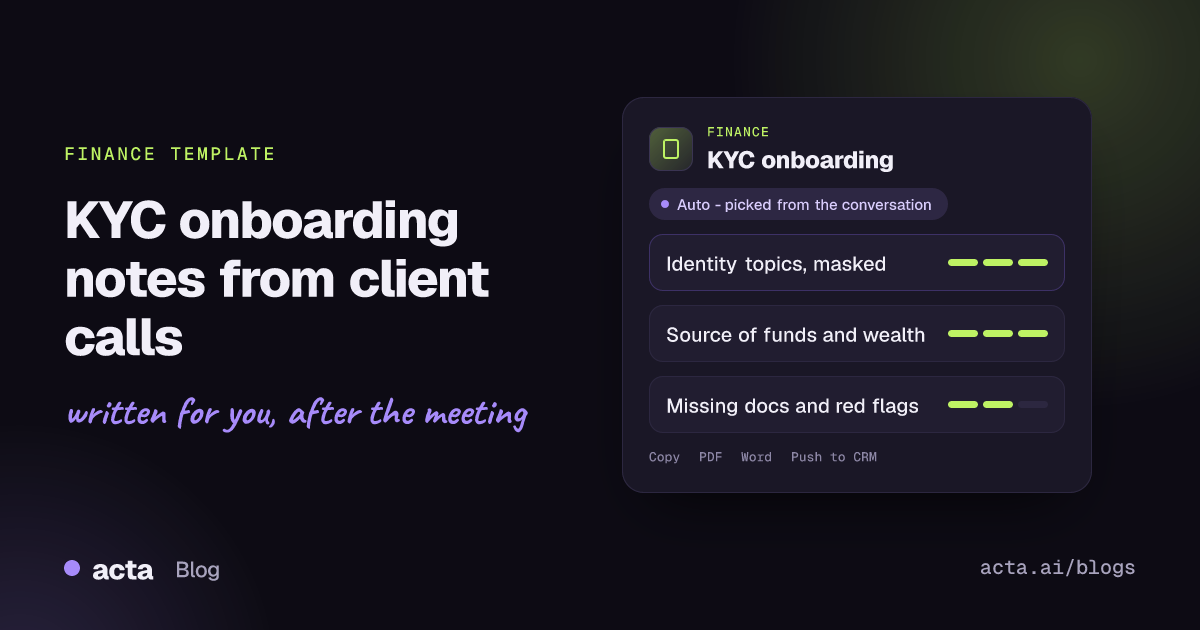
Quick answer: KYC onboarding call notes record what a client told you during onboarding: the identity and verification points covered, where the money and wealth came from, how the account will be used, which documents are still missing and anything that needs a closer look. Acta writes these notes from the recorded call, with identity numbers masked, and lists possible red flags neutrally for review.
An onboarding call does a lot of work. The relationship manager or onboarding analyst confirms who the client is, asks where the initial funds are coming from, gets a sense of how the account will be used and works out which documents are still outstanding. A good call also picks up the details that do not fit, like an unexplained holding company or a vague answer about expected transfers.
The problem is the file note. It is written after a run of calls, from memory and scribbles, and the useful nuance gets flattened into "SOF: business sale". When compliance or an auditor later asks what the client actually said, there is not much to go on.
What is KYC and customer due diligence?
Know Your Customer (KYC) is the process a financial institution uses to establish who a client is and whether the relationship makes sense from a financial crime point of view. It sits inside a firm's anti-money laundering (AML) programme and is usually described as customer due diligence, or CDD.
In the US, FinCEN's customer due diligence final rule sets out the core elements for covered institutions: identifying and verifying the customer, identifying and verifying beneficial owners of legal entity customers, understanding the nature and purpose of the relationship to build a customer risk profile, and ongoing monitoring. The FFIEC BSA/AML examination manual section on customer due diligence explains how examiners look at those risk profiles, and why higher-risk customers get more scrutiny at onboarding and over time.
Other jurisdictions use different rules and terms, but the questions on an onboarding call are similar everywhere:
- Who is the client, and who ultimately owns or controls them?
- Source of funds: where the money for this account is coming from.
- Source of wealth: how the client built their overall wealth.
- Expected activity: what normal use of the account will look like.
- Evidence: which documents support the answers, and which are missing.
What does Acta's KYC onboarding report include?
The report follows that logic, using only what was said on the call:
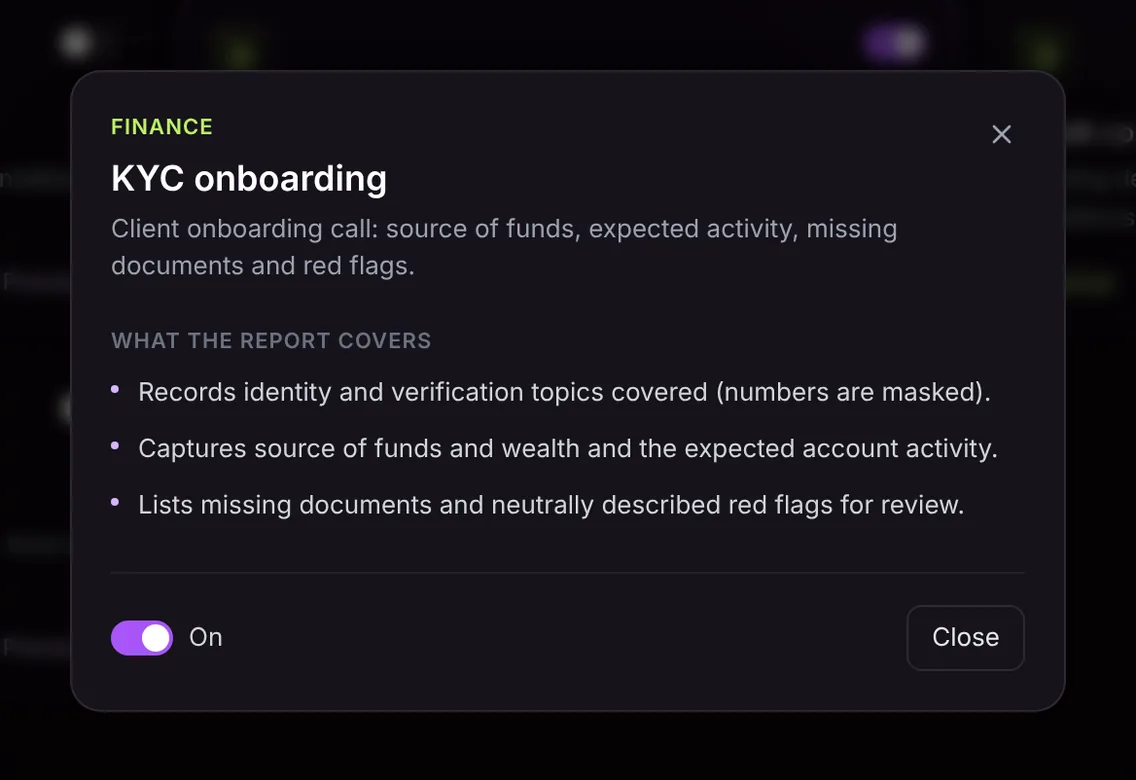
- Identity and verification topics covered. Which identity documents, addresses and ownership details were discussed. Numbers spoken on the call, such as document or account numbers, are masked in the report.
- Source of funds, source of wealth and expected activity. The client's explanation of where the initial money is coming from, how their wealth was built, and how they expect to use the account, such as transfer frequency or payments abroad.
- Missing documents and red flags for review. Documents still outstanding, and points that may need a closer look, described neutrally. These are items for your review, not conclusions about the client.
Here is the template in Acta's Templates page, with the preview of what the report covers:
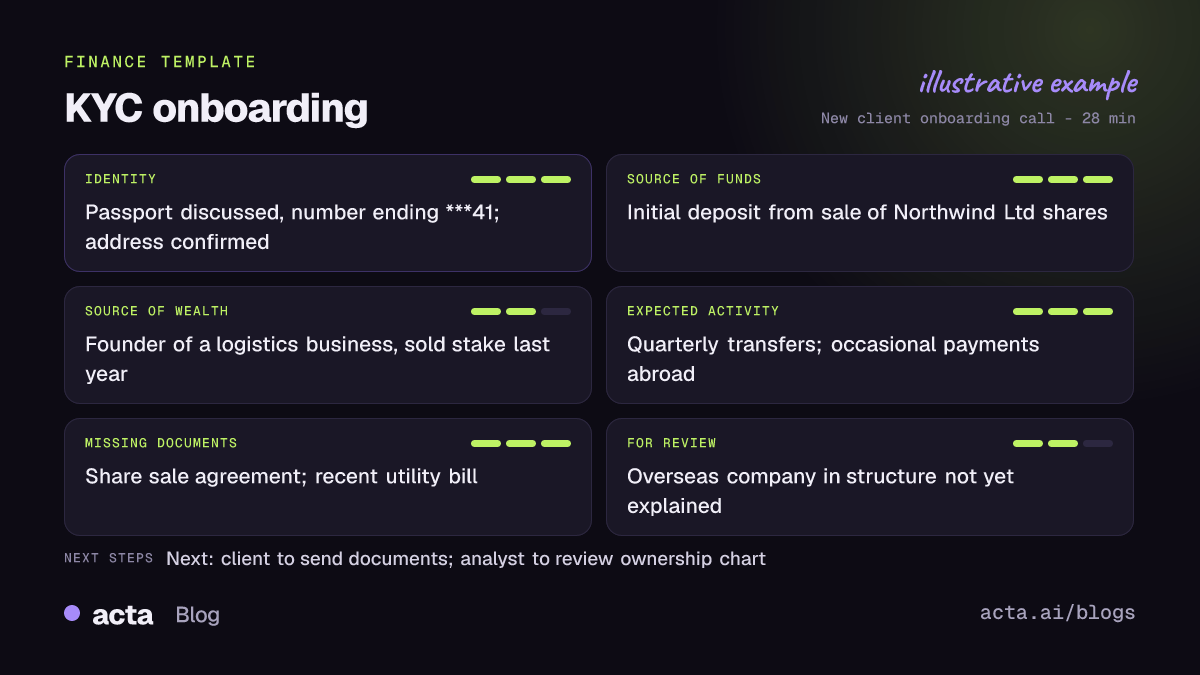
And an illustrative example of a finished report:
Who is it for, and why does it help?
The template is for onboarding analysts, relationship managers, private bankers, wealth advisers, KYC and AML operations teams, and anyone who runs client intake calls at a bank, broker, wealth manager or fintech. More on how these teams use Acta is on the financial services page.
Where it helps:
- A cleaner file from day one. The client's own explanation of source of funds and wealth is captured in their words, not reduced to a one-word category.
- Faster document chasing. The missing documents list doubles as the follow-up email to the client.
- Better handoff to compliance. The analyst reviewing the case sees the context behind each answer and the open points, rather than re-interviewing the client.
- Periodic reviews. When the relationship comes up for review, you can compare what the client said at onboarding with what the account is doing, and ask OneChat across past calls with sources.
How does Acta pick this template automatically?
Acta reads each conversation and can pick the KYC onboarding template even if you have not turned it on. The signals are an onboarding conversation: identity documents and address being confirmed, questions about where the money is coming from and how the client made it, discussion of expected account activity and a list of documents to send. The report is labelled "Auto", and Acta says why, for example that the call covered source of funds, identity verification and outstanding documents.
One click on "Turn on for future meetings" keeps it on. When the template is on, Acta checks each meeting first. An annual review with an existing client or an internal credit discussion will not produce a forced KYC note; it is listed under "Not relevant" with the reason. Those meetings fit the client review and credit committee templates instead.

How do you use the KYC onboarding template?
- Record the onboarding call. Acta records Zoom, Google Meet and Microsoft Teams calls through a meeting bot, or without a bot through the desktop app, the Chrome extension or the mobile apps. You can also upload a recording.
- Turn on KYC onboarding. In Templates, open the Finance group, preview the template and switch it on, or let Acta pick it.
- Open the Templates tab of the meeting. The KYC note sits beside the summary and transcript.
- Review and file. Copy the note into your onboarding system, or download it as PDF, Word or Markdown for the client file. On a paid plan with Salesforce, HubSpot or Zoho connected, Push to CRM adds it as a note on the client's contact.

Tips for a complete KYC note
- Ask source of funds and source of wealth as separate questions. Clients often blur them; the report is clearer when the call separates them.
- Get specific on expected activity: how often, roughly how much, which countries.
- Read back the missing documents list before ending the call.
- Avoid reading full ID numbers aloud where you can. They are masked in the report anyway, but less spoken data is simpler.
For recorded advice and sales conversations, the compliance check template adds flags for compliance review.
Frequently asked questions
Are identity numbers shown in the report?
No. Numbers mentioned on the call, such as document or account numbers, are masked in the KYC onboarding report.
Does Acta decide whether a client passes KYC?
No. The report records what was said and lists possible red flags neutrally for your review. The risk rating and onboarding decision stay with your team.
What is the difference between source of funds and source of wealth?
Source of funds is where the specific money for this account or transaction comes from. Source of wealth is how the client built their overall wealth, such as a business sale, salary or inheritance.
Can the note go into our CRM?
Yes, on a paid plan with Salesforce, HubSpot or Zoho connected, Push to CRM adds the report as a note on the client's contact.
See how it works on your next onboarding call with a free 15-day trial.


