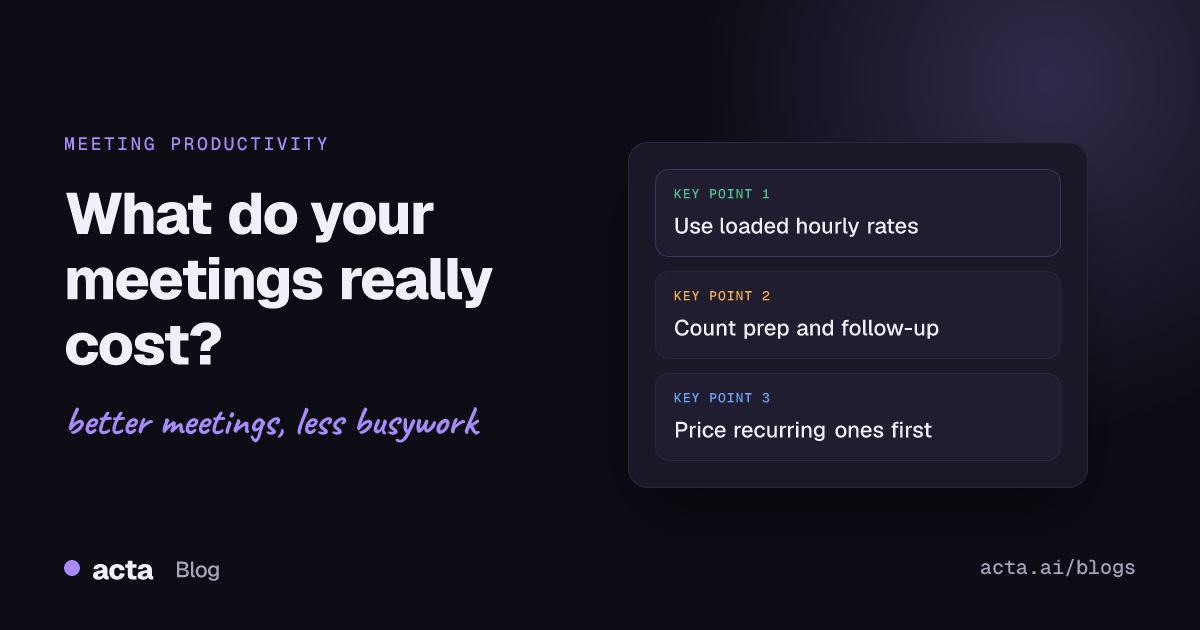
Quick answer: The cost of meetings is roughly attendees x meeting length x each person's fully loaded hourly rate, plus the time spent preparing and following up. Salary alone undercounts it: in US private industry, wages are about 70% of what employers pay per hour. An hour-long weekly meeting with eight people can cost tens of thousands of dollars a year.
Most companies know to the dollar what they spend on software licences and almost nothing about what they spend on meetings, even though meetings are usually the bigger bill. Nobody approves a calendar invite the way they approve a purchase order.
This post walks through how to put a number on it, with a worked example you can copy into a spreadsheet, the costs that don't show up in the simple formula, and how to use the result without turning it into a blame exercise.
How do you calculate the cost of meetings?
The basic formula fits on a sticky note:
Meeting cost = sum of (each attendee's loaded hourly rate x hours in the meeting) + prep time + follow-up time
Here's how to fill it in.
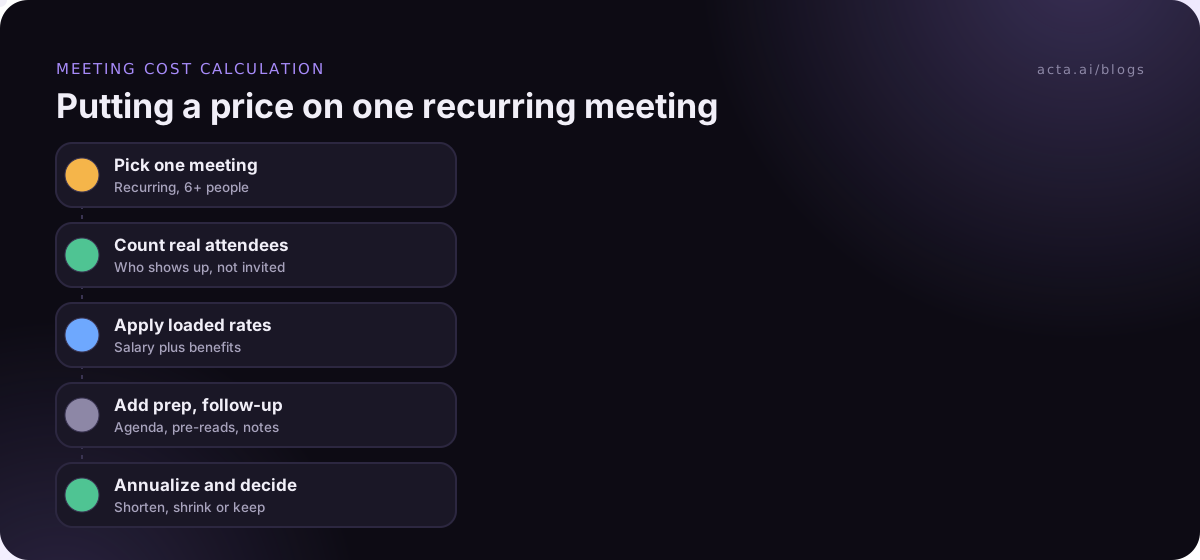
- List who attends. Use the actual attendees, not the invite list. Optional invitees who never show up cost nothing.
- Turn salary into an hourly rate. Annual salary divided by 2,080 (52 weeks of 40 hours) is the usual shortcut. A $90,000 salary works out to about $43.27 an hour.
- Load the rate. Employers pay for more than salary: health insurance, retirement contributions, payroll taxes, paid leave. The US Bureau of Labor Statistics reported that in June 2026, private industry employers spent an average of $46.89 per hour worked on compensation, of which wages and salaries were $32.82, or 70%. Dividing wages by 0.7 is a reasonable way to estimate the fully loaded hourly rate if you don't have your own finance figure. $43.27 becomes about $62.
- Multiply by the length of the meeting in hours, for each person, and add it up.
- Add prep and follow-up. The organizer writing the agenda, people reading the pre-read, someone writing up notes afterwards.
- Annualize recurring meetings. Multiply by how often it happens. A weekly meeting runs about 48 times a year once you allow for holidays.
If you don't have individual salaries (most managers shouldn't be passing those around), use an average loaded rate per role or level. Finance or HR can usually give you bands. The point is a defensible estimate, not payroll accuracy.
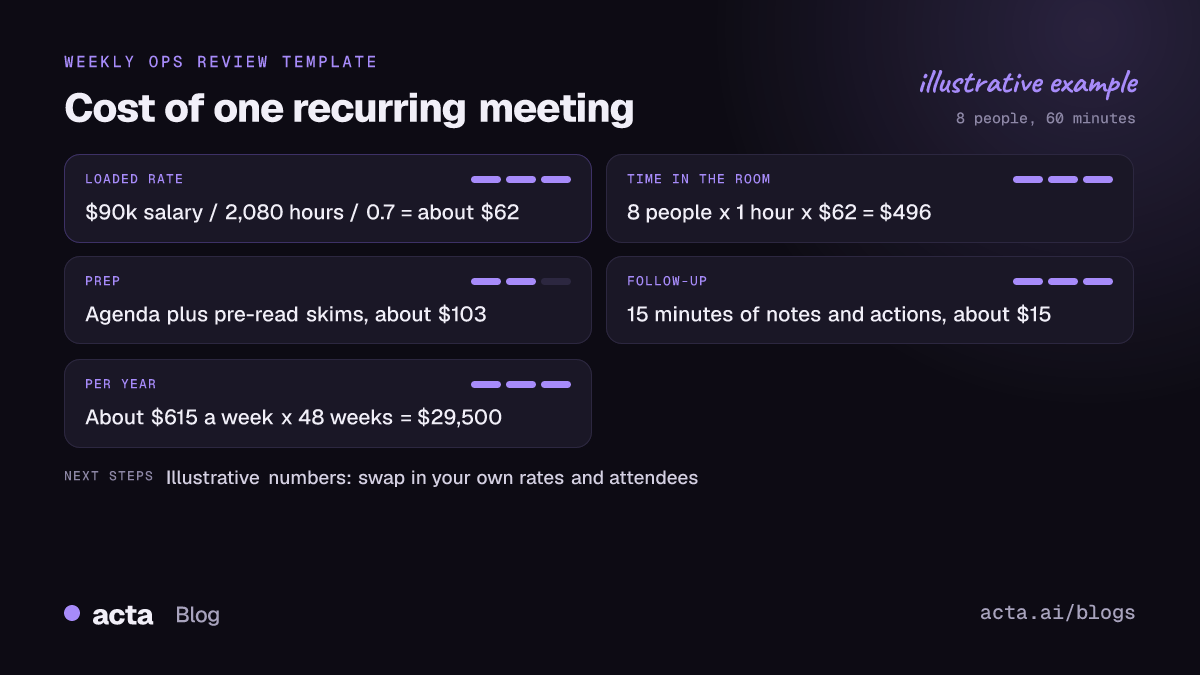
What does a typical weekly meeting cost? A worked example
Take a weekly operations review. Eight people, 60 minutes, everyone on an average salary of $90,000. These are illustrative numbers, so swap in your own.
- Loaded hourly rate: $90,000 / 2,080 = $43.27, divided by 0.7 = roughly $62.
- Time in the meeting: 8 people x 1 hour x $62 = $496.
- Prep: the organizer spends 30 minutes on the agenda and numbers ($31), and the other seven spend 10 minutes each skimming the deck (about $72).
- Follow-up: someone spends 15 minutes writing up notes and actions (about $15.50).
That's about $615 every week, or roughly $29,500 a year for one recurring meeting. Most teams have several of these.
Now the useful part. Suppose you cut the meeting to 30 minutes and only the five people who actually make decisions attend, with the other three reading the notes. Time in the meeting drops to $155, prep and follow-up to about $88, so roughly $240 a week, or around $11,700 a year. Same meeting, close to $18,000 less, and three people get an hour back every week.
What are the hidden costs of meetings?
The formula above only counts time on the clock. Some of the biggest hidden costs of meetings don't show up in it.
The ripple effect of senior meetings
A meeting with executives generates work for everyone below them: the slides, the pre-meetings to prepare for the meeting, the meeting to brief the people preparing the slides. When Bain & Company studied time use at 17 large companies in 2014, it found that one company's weekly executive committee meeting accounted for about 300,000 hours a year across the organization once all the supporting meetings and preparation were counted, as Quartz reported. The executives' own time in the room was a small slice of that. Better executive meeting notes let more of that work happen without another meeting.
Fragmented focus time
A 30-minute meeting in the middle of a morning costs more than 30 minutes. It splits a block that could have held two hours of concentrated work into two pieces too short for anything hard. That's the opportunity cost, and for engineers, designers and writers it's often larger than the meeting itself.
Decisions that don't stick
A meeting that ends without clear owners usually gets held again. If you count the second and third rounds of the same discussion, the real cost of an unproductive meeting is a multiple of the first one. We wrote about why that happens in why action items don't get done.
Context switching on either side
People rarely walk straight from deep work into a call at full attention, or straight back out. Those few minutes on either side add up across a day with five or six meetings.
Should you use a meeting cost calculator?
A spreadsheet is enough for a one-off audit. Where a meeting cost calculator starts to matter is when you want the number in front of people at the moment they create the invite.
Shopify is the well-known example. In 2023 it rolled out an internal calendar tool that estimated the cost of any meeting with three or more people, using average compensation data, the number of attendees and the length. According to an internal note quoted in CNN's report, an average 30-minute meeting with three employees cost Shopify between $700 and $1,600. That's far above what the simple salary formula gives for three people, and the public reports didn't spell out everything that went into it, so treat it as one company's internal estimate rather than a benchmark.
My view: a visible price tag works best as a nudge for the organizer, not a scoreboard for the whole company. If people feel they're being billed for collaborating, they'll stop inviting the colleague who might have spotted the problem, and that's a worse outcome than a slightly long meeting.
Which meetings should you price first?
Don't try to cost every meeting in the company. Start with the ones where the number is big and the fix is easy.
- Recurring meetings with six or more people. They repeat 48 times a year, so small changes multiply. Our guide on what to cut first when reducing meetings has a ranked list. Status meetings are the usual winner here.
- Anything with several senior people. Higher rates, plus the ripple effect of preparation below them.
- Meetings that keep getting rescheduled or re-held. A sign the decision isn't landing.
- Default 60-minute slots. Many would fit in 30 or 45 minutes without anyone noticing.
For each one, ask three questions: does it need to be live, does everyone need to be there, and does it need to be this long? Our standup and weekly meeting templates are a decent starting point if you're redesigning a recurring meeting rather than cancelling it.
How do you reduce the cost of meetings without hurting collaboration?
The goal isn't fewer conversations. It's paying less for the same outcomes. A few changes that usually pay off:
- Invite deciders, inform everyone else. Send the outcome to people who only needed to know, rather than asking them to sit through the discussion.
- Write things down so people can skip. If the notes, decisions and action items reliably go out after the meeting, optional attendees will actually feel safe not attending. Our guide on how to take meeting notes covers what to capture.
- Shorten the default. Change your calendar defaults to 25 or 50 minutes.
- Move status updates to writing. A short written update read in five minutes costs a fraction of the round-robin version.
- Record the meetings people only need to catch up on. A recording or transcript lets someone get the gist later at double speed. If you do this, tell attendees up front; our post on recording consent covers what to say. If bots aren't welcome in the call, a desktop recorder such as Acta's desktop app captures it from your own computer instead.
Then re-run the numbers a month later. Showing a team that they gave themselves back six hours a week tends to make the change stick far better than the original cost figure did.
How do you present the cost of meetings to leadership?
Lead with one or two specific meetings, not a giant company-wide figure. "Our weekly pipeline review costs about $30,000 a year and here's how we'd halve it" gets a decision. "Meetings cost us millions" gets nods and nothing else.
Show your assumptions plainly: the loaded rate, the prep time you assumed, the number of weeks. People will argue with a number they can't see the workings of. And pair the cost with what the meeting produces. Some expensive meetings are worth every cent because a real decision gets made. If you want to compare meeting time against tool spend, our piece on the ROI of AI meeting tools uses the same kind of time-based maths.
Where Acta fits
A lot of meeting cost comes from people attending just to stay informed. Acta records the meeting and produces a summary, the decisions, and action items with owners, so the people who only needed the outcome can read it afterwards instead of sitting in. It won't make a bad meeting good, but it does make it easier to send fewer people.
Frequently asked questions
What hourly rate should I use to calculate meeting cost?
Use a fully loaded rate, which includes benefits and employer taxes as well as salary. If finance can't give you one, divide the hourly wage by 0.7, based on BLS data showing wages are about 70% of US private-sector compensation costs as of June 2026.
How much does a one-hour meeting cost?
It depends entirely on who's in it. As an illustration, eight people on $90,000 salaries cost about $496 for the hour at a loaded rate, before prep and follow-up. Add senior people and the figure climbs quickly.
Should I include prep time in the cost of meetings?
Yes. For senior or recurring meetings, preparation can cost more than the meeting itself. Even a rough estimate of prep and follow-up makes the number more honest.
Is it a good idea to show meeting costs on calendar invites?
It can help organizers think twice, but use it as a nudge, not a way to shame people. If colleagues start avoiding useful invites to keep the number down, you've traded a cost problem for a collaboration problem.
What's the quickest way to cut meeting costs?
Shorten recurring meetings, cut the attendee list to people who decide or do the work, and make sure clear notes go out so others can skip without missing anything.
To see how written meeting notes and action items could let fewer people attend, look at Acta's features.