Quick answer: A good client kickoff meeting confirms why the project exists, what success looks like, who decides what, and how you'll work together each week. Prepare with a short pre-call with your main client contact, keep the kickoff itself to 60-90 minutes, spend most of it on goals, scope edges and ways of working, and send a written recap within a day.
An internal project kickoff is about getting your own team pointed the same way. A client kickoff has a second job that's easy to forget: the client is quietly deciding whether they made the right call hiring you. They've signed the contract, but they haven't seen you work yet. The kickoff is the first real sample.
That changes how you run it. You need structure, because a messy kickoff signals a messy project. But you also need to listen more than you present, because what the client tells you in the first hour shapes everything after. This guide is written for agencies, consultants and services teams; if you're kicking off an internal project, our project kickoff meeting agenda and RACI template is the better fit.
What is a client kickoff meeting for?
Three things, in roughly this order of importance:
- Agree what success looks like. Not the deliverables in the contract, the outcome the client is buying. "A new website" is a deliverable. "Demo requests from the site doubling by Q3" is an outcome.
- Set expectations on how you'll work. Who approves things, how fast people reply, how changes are handled, how often you meet.
- Start the relationship. Put faces to names on both sides and give the client a reason to trust the people doing the work, not just the people who sold it.
If you only get one of these right, make it the first. Every argument later in a project traces back to a different picture of success.
How do you prepare for a client kickoff meeting?
Most of the quality of a kickoff is decided before it starts. Here's the prep I'd do, roughly a week out.
- Read everything that was sold. The proposal, the statement of work, the sales call notes, the email thread. You want to know what was promised, including the things said on calls that never made it into the contract.
- Get a proper handover from sales. Ask the person who closed the deal: why did they buy, who pushed for it, who was sceptical, and what worries them? This is often the most useful 20 minutes of the whole prep.
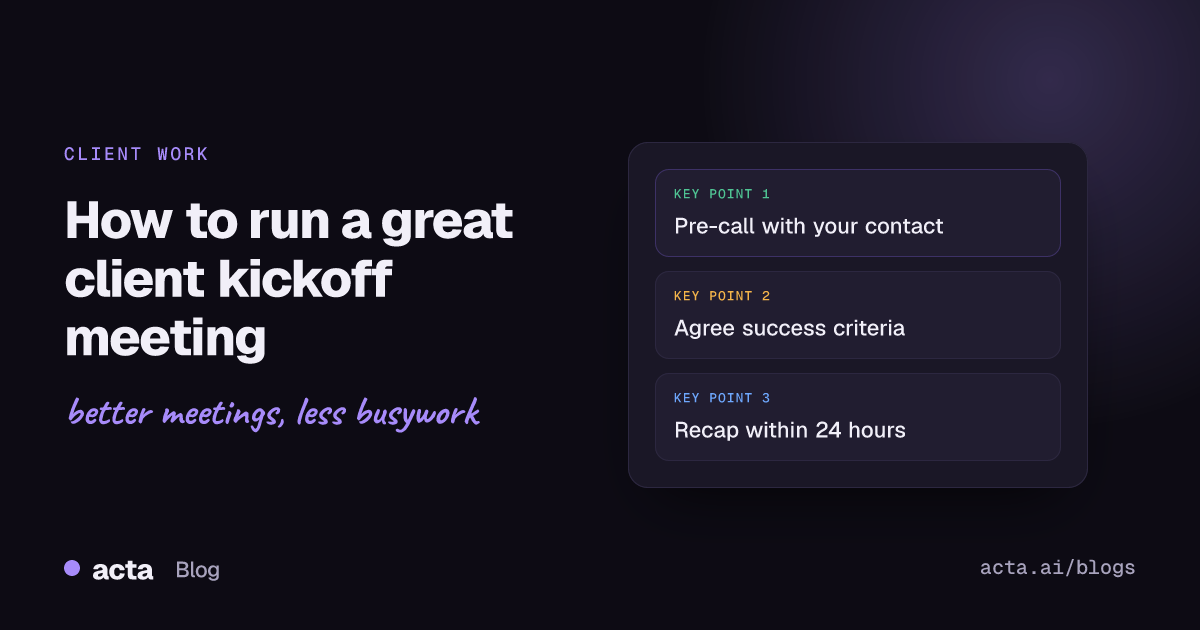
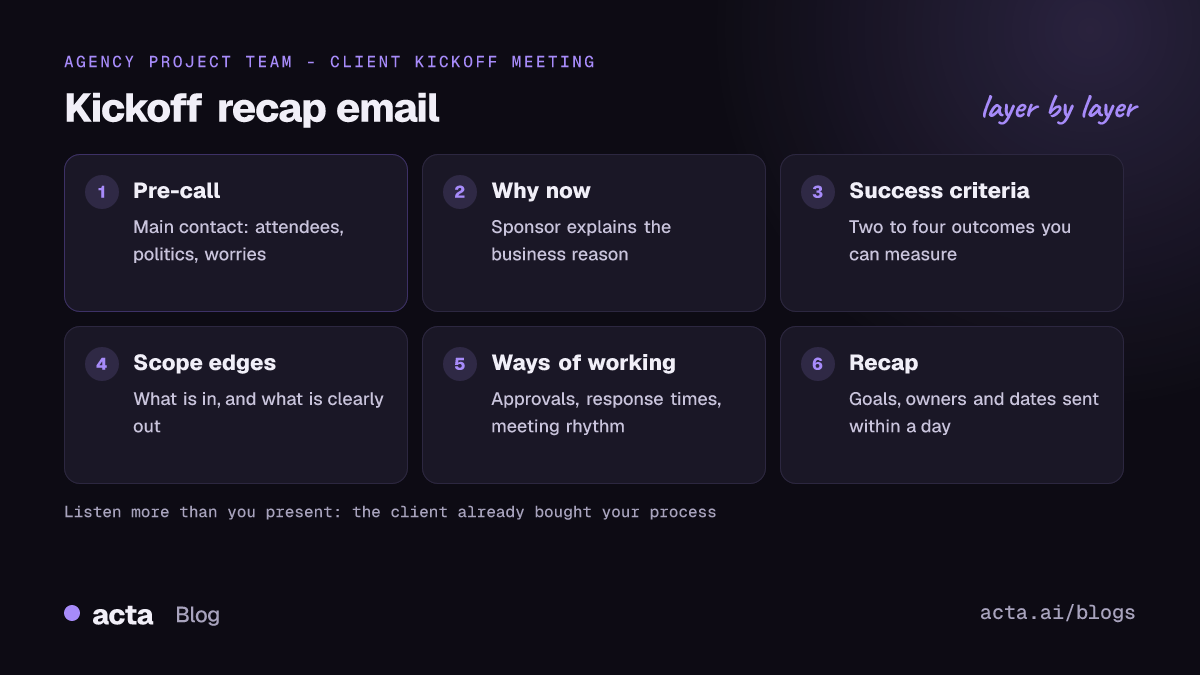
- Hold a short pre-call with your main contact. A PMI piece on setting expectations in client relationships argues for a meeting before the kickoff whose purpose is the working relationship, not requirements. I agree. Use it to check the attendee list, learn the internal politics, and ask what would make the kickoff a success from their side.
- Build a simple stakeholder map. Who decides, who influences, who uses the result, who can block it. One line each is enough.
- Send the agenda two days before. Include the two or three questions you most need answered, so the right people come prepared.
- Brief your own team. Agree who presents what and who takes notes. Clients notice when the agency side hasn't talked to itself.
What should a client kickoff meeting agenda include?
For most projects, 75 to 90 minutes is right. Atlassian's project kickoff play suggests 90 minutes for a group of 3 to 14 people, which matches what I've seen. Any longer and energy drops; much shorter and you end up skipping the hard conversations about scope. Here's a kickoff meeting agenda I'd start from:
- Introductions (10 min). Names, roles, and what each person will actually do on the project. Skip long bios.
- Why this project, why now (15 min). Ask the client sponsor to explain it in their own words. Listen for the business reason, not the brief.
- Success criteria (15 min). Agree two to four measurable outcomes and how you'll know you hit them.
- Scope and its edges (15 min). Walk through what's in, and say clearly what's out. More on this below.
- Ways of working (15 min). Meeting rhythm, channels, approvals, response times, how change requests work.
- Risks and worries (10 min). Ask what could derail this. Clients often know things they won't volunteer unless asked.
- Next steps (5 min). The first two weeks, with owners and dates.
Notice how little of that is you presenting. A common mistake is spending 40 minutes on a deck about your process. The client already bought your process. They want to know you understand their problem.
Which questions should you ask the client?
Good kickoff questions get at things the brief doesn't say. A few I keep coming back to:
- "If this goes really well, what's different six months from now?"
- "Who else in your company needs to be happy with this, and what do they care about?"
- "What happened with the last agency or vendor you worked with on this?"
- "What's the decision process when something needs sign-off? Who has the final say?"
- "What would make you nervous in the first month?"
- "Is there a date or event this has to be ready for that isn't in the plan?"
The question about the previous vendor is uncomfortable, and it's the one that tells you most. Whatever went wrong last time is what they'll be watching for with you.
How do you set expectations without sounding defensive?
This is the part of the client kickoff meeting most people rush, because it feels like it might spoil the mood. It won't, if you frame it as how you'll protect their outcome rather than how you'll protect your margin.
Scope edges
Name two or three things that are out of scope and likely to come up. "Copywriting for the product pages isn't in this phase. If you'd like it, we'll scope it separately." Saying it now is friendly. Saying it in week six sounds like an excuse. Our guide to catching scope creep in client meetings covers what to do when it starts to slip anyway.
Approvals and feedback
Agree who gives feedback, in what form, and how long reviews take. Then track it; our guide to client feedback tracking for agencies shows one way. Five reviewers sending separate emails is how timelines double. Ask for one consolidated round per deliverable.
Response times
Say what they can expect from you (for example, replies within one working day) and ask what you can expect from them. A project often stalls waiting on the client, and it's much easier to raise that if you agreed on it at the start.
Changes
Explain your change request process in two sentences. Keep it light. The point is that there is one, not the paperwork.
Who should attend the client kickoff?
From the client side: the sponsor (at least for the first half), the day-to-day contact, and anyone who'll approve deliverables. From your side: the project lead, the people doing the core work, and ideally whoever sold the deal, so the client sees continuity.
Keep it small enough that people actually talk. On big programmes, a PMI article on kickoffs and strategic alignment describes practitioners holding two kickoffs: one with senior stakeholders and one with the team doing the work. That's a sensible split when the sponsor group is large or very senior. They need the why and the risks; the working team needs the detail.
What should happen after the kickoff?
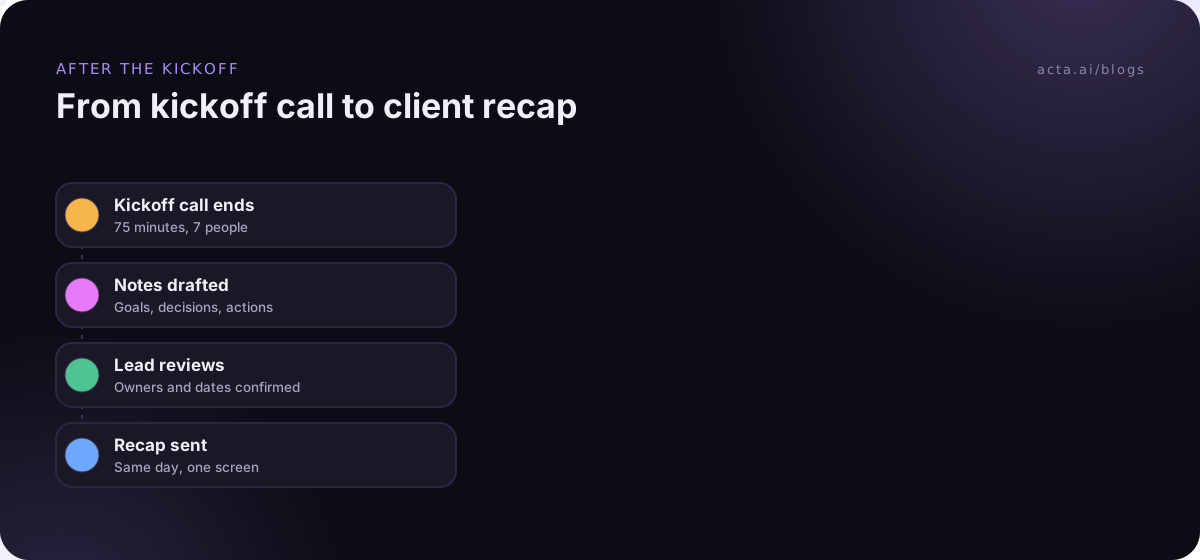
The recap is where you prove you were listening. Send it within 24 hours, and keep it short enough to read on a phone.
- Goals and success criteria as agreed, in the client's words where you can.
- Decisions made in the meeting.
- Scope notes, including the things you said were out.
- Action items with owners and dates, on both sides.
- Open questions and who's chasing them.
Writing a good recap is much easier if you're not also trying to take notes while running the meeting. Some teams assign a note-taker; others record, often after sending an AI notetaker disclosure email to the client. If you record, ask at the start and explain why, and check the rules where your client is based; our guide on recording meetings with AI and getting consent covers what to say. Some client companies block meeting bots, so a recorder that runs on your own computer is often the easier option: the Acta desktop app has a Copy notice button that pastes a recording notice into the meeting chat, and the Chrome extension works for Google Meet, Microsoft Teams in the browser and the Zoom web client.
Then book a short check-in at the end of week one. It catches misunderstandings while they're still cheap. If you want a ready structure for the recap itself, see our post on follow-up email drafts after every call.
What are the most common client kickoff mistakes?
- Presenting instead of asking. If you talk for more than half the meeting, you've missed the point.
- Skipping the sales handover. Then the client repeats everything they already told your salesperson, and wonders why.
- Vague success criteria. "A better onboarding experience" can't be checked. "Fewer support tickets in the first 30 days" can.
- Avoiding scope. The kickoff is the cheapest moment to say no.
- No recap, or a late one. A recap three days later reads like an afterthought.
- Only the senior people show up. If the person doing the work isn't there, the client can't build trust with them.
For agencies juggling lots of clients, keeping track of what was promised in each kickoff gets hard fast. Our piece on meeting notes for consultants and agencies looks at tracking client promises over time.
Where Acta fits
Acta records client calls with a meeting bot or bot-free from your desktop or browser, then writes up the summary, decisions, action items with owners, and a follow-up email draft you can edit before sending. It doesn't use customer data to train AI models, which is usually the first thing clients ask. For a kickoff, that means the recap can go out the same afternoon.
Frequently asked questions
How long should a client kickoff meeting be?
Between 60 and 90 minutes for most projects. Small, simple engagements can do it in 45; large programmes may need a separate session for senior stakeholders.
What's the difference between a client kickoff and client onboarding?
Client onboarding is the whole set-up period: contracts, access, tools, introductions. The kickoff is one meeting inside it, focused on goals, scope and ways of working.
Should the kickoff be in person or on a video call?
In person is nice for big engagements but rarely essential. A well-run video kickoff with cameras on works fine. What matters more is the prep and the recap.
Who should run the kickoff, the account manager or the project lead?
Usually the project lead, since they'll run the work day to day. The account manager or salesperson should still attend and open the meeting, so the client sees a clean handover.
What should go in the kickoff recap email?
Agreed goals and success criteria, decisions, scope notes, action items with owners and dates, and open questions. Keep it to one screen if you can.
If you'd like your next kickoff recap drafted for you, try Acta with the 15-day free trial.