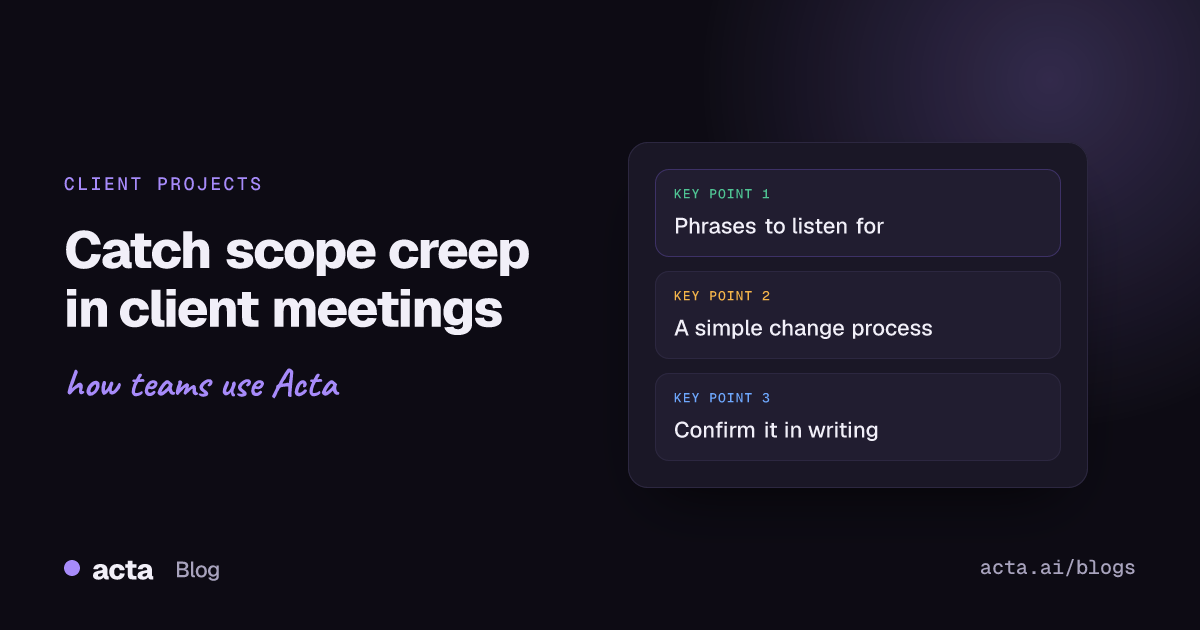
Quick answer: Scope creep in client meetings usually starts with small, friendly requests: "while you're in there", "it should be quick", "can we just add". Catch it by comparing every new commitment from a call against the statement of work, logging anything outside it as a change request with cost and time impact, and confirming the outcome in writing before any work starts.
Few projects blow up because of one big new requirement. They drift, one reasonable-sounding request at a time, usually said out loud on a call and agreed to before anyone checks the contract. By the time the budget or deadline slips, nobody can say when the extra work was promised.
This guide covers what scope creep sounds like in client calls, how to catch it while it is still a conversation, a simple change request process, and how Acta helps by surfacing the new commitments and risks raised in each meeting.
What is scope creep, and why does it start in meetings?
The Project Management Institute treats scope creep as uncontrolled growth in a project's scope: more work added without matching changes to time, cost or resources. PMI's paper on the top five causes of scope creep calls it one of the most common causes of project failure.
Meetings are where most of it starts. Written requests tend to get checked against the contract; spoken ones often do not. On a client call, the social pressure runs one way: the client asks, the team wants to be helpful, and "sure, we can look at that" feels like good service. That sentence becomes a commitment the moment the client hears it.
Three things make scope creep in client meetings hard to spot:
- Requests are small and spread out. Each one is easy to absorb. Ten of them are not.
- Different people hear different requests. The designer, the project manager and the account lead are often on different calls.
- Nobody writes them down as scope. They end up as a line in someone's notes, not as a change to the plan.
What does scope creep sound like on client calls?
Learning the phrases is the cheapest defence. When you hear one of these, it is a signal to pause and check the statement of work.
"While you're in there..."
The request is attached to existing work, so it sounds free. It rarely is: it needs design, testing and review like anything else.
"It should be a quick one"
The client is estimating your work for you. Thank them, then size it properly before agreeing.
"Can we just add..." or "One more small thing"
"Just" is the most common word in scope creep. It makes a new deliverable sound like a detail.
"Our leadership also wants to see..."
A new stakeholder has appeared with new expectations. This often means new reports, approvals or features nobody planned for.
"We assumed that was included"
This is a gap between the contract and what the client understood. It needs a clear, polite answer, not a silent yes.
Your own side: "Yeah, we can probably do that"
Scope creep is not only what clients ask for. It is also what your team agrees to. "We'll take a look" or "should be fine" can be heard as a firm yes.
How do you catch scope creep in client meetings as it happens?
You do not have to win every scope conversation on the call itself. You have to notice it and avoid committing on the spot.
- Know the scope before the call. Have the statement of work, or a one-page summary of what is in and out, open during client calls.
- Name it gently. "That sounds useful. It's outside what we scoped, so let me write it up as a change and come back with the impact." This keeps the relationship friendly and the boundary clear.
- Do not estimate live. Say when you will come back with a time and cost estimate instead of guessing.
- Capture the exact request. Note who asked, what they asked for, and why. The reason often reveals a smaller solution.
- Recap at the end of the call. List the new requests and say they will go through the change process. Everyone hears the same thing.
What should a change request process look like?
A change request process does not have to be heavy. PMI's article on scope management and project change describes the basic contractor-client flow: either side can spot a needed change, a formal request is raised, the impact is analysed, the cost is estimated and the price goes to the client. A practical version for most client projects:
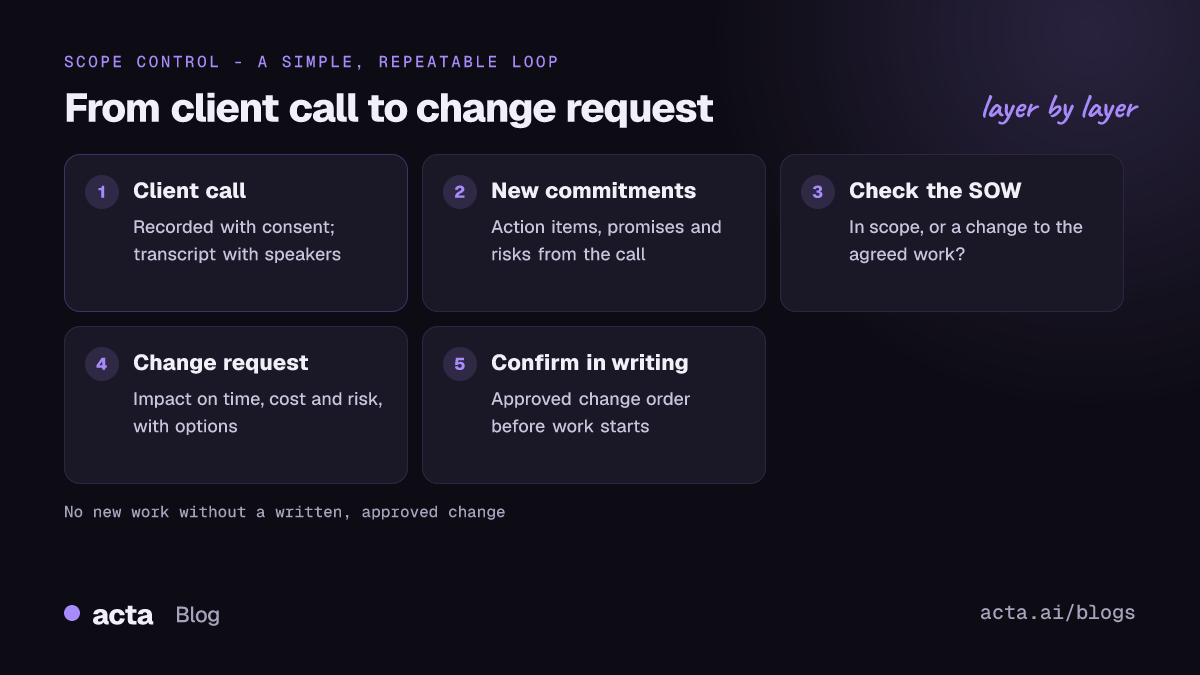
- Log the request. One line describing the change, who asked, and the meeting where it came up.
- Assess the impact. What does it add in time, cost and risk? What does it delay?
- Offer options. Add it with more budget or time, swap it for something already in scope, or move it to a later phase.
- Get a decision from the right person. The client's budget holder, not whoever asked on the call.
- Confirm in writing. Update the statement of work or send a written change order. No work starts until this is done.
- Update the plan. Change the timeline, tickets and status report so the team works from the new scope.
The rule that holds this together is simple: no new work without a written, approved change. Saying it early in the project makes it much easier to apply later.
Why should you confirm scope changes in writing?
Memory of a call is unreliable, and both sides remember it in their own favour. A short written confirmation after each client call does three things:
- It turns a vague "we'll look into it" into an explicit yes, no or change request.
- It gives the client a chance to correct a misunderstanding before work starts.
- It creates a record you can point to if there is a dispute about what was agreed.
A good follow-up email after a client call lists decisions made, action items with owners and dates, and new requests that will go through the change process. Keep it short enough that the client actually reads it.
How does Acta help you catch scope creep?
Acta does not have a special scope creep detector. What it does is make sure nothing said on a client call disappears, and pull out the parts that matter for scope: new commitments, decisions and risks. You still compare those against the statement of work; Acta makes sure you have the full list to compare.
Acta records Zoom, Google Meet and Microsoft Teams calls through a meeting bot that joins from your calendar, or without a bot through the bot-free desktop app and Chrome extension. Record clients only with their consent where the law requires it; our guide on recording consent and what to tell participants explains what to say.
From each call, Acta gives you:
- A transcript with speakers, so you can see exactly who asked for what and in which words.
- Action items with owners and due dates, including the ones your own team agreed to, which is where "yeah, we can do that" shows up.
- Promises, the commitments made in meetings, open and delivered, filterable by client. A promise that is not in the statement of work is a scope question.
- A decisions log, with who decided, the status of each decision and the meetings where it was raised, changed or reversed. See how this works in the meeting decision log.
- Risks raised in meetings, internal and client-side, each with a level, impact and a mitigation, plus warning signs such as overdue promises.
- Follow-up email drafts that you can edit into the written confirmation after the call.
You can also ask questions across all your meetings in OneChat, with sources: "What new requests did the client make in the last month?" or "Did we ever agree to the extra reporting dashboard?" The answer links to the moment in the transcript, which settles most "we assumed that was included" debates quickly.
For engineering teams, Acta's Jira integration can turn approved changes into tickets so the plan reflects the new scope. See the full list on the Acta features page.
How do scope changes become project risks?
Unmanaged scope changes rarely show up as "scope creep" in a status report. They show up as other project risks: a slipping milestone, an overworked team, a budget that no longer adds up, or a client who is unhappy that the original deliverables are late.
That is why it helps to review new commitments and risks together. A weekly look at "what did we agree to this week that was not in the plan?" catches most of it early. Our post on project risks hiding in everyday conversations covers other warning signs to listen for, and status reports written from your status meetings shows how to keep the RAG rating honest when scope moves.
PMI's paper on scope and stakeholder management is also worth reading if new stakeholders keep appearing mid-project with their own requests.
How do you say no to scope creep without hurting the relationship?
Most clients are not trying to get free work. They are asking for what they need and do not know the cost. A few habits keep the conversation easy:
- Say "yes, and here's what it takes" instead of a flat no. Offer the change with its cost, or a swap.
- Refer to the shared document, not your opinion. "The statement of work covers X; this would be an addition."
- Be consistent. If you absorb small requests for free early on, clients will reasonably expect it later.
- Bring the record. When there is disagreement about what was agreed, the transcript and the follow-up email are neutral ground.
Related reading: AI Meeting Notes for Consultants and Agencies: Track Every Client Promise
Frequently asked questions
What is the difference between scope creep and a change request?
A change request is a controlled change: it is logged, assessed, priced and approved before work starts. Scope creep is the same extra work without that process, so time and budget do not change to match.
Who should approve change requests on a client project?
Someone on the client side who controls the budget, and the project lead on your side. The person who asked for the change on a call is often not the person who can approve the cost.
Should the statement of work list what is out of scope?
Yes. A short "not included" list prevents many "we assumed that was included" conversations, because both sides agreed on the boundary in writing.
Can Acta tell me when a client asks for something outside the contract?
Not automatically. Acta does not read your contract. It lists the new commitments, decisions and risks from each call, with transcript links, so you can check them against the statement of work quickly.
What if scope creep was agreed by my own team on a call?
Treat it the same way: log it as a change request, assess the impact and confirm with the client in writing. Better to correct it early than to deliver it late or for free.
Want every client commitment and risk from your calls in one place? Start a free 15-day trial of Acta.