Use Cases 6 min read
Hospital Bed and Staffing Meeting Reports, Written From the Huddle
How Acta writes up the daily hospital operations meeting: bed capacity, staffing gaps, safety events, decisions, owned actions and escalations.
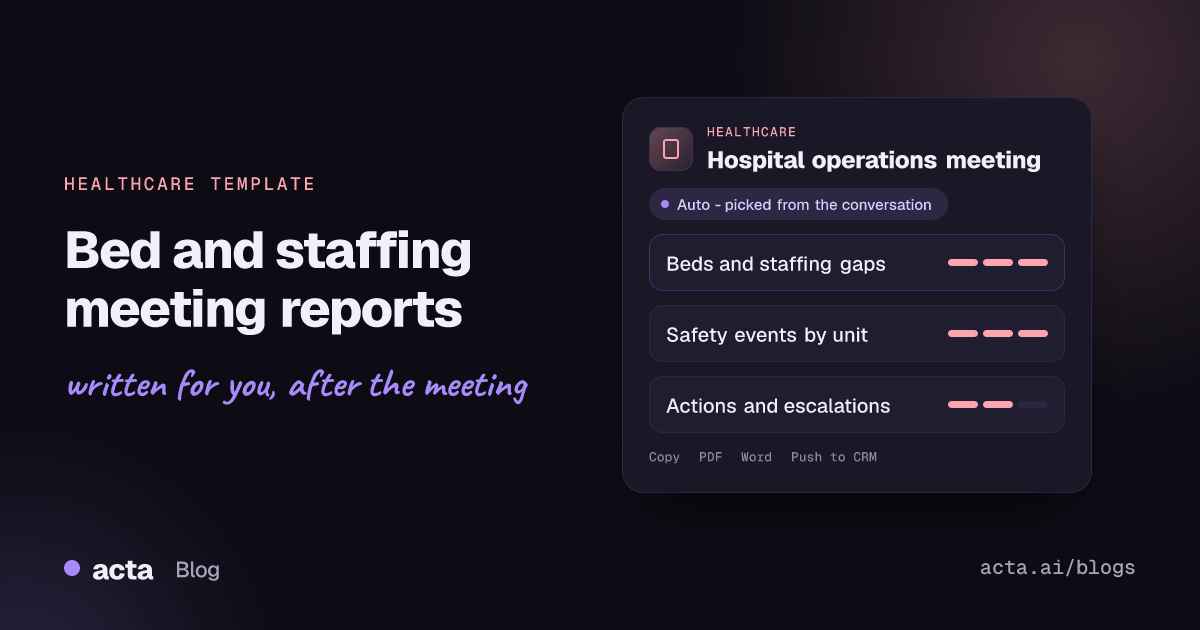
Quick answer: A hospital operations meeting report is the written record of the daily bed and staffing meeting: capacity and staffing gaps by unit, safety events and near misses with the action taken, quality metrics, decisions, owned actions and escalations. Acta writes it from the meeting recording, using only what unit leads reported, so the site manager has an accurate record minutes after the huddle ends.
The morning bed meeting moves fast. Each unit lead gives census, expected discharges and admissions, staffing holes and anything that went wrong overnight, often in under a minute. The bed manager is listening, deciding and making calls at the same time.
That leaves little room for writing it down. Notes end up scribbled on a printed bed board or reconstructed from memory after the fact, and the follow-ups agreed in the room, such as moving a nurse or escalating a delayed transfer, rely on someone remembering. A structured report from the recording fixes the record without slowing the meeting.
What is a hospital bed and staffing meeting?
Most hospitals run a short daily operations huddle, sometimes called the bed meeting, capacity huddle or safety huddle, where unit and department leads report on capacity, flow, staffing and safety. The Institute for Healthcare Improvement describes how hospitals build these routines in its piece on how to make safety huddles stick, including morning huddles that combine a bed meeting, a flow meeting and a safety discussion.
The format varies, but the purpose is the same: give operational leaders one shared picture of the day, so they can match beds to demand, cover staffing gaps, act on safety concerns early and escalate what the units cannot solve themselves. Typical attendees include the site or bed manager, nursing supervisors, unit charge nurses, the emergency department lead, and representatives from facilities, pharmacy, environmental services or patient flow.
The output that matters is short and specific: where the pressure is, what was done about it, and who is following up.
What does Acta's hospital operations meeting report include?
The template follows the order of a typical bed meeting:
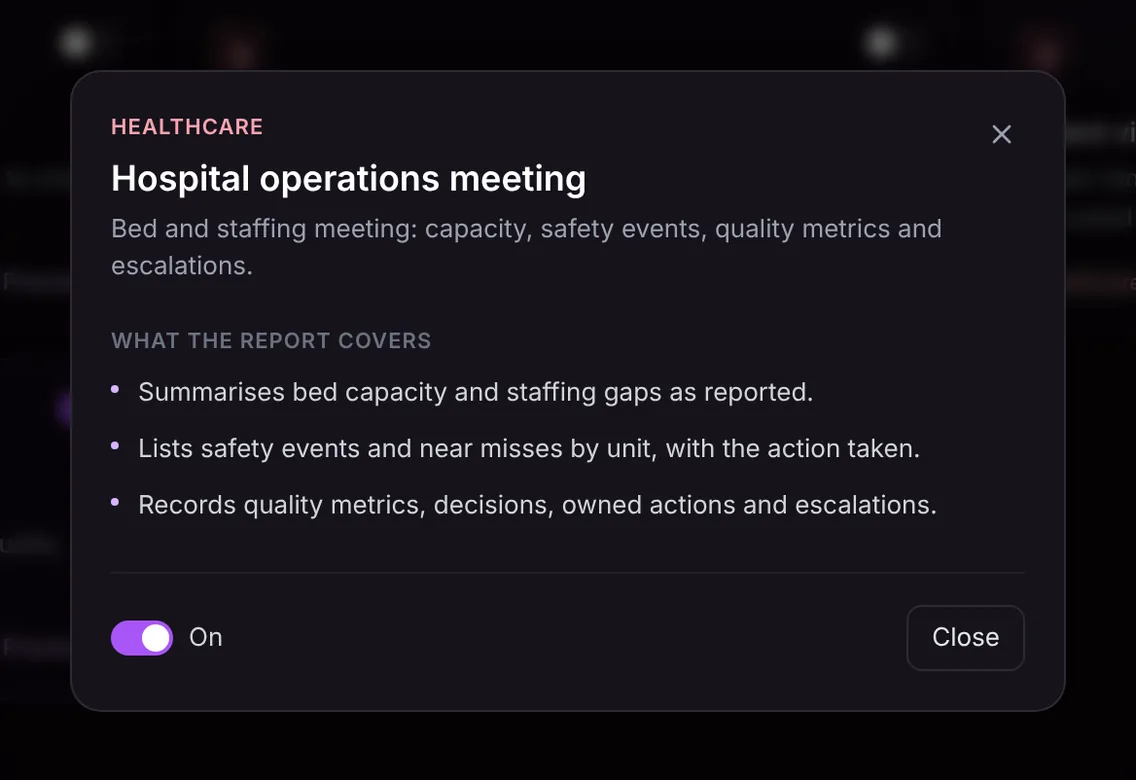
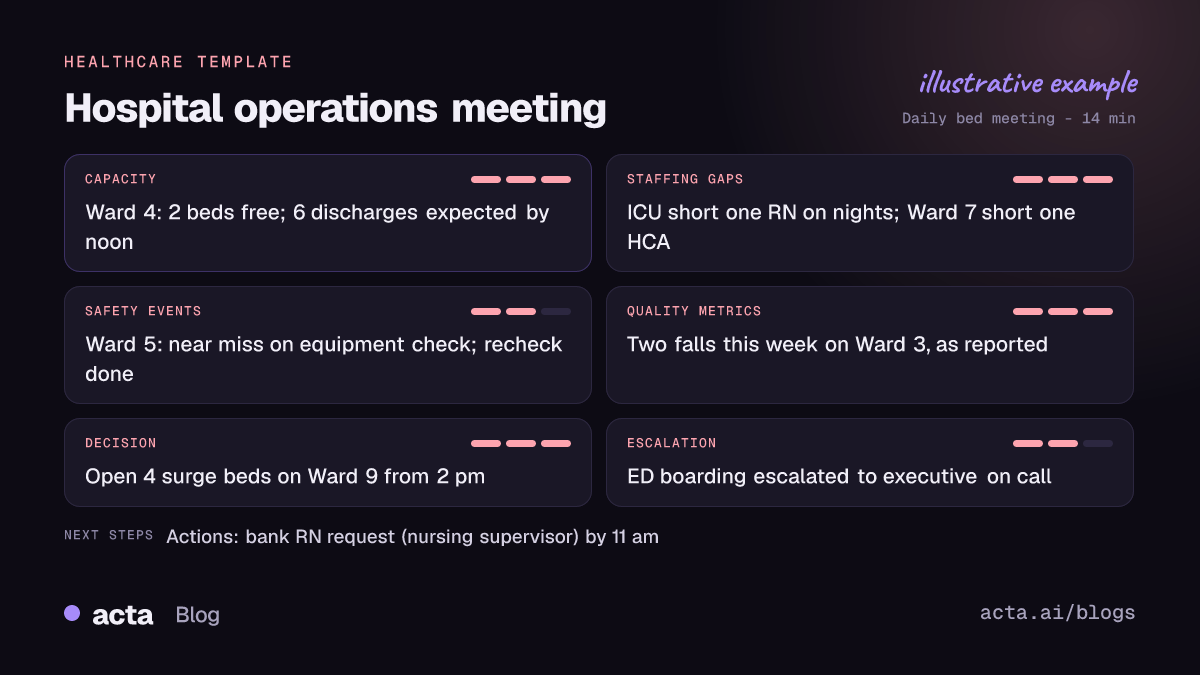
- Bed capacity and staffing gaps: beds available, expected discharges and admissions, and shortages by unit and shift, recorded as reported in the meeting.
- Safety events and near misses by unit: each event or near miss raised, the unit it happened on and the immediate action taken.
- Quality metrics: any measures discussed, such as falls, pressure injuries, infection indicators or delayed discharges, as stated by the people in the room.
- Decisions: what the group agreed, for example opening surge beds, diverting elective admissions or redeploying staff.
- Owned actions: follow-ups with the person responsible and the time agreed.
- Escalations: issues pushed to the executive on call, nursing director or another service, with the reason.
The report records numbers as people said them and does not calculate, adjust or fill in figures nobody mentioned. It is an operational record, not a clinical document, so it works best when leads talk about units and counts rather than naming patients.
Here is the template in Acta's Templates page, with the preview of what the report covers:
And an illustrative example of a finished report:
Why is a written bed meeting report useful, and who is it for?
It is built for site managers, bed managers, patient flow coordinators, nursing supervisors and the operations or quality leads who rely on what the huddle decided.
- Shift handover: the afternoon or night site manager can read what the morning meeting agreed instead of piecing it together from phone calls.
- Escalation follow-through: when a delayed transfer was escalated at 8:30, the report shows who owns it, so it does not resurface unresolved at the next huddle.
- Safety follow-up: near misses raised verbally are written down by unit, ready for the safety or quality team to pick up through the hospital's own reporting process.
- Weekly review: a week of reports gives the operations team a plain record of recurring pressure points, such as the same unit short of staff every Monday.
If your clinical teams also hold multidisciplinary huddles about individual patients, the care team huddle notes template is designed for that, with its own clinical safeguards. The hospital operations report stays at the level of units, beds and staff.
How does Acta pick the hospital operations template automatically?
Acta reads each conversation and picks a template that fits, even if you have not turned it on. A meeting where unit leads go round the table with census numbers, discharges, admissions, staffing shortfalls and overnight incidents is a clear match. The report is labelled "Auto", and Acta gives its reason, for example that the meeting covered bed availability on several wards, two staffing gaps and an escalation to the executive on call.
Other signals include talk of surge capacity, ED boarding, delayed discharges, agency or bank staff, near misses and quality indicators. If the report is what you need, "Turn on for future meetings" keeps the template on.
The relevance check stops the template from forcing a report where it does not belong. If it is on and the meeting is a budget planning session or a vendor call, you will not get an empty bed report; the template is listed under "Not relevant" with the reason.

How do you use the hospital operations report in Acta?
- Record the meeting. For a virtual huddle, Acta can join Zoom, Google Meet or Microsoft Teams with its meeting bot, or record through the bot-free desktop app or Chrome extension. For an in-person huddle at the bed board, use the mobile app, or upload a recording afterwards.
- Turn on the template. In Acta's Templates page, open the Healthcare group, preview Hospital operations meeting and switch it on, or let Acta pick it when the meeting fits.
- Open the meeting's Templates tab. The report appears next to the summary, transcript and action items.
- Share it. Copy it into the operations channel or handover note, or download it as PDF, Word or Markdown for the daily log.

Follow your organisation's rules on recording and information governance, and tell attendees the meeting is being recorded. Our article on consent and what to tell participants is a useful starting point.
Tips for a complete bed meeting report
- Have each unit report in the same order: beds, expected discharges, admissions, staffing, safety.
- Say the unit name before the numbers, so figures land against the right unit.
- When something is escalated, say to whom and why in one sentence.
- Close with a quick read-back of actions and owners.
For more on how Acta supports clinical and operational teams, see Acta for healthcare and Acta for operations. For decisions and ownership across non-clinical planning meetings, the decision log and RACI template is a good companion.
Frequently asked questions
What is discussed in a hospital bed meeting?
Usually bed availability, expected discharges and admissions, staffing gaps by unit and shift, safety concerns and near misses, and anything that needs escalating. Acta's report captures each of these as reported.
Does the report replace incident reporting?
No. It records safety events and near misses as they were raised in the meeting. Formal incident reports still go through your hospital's own reporting system.
Will Acta calculate occupancy or fill in missing numbers?
No. The report only contains what was said in the meeting. If a unit did not give a figure, it is not estimated.
Can we record an in-person huddle?
Yes. Use the Acta mobile app in the room, or upload a recording afterwards, and the report is written the same way.
Give your next bed meeting a written record without extra admin: try Acta free for 15 days.


