An AI scorecard drafts the assessment, a person confirms it
Every scorecard has three parts: a rubric (the criteria and what each rating means), a call (the transcript, with speaker names and timestamps) and a judgement. With a manual scorecard, a manager listens to the call and fills in the form. With an AI scorecard, the software reads the transcript, answers each rubric question, and links the answer to the moment in the call. The manager's job shifts from listening to 45 minutes of audio to checking a page of evidence.
Conversation intelligence tools implement this in different ways, so read the vendor's own docs rather than the product page. Gong is a useful reference because its help centre is detailed. As of November 2026, Gong's help page on AI for scoring describes two modes: Gong AI suggests answers to scorecard questions, which the scorer can accept or replace, or it reviews calls automatically. According to Gong's setup guide for automatic review, a tech admin has to switch automatic review on at company level, questions the AI can't answer are skipped, the overall score must be calculated, and by default only the call host is scored. Gong also says it can't score voicemails or calls with fewer than 100 words in the transcript, and only people with an override permission can change an automatic result. Check the vendor's page, plans and features change.
Two things are worth noticing in that design. Unanswered questions are skipped rather than scored zero, and editing a score is a controlled permission. Both are good habits for any AI scorecard, whatever tool you use.

What goes on an AI scorecard depends on your sales method
A sales call scorecard should mirror how your team already sells. If you qualify with MEDDIC, score MEDDIC. If you use BANT for inbound leads, score BANT on those calls. A generic "rapport, discovery, close" sheet tells reps nothing they can act on.
Group criteria into four blocks:
- Discovery: did the rep ask about the current process, the problem's cost and who else is affected? Did they let the buyer talk?
- Qualification: the elements of your method. For MEDDIC that's metrics, economic buyer, decision criteria, decision process, identified pain and champion; our MEDDIC sales methodology guide has the questions for each. For BANT it's budget, authority, need and timing, covered in BANT explained.
- Handling: objections answered with specifics, competitors mentioned and how the rep responded, pricing discussed at the right stage.
- Next steps: a dated next meeting, a named owner on each side, and a summary the buyer agreed to.
| Criterion | Evidence that counts | Scale |
|---|
| Uncovered the business pain | Buyer states a problem in their own words and its effect | 0 none, 1 named, 2 quantified |
| Identified the economic buyer | A named person who signs off on budget | 0 / 1 / 2 |
| Mapped the decision process | Steps, approvers or dates for the decision | 0 / 1 / 2 |
| Handled the main objection | Objection restated and answered with a specific | 0 / 1 / 2 or Not raised |
| Agreed a next step | Date, attendees and purpose confirmed by the buyer | 0 / 1 / 2 |
For customer calls (onboarding, QBRs, support escalations) swap qualification for criteria such as "confirmed the customer's goal for the quarter" or "logged every promise with an owner". The structure stays the same.
AI scorecards differ from manual and interview scorecards
The word "scorecard" covers three different things, and teams often mix them up.
| Type | Who fills it in | What it judges | Main risk |
|---|
| Manual call scorecard | Manager after listening | Rep's skills on a sample of calls | Few calls reviewed; reviewer fatigue |
| AI scorecard | Software drafts, person confirms | Rep's skills across many calls | Over-trusting the number |
| Interview scorecard | Interviewer, sometimes AI-assisted | A candidate against role criteria | Bias in a hiring decision |
The manual version is accurate on the calls it covers, but managers rarely get through more than a few per rep. The AI version covers far more calls, so patterns show up (a rep who never asks about the decision process, a team that skips next steps on Fridays), at the cost of needing checks on the AI's judgement.
Interview scorecards look similar but carry higher stakes: they feed a hiring decision about a person outside your company. There the rule is stricter, and we argue for AI drafting the evidence while the interviewer gives the rating, as set out in interview scorecard automation. Don't reuse a sales rubric for interviews or the other way round.
A fair call scoring rubric scores what the rep controls
Most scorecard arguments are really rubric arguments. A rep who loses a point for "buyer didn't share budget" will rightly say they asked twice. Write criteria about the rep's behaviour and let the outcome show up in the pipeline, not the scorecard.
- Pick the call type. One rubric per type: first discovery, demo, negotiation, renewal. A demo shouldn't be marked down for thin discovery.
- Choose 6-10 criteria. Pull them from your method and your win-loss reviews. If nobody can say why a criterion matters, drop it.
- Write anchors for each rating. "2 = buyer quantified the problem (hours, money, headcount); 1 = buyer named it; 0 = not explored." Anchors are what make two managers, or a manager and the AI, agree.
- Add "Not discussed" and "Not applicable". These are not zeros. A follow-up call that didn't need pricing shouldn't score badly on pricing.
- Require evidence. Every rating links to a quote or timestamp. If the AI can't find one, the criterion stays empty for a person to fill in.
- Test on past calls. Score 10-15 calls by hand, run the AI on the same calls, and compare. Rewrite any criterion where the two disagree often.
A short template you can copy:
Call type: First discovery call
1. Problem: did the rep get the buyer to describe the problem and its impact? (0 not explored / 1 named / 2 quantified) Evidence:
2. Current process: did the rep ask how the buyer handles it today? (0 / 1 / 2) Evidence:
3. Decision process: did the rep ask who decides and how? (0 / 1 / 2 / Not discussed) Evidence:
4. Talk balance: did the buyer do most of the talking during discovery? (0 / 1 / 2) Evidence:
5. Next step: was a dated next step agreed? (0 none / 1 vague / 2 dated with attendees) Evidence:
Coaching note (one thing to keep, one thing to try):
A worked example shows evidence beats the number
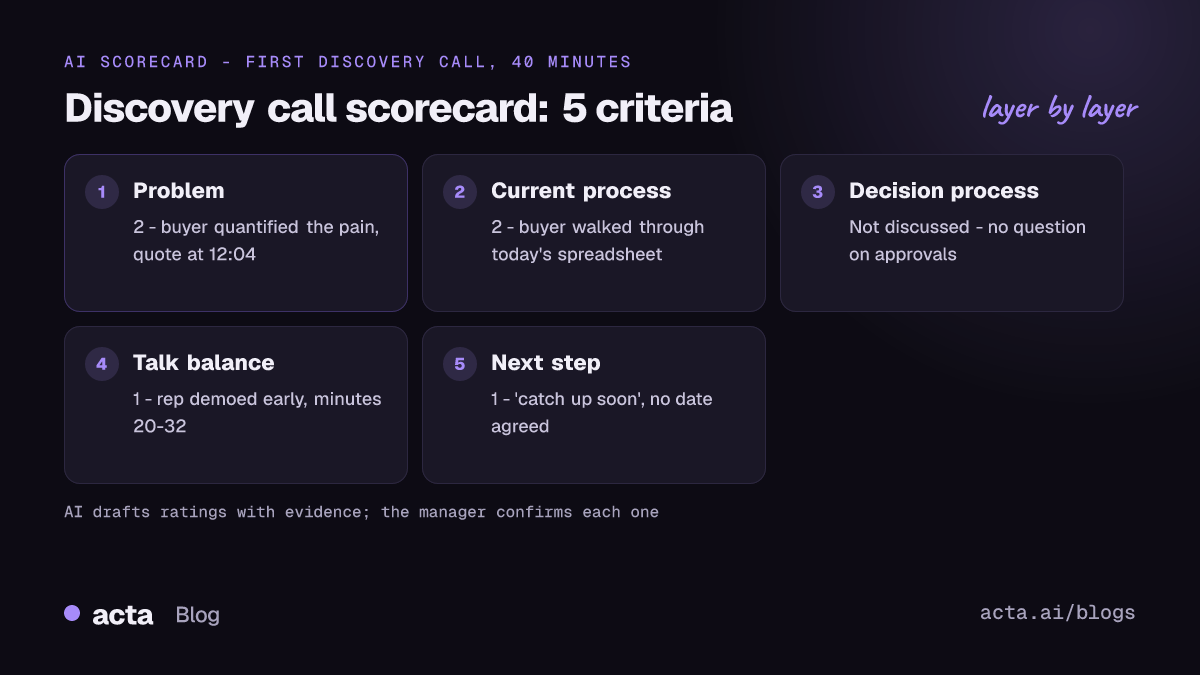
Here's an illustrative example. Priya, an account executive, runs a 40-minute first discovery call with Marco, operations director at a mid-sized logistics firm. The AI scorecard comes back like this:
- Problem (2): "We lose about two days every month reconciling carrier invoices by hand." (12:04)
- Current process (2): Marco walks through the spreadsheet his team uses. (14:30)
- Decision process (Not discussed): no question about approvals or who signs.
- Talk balance (1): Priya spoke for most of minutes 20-32 while demoing early.
- Next step (1): "Let's catch up again soon." No date agreed. (38:50)
Total: 6 out of 8 on the scored items. On its own that number says "decent call". The evidence says something more useful: Priya is strong on pain, slipped into a demo too early, and left without a decision process or a dated next step. Her manager, Dana, confirms three ratings, checks the evidence for the rest, and changes one: after replaying minutes 20-32 she drops talk balance to 0, because Marco barely spoke. Then she writes one coaching note: "Before you show anything, ask who else needs to agree and book the next call before you hang up." That's the output that changes behaviour. For the coaching conversation itself, see sales call coaching from recordings.
Gaming, bias and over-trust are the main failure modes
Gaming. Once reps know the rubric, some will say the magic words: "So who's the economic buyer here?" asked in a way that gets no real answer. Score the buyer's response, not the rep's question. "Rep asked and buyer named a person" is harder to game than "rep mentioned budget".
Bias. Models can misread accents, overlapping speech and indirect styles, and a rubric written around one selling style can mark down reps who sell differently but well. NIST's guidance on AI risk management and human-AI interaction notes that in some conditions the AI part of a human-AI pairing can amplify human biases, producing more biased decisions than either alone. Check score distributions by team, region and language each quarter. If one group scores lower across the board, look at the rubric and the transcripts before you look at the reps.
Over-trust. The same NIST appendix flags how far people actually feel able to challenge AI output as an open question. In practice, a confident number gets accepted. Counter it with process: managers must open the evidence before confirming, and scores feed coaching, not compensation, until you've checked the AI against human scorers for a few months. If scores will ever affect pay or performance reviews, take advice on employment rules where you operate; this guide is general information, not legal advice.
One more practical point: AI scoring needs a transcript, which means the call has to be captured. Tell customers the call is being recorded and follow local rules; our guide on recording consent and what to tell participants covers this.
Managers should coach from the evidence, not the total
A scorecard earns its keep in the weekly one-to-one, which is where sales coaching actually happens. Totals are good for spotting trends; coaching happens at the level of one criterion and one moment in one call.
- Pick one criterion per rep per fortnight. "This fortnight, every discovery call ends with a dated next step." Then watch that line on their scorecards.
- Play the moment together. Thirty seconds of the actual call beats any written note. Ask the rep what they'd do differently.
- Find the bright spots. Pull the best-scored example of each criterion from across the team and share it as a model answer.
- Feed the rubric back. If reps keep losing points on a criterion that doesn't predict wins, change the criterion, not the reps.
The same approach works for customer success. Score QBRs on "confirmed goals", "reviewed open promises" and "agreed next review date", and coach from the moments where an account went quiet.
Where Acta fits
Acta writes structured reports from each call rather than a single score: built-in templates such as BANT qualification, MEDDPICC deal report, SPICED and Product demo review add an "In short" summary, a confidence rating and key quotes, and write "Not discussed" rather than guessing. On paid plans you can build a custom template with a Table or Checklist section to mirror your own rubric and test it on a past meeting first. Calls can be captured without a bot through the desktop app for Zoom and Teams desktop meetings.
Frequently asked questions
What is an AI scorecard in sales?
An AI scorecard is an assessment of a sales call drafted by software from the call transcript. It rates the call against a rubric, such as discovery, MEDDIC or BANT criteria and next steps, and links each rating to a quote or timestamp. A manager or rep then confirms or changes the ratings before they're used for coaching.
How accurate is AI call scoring?
It depends on the rubric, the transcript quality and the tool, and vendors rarely publish comparable figures. Test it yourself: score 10-15 past calls by hand, run the AI on the same calls, and compare criterion by criterion. Where they disagree often, the criterion's anchors are usually too vague. Keep a person confirming scores either way.
What is the difference between an AI scorecard and conversation intelligence?
Conversation intelligence is the wider category: transcribing calls, tracking topics, talk time, competitors and trends across many conversations. An AI scorecard is one feature inside or beside it, focused on rating a single call against a rubric. You can have conversation intelligence without scorecards, but an AI scorecard always needs a transcript to work from.
Should AI scorecards be used for performance reviews?
Not at first. Use them for coaching until you've checked the AI's ratings against experienced human scorers over several months and looked for patterns by team, region and accent. If scores later feed reviews or pay, keep a person confirming each one, let reps see the evidence, and check the employment rules where you operate.
How many criteria should a sales call scorecard have?
Six to ten is a good range for one call type. Fewer than six rarely covers discovery, qualification and next steps; more than ten makes scoring slow and the total meaningless. Use a short scale with written anchors, such as 0-2, and add "Not discussed" so skipped topics aren't counted as failures.
Roll out an AI scorecard in five steps
A scorecard rollout succeeds or fails on trust. Start small, show reps the evidence, and change the rubric when it's wrong.
- Define one call type: start with first discovery calls, where the rubric is clearest.
- Write anchored criteria: 6-10 rep-controlled behaviours, each with a 0-2 scale and "Not discussed".
- Calibrate on past calls: compare AI and human scores on 10-15 calls and rewrite vague criteria.
- Confirm before sharing: a manager opens the evidence and confirms each score before the rep sees it.
- Coach one criterion at a time: pick one behaviour per rep and track it for two weeks.
If your calls run in Meet, Teams or Zoom in the browser, the Acta Chrome extension captures them without a bot so the transcript is ready for scoring; the 15-day free trial lets you test the templates on real calls.