Advisor meeting notes are a record of advice, not a diary
Advisor meeting notes are the written record of what a client told you, what you advised, why, and what happens next. They sit in the client file alongside account forms, statements and correspondence. Their job is to let someone who wasn't in the room, a supervisor, a colleague covering your book or an examiner two years from now, understand the advice and the reasoning behind it.
On spelling: US firms mostly write "financial advisor", while the SEC and the Investment Advisers Act use "adviser". This guide covers broker-dealer representatives, investment adviser representatives and dual registrants alike.
Useful financial advisor meeting notes capture judgement. "Met with client, discussed portfolio, all fine" proves you met, not why you advised what you did. The note should answer what the client wanted, what you knew about them, what you recommended, and why that suited this person.
SEC and FINRA rules explain why the note matters
No single rule says "write a meeting note in this format". The need for good notes comes from several obligations that are hard to show you met without them. As of November 2026, these are the main ones.
Regulation Best Interest for broker-dealers
The SEC adopted Regulation Best Interest (Reg BI) in June 2019. It applies when a broker-dealer recommends a securities transaction or strategy to a retail customer, and it has four parts: disclosure, care, conflict of interest and compliance. The care obligation is the one your notes support most directly. SEC staff guidance on the care obligations of broker-dealers and investment advisers says firms must exercise reasonable diligence, care and skill, understand the investor's profile (finances, age, time horizon, liquidity needs, risk tolerance and experience among other factors), and weigh reasonably available alternatives. The same guidance says cost is one factor among several, and that picking the cheapest product without further analysis doesn't satisfy the obligation.
Good Regulation Best Interest documentation therefore shows the profile you relied on, the alternatives you considered and the reason you chose one. FINRA's 2026 Annual Regulatory Oversight Report section on Reg BI and Form CRS lists, among its findings, firms that required representatives to document their rationale but didn't follow up when the rationale was generic or insufficient. A rationale copied from the last client is exactly the kind of note that finding describes.
The fiduciary duty for investment advisers
For investment advisers, the SEC's 2019 interpretation of the standard of conduct describes a fiduciary duty made up of a duty of care and a duty of loyalty, applying to the whole relationship with the client. It says a reasonable belief that advice is in the client's best interest requires a reasonable investigation, and that the duty can't be met through disclosure alone. The care obligations bulletin linked above covers advisers as well as broker-dealers.
Separately, Advisers Act Rule 204-2 requires advisers to keep written communications sent and received that relate to recommendations or advice. SEC staff have said the rule doesn't itself require an adviser to put advice in writing. In practice, though, a dated note is the clearest evidence of what you advised and why.
FINRA know your customer and recordkeeping rules
FINRA Rule 2090, Know Your Customer, requires member firms to use reasonable diligence to know and keep the essential facts about every customer and about anyone authorised to act for them. The duty starts when the account is opened, whether or not a recommendation has been made. When a client mentions a new power of attorney or a spouse joining meetings, that belongs in the note.
On FINRA recordkeeping, FINRA's books and records topic page explains Rule 4511: where no other rule sets a period, records must be kept for at least six years, and records must be kept in a format that complies with SEA Rule 17a-4. Which of your notes count as required records, and where they must be stored, is a question for your compliance team, not something to settle on your own.
Record six things from every client meeting
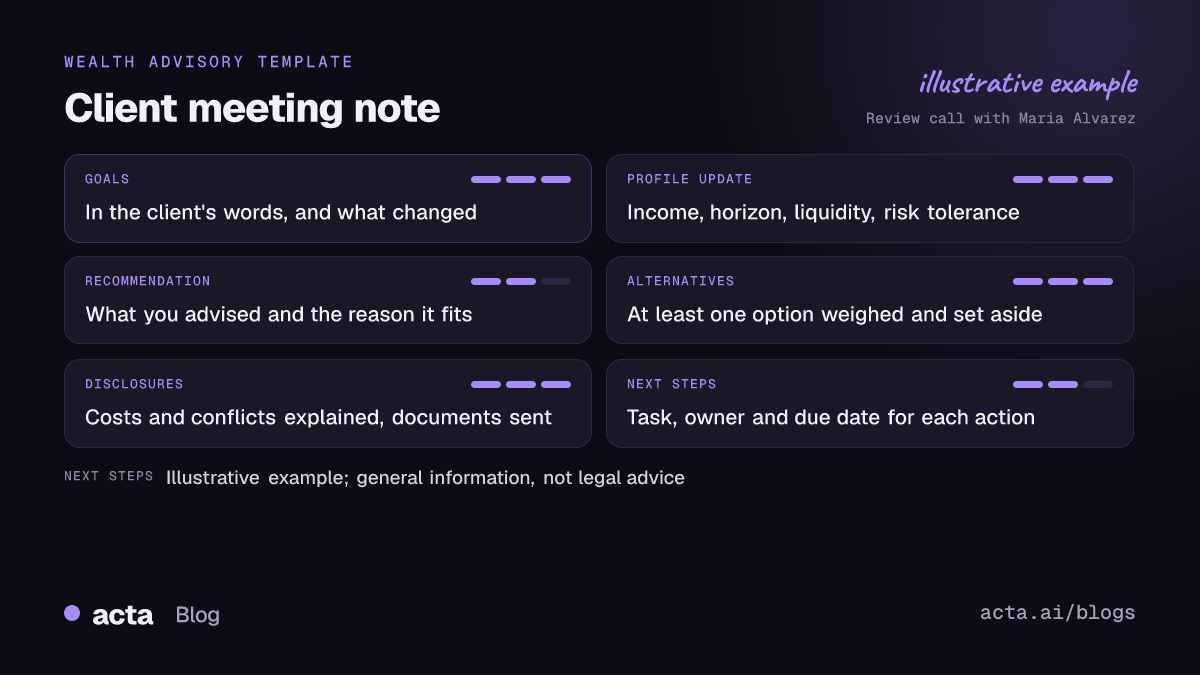
These six headings cover what the rules above care about and what you'll need the next time you meet the client.
| What to record | Why it matters | Example line |
|---|
| Goals and priorities | Anchors every recommendation | Wants to retire at 62; college fund for daughter by 2031 |
| Profile changes | Know your customer and the care obligation | New job, income up; still no need for cash within 3 years |
| Recommendation and reason | Shows the basis for the advice | Raise monthly contribution because goal date moved earlier |
| Alternatives weighed | Shows reasonably available options were considered | Looked at paying down mortgage instead; client prefers liquidity |
| Disclosures given | Shows what the client was told, and when | Explained fees and the conflict on proprietary fund; gave document |
| Questions and next steps | Shows understanding and who acts next | Asked about tax on withdrawal; I send comparison by Friday |
Use the client's own words for goals and worries: "I can't lose this money" says more about risk tolerance than "moderate". And note what the client declined, with their reason.
A note structure that holds up in a file review
Use one structure for every meeting so a supervisor finds the recommendation and reason in seconds. Copy this client meeting notes template into your CRM:
- Meeting: date, format (in person, video, phone), who attended, who else is authorised on the account
- Purpose: why the meeting happened (annual review, life event, client request, new money)
- Goals and priorities: in the client's words; what changed since last time
- Profile update: income, assets, time horizon, liquidity needs, risk tolerance, experience; "no change" if confirmed
- Recommendation: what you recommended, in one or two sentences
- Reason: why this fits this client's goals and profile
- Alternatives considered: at least one, and why it wasn't chosen
- Costs and conflicts discussed: what you explained and which documents you gave
- Client questions: each question and your answer
- Client decision: accepted, declined or wants time; any instructions in their words
- Next steps: task, owner, due date
Keep each field short. A reader should see the line from goals to profile to recommendation to reason without guessing.
If your firm already uses a review template, map these fields onto it rather than running two systems. Our post with six client review meeting notes templates has variations for annual reviews and account managers.
A worked example: a rollover conversation
Here's a filled-in note for an illustrative meeting. The advisor, Daniel Brooks, and his client, Maria Alvarez, are invented, and the recommendation is an example of the note's shape, not investment advice. Account-type recommendations such as rollovers are an area SEC staff have published separate guidance on, so many firms expect extra detail here.
- Meeting: 14 Nov, video call, 45 minutes. Maria Alvarez only; no one else authorised on the account.
- Purpose: Maria left her employer in October and asked what to do with her 401(k).
- Goals: "I want one place to see everything, and I don't want to touch it for at least 15 years." Retirement target still age 63.
- Profile update: New role, similar salary. Emergency fund covers six months. Risk tolerance unchanged ("comfortable with ups and downs as long as I don't need the money"). Time horizon over 15 years.
- Recommendation: Discussed rolling the 401(k) to an IRA at our firm.
- Reason: Maria wants consolidated oversight and ongoing advice; her old plan offers no advice service.
- Alternatives considered: Leaving assets in the old plan (lower fund costs, which I explained); moving to her new employer's plan (she hasn't reviewed its fund list yet). Maria will check the new plan's options before deciding.
- Costs and conflicts: Explained our advisory fee against her current plan costs, and that the firm earns more if she rolls over. Sent the relationship summary and fee schedule.
- Client questions: Asked whether a rollover is taxed. Explained a direct rollover generally isn't a taxable event and suggested she confirm with her tax preparer.
- Client decision: Wants time to compare the new employer's plan.
- Next steps: Daniel sends a side-by-side cost comparison by 18 Nov. Maria sends the new plan's fund list. Follow-up call booked for 25 Nov.
The note records the conflict and the cheaper alternative plainly, shows the client hasn't decided, and says who owes what. A reviewer won't need to call Daniel.
Follow up within a business day while the reasons are fresh
The hour after the meeting is where most files go wrong: back-to-back calls, and by Thursday nobody remembers why the alternative was rejected. Use this order:
- Finish the note the same day. Fill every heading, even with "no change". A note written a week later reads like a reconstruction, because it is one.
- Send the client a recap. Three to six lines: what you discussed, what they decided, what each of you will do and by when. Keep a copy in the file. Written communications about advice are records your firm will want to keep.
- Create the tasks. Every next step gets an owner and a date in your CRM or task list, so the comparison promised for Friday actually goes out.
- Update the client profile. If income, time horizon or authorised persons changed, update the account record, not just the meeting note.
- Flag anything for supervision. Complaints, unusual instructions or a recommendation outside the client's stated profile should go to your supervisor or compliance contact under your firm's procedures.

If you record client calls to help with notes, tell the client first and follow your firm's policy on where recordings may be kept. Our guides to recording meetings with AI and consent and FINRA meeting recording rules cover the questions to settle before you start.
Handwritten, typed or AI-drafted: how the methods compare
Each common method fails differently.
| Method | Strength | Weak spot |
|---|
| Handwritten during the meeting | Keeps eye contact; quick | Gets typed up late or not at all; hard to search |
| Typed into the CRM afterwards | Lands where supervisors look | Relies on memory; reasons get thin |
| AI-drafted from a recording | Captures questions and exact words | Needs review; new recordkeeping questions |
AI-drafted notes are the newest option, and regulators are still working through them. FINRA's Regulatory Notice 25-07 asked member firms what recordkeeping challenges they face with AI-generated communications, naming AI-generated transcripts and summaries of meetings as an example. FINRA's 2026 oversight report also describes its rules as technology-neutral: they apply to generative AI tools as they do to any other. In practice that means the summary, the transcript and the recording may each raise their own retention question, and your compliance team should decide which are kept and where.
Whatever the method, the advisor owns the note. An AI draft that says "client is moderate risk" when the client said "I can't lose this money" is worse than no draft, so read it against what you heard before you file it.
Common mistakes that weaken a client file
- Generic rationale. "In line with client objectives" fits every client, which is why it proves nothing. Name the objective and connect it to the recommendation.
- Copy-forward notes. Pasting last year's profile with a new date tells a reviewer nobody asked. Write "confirmed no change" only after you actually confirmed it.
- Leaving out the alternative. If the note shows only one option, a reader can't tell whether you considered others.
- Missing the client's decision. Record "declined" and "wants time" as carefully as "accepted". Declined advice protects you later.
- Editing notes long after the fact. If you must correct a note, add a dated addendum instead of rewriting the original.
Many firms run a periodic check on client-call notes for missing disclosures or promises. Our piece on a compliance check for client calls shows what that review looks for.
Where Acta fits
Acta records client meetings with a bot or from your own computer with the desktop app (its Copy notice button pastes a recording notice into the meeting chat), and writes a transcript with speaker names, a summary, decisions and action items with owners, plus a follow-up email draft. Its finance report templates include Client review, KYC onboarding and Compliance check (see Acta for financial services), and a report can be pushed as a note to Salesforce, HubSpot or Zoho. It doesn't replace your firm's books-and-records archive or your own review of the note, and Acta doesn't use customer data to train AI models.
Frequently asked questions
What should a financial advisor write in client meeting notes?
Write the client's goals, any changes to their investment profile, what you recommended, the reason it suits this client, at least one alternative you considered, the costs and conflicts you disclosed, the client's questions and decision, and next steps with owners and dates. That set reflects what SEC care-obligation guidance and FINRA's know-your-customer rule focus on.
Are advisor meeting notes required by the SEC or FINRA?
No single SEC or FINRA rule prescribes a meeting-note format. But Reg BI's care obligation, the adviser fiduciary duty and FINRA's know-your-customer and books-and-records rules all assume you can show the basis for your advice. Notes are usually the evidence. Check your firm's written procedures for what it requires.
How long should advisor meeting notes be kept?
It depends on the rule and the firm. FINRA Rule 4511 sets a six-year minimum for records with no other specified period, and Exchange Act and Advisers Act rules set their own periods for particular records. Your compliance team decides which category your notes fall into and how long to keep them.
Can I use an AI notetaker for client meetings?
Many advisors do, but ask compliance first. FINRA's Regulatory Notice 25-07 asked firms about recordkeeping challenges with AI-generated meeting transcripts and summaries, so firms need a policy on what is kept and supervised. Tell clients the meeting is recorded, and review every AI draft before it goes in the file.
What is the difference between meeting notes and a client recap email?
Meeting notes are your internal record of the client's profile, your advice and your reasoning. The recap email is a short message to the client confirming what was agreed and who does what next. Keep both: the note shows your judgement, and the recap shows the client was told.
Build a note habit that survives an exam
Good advisor meeting notes are a habit more than a skill. Use this checklist for your next ten client meetings and the structure will stick:
- Use one template: the same headings every time, so reviewers know where to look.
- Write the reason in the client's terms: connect each recommendation to a stated goal and profile fact.
- Name an alternative: at least one, with why it wasn't chosen.
- Close the loop the same day: note filed, recap sent, tasks created with owners and dates.
- Check with compliance: confirm where notes, recordings and AI summaries must be stored and for how long.
If you'd like the first draft written for you from the call, the Acta desktop app records Zoom, Teams or any calling app on your computer without a bot, and every account starts with a 15-day free trial.