An after-visit summary must answer six questions
An after-visit summary is a short written record, given to the patient at or soon after a visit, of what happened and what to do next. CMS described the older "clinical summary" as an after-visit summary giving the patient "relevant and actionable instructions" from the visit. That's still the best test: a line that isn't relevant or doesn't lead to an action belongs in the chart.
The CMS measure (from the Meaningful Use era, since folded into Promoting Interoperability; check current CMS rules for your reporting) listed what a clinical summary contained: the provider's name and office contact details, date and location of the visit, the reason for the visit, medicines or immunizations given, tests still pending, clinical instructions and future appointments. CMS didn't prescribe a layout.
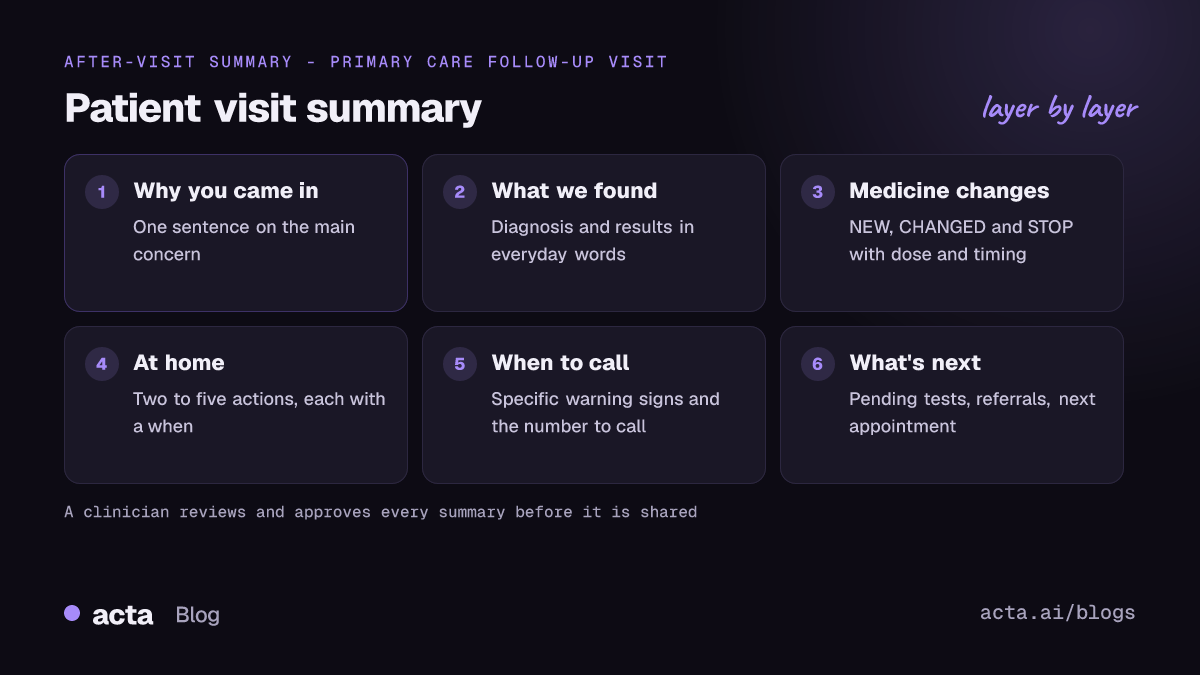
From the patient's side, the same content boils down to six questions:
- Why did I come in?
- What did you find?
- What changes today?
- What do I do at home?
- When should I call or go to urgent care?
- What happens next?
The patient after visit summary template to copy
Use this patient after visit summary template as a starting point and lock the headings so every clinician in the practice fills the same blocks. Square brackets are placeholders. Delete any block that doesn't apply rather than writing "N/A", which only adds noise.
Your visit on [date] with [clinician name] at [practice name, address]
Why you came in: [one sentence, the patient's main concern]
What we found: [diagnosis or impression in everyday words; results already back]
Changes to your medicines: NEW: [name, dose, when, for how long] / CHANGED: [old dose to new dose] / STOP: [name]
What to do at home: 1. [action + when] 2. [action + when] 3. [action + when]
Call us at [number] if: [specific sign with a number or time]. Call 911 or go to the emergency room if: [red-flag signs]
What happens next: [tests pending and when you'll hear] / [referral and who books it] / [next appointment date or when to book]
Questions? [portal or phone, hours]
The NEW, CHANGED and STOP labels show patients what differs from last time. The emergency line sits apart from "call us" so every symptom doesn't read as the same level of worry. In the UK or India, swap 911 for the local emergency number.
Seven filled examples cover the most common visits
Each after visit summary example below is illustrative: the patients are invented, and the clinical details are typical examples, not advice for any real person. They show shape and wording; your clinicians set the content.
1. Primary care follow-up (blood pressure)
When to use it: routine follow-ups where nothing big changes but the patient needs to keep doing something.
Why you came in: To check your blood pressure after one month of home readings.
What we found: Your blood pressure is lower than last month but still above your goal. Your readings at home averaged a little higher than our goal for you.
Changes to your medicines: No changes. Keep taking your blood pressure tablet each morning.
What to do at home: 1. Check your blood pressure every morning before breakfast and write it down. 2. Walk 20 minutes on at least five days this week. 3. Bring your log to the next visit.
Call us if: your top number is over [clinician sets threshold] twice in a row. Call 911 if: you have chest pain, sudden weakness on one side or trouble speaking.
What happens next: Visit in 4 weeks. Our front desk will call you to book.
2. New prescription
When to use it: any visit where a medicine starts. Lead with the medicine, because that's what the patient will act on tonight.
Why you came in: Burning when you pee for two days.
What we found: Your urine test shows a bladder infection.
Changes to your medicines: NEW: [antibiotic name, dose], [how many times a day] for [number] days. Take every dose, even if you feel better sooner.
What to do at home: 1. Start the antibiotic today. 2. Drink water through the day.
Call us if: you are not better after 2 days of the medicine, or you get a rash. Go to urgent care if: you have a fever, shaking chills or pain in your back or side.
What happens next: Your urine culture result comes back in [number] days. We'll message you on the portal only if we need to change your medicine.
3. Chronic condition check (type 2 diabetes)
When to use it: quarterly or six-monthly reviews with a result to explain and several small goals.
Why you came in: Your regular diabetes check.
What we found: Your A1C (your average blood sugar over about 3 months) is [result], down from [last result]. Your feet look healthy.
Changes to your medicines: CHANGED: [medicine] from [old dose] to [new dose], with your evening meal.
What to do at home: 1. Start the new dose tomorrow evening. 2. Check your feet each night for cuts or sores. 3. Book your yearly eye exam.
Call us if: your sugar reading is under [number] or you feel shaky, sweaty or confused.
What happens next: Blood test in 3 months, then a visit one week after.
4. Pediatric visit (ear infection)
When to use it: child visits, read by a tired parent or carer.
Why you came in: Leo (age 3) has had ear pain and a fever since Sunday.
What we found: Leo has an infection in his left ear.
Changes to medicines: NEW: [medicine, dose in mL], [times a day] for [number] days. Use the syringe from the pharmacy, not a kitchen spoon.
What to do at home: 1. Give the medicine with food. 2. For pain or fever, give [pain reliever] by weight, following the chart on the label.
Call us if: Leo still has a fever after 2 days of medicine, or fluid comes out of his ear. Call 911 if: he is very hard to wake or has trouble breathing.
What happens next: No follow-up needed if he is better. Book a visit if the ear pain comes back.
5. Post-procedure (skin lesion removal)
When to use it: minor procedures, where wound care and a pending lab result are the whole story.
Why you came in: To remove the mole on your upper back.
What we did: We removed the mole and closed the skin with [number] stitches. We sent the mole to the lab.
What to do at home: 1. Keep the bandage dry for 24 hours. 2. After that, wash gently with soap and water once a day and put on a fresh bandage. 3. No swimming or hot tubs until the stitches are out.
Call us if: the area gets redder, hotter or more painful after day 2, or you see pus or have a fever.
What happens next: Stitches out on [date]. The lab result takes about [number] days; we'll call you either way.
6. Telehealth visit (medication review)
When to use it: video or phone visits, where the patient has no paper in hand.
Why you came in: A video visit to review how your new reflux medicine is working.
What we found: Your heartburn is better on most days. You still get it after late dinners.
Changes to your medicines: No changes. Keep taking [medicine] 30 minutes before breakfast.
What to do at home: 1. Finish dinner at least 3 hours before bed. 2. Keep a short note of the nights you get heartburn.
Call us if: you have trouble swallowing, vomit blood or have black stools.
What happens next: Video visit in 8 weeks. The link will be in your portal.
7. Specialist referral (knee pain)
When to use it: any visit that ends with a referral. Say exactly who books what.
Why you came in: Pain in your right knee for six weeks, worse on stairs.
What we found: Your X-ray shows wear in the knee joint. We think a knee specialist (orthopedics) should see you.
What to do at home: 1. Use ice for 15 minutes after activity. 2. Do the three exercises on the sheet we gave you, once a day.
Call us if: your knee becomes hot, swollen and red, or you can't put weight on it.
What happens next: We sent the referral to [specialist practice] today. They will call you within [number] working days. If you haven't heard by [date], call them at [number].
Plain language rules decide whether the AVS gets read
A template only fixes the order. The words still have to work. The CDC defines plain language as communication your audience can understand the first time they read or hear it, and its plain language materials and resources page is a good starting point. For plain language patient instructions specifically, these rules from US health agencies do most of the work:
- Main message first. NIH's guidance says to put the main point first and organise around the questions readers will ask, which is exactly what the six-block template does.
- Short sentences. NIH suggests one idea per sentence and sentences of about 10 to 20 words. If an instruction needs "and" twice, split it.
- Everyday words. CDC's clear-writing guidance gives the classic swap: "high blood pressure", not "hypertension". CDC's Everyday Words list adds others, such as "find" for "detect". It also warns that swapping one word isn't always enough; sometimes you rewrite the sentence.
- Easy layout. AHRQ's Tool 11 on easy-to-understand materials recommends left-aligned text, white space, and avoiding all caps and italics. It also names the after-visit summary as one of the first materials a practice should review.
To check a finished template, score it. The CDC Clear Communication Index has 20 items, each scored zero or one, and AHRQ points practices to PEMAT for judging how understandable and actionable a material is. Score the template once and fix what fails. The NIH plain language guidance also advises defining a technical term rather than dropping it when the term matters.
A clinician reviews every summary before it is shared
Whoever drafts the AVS, the clinician who saw the patient owns what it says. Drafts from scribes, templates or a recording of the consultation can mishear a dose or turn "we might consider" into "start". A fixed template keeps the check quick.
A 60-second review checklist:
- Medicines: every NEW, CHANGED and STOP line matches the order you placed, including dose and duration.
- Thresholds: the numbers in "call us if" are the ones you'd actually act on for this patient.
- Pending items: every test or referral has a date and a named party who follows up.
- Tone: nothing reads as a diagnosis you haven't made, and nothing sensitive appears that the patient didn't discuss.
- Reading: one pass for jargon. If you'd have to explain a word aloud, explain it on the page.
Pair the written summary with spoken checking. AHRQ describes the teach-back method as asking patients to say in their own words what they need to know or do. Ask a teach-back question about the top instruction on the AVS ("So that I know I explained it well, tell me how you'll take the new medicine"). If the answer is off, the summary probably is too.
If your practice records consultations to draft the summary, get the patient's consent first and make sure your data-processing agreements cover patient data. Our guide on recording consent and what to tell participants covers consent basics; it is general information, not legal advice, and healthcare rules vary by country and state. What clinicians should know before using a notetaker goes further on the clinical side.
Five mistakes make an AVS harder to follow
- Printing the whole medication list with no labels. Twelve medicines in alphabetical order hides the one that changed. Use NEW, CHANGED, STOP and put unchanged medicines in a separate short line or the portal.
- Writing the clinical summary for the chart instead of the patient. A clinical summary that copies the assessment and plan from the note is accurate and unreadable. Keep the SOAP note for colleagues; our SOAP notes examples show what belongs there, and it's a different document.
- Soft warning signs. "Call if things get worse" gives the patient nothing to measure. Give a number, a duration or a named symptom.
- No owner for the next step. "Referral to cardiology" leaves the patient wondering whether to call. Say who books and by when.
- Too long. Past one page, you've included chart content. Move leaflets to a separate handout.
For a deeper look at the wording side, the companion piece on plain-language patient visit summaries drafted from the consultation walks through rewriting a single summary line by line. This guide stays with the template and the examples.

Where Acta fits in the summary workflow
Acta records a consultation, in person with the mobile app or on a video call with the desktop app, and its built-in Patient visit summary template drafts the summary from what was said; it sits in the Healthcare group alongside a SOAP note template, listed on the templates by role page. The draft is a starting point for the clinician to check and edit, not something to send unread. The healthcare page has more on how clinicians use it.
Frequently asked questions
What should a patient after visit summary template include?
A patient after visit summary template should include the reason for the visit, what the clinician found, changes to medicines labelled new, changed or stopped, home instructions with times, specific warning signs with a phone number, and next steps such as pending tests, referrals and the next appointment. Add the clinician's name, date, location and practice contact details at the top.
How long should an after-visit summary be?
One page is a good limit for most outpatient visits. If the summary runs longer, it usually contains chart content, full medication lists or education material that belongs elsewhere. Keep the summary to the actions and changes from this visit, and hand out or link longer leaflets separately so the main instructions stay easy to find.
Is an after-visit summary the same as a SOAP note?
No. A SOAP note is clinical documentation written for other clinicians, organised as Subjective, Objective, Assessment and Plan. An after-visit summary is written for the patient in plain language and focuses on what to do next. Both come from the same visit, but they serve different readers, so write them separately rather than copying one into the other.
Who should review an AVS before it goes to the patient?
The clinician who saw the patient should review and approve every after-visit summary, even when a nurse, scribe, template or software drafted it. Check medicines, doses, warning-sign thresholds and pending items against the orders placed. A short fixed checklist keeps the review to about a minute for routine visits.
Before you roll an AVS template out, settle these five things:
- Fix the blocks: adopt the six-block order and lock the headings in your EHR or template tool.
- Set the medicine labels: NEW, CHANGED and STOP on every summary, with dose, timing and duration.
- Write thresholds once: agree warning-sign wording per visit type; clinicians edit only the numbers.
- Score the template: run it through the CDC Clear Communication Index or PEMAT and fix what fails.
- Make review routine: clinician sign-off plus teach-back on the top instruction, every visit.
If you want a draft summary waiting after each video consultation, the Acta desktop app records the call without a bot, and you can try it free for 15 days.