Restaurant groups run on four recurring meetings
The weekly ops meeting is the anchor. It usually happens between lunch and dinner service, around 3:30 pm, at the central kitchen or on a call: the operations head or GM, all outlet managers, the executive chef, the purchase head, the quality and hygiene lead, and finance for the numbers. A good restaurant manager meeting agenda covers covers and sales by outlet, food cost and wastage, guest complaints and reviews, vendor issues, hygiene and maintenance, and staffing for the coming week.
Then there is the monthly menu meeting: tastings, menu engineering (which dishes earn their place), price changes and recipe standardisation across outlets. Vendor reviews with dairy, poultry, vegetable and dry-goods suppliers deal with quality, delivery times and rates; good restaurant vendor management depends on remembering what each supplier promised last time. And every outlet runs pre-shift briefings, which are short and mostly don't need a record.
What goes wrong is memory across meetings. The chef mentions a problem on the 15th, the purchase head agrees to something on the 22nd, the menu meeting changes a dish on the 1st. Each meeting's notes, if they exist, live in a WhatsApp message or one person's notebook. When a hygiene finding or a guest complaint arrives, nobody can reconstruct the chain quickly, and the review turns into an argument about who said what.
Hygiene is the area where this matters most. In India, FSSAI's hygiene requirements set out the sanitary and hygiene conditions food businesses must meet under Schedule 4, including a part for catering and food service, and its food safety pages collect the guidance. As of November 2026, check those pages for what applies to your licence; this is general information, not legal advice. Whatever the rules say, your own record of who raised which issue and what was done about it is what you'll want in hand.
A torn chiller gasket was mentioned three times
An illustrative example. Ember & Leaf Hospitality (invented) runs six outlets in Bengaluru: four casual dining restaurants, a cafe and a cloud kitchen, with about 170 people. Founder Nisha, operations head Rohan, executive chef Imran, purchase head Shalini, hygiene lead Teresa and the six outlet managers meet every Monday at 3:30.
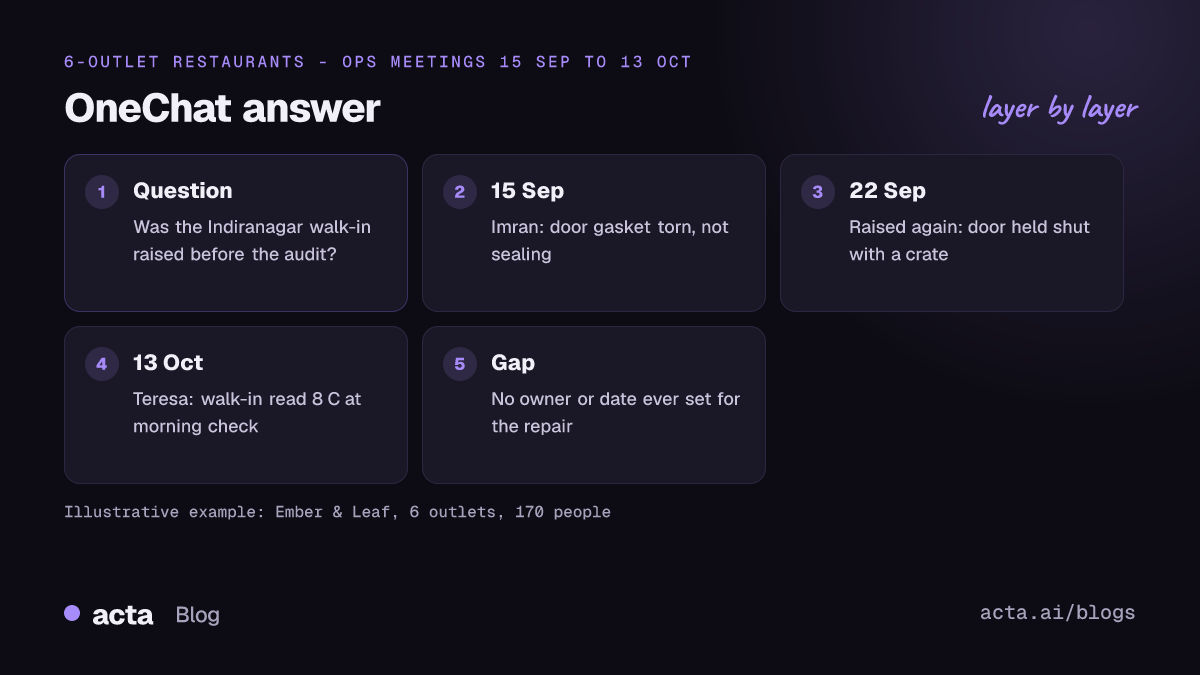
- 15 September, ops meeting. Imran: "The walk-in at Indiranagar, the door gasket is torn, it's not sealing." Rohan says maintenance will look at it.
- 22 September, ops meeting. Two outlets report sour paneer from the regular dairy vendor. Shalini agrees to trial a second vendor at Indiranagar and Koramangala for four weeks. Imran mentions the walk-in again: "still the same, we're keeping the door shut with a crate".
- 1 October, menu meeting. Paneer tikka comes off the cloud kitchen menu until the vendor trial ends.
- 6 October, vendor review with the regular dairy supplier. The supplier promises a new cold-chain van by the 20th.
- 13 October, ops meeting. Teresa says the Indiranagar walk-in read 8°C at the morning check twice that week.
On 24 October the group's external hygiene auditor visits Indiranagar and records two findings: the walk-in chiller above the safe range with a damaged door seal, and dairy stored on the floor of the reach-in. Nisha's first question in the debrief: "Did anyone raise this before?" Imran says he raised it in September. Rohan remembers it as "a small repair". Nobody can say whether maintenance was ever assigned. The meeting loses forty minutes and ends with a bad mood rather than a fix.
OneChat turns restaurant operations meeting notes into answers
OneChat is the first item in Acta's sidebar. It answers questions across all your meetings, plus any files and links you add, and every answer shows Found in: the meetings and files it came from, opening at the exact moment. It is different from Ask Acta, which sits on one meeting's page and answers only about that meeting. The OneChat help page covers the basics.
Here is how the 24 October debrief changes. Nisha opens OneChat before the meeting and asks:
Question: Was the Indiranagar walk-in chiller raised in our meetings before the audit? Who raised it, what was agreed, and was it done?
Answer: Yes, three times. Imran raised the torn door gasket on 15 September; Rohan said maintenance would look at it, but no owner or date was set. Imran raised it again on 22 September ("we're keeping the door shut with a crate"). Teresa reported 8°C readings on 13 October. No action item for the repair was completed.
Found in: Ops meeting 15 Sep (12:40) · Ops meeting 22 Sep (31:05) · Ops meeting 13 Oct (18:22)
That answer takes the argument out of the debrief. The conversation moves straight to "why did a known problem have no owner?", which is the useful question.
Other questions worth asking a month of meetings:
- "What did the dairy supplier promise in the 6 October vendor review, and has anyone said it happened?"
- "Which dishes did we change or remove in the last two menu meetings, and at which outlets?"
- "What's overdue for Teresa?"
- "Which guest complaints came up more than once across outlets in October?"
Two features suit restaurants in particular. First, files: drop the auditor's report, vendor rate cards or your recipe costing sheet into OneChat (up to 10 at a time; they are kept under Artifacts and read in the background) and ask "Which findings in this audit were already raised in our ops meetings?" Second, the scope button under the question box lets you limit a question to some meetings, for example only vendor reviews, or widen it with "Look in all my meetings". You can download an answer as a Word report or a PowerPoint deck for the partners' meeting.
One limit to know: OneChat answers only from meetings, files and links the person asking can see. If outlet managers ask about meetings Rohan recorded, those meetings must be shared with the workspace. For a deeper look at this way of working, read how to ask questions across every meeting you've had.
Actions, decisions and risks sit behind every answer
OneChat's answers about overdue work, decisions and risks come from three views under My meetings. Each is per person, built from the meetings that person recorded or that were shared with them.
Action items
Under Outcomes > Action items, with Open, Overdue, Due this week and Done tiles. A filled row from Rohan's view after the 13 October meeting: "Replace walk-in door gasket, Indiranagar; log temperatures twice daily until fixed" · owner Vinod (maintenance) · Overdue 9 days · comment "Part ordered 16 Oct, vendor visit pending". Had that row existed on 15 September, the audit finding would likely never have happened.
Decision log
Under Outcomes > Decision log: Decision: trial a second dairy vendor for paneer at Indiranagar and Koramangala for four weeks. Status: Active. Decided by: Nisha. Owner: Shalini. History: first raised 22 Sep, confirmed 1 Oct in the menu meeting. Actions: 2 of 3 done. When the trial ends, mark it Done, or the card shows Changed if the group switches vendors.
Risk Registry
The Risk Registry tab: Risk: Indiranagar walk-in not holding temperature, door gasket torn. Mitigation: move dairy and meat to reach-in units until repaired (Suggested, until someone agrees it). Owner: No owner. Impact: High. Status: Open, tagged "Getting worse" after the 13 October readings. It would have sat in the "High · no owner" card from 22 September onward.
A weekly ops template gives every outlet the same shape
Each recorded meeting gets standard notes: summary, decisions and action items with owners. The built-in Vendor review template from Acta's templates by role suits supplier meetings, and Incident post-mortem works after a serious guest complaint. For the Monday meeting, write a custom template (paid plan; up to 12 sections):
Template name: Weekly restaurant ops
What should this report do? For a restaurant group's weekly operations meeting: numbers by outlet, menu changes, vendor issues, hygiene and maintenance problems, staffing, and every task with an owner.
1. Outlet numbers (Table: Outlet | Covers | Food cost % | Wastage | Complaints)
2. Menu changes (Table: Dish | Outlets | Change | From when)
3. Vendor issues (Table: Vendor | Item | Issue | Next step)
4. Hygiene and maintenance (Checklist: task, owner, due date)
5. Raised before? (Bullets: any issue that sounds like one from an earlier meeting)
6. Staffing (Bullets)
When should Acta use it? Only matching meetings.
The hygiene section doubles as your weekly kitchen hygiene checklist of open repairs. Test it with "Test on a past meeting", then share it with your team; the custom templates guide covers the details.
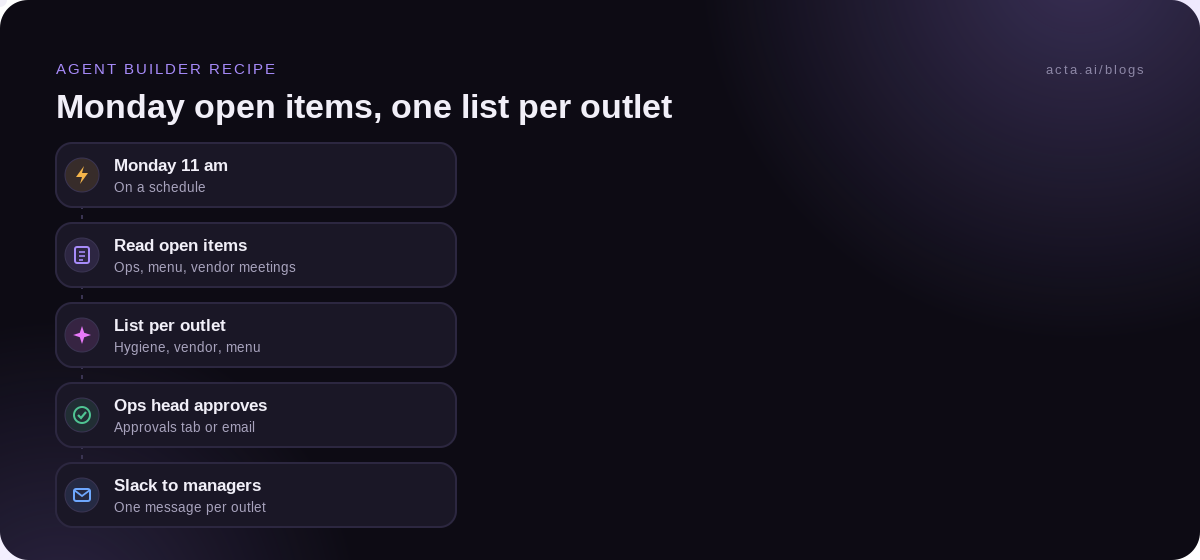
A Monday agent sends each outlet its open items
Agent Builder (beta) can turn the week's open items into one short message per outlet, approved by the operations head:
- Click "New agent" and pick the trigger On a schedule: Mondays at 11 am, before lunch service.
- Add an Acta data step that reads open action items from meetings whose title contains "ops", "menu" or "vendor".
- Add a For each step over the six outlets.
- Inside it, an AI step: "List this outlet's open items under Hygiene, Vendor and Menu, oldest first, with owner and days overdue. Five lines at most."
- Add Human approval so Rohan checks the batch; approve or reject in the Approvals tab or by email. If nobody answers in 24 hours, nothing goes out.
- Add a Slack action to message each outlet manager, or a Gmail action if your managers live in email.
- Run Test on last week's data, check the six messages, then Turn on.
The three example agents show the editor step by step.
Six outlets can be live in two weeks
Every person in the workspace uses a seat, so start with the people who run the meetings. At Ember & Leaf that is Nisha, Rohan, Imran, Shalini and Teresa; outlet managers can be added later if they want to ask OneChat themselves. Pro is $8 per seat a month or $72 a year, and OneChat, the Outcomes views and Risk Registry are included in the 15-day trial and in Pro.
Who records what. Rohan records the Monday ops meeting; in person at the central kitchen, the mobile app on the table is enough. Shalini records vendor reviews, which often happen on phone or WhatsApp calls; the desktop app records any call on her laptop when she presses Record. Kitchen teams often switch between English, Hindi and Kannada; Acta supports 15 meeting languages, with Hindi detected automatically and Kannada in beta. Tell vendors and staff when you record; the recording consent guide has wording.
Sharing. Meetings are private by default; share ops, menu and vendor meetings with "Everyone in" the workspace so everyone's OneChat can answer from them. Invites and roles are in the team setup guide.
- Days 1-3: Create the workspace, invite the five recorders, record Monday's ops meeting and one vendor call.
- Days 4-7: Ask OneChat five real questions a day; fix owners on any "Unassigned" items.
- Days 8-10: Upload the last audit report and vendor rate cards; ask which findings were raised before.
- Days 11-14: Build the weekly ops template and the Monday agent; test both on the first two meetings.
Mistakes to avoid: recording pre-shift briefings nobody reads, keeping vendor calls private, asking OneChat vague questions ("anything about hygiene?") instead of specific ones, and treating an answer as the fix. An answer tells you who owns what; someone still has to call maintenance.
Frequently asked questions
What should restaurant operations meeting notes include?
Covers and sales by outlet, food cost and wastage, guest complaints, menu changes with the outlets affected, vendor issues and next steps, hygiene and maintenance problems with an owner and date, and staffing for the week. Mark anything that was raised in an earlier meeting, because repeats are where the risk is.
Can outlet managers ask OneChat questions too?
Yes, once they are in the workspace, which uses a seat. OneChat answers each person from the meetings they recorded plus those shared with them in the workspace, along with their own files and links. If the ops meeting isn't shared, an outlet manager's OneChat won't see it.
How is OneChat different from searching transcripts?
Search finds words. OneChat answers a question by reading across meetings, and it can draw on the action items, Decision log and risks built from them, then cites where each part came from. "Was the chiller repair ever assigned?" needs an answer, not a list of every time someone said "chiller".
Can we upload audit reports and supplier documents?
Yes. Drop files or links into OneChat, up to 10 at a time. They are kept under Artifacts and read in the background, and you can then ask questions that combine them with your meetings, such as which audit findings were already discussed and by whom.
Which restaurant meetings should we record first?
Start with the weekly ops meeting, because it touches every outlet and most follow-ups start there. Add vendor reviews next, since supplier promises are easy to forget and expensive to lose. Add the monthly menu meeting after that. Pre-shift briefings can wait.
Pick the questions you want answered next month
Decide now which questions you'll want to answer quickly when the next audit or bad review arrives, and set up the meetings that feed them:
- Record the anchor meeting: Monday ops, every week, every outlet.
- Add vendor calls: so supplier promises are on record.
- Share by default: ops, menu and vendor meetings go to the workspace.
- Upload the evidence: audit reports and rate cards sit next to the meetings.
- Ask before you argue: open OneChat before every debrief.
Put the desktop app on your purchase head's laptop for vendor calls, and start the 15-day free trial before next Monday's ops meeting.