A quarterly planning meeting agenda built around OKRs has four parts: score last quarter honestly, agree what's changed, set three to five objectives with two to four key results each, and assign owners and check-in dates. Below are eight copy-ready agendas, from a half-day leadership session to a 30-minute mid-quarter check-in, with timings, pre-work and an output template.
Meeting Productivity 11 min read
Quarterly Planning Meeting Agenda: 8 OKR Templates With Timings
Eight copy-ready quarterly planning agendas, from a half-day leadership session to a 30-minute OKR check-in, with pre-work, scoring guidance and a sample output.
By Sarma BKP, Founder & CEO, Acta · Updated
This guide is for founders, leadership teams, department heads and team leads who run planning every quarter and want it to produce a short list of goals people actually use. It covers the agenda, the pre-work that makes the meeting short, and how to write up the output. It assumes you use OKRs or something close; if your company plans annually with no quarterly goals, the review and dependency sections still apply.
Key takeaways
- Send pre-work a week ahead: last quarter's scores, key metrics and each team's draft OKRs. The meeting should debate drafts, not write from scratch.
- Limit each team to three to five objectives with two to four key results each. More than that and nothing gets prioritised.
- Spend the first quarter of the meeting reviewing last quarter, including what you'll stop doing.
- Name one owner per key result and agree the check-in rhythm (often monthly) before anyone leaves.
- Publish the final OKRs within two working days, with owners, measures and the first check-in date.
Table of contents
- Quarterly planning turns strategy into the next 13 weeks of work
- Pre-work decides whether the meeting runs on time
- Every quarterly planning meeting agenda follows four phases
- Eight quarterly planning agendas you can copy
- Well-written OKRs make the output usable
- A filled-in output shows what to publish
- Six mistakes turn planning into a wish list
- Where Acta fits in planning meetings
- Frequently asked questions
- Run your next quarterly planning session with this checklist
Quarterly planning turns strategy into the next 13 weeks of work
A quarterly planning meeting is where a leadership team or team agrees its goals for the next three months, reviews how the last three went, and decides who owns what. When the goals are written as OKRs (objectives and key results), each objective says what you want to achieve and each key result says how you'll know you got there.
A quarter is long enough to finish meaningful work and short enough to correct course. Companies that publish their process show how much of it happens before the meeting. GitLab's handbook describes its OKRs as quarterly objectives that help it achieve its KPIs and annual company goals, and its product division's OKR process starts with a kick-off about five weeks before each quarter begins. You don't need five weeks, but you do need the drafts in hand before the room fills up.
One thing the meeting shouldn't be: a performance review. Google's re:Work guide to setting goals with OKRs is explicit that OKRs aren't the same as employee evaluations. Keep scoring about the goals, not the people, or people will start setting goals they know they'll hit.
Pre-work decides whether the meeting runs on time
The single biggest time saver in quarterly planning is a pre-read. Send it five to seven days before, and ask people to comment in the document rather than save it all for the meeting.
Quarterly planning pre-read
1. Last quarter's OKRs, scored: each key result with its score and a one-line reason
2. Key metrics: the handful the company tracks, against plan
3. What changed: market, customers, team, budget, anything that alters priorities
4. Draft OKRs per team: three to five objectives, two to four key results each
5. Known dependencies and conflicts: where one team's goal needs another team's time
6. Questions for the meeting: the decisions only this group can make
If the drafts don't arrive, postpone or shorten the meeting. Writing OKRs live with 12 people is slow and produces vague goals.
Every quarterly planning meeting agenda follows four phases
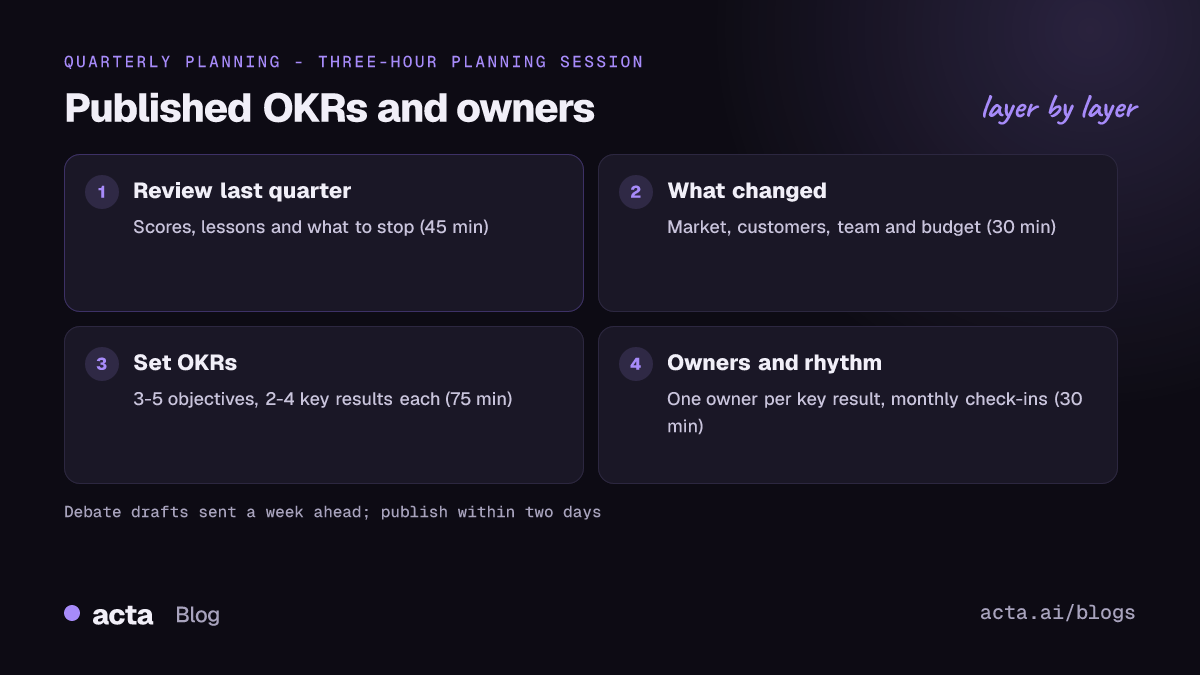
Whatever the size of the group, the same four phases work. Rough share of time for a three-hour session:
- Review last quarter (45 minutes): scores, what worked, what didn't, what you'll stop.
- Agree what's changed (30 minutes): new information that shifts priorities.
- Set next quarter's OKRs (75 minutes): debate the drafts, cut, merge, resolve conflicts.
- Owners and rhythm (30 minutes): one owner per key result, check-in dates, how progress is shared.
The phase people try to skip is the review, because it feels backward-looking. Don't. A team that doesn't look at why last quarter's key results missed will write the same ones again.
On OKR scoring: re:Work describes grading OKRs on a 0.0 to 1.0 scale, where hitting about 0.6 to 0.7 on an ambitious objective counts as a good result, while committed OKRs are expected to be delivered in full. Whatever scale you use, decide in advance which goals are stretch goals and which are commitments, and score them that way.
Eight quarterly planning agendas you can copy
Each agenda below is a starting point. Edit the timings, then put them in the invite.
1. Leadership team quarterly planning (half day)
Use it for the executive team setting company-level OKRs.
- 9:00 Purpose, decisions needed today (CEO, 10 min)
- 9:10 Last quarter scored: company OKRs and metrics (40 min)
- 9:50 What changed and what it means (30 min)
- 10:20 Break
- 10:35 Company objectives: debate and agree 3-5 (60 min)
- 11:35 Key results and owners per objective (45 min)
- 12:20 What we'll stop or delay (15 min)
- 12:35 Communication plan for the all-hands (15 min)
- 12:50 Close: decisions recap and owners
The communication slot matters: once leadership agrees, the plan has to reach the company. Our all-hands meeting agenda templates include a quarterly version built for that.
2. Team OKR planning meeting (2 hours)
Use it for a product, engineering, sales or operations team turning company OKRs into team goals.
- 0:00 Company OKRs for the quarter and what they ask of us (10 min)
- 0:10 Our last quarter: scores and lessons (25 min)
- 0:35 Draft team OKRs: walk-through (20 min)
- 0:55 Debate: what to cut, merge or sharpen (35 min)
- 1:30 Capacity check: does this fit the people we have? (15 min)
- 1:45 Owners, check-in dates, next steps (15 min)
3. Startup quarterly planning (90 minutes)
Use it when the whole company is one planning group.
- 0:00 Runway, revenue and the one metric that matters most (10 min)
- 0:10 Last quarter: what worked, what didn't (20 min)
- 0:30 The one or two bets for this quarter (30 min)
- 1:00 Key results for each bet, with owners (20 min)
- 1:20 What we're not doing this quarter (10 min)
4. Remote quarterly planning (async week plus 90-minute call)
Use it for distributed teams where a long live session across time zones isn't fair to anyone.
- Monday: pre-read and draft OKRs shared
- Tuesday-Thursday: written comments and questions in the document
- Friday call 0:00 Open questions only, most-commented first (45 min)
- 0:45 Conflicts and trade-offs needing a decision (30 min)
- 1:15 Owners and check-in dates (15 min)
5. End-of-quarter review and retro (60 minutes)
Use it a week before planning, so scores and lessons are ready as input.
- 0:00 Each key result: score, owner's one-line explanation (25 min)
- 0:25 What helped us hit goals (10 min)
- 0:35 What got in the way (15 min)
- 0:50 Three lessons to carry into planning (10 min)
For running the retro part so people speak openly, see how to run a retrospective people speak up in.
6. Cross-team dependency planning (75 minutes)
Use it after teams draft OKRs, when several goals depend on the same people or systems.
- 0:00 Each team: top objective and what it needs from others (30 min)
- 0:30 Dependency map: who needs what, by when (20 min)
- 0:50 Conflicts: decide, defer or escalate (20 min)
- 1:10 Agreed commitments between teams (5 min)
7. Department planning day (full day)
Use it for a planning offsite with a larger department, such as a sales or marketing organisation.
- Morning: last quarter's results, customer and market changes, wins
- Late morning: department objectives agreed with the leader
- Afternoon: team breakouts to write key results
- Late afternoon: teams present, conflicts resolved, owners confirmed
- End: one-page summary read back to the room
8. Mid-quarter OKR check-in (30 minutes)
Use it monthly or at week six to catch problems early.
- 0:00 Each key result: on track, at risk, off track (15 min)
- 0:15 At-risk items: what would get them back on track? (10 min)
- 0:25 Changes to goals, if any, and who approves (5 min)
| Agenda | Length | Who | Main output |
|---|---|---|---|
| Leadership | Half day | Executive team | Company OKRs |
| Team OKR planning | 2 hours | One team | Team OKRs and owners |
| Startup | 90 min | Whole company | One or two bets |
| Remote | Async + 90 min | Distributed team | OKRs, decisions on conflicts |
| End-of-quarter review | 60 min | Team | Scores and lessons |
| Dependencies | 75 min | Team leads | Cross-team commitments |
| Department day | Full day | Department | Department OKRs |
| Mid-quarter check-in | 30 min | Team | At-risk fixes |
Well-written OKRs make the output usable
An objective is qualitative and short: what you want, in words people remember. A key result is measurable and has a date: how you'll know. Use this quarterly planning template for each objective:
Objective: [what we want to achieve, in one sentence]
Why now: [one line linking it to strategy or a company OKR]
Key result 1: [metric] from [baseline] to [target] by [date]. Owner: [name]
Key result 2: [metric] from [baseline] to [target] by [date]. Owner: [name]
Committed or aspirational: [which]
Dependencies: [teams or people needed]
Not doing this quarter: [what we've dropped to make room]
Test each key result: could someone outside the team tell, on the last day of the quarter, whether it was hit? "Improve onboarding" fails. "New customers completing setup within 7 days, from 40% to 60%" passes. And watch for tasks posing as key results: "launch the new pricing page" is a task; the result is what the page is supposed to change.
Keep quarterly goals few. Three to five objectives per team is the common guidance for a reason: when everything is a priority, the team picks its own priorities and they rarely match yours.
A filled-in output shows what to publish
Here's an illustrative output from a team OKR planning meeting. The team, people and numbers are made up.
Customer success team, Q1 OKRs (agreed 12 December; check-ins on the first Tuesday of each month)
Last quarter: Renewal rate key result hit; onboarding time key result missed (setup data imports took longer than planned).
Objective 1: New customers get value in their first month.
- KR1: Customers completing setup within 14 days, from 55% to 75%. Owner: Dana.
- KR2: Median time to first report shared, from 21 days to 10. Owner: Marco.
Objective 2: No renewal is a surprise.
- KR1: Every account over the size threshold has a health review 90 days before renewal. Owner: Priya (committed).
- KR2: At-risk accounts with a written save plan within one week of flagging: 100%. Owner: Priya.
Stopped: Monthly newsletter to customers, paused for the quarter.
Dependencies: Two days a sprint from the data team for import fixes (agreed with Sam).
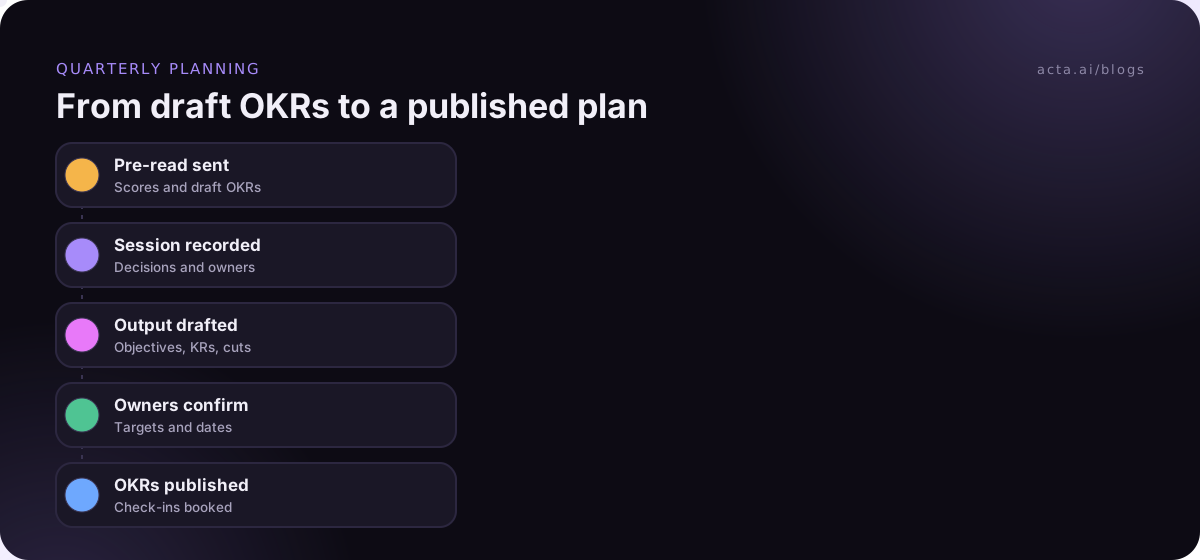
Publish it where everyone can find it within two working days, and keep a short decision log of what was cut and why, so nobody reopens the same debate in week three.
Six mistakes turn planning into a wish list
- Too many objectives. Eight objectives means none of them are priorities. Cut until it hurts.
- No review of last quarter. Missed key results quietly roll forward with new wording.
- Shared ownership. "Owner: sales and marketing" means nobody. One name per key result.
- No capacity check. If the team is already fully booked with existing work, new OKRs are fiction.
- Nothing stopped. If nothing comes off the list, the new goals compete with everything already there.
- No check-ins until the end. By week 13 it's too late. Book the monthly check-ins in the planning meeting.
Ending with clear owners is a skill of its own; our guide on how to end a meeting with owners and deadlines covers the last ten minutes.
Where Acta fits in planning meetings
Acta records the planning session, writes a transcript with speaker names, and pulls out decisions and action items with owners, which covers most of the published output. If you're planning in the Zoom or Teams desktop app and don't want a bot joining, the desktop app records from your own computer. With Agent Builder, you can send the agreed owners and dates on to Jira, Notion or Confluence. If you record a planning offsite, tell everyone first; our guide to recording consent covers what to say.
Frequently asked questions
How long should a quarterly planning meeting be?
For a single team with good pre-work, two hours is usually enough. A leadership team setting company OKRs often needs a half day, and a department planning offsite may take a full day. If drafts are prepared and commented on in advance, the live session can be shorter, because it only handles questions and conflicts.
What is the difference between quarterly planning and a quarterly business review?
Quarterly planning is internal and forward-looking: setting the next quarter's goals and owners. A quarterly business review usually looks back at results, often with a customer or board, to show value and agree priorities. Many teams run the review first and use its findings as input to planning.
How many OKRs should a team have per quarter?
Three to five objectives, each with two to four key results, is the common range. A small team or startup may do better with one or two objectives. If you find yourself with more, check whether some are tasks or business-as-usual work that doesn't need an OKR.
How do you score OKRs at the end of a quarter?
Give each key result a score, often on a 0.0 to 1.0 scale or as a percentage, plus a one-line explanation from its owner. Treat committed goals and stretch goals differently: committed ones should be delivered in full, while partial progress on an ambitious goal can be a good result. Score goals, not people.
Who should attend an OKR planning meeting?
The people who own the goals and the people who control the resources: the team or department lead, the owners of each key result, and anyone whose capacity the plan depends on. Keep it under about ten people for real debate; others can comment on the pre-read and hear the outcome afterwards.
Run your next quarterly planning session with this checklist
Two weeks before the quarter starts:
- Score last quarter: run the end-of-quarter review and collect scores with one-line reasons.
- Send the pre-read: metrics, what changed and draft OKRs, five to seven days before.
- Pick the agenda: choose the template that fits the group and put timings in the invite.
- Decide what stops: come with candidates for work to pause or drop.
- Publish within two days: OKRs with owners, measures, check-in dates and a decision log.
If you'd like the decisions and owners written up for you, try the Acta Chrome extension or the desktop app on your next planning session during the 15-day free trial.
Found this useful? Share it with your team.