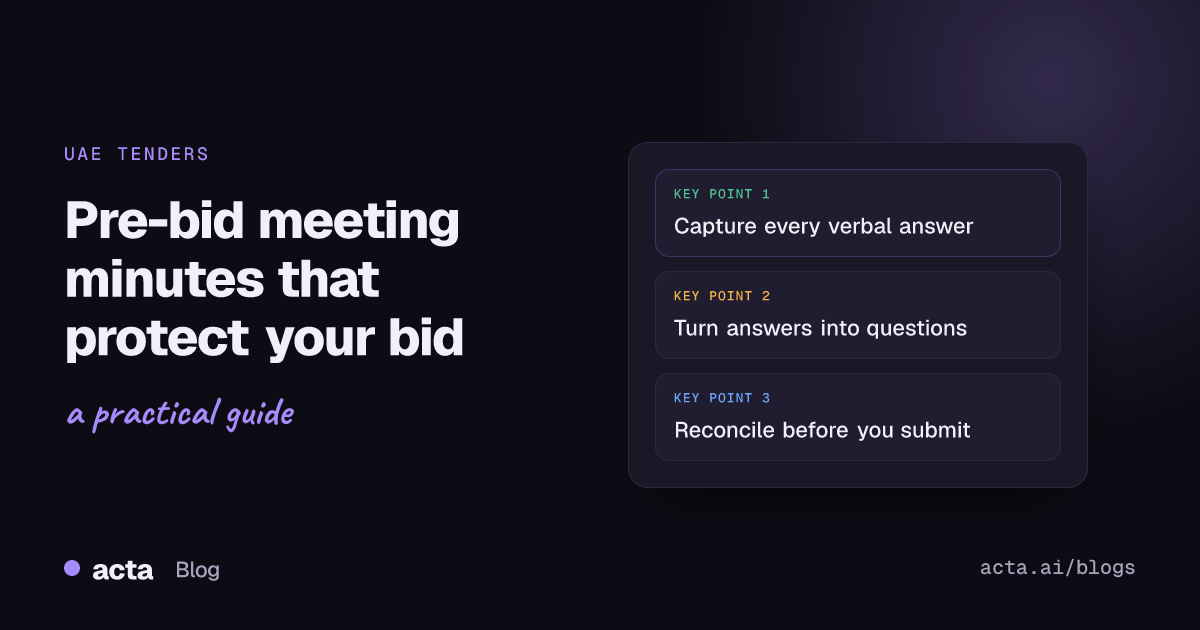
Pre-bid meeting minutes are the bidder's record, not the buyer's
A pre-bid meeting (also called a tender clarification meeting or bidders' conference) is the session where the buyer walks suppliers through the scope, answers early questions and sometimes runs a site visit. The buyer may publish its own notes or a consolidated clarification response afterwards. Your pre-bid meeting minutes are something different: an internal record that serves your bid, written from your side, with your actions and your doubts in it.
Who you are bidding to shapes how formal this gets. As of November 2026, federal entities buy through the Ministry of Finance's Digital Procurement Platform, and federal procurement is governed by Federal Decree-Law No. 11 of 2023, which WAM reported came into force on 1 December 2023. Dubai Government entities publish many tenders on eSupply, described on the Dubai government procurement page, and some Dubai entities, such as DEWA, run their own supplier portals. Abu Dhabi uses its own procurement gate. Semi-government companies and large private developers usually have their own systems and their own tender rules.
What these settings share is that the written tender documents and formal addenda govern. A comment from the buyer's project manager in a meeting room in Al Quoz is useful intelligence, but it doesn't change the scope. Your minutes exist so you remember that comment, ask about it formally, and price it only once the answer is on paper.
Preparation decides what your minutes can catch
Most weak minutes come from a team that walked in without having read the documents. If nobody knows that the bill of quantities leaves out chiller maintenance, nobody notices when the buyer's engineer mentions it in passing.
- Read the tender pack before the meeting. Split it: commercial terms to the bid manager, specifications and drawings to the estimator, contract conditions to whoever handles risk.
- Draft a question list. Number every question (Q-01, Q-02) and tag it to the clause or drawing it concerns. You will reuse these numbers all the way to submission.
- Assign roles. One person asks questions, one person writes. The person asking cannot also take good notes.
- Check the logistics. Confirm whether the session is in person, on Microsoft Teams or Zoom, and whether a site visit follows. Federal entities moved to a four-and-a-half-day week from January 2022, with Friday a short day, according to WAM's announcement, so a Friday session may end early.
- Ask before you record. If you want an audio record, ask the chair at the start. Some buyers will say no, and you should respect that. See what to tell participants when AI records and our UAE PDPL guide to meeting recording for how to raise it.
When recording is allowed and the session is online, a recorder on your own laptop is less intrusive than adding a bot to the buyer's call. A desktop recorder captures the call's audio and your microphone from your computer without joining as a participant. For an in-person session, a phone recording on the table, with permission, does the same job.
Seven things every pre-bid record must hold
Pre-bid meeting minutes are not a transcript. They are a structured list of things that could change your price, your programme or your compliance. These seven categories cover almost everything that matters.
| What to capture | Why it matters | Where it goes next |
|---|
| Attendees and roles | Tells you who can speak for the buyer | Bid file, contact list |
| Your questions and verbal answers | Shows what is still unconfirmed | Clarification log |
| Other bidders' questions | Reveals risks you missed | Clarification log, risk list |
| Site visit observations | Access, utilities, working constraints | Method statement, pricing |
| Dates and deadlines | Question cut-off, submission, validity | Bid calendar |
| Buyer promises | "We will issue drawings" is a dependency | Follow-up list |
| Your internal actions | Who checks what, by when | Bid team tracker |
Write the speaker next to every answer. "Electrical scope excludes the substation (buyer's MEP lead)" is worth far more than "substation excluded", because when the written response says something different, you know exactly who to ask about the gap.
Pay attention to other bidders' questions. They are often the best risk review you will get for free. If a competitor asks whether the liquidated damages cap applies per phase, write it down even if you hadn't thought about it. Then decide whether to price it or ask a follow-up of your own.
Only the written addendum changes the tender
A clarification is the buyer's answer to a question about the tender. An addendum is a formal change to the tender documents themselves. Some answers stay as clarifications ("yes, the site is accessible from the service road"); others lead to an addendum that replaces a drawing, extends the submission date or changes the bill of quantities. Your job is to track each verbal answer until it becomes one or the other, in writing.
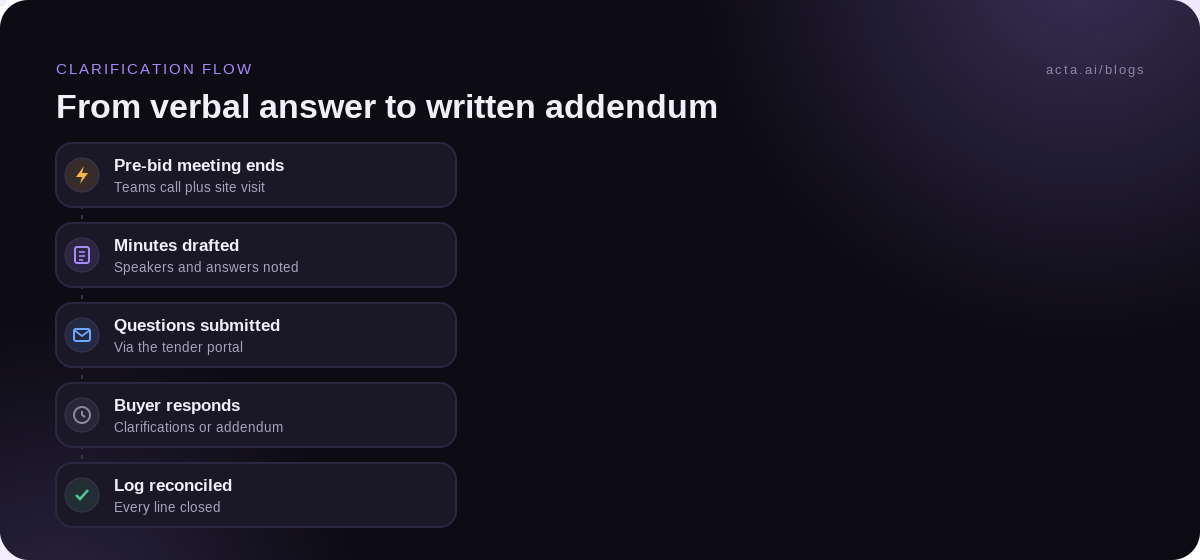
The flow is the same whatever the portal:
- Within a day, convert every unconfirmed verbal answer in your minutes into a formal written question.
- Submit it through the channel the tender documents name, before the stated cut-off. Questions sent by WhatsApp to a friendly contact at the buyer don't count, however quick the reply.
- When the buyer publishes responses or an addendum, match each one to your question number.
- Update the bid section it affects and note the addendum number on the change.
- Acknowledge every addendum in the way the documents require. Missing an acknowledgement can make a strong bid non-compliant.
The most expensive mistake in this whole process is pricing on the verbal answer. If the buyer's engineer says the existing cabling can be reused and the written response later says it must be replaced, the gap comes out of your margin. When an answer never arrives in writing, carry it as a stated assumption or qualification in your submission, if the tender allows qualifications, rather than silently relying on it.
A pre-bid meeting minutes template you can copy
Paste this into your bid folder and fill it in during the meeting or straight after. Keep the question numbers aligned with your formal question list. For a general format you can adapt to other meetings, see our meeting minutes template with a free example.
Tender: [Reference number and title]
Buyer: [Entity] | Portal: [e.g. Digital Procurement Platform, eSupply, entity portal]
Meeting: [Date, time, place or online platform] | Site visit: [Yes/No, location]
Buyer attendees: [Name, role]
Our attendees: [Name, role] | Note-taker: [Name]
Recording: [Permission asked of / answer]
Key dates confirmed: Question cut-off [ ] | Submission [ ] | Bid validity [ ] | Bond or guarantee [ ]
Clarifications (one line each): Q-no. | Topic and clause | Question | Verbal answer | Said by | Status: verbal only / submitted / answered in writing / addendum no.
Other bidders' questions: Topic | Verbal answer | Impact on our bid
Site observations: Access, utilities, working hours, permits, storage, safety
Buyer commitments: What they promised to issue, and by when
Our actions: Action | Owner | Due
Open risks and assumptions: Item | Proposed treatment (price, qualify, ask)
Keep the status column honest. "Verbal only" in a status cell is a warning that something isn't safe to price yet. If you can't fill the "Said by" column, write "unclear", and ask about it formally.
A filled example from a facilities tender
Here is a short, illustrative example. The tender, people and answers are made up to show the format. A facilities management contractor in Abu Dhabi is bidding for a three-year maintenance contract at a semi-government office campus. The pre-bid meeting runs on Microsoft Teams, followed by a site visit two days later.
Tender: FM-2026-114, Integrated facilities maintenance, Campus B
Buyer attendees: Mariam Al Hammadi (procurement lead), Khalid Rahman (facilities manager)
Our attendees: Rajesh Menon (bid manager), Joseph Santos (estimator), Karim Haddad (MEP engineer, note-taker)
Recording: Asked by Rajesh at the start; Mariam agreed for internal use only.
Key dates confirmed: Question cut-off 3 December; submission 17 December; bid validity 120 days (as stated in the documents).
Q-04 | Chiller maintenance, Scope clause 3.2 | Are the two rooftop chillers included? | "Yes, including annual overhaul" | Khalid | Verbal only
Q-07 | Manpower, Schedule C | Is a resident engineer required on site full time? | "We expect it, the documents will be updated" | Mariam | Verbal only, addendum promised
Q-09 | Payment terms | Monthly or quarterly certification? | "Monthly, per the draft contract" | Mariam | Matches documents
Other bidders' questions: Another bidder asked whether spare parts above a set value are reimbursable. Answer: "We'll come back on that." Impact: could shift our parts allowance.
Buyer commitments: Updated Schedule C and the asset register in Excel, "by next week" (Mariam).
Our actions: Submit Q-04, Q-07 and the spare-parts question on the portal (Rajesh, tomorrow). Price chiller overhaul as an option until confirmed (Joseph). Check rooftop access at site visit (Karim).
Notice what the example does: Q-04 and Q-07 are marked "verbal only", so nobody prices them as settled. Q-09 already matches the documents, so it needs no further question. And the competitor's spare-parts question has become your own action. That is the whole value of good pre-bid meeting minutes: they turn a conversation into a short list of things to confirm.
Close the gap between clarification and submission
The weeks between the pre-bid meeting and the deadline are where commitments go missing. People change, someone goes on leave, and the addendum that changed the manpower schedule lands in one person's inbox. Use this sequence.
- Same day: clean up the minutes, mark every status, and circulate them to the bid team only.
- Next working day: submit formal questions through the portal or channel named in the documents. Record the submission reference.
- Every time a response arrives: update the status column and tell the owner of the affected bid section.
- When an addendum is issued: log its number, acknowledge it as required, and list every document it replaces.
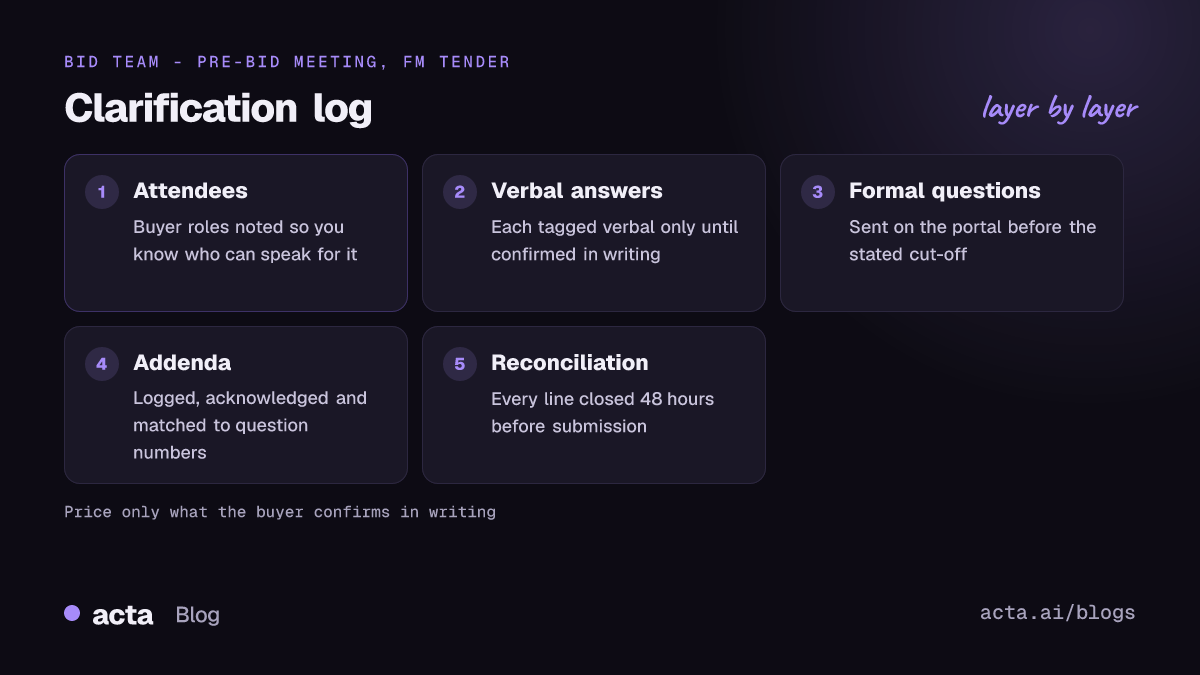
- 48 hours before submission: run a reconciliation. Every line should read "answered in writing", "addendum no." or "carried as an assumption".
- Before upload: confirm the latest addendum's date and documents are the ones your technical and commercial bids are built on.
Troubleshooting a few common problems:
- The buyer never answered a question. Don't assume the verbal answer stands. Carry it as a clearly worded assumption if the rules allow, or price the risk.
- Two attendees remember the answer differently. Check the recording if you have one. If not, submit the question formally and stop debating it internally.
- An addendum arrives after you've priced. Re-open only the affected sections, and note the change in your bid log so the reviewer sees why the number moved.
- Several meetings and site visits on one tender. Keep one clarification log across all of them, not separate minutes per meeting that nobody cross-checks.
The same discipline applies after award, when negotiation starts. Our guide to contract negotiation notes, clause by clause picks up where this one stops.
Where a meeting recorder fits in bid work
If the buyer agrees to recording, Acta can turn an online or in-person pre-bid session into a transcript with speaker names, a summary, decisions and action items with owners, and you can ask OneChat later what was said about a clause across several clarification meetings, with the source moment linked. For Arabic-speaking sessions, Arabic is supported in beta and has to be chosen in Settings, as explained on the meeting languages help page. Acta's page for teams in the UAE and the facility management page show how this works for local bid teams. It helps you keep the record; it doesn't replace reading the addenda.
Frequently asked questions
What should pre-bid meeting minutes include in the UAE?
Pre-bid meeting minutes for a UAE tender should list buyer and bidder attendees, every question with the verbal answer and who gave it, other bidders' questions, site observations, confirmed dates, promises the buyer made and your own actions. Mark each answer as verbal only, submitted, answered in writing or covered by an addendum, so nobody prices an unconfirmed answer.
Is a verbal answer at a tender clarification meeting binding?
Generally, no. In UAE government and developer tenders, the written tender documents and any formal addenda or clarification responses govern. Treat a verbal answer as information only, and submit it as a formal question through the channel the tender documents name. This is general information, not legal advice; check your specific tender's instructions to bidders.
What is the difference between a clarification and a tender addendum?
A clarification answers a bidder's question about the existing tender documents. A tender addendum formally changes those documents, for example by replacing a drawing, amending quantities or moving the submission date. In UAE tenders, both usually arrive in writing through the procurement portal, and addenda often need to be acknowledged in your submission.
Where do suppliers find UAE government tenders?
As of November 2026, federal entities publish tenders on the Ministry of Finance's Digital Procurement Platform, many Dubai Government entities use Dubai eSupply, and Abu Dhabi has its own procurement gate. Some entities, such as DEWA, run their own supplier portals. Registration rules differ by portal, so check each entity's supplier page.
Can I record a pre-bid meeting?
Only with the buyer's permission. Ask the chair at the start of the UAE pre-bid meeting, explain it is for your internal minutes, and accept a refusal. If recording is declined, assign a dedicated note-taker and read the minutes back to your team the same day while memories are fresh.
Set up your bid team's clarification routine
A routine beats heroics on deadline night. Before your next tender, agree these five things with the team.
- Name a note-taker: one person per pre-bid meeting who writes and does not ask questions.
- Number every question: use the same Q-numbers from first draft to final reconciliation.
- Track status, not just answers: verbal only, submitted, answered in writing, addendum.
- Price only what's written: unconfirmed items become assumptions or priced risk.
- Reconcile 48 hours out: every line closed before upload, every addendum acknowledged.
If you want a record of your next permitted clarification session without adding a bot to the buyer's call, try the Acta desktop app or the Chrome extension on your next tender.