Italian is a beta language, so you switch it on yourself
Acta works with 15 languages, in two groups. English, Hindi, French, Spanish and German are detected automatically when you set the language to Auto. Italian, Portuguese, Dutch, Arabic, Japanese, Telugu, Tamil, Kannada, Marathi and Bengali are beta languages that you choose in Settings. Auto never picks them.
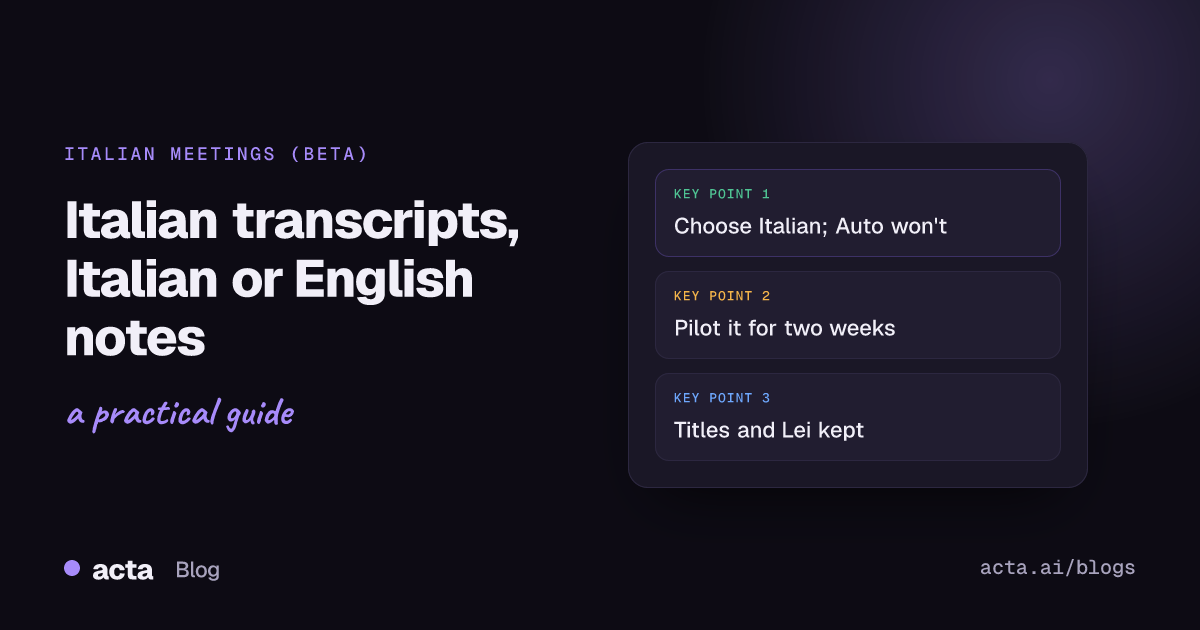
For Italian this has a practical consequence. Someone who set Auto months ago for their English and German calls will find that their first Italian meeting doesn't come out in Italian. Nothing is broken; Auto simply had no Italian option. Choose Italian before the meeting and the transcript follows.
What does beta mean in practice? It works, and you'll get a usable Italian transcript and notes. But accuracy is still improving, and it's more sensitive than the automatic languages to poor audio, crosstalk and strong regional speech. That's why this guide puts a pilot before the rollout. A beta language deserves a week of checking against your own meetings rather than trust on day one.
Italian is also one language per meeting. If a Turin plant meeting switches to English when the Indian engineering lead joins, decide which language carries the decisions, or split the call. The only mixed-language case Acta supports within one meeting is Hindi with English.
Turn on Italian meeting transcription before the first call
- In the Acta dashboard, open Settings and choose Meetings.
- Look for the Language card, placed right after "Add Acta Notetaker to my meeting invites".
- In Language spoken in meetings, select Italian (beta). Beta languages carry that label in the list.
- In Language for my notes, leave Same as the meeting for Italian notes, or choose English if the readers don't speak Italian.
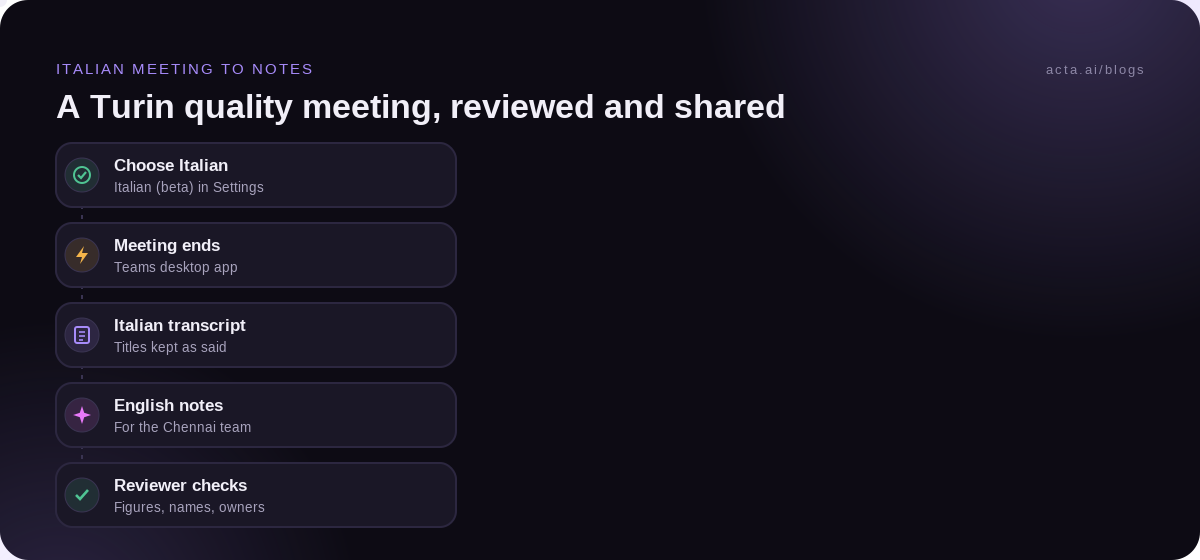
- Record the meeting, then confirm that the language chip beside the meeting tabs shows Italian. The Change language link goes straight back to the card.
The setting applies from the next meeting you record; older meetings keep their language. Italian works with every recording method: the Acta notetaker in Zoom, Google Meet or Teams, the desktop app for the Zoom and Teams apps or any other calling tool, the Chrome extension, uploaded files, and the mobile app for meetings around a workshop table. The meeting languages help article lists every option.
Before the first recording, say you're recording and why. "Registriamo la riunione per il verbale, va bene per tutti?" (We're recording the meeting for the minutes, is that OK with everyone?) is the kind of line that works. The guide on recording consent and what to tell participants covers the general rules, and the GDPR checklist for AI note takers is useful general reading for EU teams.
Run a two-week pilot before anyone relies on the notes
A pilot doesn't need a project plan. It needs one person who speaks Italian well, three kinds of meeting, and twenty minutes per meeting to compare notes with what happened. Pick meetings that represent your real week:
- An internal meeting on a good connection: a weekly production or design meeting on Teams, with headsets. This shows you the best case.
- A meeting with an outside party: a supplier or client call, ideally with someone who speaks fast or with a regional accent.
- A noisy room: a meeting around a table on the shop floor or in a showroom, recorded on a phone. This shows you the worst case.
For each meeting, the reviewer checks four things against their own memory or written notes: are the names right, are the numbers and part codes right, does the decisions list match what was actually decided, and are the action items assigned to the right people? Keep a simple log with one line per meeting: what was right, what was wrong, and whether the error would have mattered.
At the end of two weeks you'll know where the beta is ready for your team and where it isn't. A typical outcome is that headset meetings are fine to share after a quick read, while shop-floor meetings need a closer check or a better microphone. Write that down as your rule. Our guide to accents, noise and crosstalk has fixes for the noisy-room case that apply to Italian as much as to English.
Titles, Lei and family-firm shorthand stay as spoken
Italian business speech uses professional titles constantly. An engineer is "l'ingegner Rossi", a graduate is "il dottor Bianchi" or "la dottoressa Ferrari", a surveyor is "il geometra", a lawyer "l'avvocato". These titles tell you who someone is in the conversation, and Acta keeps names and titles as they were said.
The formal Lei works the same way. A supplier who addresses you with Lei ("Mi può mandare il disegno aggiornato?", could you send me the updated drawing?) is keeping a formal distance; a move to tu is a signal that the relationship has changed. The Italian transcript preserves it. English notes can't, since English has a single "you".
Family-owned firms add their own shorthand. In a company where the founder's son runs sales, "il dottore" in a meeting might mean one specific person, and "la signora" might mean the founder's wife who signs off on purchases. A transcript will record the words faithfully; only someone inside the firm knows who they refer to. If your English notes go to a partner abroad, add the full name next to the title the first time it appears. "Il dottore (Marco Bianchi, sales director)" saves a confused email later.
Dialect is where the beta is tested hardest
Italy's regional languages and dialects are still part of working life, even if less than they were. Istat's 2024 report on the use of Italian, dialects and foreign languages tracks how often people use Italian or dialect at home, with friends and with strangers.
In meetings, that usually means standard Italian with regional colour: a Piedmontese expression on a Turin shop floor, a Venetian aside in a Treviso workshop, Neapolitan between two colleagues from Naples. Acta's setting is Italian, so short dialect phrases inside Italian sentences may come out wrong or garbled in the transcript, and a conversation held entirely in dialect isn't something to rely on.
The fix is not to ask people to change how they talk. Instead, make sure the decisions are stated clearly in Italian at the end of each item, which good chairs do anyway, and treat any dialect-heavy passage as a place to check the recording before quoting it.
Worked example: a Turin supplier's quality meeting with English notes
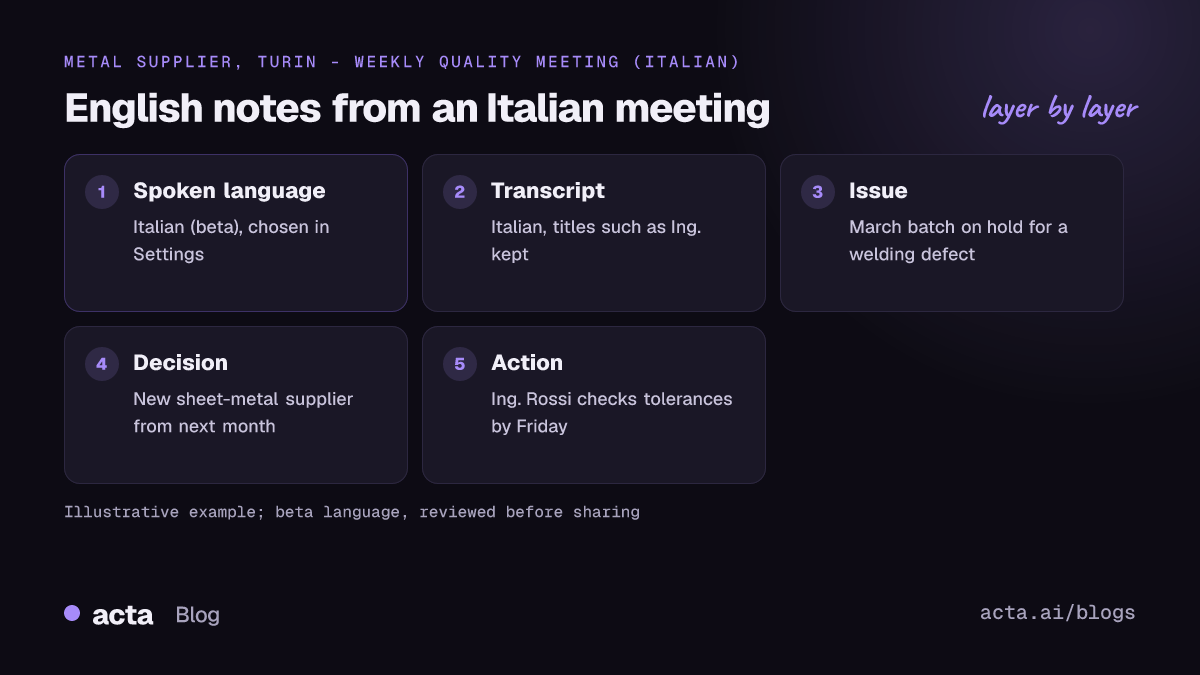
An illustrative example, not a customer story. A sheet-metal supplier near Turin makes stamped parts for automotive customers. Its engineering partner in Chennai handles drawings and tooling changes. Every week the Turin quality team holds its meeting in Italian, and the Chennai team needs the outcome. The quality manager sets Italian (beta) as the meeting language and English for the notes.
Three lines from the Italian transcript:
- "Il lotto di marzo è stato bloccato per un difetto di saldatura." (The March batch was held back because of a welding defect.)
- "L'ingegner Rossi verifica le tolleranze entro venerdì." (Engineer Rossi checks the tolerances by Friday.)
- "Passiamo al nuovo fornitore di lamiera dal mese prossimo." (We're switching to the new sheet-metal supplier from next month.)
The English notes the Chennai team receives:
- Issue: March batch on hold for a welding defect.
- Decision: switch to the new sheet-metal supplier from next month.
- Action: Ing. Rossi to check tolerances by Friday.
The Chennai lead reads the notes, asks Acta in English "which drawings are affected by the welding defect?" about that meeting, and gets the answer in English. When a figure looks odd, a colleague in Turin checks the Italian quote. For recurring supplier reviews, the vendor review meeting report shows a structure for keeping SLAs and issues in one place.
A Milan design studio is a case for Italian notes
Not every Italian meeting needs English notes. Take a Milan accessories brand reviewing a new collection with its leather workshop in Tuscany. Everyone in the meeting is Italian, the notes go to the same people, and the vocabulary is specific: campionario (the sample collection), pellame (leather hides), the name of a particular finish or colour as the workshop calls it.
Here, Italian notes ("Same as the meeting") are the better choice. Translating "campionario" or a colour name into English adds nothing and risks losing the term the workshop will use on its order. Acta keeps product names and technical terms as said in any case, but notes in Italian keep the surrounding sentence natural too.
The test is simple. If every reader of the notes speaks Italian, keep them Italian. If even one important reader doesn't, choose English and keep the Italian transcript as the reference. Each person sets their own notes language, so a bilingual team can have it both ways.
Check five things before you forward Italian notes
- Numbers: Italian uses a point for thousands and a comma for decimals. "15.000 euro" is fifteen thousand; "1,2 milioni" is 1.2 million. Amounts are kept as said, so check them against the offer or the drawing.
- Dates: 05/06 is 5 June, not 6 May. "Entro fine mese" means by the end of the month; give it a real date in your plan.
- Names and titles: confirm the spelling of surnames and that Ing., Dott. or Arch. match what was said.
- Decisions versus discussion: "vediamo" (let's see) or "ci aggiorniamo" (we'll catch up) closes a topic without deciding it. If the notes list a decision, make sure someone actually made it.
- Owners: check that each action item belongs to the person who agreed to it, not to the person who raised it.
Five minutes on this list will catch the errors a beta language is most likely to make, and some a human minute-taker makes too.
Where Acta fits
Acta records the meeting, produces the Italian transcript and writes notes, decisions and action items in Italian or English, keeping titles, figures and terms as spoken. Italian is in beta, so treat the first weeks as a pilot and keep a reviewer who speaks the language. Both Ask Acta and OneChat answer in whichever language you ask in.
Frequently asked questions
Can AI transcribe Italian meetings?
Yes. Acta transcribes Italian meetings as a beta language: you choose Italian (beta) in Settings, and the transcript comes back in Italian with notes, decisions and action items in Italian or English. Beta means it works but accuracy is still improving, so check the first few meetings against what was said.
Does Acta detect Italian automatically?
No. Auto detects only English, Hindi, French, Spanish and German. Italian is one of ten beta languages that must be selected in Settings under Meetings, then the Language card. If an Italian meeting was recorded on Auto or English, change the setting; it applies to meetings recorded after the change.
Can I get English notes from an Italian meeting?
Yes. Set "Language for my notes" to English. The transcript stays in Italian, while the summary, decisions, action items, report templates and follow-up email are written in English. Quotes, names, titles such as Ingegnere, and figures stay as they were said, so a reader can check the original.
How accurate is Italian transcription in beta?
Acta doesn't publish accuracy figures, and results depend on your audio and speakers. Headset calls in standard Italian give the best transcripts; noisy rooms, crosstalk and dialect-heavy speech give weaker ones. A two-week pilot on your own meetings is the most reliable way to find out what to expect.
Does it understand Italian dialects?
The setting is Italian, so standard Italian with regional accents is the expected case. Short dialect expressions may be transcribed incorrectly, and meetings held entirely in Piedmontese, Venetian, Neapolitan or another regional language aren't something to rely on. Ask chairs to restate decisions in Italian at the end of each item.
Does Italian work with Zoom, Teams and in-person meetings?
Yes. The language setting applies to every recording method: the Acta notetaker in Zoom, Google Meet or Microsoft Teams, the desktop app, the Chrome extension, the mobile app for in-person meetings and uploaded recordings. In-person meetings benefit most from placing the phone close to the people speaking.
Decide whether Italian is ready for your meetings
After the pilot, decide with a short checklist:
- Set the language: Italian (beta) for everyone whose meetings are mostly Italian.
- Pick notes by reader: Italian for Italian-only teams, English for partners abroad.
- Name a reviewer: one Italian speaker checks notes before they leave the team.
- Fix the audio: headsets for calls, a phone close to speakers in rooms.
- Write your rule: which meeting types can be shared after a quick read, and which need a closer check.
The European Commission's Eurobarometer on languages lists English as the foreign language Europeans speak most, which is why English notes are often the shared record across a European supply chain. To start your own pilot, install the Acta desktop app and use the 15-day free trial.