German meeting transcription works call by call
Take a typical setup. A pump manufacturer in Munich runs a weekly design review with an engineering services team in Pune and a programme manager in Manchester. The agreed meeting language is English. Then, twenty minutes in, two Munich engineers start arguing about a flange tolerance in German, and the decision that matters gets made in that stretch.
Acta handles one language per meeting. That's the first thing to understand, because it decides how you should run calls like this one. If a call is mostly English with a German aside, set it to English and accept that the aside won't transcribe well. If the German part is where the engineering decisions happen, give it its own short meeting in German and record that separately. Hindi mixed with English is the only mix Acta supports within one meeting; German and English in the same call isn't.
The language list itself is short and fixed. Acta detects English, Hindi, French, Spanish and German automatically when the setting is Auto. Ten more languages (Italian, Portuguese, Dutch, Arabic, Japanese, Telugu, Tamil, Kannada, Marathi and Bengali) are in beta and have to be chosen in Settings. German is in the first group, so it isn't a beta language.
Language switching is normal in European business. The European Commission's latest Eurobarometer on languages looks at how many Europeans can hold a conversation in a language other than their mother tongue. That's exactly why so many DACH teams default to English the moment one non-German speaker joins, and why it's worth deciding each call's language on purpose rather than by habit.
Set up German meeting transcription in six steps
- Open the Acta dashboard, click Settings and switch to the Meetings tab.
- Scroll to the Language card. It sits under the "Add Acta Notetaker to my meeting invites" option.
- Under Language spoken in meetings, choose German. If your calendar mixes German and English calls, Auto covers both. The default is English, so a new account won't pick German for you.
- Under Language for my notes, keep Same as the meeting for German notes, or switch to English for colleagues who don't read German.
- Record the meeting as you normally would: the Acta notetaker in Zoom, Google Meet or Teams, the desktop app, the Chrome extension, the mobile app, or an uploaded file.
- When the notes arrive, look at the small language chip beside the meeting tabs. If it doesn't say German, click Change language and fix the setting before the next call.
The change applies to meetings recorded after you save it. Meetings already processed keep the language they had. The notes email also states the meeting's language, so a wrong setting is easy to spot from your inbox. The full list of options is in the meeting languages help article.
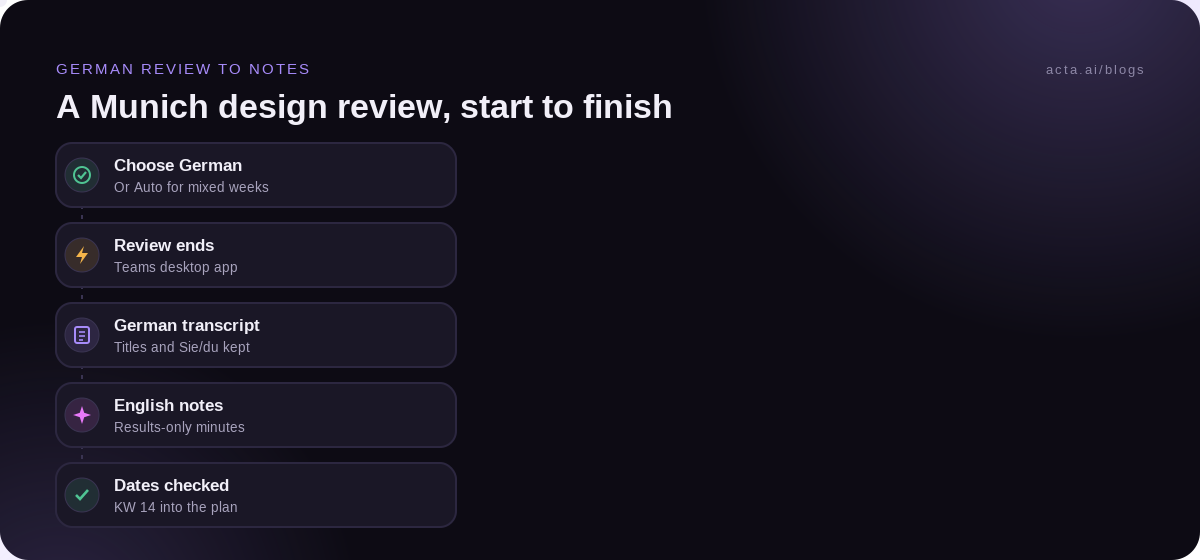
Some German clients don't allow outside meeting bots into their Teams tenant. In that case the Acta desktop app records the Teams or Zoom app from your own computer, and any other calling tool, Webex included, works by pressing Record. Whichever way you record, tell everyone at the start; the desktop app's Copy notice button gives you a line to paste into the chat. The guide on recording consent and what to tell participants covers the general rules.
An Ergebnisprotokoll format suits most German meetings
German offices tend to distinguish two kinds of minutes. A Verlaufsprotokoll records the course of the discussion, roughly who said what and in which order. An Ergebnisprotokoll records results only: decisions, tasks, owners and deadlines. Ask a German project lead which one they want after a design review and the answer is almost always the second.
An AI transcript already gives you the Verlauf, word for word and with speaker names where they're available. So the notes should be the Ergebnis. Here's a structure to copy, with English glosses:
Ergebnisprotokoll (results minutes): [Projekt], [Datum]
Teilnehmende (participants): names, with titles as used in the meeting
Beschlüsse (decisions): one line each, no discussion
Aufgaben (tasks): Wer / Was / Bis wann (who / what / by when)
Offene Punkte (open points): what was raised but not settled
Nächster Termin (next meeting): date and purpose
You can build this as a custom report template so every German review comes back in the same shape. Custom templates are written in your notes language, German or English. Acta's own section headings in built-in reports, such as "In short", stay in English, as does the dashboard, so try the template on a test meeting and see how it reads before you share it with the Munich team.
For a wider view on what makes minutes useful at all, the meeting minutes template guide is a good companion.
Sie, du and titles stay exactly as they were said
German business speech carries a lot of information in forms of address. Doctorates are used in daily business: a client is "Herr Dr. Weber" in the meeting and in the email signature. Austrian business culture goes further, with titles such as Mag. (Magister) or DI (Diplom-Ingenieur) in common use. Acta keeps names as spoken. It doesn't add a title nobody used, and it doesn't drop one that was used.
The same applies to Sie and du. When a client who has said Sie for six months suddenly offers the du ("Wir können uns gerne duzen", roughly "let's use first names"), that's a relationship signal worth noticing, and the German transcript keeps it. English notes can't show it, since English only has "you". If the tone of a relationship matters to you, read the German quotes rather than relying on the English summary.
A few lines as they'd appear in a German transcript:
- „Frau Huber, könnten Sie die Zeichnung bis Freitag freigeben?“ (Ms Huber, could you approve the drawing by Friday?)
- „Klar, ich schicke sie dir heute Abend.“ (Sure, I'll send it to you tonight.) The switch to du is visible here.
- „Herr Dr. Weber übernimmt die Abstimmung mit dem Lieferanten.“ (Dr Weber takes over coordination with the supplier.)
When you edit English notes yourself, keep the titles. "Weber to coordinate with supplier" reads as rude to a German reader who sees it forwarded; "Dr. Weber" costs four characters.
Compound terms, Denglisch and German numbers come through as spoken
German engineering vocabulary is built from long compounds, and many of them have no neat English equivalent. Lastenheft is the customer's requirements specification; Pflichtenheft is the supplier's response describing how it will meet them. Abnahmeprotokoll is the signed acceptance record, and Inbetriebnahme is commissioning. Translate both of the first two as "specification" and you lose the one distinction a contract dispute will turn on.
Acta keeps technical terms, product names, numbers, dates and amounts as they were said. In English notes from a German meeting, that means you'll often see "Lastenheft approved" rather than an English paraphrase. That's the right behaviour, but it means your Pune and Manchester readers need a short glossary. Put five or six terms at the top of the project's shared page and the problem goes away.
Denglisch, the everyday mix of English words in German sentences, stays in the German transcript too. Phrases like „Wir müssen das bis Freitag fixen“ (we need to fix that by Friday) or „Ich schicke dir den Link nach dem Call“ (I'll send you the link after the call) are German sentences with English loanwords, so they belong in a German-language meeting. They're not a language switch.
German number and date formats are where English readers trip most:
- Dates: 03.04. is 3 April. "KW 14" is calendar week 14, which German planners use constantly.
- Decimals: 1,5 Mio. Euro is 1.5 million euros. The comma is the decimal mark, and the point separates thousands.
- Times: „halb drei“ means 2:30, half an hour before three. English speakers routinely read it as 3:30.
Since amounts and dates are kept as said, the notes will say "KW 14" and "halb drei" if that's what was spoken. Check them before an English summary goes out.
Worked example: a Munich design review with Pune and Manchester
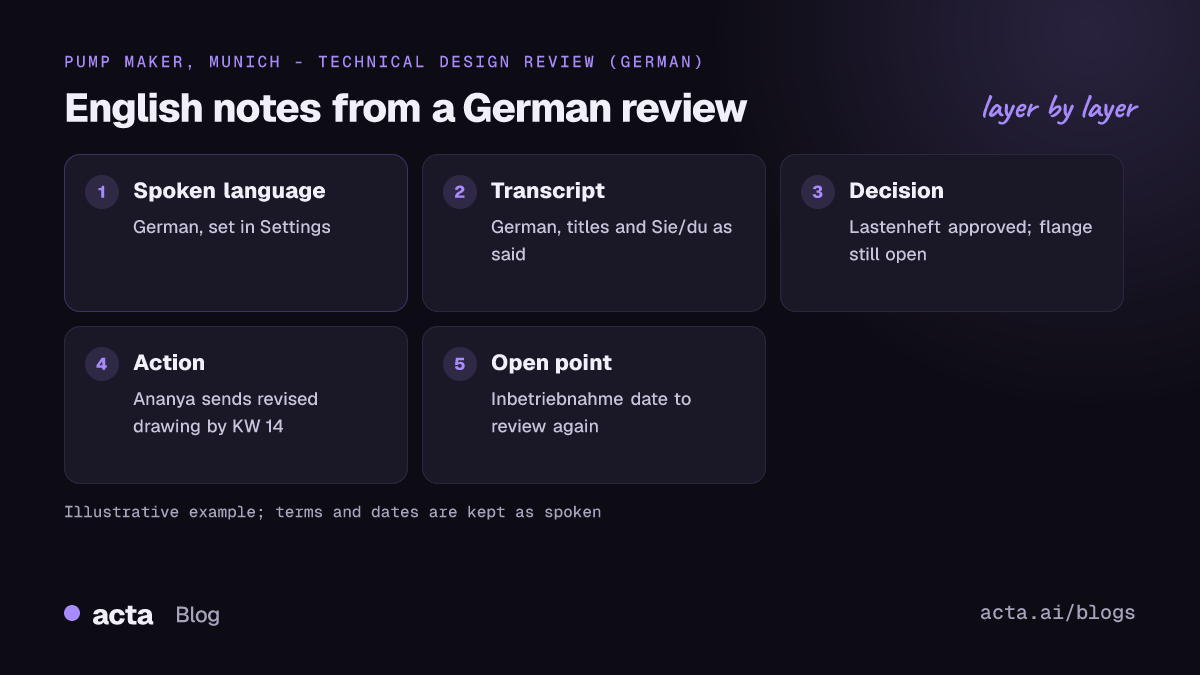
This is an illustrative example, not a customer story. The pump manufacturer from earlier splits its review: the cross-team status part runs in English, and a 30-minute technical session runs in German between two Munich engineers and Ananya, the Pune team lead, who works in German with this client. The technical session is set to German with English notes, because the Manchester programme manager and the rest of the Pune team need to read it.
Three lines from the German transcript:
- Dr. Weber: „Das Lastenheft ist freigegeben, aber die Toleranzen am Flansch müssen wir noch prüfen.“ (The requirements spec is approved, but we still need to check the flange tolerances.)
- Ananya: „Wir schicken die überarbeitete Zeichnung bis KW 14.“ (We'll send the revised drawing by calendar week 14.)
- Frau Huber: „Den Termin für die Inbetriebnahme sollten wir nach dem Call nochmal challengen.“ (We should question the commissioning date again after the call.)
And what the English notes would contain:
- Decision: Lastenheft approved. Flange tolerances still to be checked.
- Action: Ananya sends the revised drawing by KW 14.
- Open point: Inbetriebnahme date to be reviewed again; raised by Frau Huber.
Before forwarding, the Manchester programme manager did three things. She converted KW 14 into a date for the project plan, checked that "flange tolerances" matched the item in the drawing register, and added the open point to the next agenda. The German quotes stayed in the record, so when Dr. Weber later asked what exactly had been approved, the answer was one search away. For engineering teams that push actions onward, Acta's product and engineering notes can feed tickets from the same meeting.
Talk to the works council before a rollout in Germany
This section is general information, not legal advice. Many German companies have a works council (Betriebsrat), and the Works Constitution Act gives it co-determination rights in specific areas. Section 87(1) No. 6 of the Betriebsverfassungsgesetz covers the introduction and use of technical equipment designed to monitor employees' behaviour or performance.
Whether a meeting notetaker falls under that rule is a question for your works council and your employment lawyer, not for a blog post. In practice, though, any tool that records employees' meetings tends to come up, and raising it early is far easier than pausing a rollout halfway. Bring a clear description: which meetings will be recorded, who can see transcripts, how long they're kept, and what the tool is not used for.
Data protection is a separate question. For a general checklist on GDPR and AI note takers, read the GDPR checklist for EU and UK teams. Austria and Switzerland have their own labour and data rules, so check locally if your team sits there.
Most problems with German transcripts have simple causes
When German notes look wrong, the cause is usually one of these:
- The chip says English. The setting was still on the default. Change it and record the next meeting; the past one stays as it was.
- Half the call was English. One language per meeting. Split mixed calls, or set the language that carries the decisions.
- Strong dialect. Swiss German, Bavarian and Austrian dialects differ a lot from standard German. In mixed Swiss meetings people often switch to standard German anyway, but test a typical meeting before you depend on it.
- People talking over each other. Crosstalk hurts every language. The guide to accents, noise and crosstalk has fixes that work for German calls too.
- No speaker names. If speaker labels aren't available for a recording, the German transcript still comes back, without names. It won't switch to English or fail.
Where Acta fits
Acta records the meeting, writes a German transcript and gives you notes, decisions and action items in German or English, with names, titles and figures as spoken. Ask Acta about a single meeting or use OneChat across many; both answer in the language you ask in. It's one way to get there; a careful human minute-taker still beats any tool on a sensitive negotiation.
Frequently asked questions
Can AI transcribe German meetings accurately?
Yes, German is one of the five languages Acta detects automatically, alongside English, Hindi, French and Spanish, so it isn't a beta language. Results depend on audio: clear microphones, one person speaking at a time and standard German give the best transcripts. Strong dialects and crosstalk lower quality, so test a typical meeting first.
Does Acta detect German automatically?
Yes, when "Language spoken in meetings" is set to Auto, Acta picks among English, Hindi, French, Spanish and German, and German meetings are recognised. The default setting is English, though, so you need to switch to Auto or German once. The setting applies to new meetings; earlier recordings keep their language.
Can I get English notes from a German meeting?
Yes. Set "Language for my notes" to English. The transcript stays in German, while the summary, decisions, action items, report templates and follow-up email draft are written in English. Quotes, names, titles, numbers and technical terms such as Lastenheft stay as they were said, so keep a short glossary for English readers.
What happens if a meeting switches between German and English?
Acta transcribes one language per meeting, and German with English isn't a supported mix. Choose the language that carries most of the discussion, or split the call into an English status part and a German technical part, each recorded as its own meeting. English loanwords inside German sentences are fine; that's still German.
Does it work for Swiss German or Austrian German?
Acta transcribes German. Standard German spoken with a Swiss or Austrian accent is the safe case. Spoken Swiss German dialect differs a lot from standard German, so run a test meeting before relying on it. Many mixed Swiss meetings move to standard German anyway once a non-Swiss participant joins.
Do I need works council approval to use an AI notetaker in Germany?
Possibly; it depends on your company and how the tool is used. Section 87(1) No. 6 of the Works Constitution Act gives works councils co-determination rights over technical equipment designed to monitor behaviour or performance. Ask your works council and employment lawyer early. This is general information, not legal advice.
Plan your first German meetings in Acta
A short checklist before your first German-language week:
- Set the language: German or Auto under "Language spoken in meetings"; English is the default.
- Pick the readers: German notes for the DACH team, English notes for everyone else.
- Split mixed calls: one recorded meeting per language when decisions happen in both.
- Write a glossary: Lastenheft, Pflichtenheft, Abnahme, KW, with one-line English meanings.
- Raise it early: brief the works council and tell participants before you record.
To try it on your next Munich or Vienna call, install the Acta Chrome extension for browser meetings or start the 15-day free trial.