Quick answer: Of the three note taking methods, Cornell is best when you need to review and remember material, outline suits structured talks where the order is clear, and AI notes win for meetings where you need to take part rather than type. Most people get the best result by combining them: let AI capture the record and handwrite a few cues and decisions yourself.
Ask five colleagues how they take notes and you'll get five answers: a paper notebook with arrows everywhere, a bulleted doc, nothing at all, a Cornell template left over from university, and "the AI does it." Each one works for someone. The trick is knowing which method fits which job, because a method that's great for a lecture can be useless in a fast negotiation.
This post compares the three most common note taking methods, Cornell, outline and AI, for real work: meetings, calls, interviews and training sessions. If you want what to capture in meeting notes specifically, our guide on how to take meeting notes covers that; here the focus is on the method itself.
What is the Cornell method?
The Cornell method splits a page into three parts: a wide notes column on the right, a narrow cue column on the left, and a summary box along the bottom. It was developed at Cornell by education professor Walter Pauk, and Cornell's own Learning Strategies Center guide still teaches it today.
How it works in practice:
- Record. During the session, write notes in the main column. Keep the cue column empty.
- Reduce. Afterwards, ideally the same day, pull out keywords and questions into the cue column.
- Recite. Cover the notes and try to answer the cue questions from memory.
- Reflect. Write a two- or three-sentence summary at the bottom of the page.
- Review. Go back to the cues and summaries every so often, a few minutes at a time.
Guides such as this one from SUNY Schenectady lay out the classic page proportions, but the exact measurements matter much less than the habit of going back to fill in the cues.
Where Cornell shines
Anything you need to remember later: training, onboarding, a new product walkthrough, a certification course. The recite step is basically a self-quiz, and that's what makes the material stick.
Where it struggles
Fast meetings. The method assumes you'll come back and do the reduce and reflect steps. After a day of six back-to-back calls, almost nobody does. Then you've got a notes column and two empty boxes.
What is the outline method?
The outline method is the one most people use without naming it: main topics on the left, supporting points indented underneath, details indented further. University learning centres describe it as a hierarchy of main points, supporting points and details, and it's quick to do in any notes app.
Where outlining shines
Structured sessions where the speaker follows an agenda: a planning meeting with five clear items, a presentation with sections, a project review that goes workstream by workstream. The outline mirrors the structure, so your notes are tidy without extra effort.
Where it struggles
Conversations that jump around. A sales call or a brainstorm doesn't follow a hierarchy, and you end up with an outline where half the points belong under a different heading. For sales calls specifically, see sales call note-taking without losing eye contact. It also tends to capture topics rather than decisions. You'll have "Pricing: discussed annual vs monthly" and no record of what was agreed.
How does AI note taking work?
With AI note taking, a tool records the conversation, transcribes it, and writes a summary, often with decisions and action items pulled out. You don't write during the meeting at all, or only jot the odd thing. Our explainer on what an AI notes taker is goes into the mechanics.
Where AI shines
Meetings where you need to be fully present: running the meeting, selling, interviewing, negotiating. It also wins on completeness. A transcript catches the number the client mentioned at minute 34 that you'd never have written down. And you can search across months of meetings later, which no paper notebook allows.
Where it struggles
AI notes capture what was said, not what you thought about it. They won't record that the client looked unconvinced, or that you suspect the timeline is fiction. Summaries can also get things wrong, so skim them before you send them anywhere; our post on reducing errors in AI meeting summaries explains why. And you need consent to record, which isn't always given. See our guide to recording consent and what to tell participants.
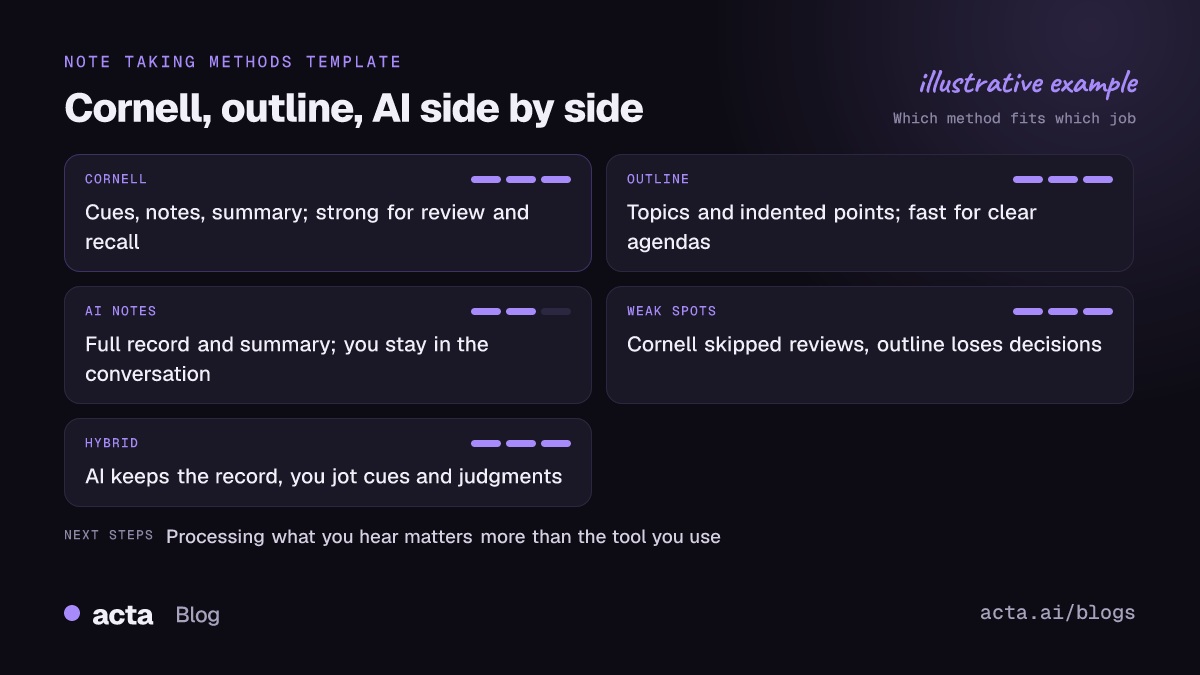
Cornell vs outline vs AI: which of these note taking methods is best?
Here's how they compare on the things that matter at work.
- Effort during the meeting: Cornell and outline both need you writing the whole time. AI needs almost nothing.
- Effort afterwards: Cornell needs the most (reduce, reflect, review). Outline needs a quick tidy. AI needs a review of the summary, usually a couple of minutes.
- Helps you remember: Cornell is strongest because of the self-testing. Outline is middling. AI on its own does little for memory, since you didn't process anything.
- Completeness: AI wins easily. Handwritten methods capture a fraction of what's said.
- Your own judgment: Cornell and outline both capture your interpretation. AI captures the conversation, not your read of it.
- Searchable later: AI and digital outlines, yes. Paper Cornell notes, no.
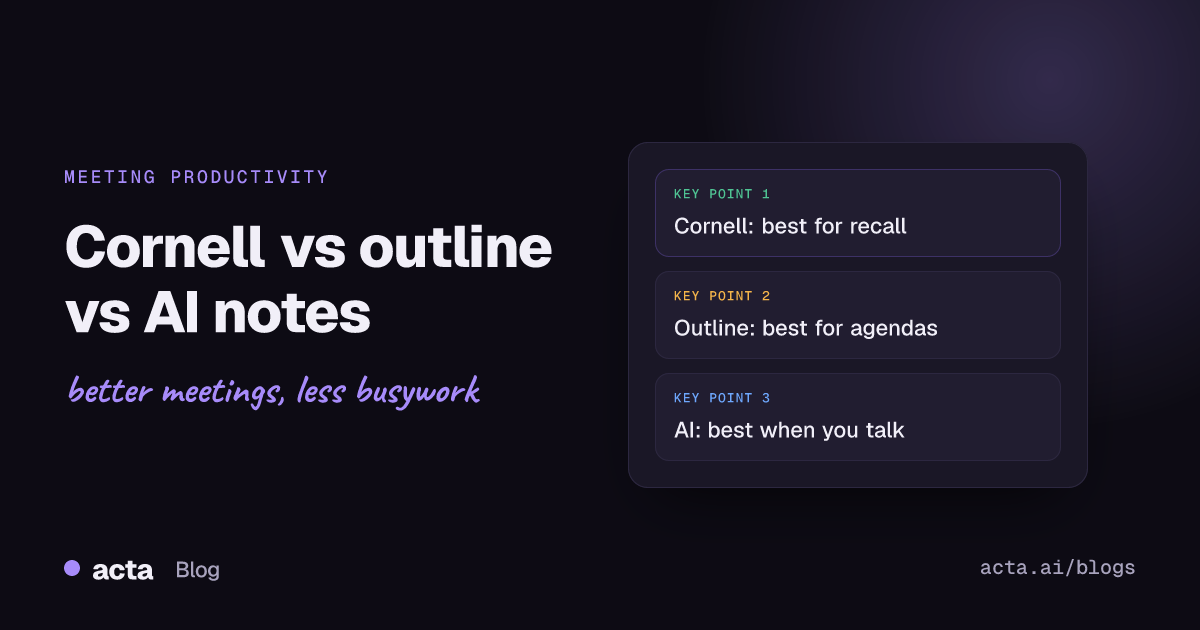
So "best" depends on the job. For learning, Cornell. For a structured agenda you're attending rather than running, outline. For anything where you're talking, AI.
Handwritten vs typed notes: what does the research say?
You've probably heard that writing by hand beats typing. That claim mostly traces back to a 2014 study by Pam Mueller and Daniel Oppenheimer, which found students who typed lecture notes took more verbatim notes and did worse on conceptual questions than students who wrote by hand.
It's shakier than its fame suggests. A 2021 direct replication published in Psychological Science found no significant difference between typed and handwritten notes for either factual or conceptual recall, though typed notes were again longer and more word-for-word. The Association for Psychological Science summarised the replication with the headline "don't ditch the laptop just yet".
The practical takeaway I'd draw: the tool matters less than whether you process what you hear. Copying words down, by hand or keyboard, isn't thinking. Writing a question in a cue column or a one-line "so what" is. That's also why AI notes alone don't help you remember much. They save you from transcribing, which is good, but the thinking part is still yours to do.
A hybrid method for meetings
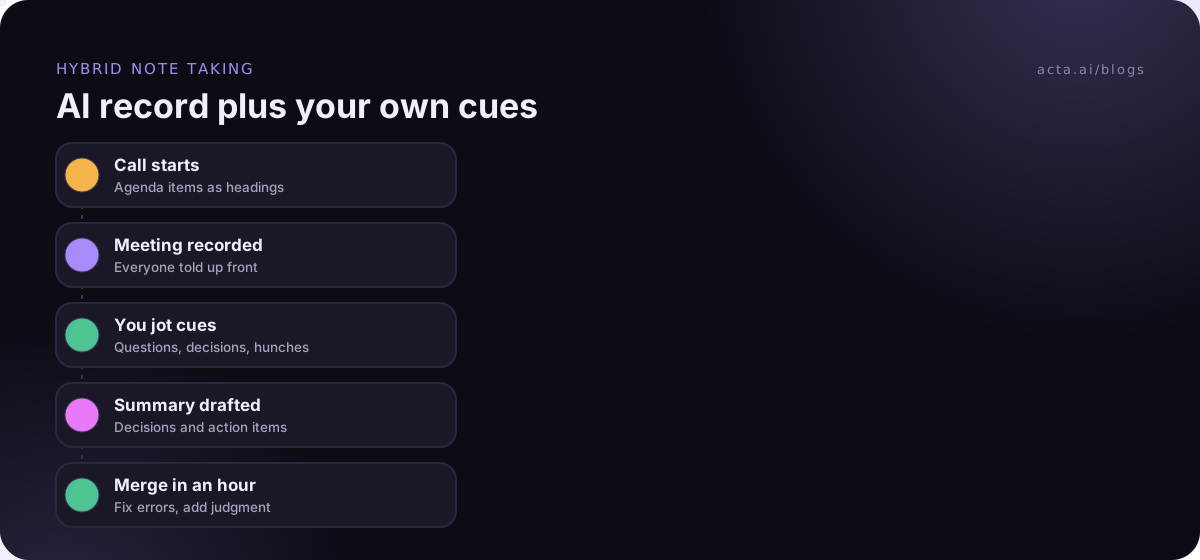
Here's the routine I'd suggest for most people who sit in a lot of meetings. It borrows the best piece of each method.
- Let AI keep the record. Record the call (with everyone's knowledge) so you're not typing. If bots aren't allowed, a Chrome extension or desktop app can record from your own computer instead.
- Keep a Cornell-style cue column on paper or in a doc. During the call, write only short cues: questions you want answered, decisions as they happen, your own reactions. "Budget owner = Dana?" "They flinched at the timeline."
- Use outline structure for the agenda. If the meeting has a clear agenda, put the items down as headings before it starts, then drop cues under each.
- Merge within the hour. Read the AI summary, check it against your cues, fix anything wrong, and add your judgment calls. Write a two-line summary at the top: what happened and what you'll do.
- Review before the next meeting. Skim the summary and your cues before the follow-up call. That's the Cornell review step, and it takes three minutes.
If you want a format for the merged result, our meeting notes template has one.
Which method should you pick?
- Students and anyone learning new material: Cornell. The recite and review steps are the point. Recorded lectures can feed it too; see our post on lecture notes and review questions from recordings.
- People who attend structured meetings but don't run them: outline, typed, with decisions marked in bold.
- Managers, salespeople, recruiters, anyone running the conversation: AI for the record, plus a handful of handwritten cues.
- Sensitive conversations where recording isn't appropriate: outline or Cornell by hand, written up straight after while it's fresh.
The one approach I'd talk you out of is trying to type everything verbatim during a meeting. You end up with long notes, little understanding, and a conversation you weren't really part of.
Where Acta fits
Acta is an AI note taker for Zoom, Google Meet and Microsoft Teams, recording with a bot or bot-free from your computer, and through mobile apps for in-person meetings. It writes the transcript with speaker names, a summary, decisions and action items with owners, which covers the "record" part of the hybrid method. Your own cues and judgment calls are still yours to add.
Frequently asked questions
Is the Cornell method good for meeting notes?
It's good for meetings you need to learn from, like training or onboarding. For fast working meetings, people rarely do the review steps, so a lighter version (a cue column plus a short summary) works better.
Is AI note taking better than taking notes by hand?
For completeness and searchability, yes. For remembering and understanding, no, because you skip the processing step. Most people do best with AI for the record and a few handwritten cues.
What is the fastest note taking method?
The outline method is the fastest of the manual ones, since it follows the speaker's structure. AI note taking is faster still during the meeting, but you need a couple of minutes afterwards to check the summary.
Do handwritten notes help you remember more than typed notes?
The evidence is mixed. A well-known 2014 study found an advantage for handwriting, but a 2021 replication found no significant difference. Processing the material, by summarizing or asking questions, matters more than the tool.
Can I combine note taking methods?
Yes, and it's usually the best option. A common mix is outline headings from the agenda, Cornell-style cues during the meeting, and an AI transcript and summary as the full record.
If you'd like to try the AI part of that mix on your own meetings, Acta has a 15-day free trial.