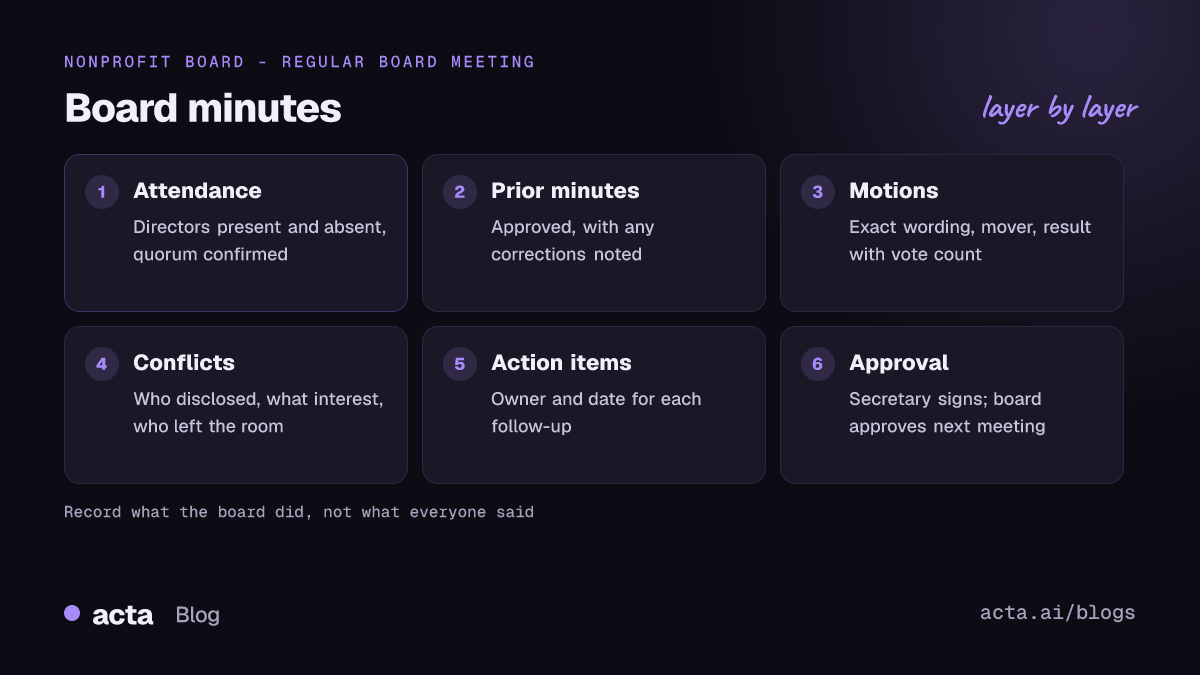
Good nonprofit board meeting minutes record what the board decided, not what everyone said: who attended, whether there was a quorum, each motion with its exact wording, the vote result, any conflicts disclosed, and who owes what by when. Below are eight copy-ready examples for the situations volunteer secretaries struggle with most, from a routine monthly meeting to an executive session and an email vote.
Use Cases 13 min read
Nonprofit Board Meeting Minutes: 8 Examples You Can Copy
Eight copy-ready minute blocks for nonprofit boards: regular meetings, consent agendas, elections, executive sessions, conflicts of interest, email votes and more.
By Sarma BKP, Founder & CEO, Acta · Updated
This post is a set of fill-in blocks rather than a full how-to. If you're new to the secretary role and want the basics first, start with our guide to nonprofit board minutes for volunteer secretaries, then come back here for wording. Everything below is general information, not legal advice. Your bylaws and your state's nonprofit law decide what is actually required, so check both before you adopt a format.
Key takeaways
- Record actions, not debate. Robert's Rules treats minutes as a record of what was done; one line per motion is usually enough.
- Every motion block needs four things: the exact wording, who moved it, the result (with counts for anything contested) and any recusals.
- The IRS Form 990 asks whether meetings were documented contemporaneously, which its instructions define as by the later of the next meeting or 60 days after it.
- Conflict of interest disclosures belong in the minutes by name, with a note that the person left the room or abstained.
- Keep executive session minutes separate and short, and decide who can read them before the session starts.
Table of contents
- Nonprofit board meeting minutes have a small required core
- Example 1: a regular board meeting fits on one page
- Examples 2 and 3: consent agendas and annual meetings need list-style entries
- Examples 4 and 5: executive sessions and conflicts need the least detail and the most care
- Examples 6 and 7: email votes and the Form 990 review leave a paper trail
- Example 8: a special meeting records the notice and one purpose
- Five mistakes make board minutes harder to defend
- Frequently asked questions
- Choose a minutes format your board will keep using
Nonprofit board meeting minutes have a small required core
Minutes are the board's official memory. Years from now, an auditor, a funder or a new executive director may read them to find out whether the board approved a lease or knew about a problem. That reader cares whether the motion passed and who voted, not how long the gala discussion ran.
The City of Madison's plain-English summary of Robert's Rules puts it well: minutes record what was done at a meeting, and the rules are largely silent on recording the substance of debate. Most nonprofit attorneys give the same advice for a practical reason: a paragraph summarising one director's objection can be read later in ways nobody intended.
There's also a tax angle for US charities. Part VI of the IRS Form 990 asks whether the organization contemporaneously documented the meetings and written actions of its governing body and of committees with authority to act for it. According to the IRS Form 990 instructions, documentation counts as contemporaneous if it's made by the later of the next meeting or 60 days after the meeting, and it can be approved minutes, emails or similar writings that show the action taken, when, and who decided. An organization that answers "No" explains its practice on Schedule O. Check the current year's instructions before you file, since forms are revised.
So the required core is short. Use this checklist as the skeleton under every example below:
- Organization name, meeting type (regular, annual, special), date, start time, place or video link.
- Directors present, absent and excused; staff and guests present; whether a quorum was confirmed.
- Who chaired and who took the minutes.
- Approval of the previous minutes, with any corrections.
- Each motion: wording, mover, result, recusals.
- Reports received (listed, with documents attached rather than summarised).
- Action items with an owner and a date; adjournment time.
Example 1: a regular board meeting fits on one page
Use this for the monthly or quarterly meeting where the board hears reports and approves a few things. If minutes for a 90-minute meeting run past two pages, you're probably recording discussion.
Riverbend Food Pantry, Inc. Minutes of the Regular Meeting of the Board of Directors
Date and place: 14 October, 6:30 pm, community room and video call. Presiding: Ana Ruiz, Chair. Minutes: Tom Becker, Secretary.
Present: Ruiz, Becker, Okafor, Lindqvist, Patel, Chen, Moreau (7 of 9 directors; quorum confirmed). Absent: Hughes (excused), Park. Staff: Dana Wells, Executive Director.
1. Minutes of 9 September approved as corrected (Patel's name added to attendance). Moved Okafor; approved unanimously.
2. Treasurer's report for Q3 received and filed (attached).
3. Motion: "To approve the purchase of a refrigerated van for up to $X from the restricted vehicle fund." Moved Lindqvist. Approved 6-0; Chen abstained (see conflict disclosure, item 4).
4. Conflict of interest: Chen disclosed that a family member works at the dealership quoting the van. Chen did not take part in the discussion or vote.
5. Executive Director's report received (attached).
Action items: Wells to sign the van purchase agreement by 31 October. Becker to circulate draft minutes by 21 October.
Adjourned 7:52 pm. Submitted by Tom Becker, Secretary. Approved on: ________
Notice what's missing: no summary of the debate about the van. If a director wants a dissent on the record, note "Moreau asked that her no vote be recorded."
Examples 2 and 3: consent agendas and annual meetings need list-style entries
A consent agenda bundles routine items, such as the prior minutes, committee reports and a renewed insurance policy, into one vote. It saves time, but the minutes must still list every item included, or the single vote approves something nobody can identify later.
Example 2: consent agenda
Use it when your bylaws or board policy allow a consent agenda and any director can pull an item for separate discussion.
Consent agenda. The Chair asked whether any director wished to remove an item. Okafor asked to remove item (c). The remaining items were approved by a single motion (moved Patel; approved unanimously):
(a) Minutes of the 9 September meeting. (b) Finance Committee report dated 2 October. (d) Renewal of the general liability policy with the current carrier for the next policy year.
Item (c), the volunteer handbook revision, was discussed separately. Motion to approve the handbook as revised in the 10 October draft. Moved Okafor. Approved 7-0.
Example 3: annual meeting and elections
Annual meetings usually elect directors and officers and may receive the annual report. Record the terms, because three years later someone will need to know whose seat expires when.
Election of directors. The Governance Committee presented the slate (attached). Motion to elect Grace Mensah and Luis Ortega as directors for three-year terms ending at the annual meeting three years from now, and to re-elect Priya Patel for a second three-year term. Moved Becker. Approved unanimously.
Election of officers. Motion to elect Ana Ruiz as Chair, Ken Okafor as Vice Chair, Elin Lindqvist as Treasurer and Tom Becker as Secretary, each for a one-year term. Moved Chen. Approved 8-0; Ruiz abstained.
Recognition. The board thanked retiring director Sam Hughes for six years of service.
Examples 4 and 5: executive sessions and conflicts need the least detail and the most care
These two are where secretaries most often write too much. The rule of thumb: record that the session happened, who was there, the topic in a few words and any action taken. Leave the conversation out.
Example 4: executive session
Use it when the board meets without staff to discuss the executive director's performance or pay, a personnel matter, or legal advice. Keep the executive session minutes as a separate document with restricted access, and decide in advance who keeps them.
Executive session. At 8:05 pm the board went into executive session to discuss the Executive Director's annual review. Present: all directors listed above. Staff left the room. The board returned to open session at 8:40 pm.
Action taken in executive session: Motion to approve the Executive Director's compensation for next year as recommended by the Compensation Committee (comparability data attached to the confidential file). Moved Lindqvist. Approved 7-0.
For US charities, compensation is where documentation gets read most closely. The IRS sample conflict of interest policy, published in the Form 1023 instructions and discussed by the Council on Foundations, asks boards to keep minutes of these proceedings, including any votes. Reference or attach the comparison data the committee used, so the record shows how the board arrived at the number.
Example 5: conflict of interest disclosure and recusal
Under the IRS sample policy, minutes should record the names of people who disclosed or were found to have a financial interest, the nature of the interest, whether the board found a conflict, who was present for the discussion and how the vote went. Here is a block you can paste:
Conflict of interest. Before discussion of the office lease, Director Lindqvist disclosed that she owns a minority share in the company that owns the building. The board determined that a conflict of interest exists. Lindqvist left the meeting at 7:10 pm and did not take part in the discussion or vote.
The board reviewed two alternative locations (comparison attached). Motion to approve the five-year lease on the terms in the 3 October draft, finding it fair and reasonable to the organization and in its best interest. Moved Patel. Approved 6-0. Lindqvist returned at 7:30 pm.
Examples 6 and 7: email votes and the Form 990 review leave a paper trail
Example 6: action by unanimous written consent
Many state laws and bylaws allow the board to act without a meeting if every director consents in writing, and some allow email. Whether yours does, and whether it must be unanimous, is a question for your bylaws and counsel. When it's allowed, record it like this and file the consents with the minutes:
Action by written consent. On 22 November the Secretary emailed all nine directors the following resolution: "Resolved, that the organization accept the city's grant agreement dated 18 November and authorize the Executive Director to sign it." By 25 November all nine directors had replied "I consent" by email (copies attached). The action was effective 25 November and is reported at the next regular meeting.
Then, at the next meeting, add one line to the minutes: "The Secretary reported the action by written consent dated 25 November (attached)." That closes the loop and satisfies the "written actions" half of the Form 990 question.
Example 7: Form 990 review before filing
Form 990 Part VI also asks whether a complete copy of the return went to every director before filing, and how the organization reviewed it (described on Schedule O). A one-line minute makes that answer easy to support.
Form 990. The Treasurer reported that a copy of the draft Form 990 for the last fiscal year was emailed to all directors on 3 April. Questions from Okafor about program expense allocation were answered by the auditor. The board received the return and authorized the Executive Director to file it.
The Minnesota Council of Nonprofits has a short explainer on how the 990's documentation questions map to everyday minute taking if you want a second view.
Example 8: a special meeting records the notice and one purpose
Special meetings are called between regular meetings for something urgent, such as an executive director resigning. Bylaws usually require specific notice and often limit business to the stated purpose, so the minutes should prove both.
Special meeting. Called by the Chair under Article IV, Section 3 of the bylaws. Notice stating the purpose was emailed to all directors on 2 March (copy attached). Purpose: to appoint an interim Executive Director.
Present: 8 of 9 directors; quorum confirmed. Motion to appoint Marco Silva as interim Executive Director from 10 March until a permanent appointment is made, at the salary in the attached offer letter. Moved Ruiz. Approved 8-0. No other business was conducted. Adjourned 6:20 pm.
Here's a quick summary of which example to reach for:
| Situation | Example | Must include |
|---|---|---|
| Monthly or quarterly meeting | 1 | Quorum, motions, votes, actions |
| Routine items in one vote | 2 | Every item listed; pulled items |
| Annual meeting | 3 | Names, offices, term end dates |
| Board without staff | 4 | Topic, time in and out, actions only |
| Director has an interest | 5 | Name, interest, recusal, alternatives |
| Vote without a meeting | 6 | Resolution text, all consents attached |
| Tax return review | 7 | Date shared, board review noted |
| Urgent single issue | 8 | Notice, purpose, no other business |
Five mistakes make board minutes harder to defend
Most problems I see in nonprofit board meeting minutes come from a secretary trying to be thorough, so the minutes turn into a transcript.
- Summarising debate. "Several directors expressed concern about the auditor" invites the question of which ones and what they knew. Record the motion and the vote.
- Vague motions. "Approved the budget" doesn't say which version. Name the document and its date, and attach it.
- Missing recusals. If someone stepped out, say so with times. An absent recusal is the most common gap in conflict documentation.
- Late drafts. Minutes written five weeks later from memory are less accurate and can miss the 990's contemporaneous window. Circulate a draft within a week.
- Never approving them. Draft minutes aren't the record until the board approves them. Put "approval of prior minutes" first on every agenda.
A recording helps with the fourth problem, as long as everyone knows it's happening. Some boards record only to help the secretary draft accurately and delete the audio once the minutes are approved; others keep nothing. Decide as a board, tell attendees at the start, and read our guide on recording meetings with AI and what to tell participants. For executive sessions, most boards simply don't record. Our post on recording sensitive board and HR calls covers when to switch it off.
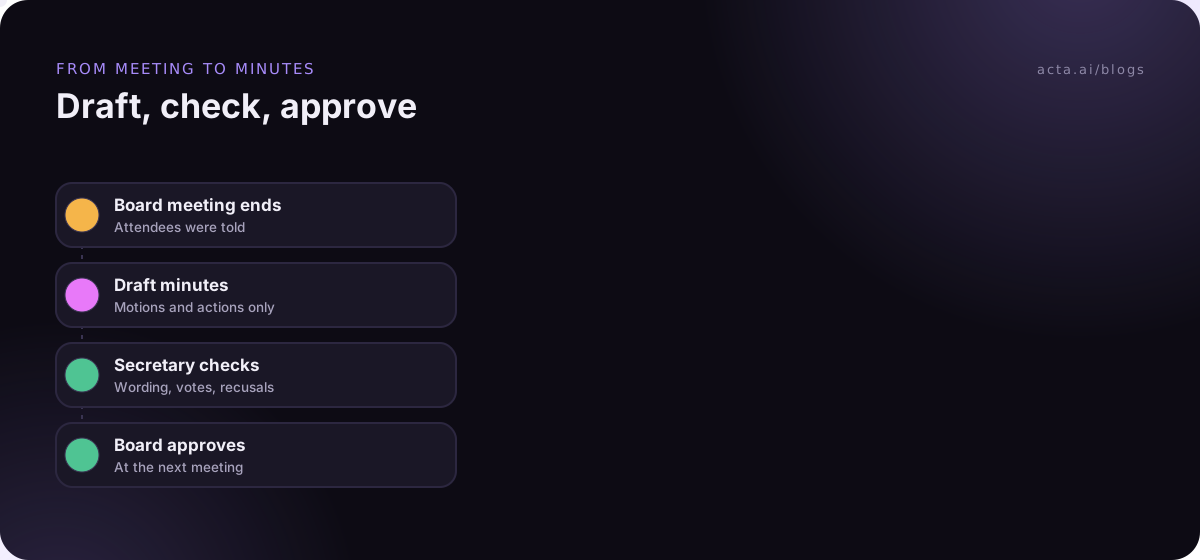
If you do use an AI notetaker to draft, treat its output as a first draft. Check every motion's wording against what the chair read out, confirm vote counts and recusals by hand, and strip any discussion summary before the draft goes to the board. Our guide to board meeting minutes from the recording walks through that review step by step.
Acta can help with that first draft. It records the meeting with a bot, or without one through the Acta desktop app for Zoom and Teams on your computer, or the mobile app when the board meets in a room, and turns the transcript into minutes using one of its report templates, with decisions and action items listed by owner. The secretary still edits, and the board still approves.
Frequently asked questions
What should be included in nonprofit board meeting minutes?
Include the organization's name, meeting type, date, time and place; who attended and whether a quorum was present; approval of prior minutes; each motion's wording, mover and result; conflicts disclosed and recusals; reports received (attached, not summarised); action items with owners; and adjournment time. Your bylaws may add more, so check them.
Do nonprofit board minutes need to record who voted no?
Usually not. Most boards record the result ("approved 6-1") and name individual votes only for a roll-call vote or when a director asks for their vote to be recorded. Abstentions and recusals for conflicts are different: name those, because they show the conflict process worked.
How long should a nonprofit keep board meeting minutes?
Many nonprofit advisers recommend keeping approved board minutes permanently, since they are the record of the organization's governing decisions. State law and your own records retention policy may set specific periods for other documents. Ask your attorney or accountant to confirm what applies to you.
Is it okay to record a board meeting to write the minutes?
It can be, if your board agrees and everyone present is told. Recording-consent rules differ by place, so check local law. Many boards keep the audio only until the minutes are approved, then delete it, and don't record executive sessions at all. Put the practice in a short written policy.
What is the difference between minutes and a transcript?
A transcript captures every word spoken; minutes record what the board did. Minutes are the official, approved record and are usually one or two pages. A transcript or recording is at most a working aid for the secretary, and most boards don't keep one as part of the record.
Choose a minutes format your board will keep using
The best format is the one your next secretary can pick up without training. Settle these points once, write them on a single page, and file it with the bylaws.
- Pick a default template: start from Example 1 and add the consent, conflict and executive session blocks only when needed.
- Set a deadline: draft minutes to directors within seven days, approval at the next meeting.
- Agree on recordings: decide whether you record, who tells attendees, and when the audio is deleted.
- Standardise motions: exact wording, document name and date, mover, result, recusals.
- Decide where minutes live: one shared folder with approved minutes, attachments and written consents together.
If you'd like a draft waiting for you after the next board call, try the Acta desktop app on a 15-day free trial and see whether its minutes save your secretary an evening.
Found this useful? Share it with your team.