Renewal season runs on four broker meetings
A commercial insurance renewal usually involves four conversations. The pre-renewal meeting, eight to twelve weeks out, where the account executive asks what has changed: new sites, turnover, wage roll, vehicles, contracts, claims. The renewal strategy meeting inside the broker, where the account director decides whether to go to market or negotiate with the incumbent insurer. Market calls with underwriters. And the renewal presentation, where terms are explained and the client instructs. Large brokers add a weekly renewal pipeline meeting on top.
The pre-renewal meeting produces the most promises, nearly all of them from the client: "I'll get finance to send the turnover split", "the sprinkler service cert is in the facilities office, I'll scan it", "our fleet manager has the new vehicle list". Each is reasonable and each is easy to forget. Multiply by 40 clients renewing on the same date and the account team is holding a few hundred small promises in notebooks, inboxes and memory.
There is a regulatory side too. In the UK, the FCA's general insurance renewal rules sit in ICOBS 6.5, and ICOBS 4 requires an intermediary to tell the customer at renewal, at least, whether it gives a personal recommendation. The FCA has also published a multi-firm review of firms falling short of renewal expectations. Which rules apply depends on your clients and your role, so check with your compliance adviser. Clear notes of what you told each client and when make that conversation easier.
Forty clients promised documents and five never sent them
Here is an illustrative renewal season. Northgate Risk Partners is a 45-person commercial broker in Manchester with a heavy 1 April date: 40 corporate clients renew that day, from a 30-vehicle haulage firm to a food manufacturer with two factories. Graham Lewis is the managing director, Hannah Okafor the account director, Tom Brennan and Aisha Rahman account executives, and Mei Chen the account handler who prepares submissions.
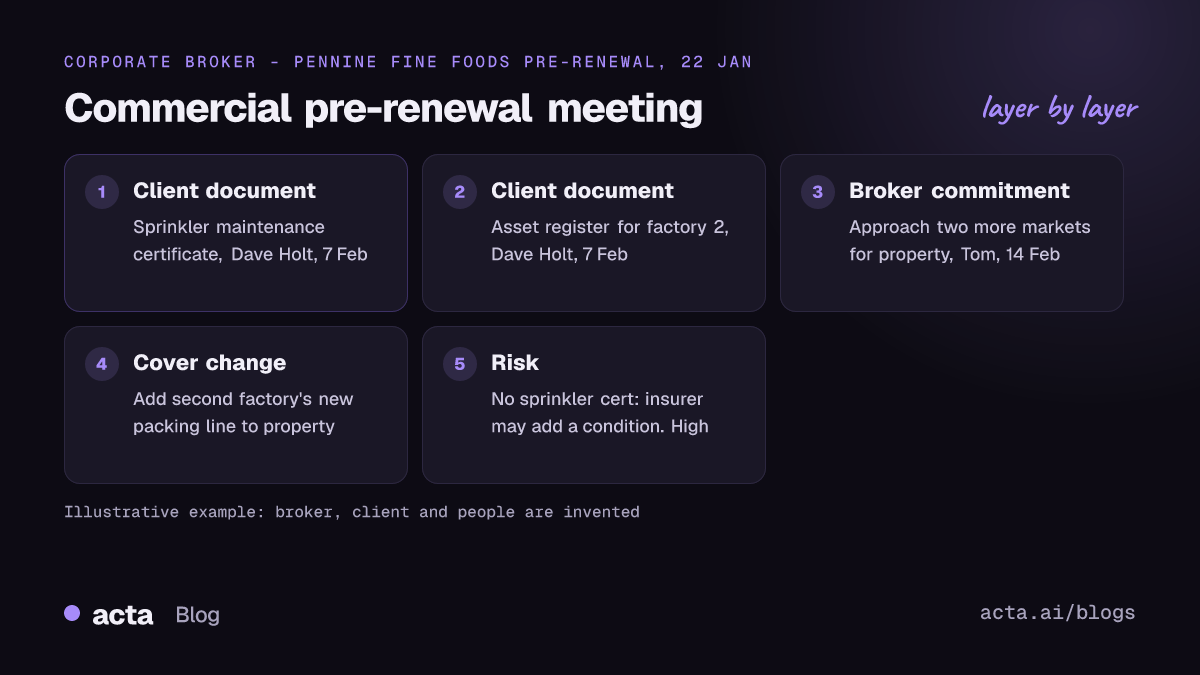
In January and February, Tom and Aisha held pre-renewal meetings with all 40. Most went well. The trouble was the tail. On 22 January, at Pennine Fine Foods, the facilities manager Dave Holt promised three things: the updated asset register for the second factory, the sprinkler maintenance certificate, and evidence that last year's survey recommendation on thermal imaging had been completed. Tom wrote "Dave to send docs" in his notebook. Tom himself promised to approach two additional markets for the property cover.
By 10 March, Mei was building submissions and found five clients missing documents, Pennine among them. Nobody could say exactly what each client had promised, because the notes said "docs". Tom spent a day ringing clients. Dave sent the asset register but not the certificate. The incumbent insurer's terms came back on 21 March with a sprinkler condition and a higher deductible, the alternative markets had too little time to quote properly, and Pennine renewed on worse terms than it might have. Graham's verdict at the post-season review: "We didn't lose anything we couldn't see. We just didn't look."
Insurance renewal meeting notes start with a promise list
The fix starts with the notes themselves. Good insurance renewal meeting notes put promises first, because that is what the next eight weeks depend on, and write them as tasks. Treat the following as your insurance renewal checklist for the meeting, and build it as a report template so it is written the same way every time.
In Acta, the built-in Client review template (Finance group) suits an annual stewardship meeting, Customer QBR suits large accounts you see quarterly, and Contract negotiation fits the call where you negotiate terms with an incumbent insurer. For the pre-renewal meeting, a custom template is worth the half hour. Custom templates are on paid plans, up to 10 per person and 12 sections each (see the custom templates guide):
Template name: Commercial pre-renewal meeting
What should this report do? For meetings with a business client before their insurance renewal: record changes to the business, documents the client promised, cover changes requested, claims or incidents mentioned and what the broker committed to.
1. Changes since last renewal (Bullets: sites, turnover, staff, vehicles, contracts)
2. Documents promised by the client (Checklist: task, owner, due date)
3. Broker commitments (Checklist: task, owner, due date)
4. Cover changes requested (Table: Policy | Change | Reason)
5. Claims and incidents mentioned (Table: Date | What happened | Status)
6. Market approach discussed (Paragraph)
Extra instructions: Name the client person for each document. If no date was given, write "No date given".
Set it to "Only matching meetings" so it runs on client renewal meetings and skips internal calls. Check it first with "Test on a past meeting".
The action item tracker shows who owes what by person
Notes per meeting are not enough in renewal season; you need the promises from 40 meetings in one list. That is the job of Outcomes > Action items in My meetings, an action item tracker built from the meetings you recorded or that were shared with you. Each person has their own view, so Tom's list covers Tom's meetings plus whatever colleagues shared with him in the workspace.
The screen has four tiles that double as filters: Open, Overdue, Due this week and Done. You can group by Meeting or by Person, and search, for example "sprinkler" or "fleet". Each row has a tick to mark it done, the owner, comments, and a status pill such as "Overdue 6 days", "Due tomorrow" or "No due date". Grouped by Person, the Pennine meeting would have given Tom this:
Dave Holt · Send sprinkler maintenance certificate · Pennine pre-renewal, 22 Jan · Due 7 Feb · Overdue 31 days
Dave Holt · Send asset register for factory 2 · Pennine pre-renewal, 22 Jan · Due 7 Feb · Done
Dave Holt · Evidence of thermal imaging survey completed · Pennine pre-renewal, 22 Jan · No due date
Tom Brennan · Approach two more markets for property cover · Pennine pre-renewal, 22 Jan · Due 14 Feb · Overdue 24 days
Two of those four lines are the whole Pennine problem, and one of them is the broker's own promise. Grouping by Meeting gives a different angle: each client card shows "N overdue", "X of Y done" and a one-line synopsis, which is a quick client document tracker for the Monday pipeline meeting. On a card, the Follow-up email button writes a draft you can edit and send yourself.
For the internal side, turn on Auto follow-up. It emails a reminder of open action items every day until they are done, for meetings you own. Choose "Weekdays", pick "Me, a summary of everyone's items" if you want one digest rather than emails to each owner, set "Which items" to Due or overdue and "Stop after" to 30 days, which covers most pre-renewal windows. It is off until you switch it on, and Preview email shows exactly what will be sent. For the habits behind this, our piece on why action items don't get done is worth ten minutes.
Decisions, risks and OneChat cover the rest of the file
Action items carry the season, but three other views stop the expensive surprises.
The Decision log (Outcomes > Decision log) keeps what was decided across meetings, merged into one card per decision with a history. Hannah's log, built from her strategy meetings and the client meetings shared with her, would hold: "Pennine: go to market for property, stay with incumbent for liability · Status: Active · Decided by: Hannah Okafor · Owner: Tom Brennan · Actions: 0 of 1 done". The tile Need follow-through flags exactly that kind of decision: made, owned, not yet carried out.
The Risk Registry tab picks up risks people mention. Dave had said, half joking, "the insurer was quite keen on that sprinkler cert last year". The registry would have kept: "Risk: Sprinkler certificate not provided; insurer may add a sprinkler condition or raise the deductible · Mitigation: Agreed, client sends certificate by 7 Feb · Owner: Tom Brennan · Date: 7 Feb · overdue · Impact: High · Status: Open", and the Fix is overdue card would have sat at the top of Tom's screen from 8 February.
OneChat answers questions across your meetings with the source of each answer. In renewal season the useful question is broad:
Question: Which of my 1 April renewals are still waiting on documents from the client, and what exactly was promised?
Answer: Five clients. Pennine Fine Foods: Dave Holt promised the sprinkler maintenance certificate and evidence the thermal imaging survey was done ("I'll get both over to you by the end of next week"). Calder Haulage: the updated fleet list, promised by the fleet manager. Three more are listed below with the person and date for each.
Found in: Pennine pre-renewal, 22 Jan (00:18:32); Calder Haulage pre-renewal, 29 Jan (00:09:05); and three more meetings
Clicking a source opens the meeting at the moment it was said. OneChat reads only meetings you can see, so the account handler needs the AEs' client meetings shared with the workspace.
An agent drafts the chaser when a document goes overdue
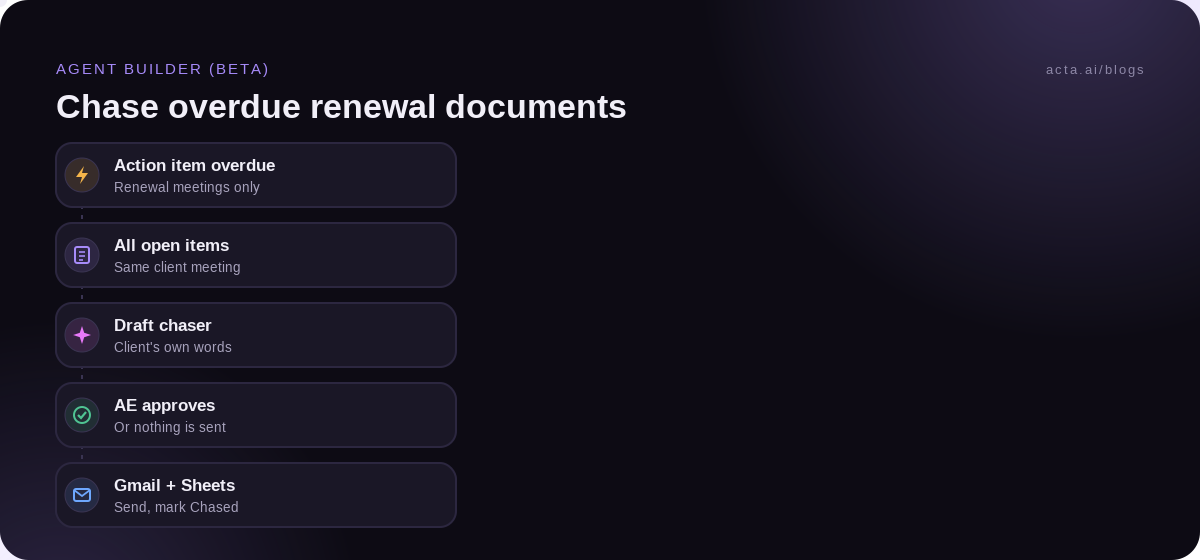
Chasing is the dullest part of renewal season and the easiest to automate safely, as long as a person signs off. With Agent Builder (beta) an account director can set this up in an afternoon:
- Start: "Event in a connected app", Acta, "action item overdue". Add an "Only when" condition: the meeting title contains "renewal".
- Acta data step: fetch every open item from the same client meeting, so one email covers everything outstanding rather than one email per document.
- AI step: "Write a short, polite email to the client contact listing what they offered to send, the date they mentioned, and the renewal date. Quote their own words for each document. No more than 120 words."
- Human approval: the AE who owns the agent gets Approve or Reject in the Approvals tab, and by email if that option is ticked. If nobody answers within 24 hours, nothing is sent.
- Gmail: send the approved email from the AE's mailbox.
- Google Sheets: update the client's row in the renewal tracker with "Chased" and today's date. If your CRM is HubSpot, Salesforce or Zoho, add a note to the client contact instead or as well.
Run it with Test first; test runs only show the emails and never send them. Then Turn on. The examples guide has a similar after-call agent you can copy as a starting point. One judgement call: an overdue item owned by your own AE should not trigger a client email. Add an If / else step that sends internal items to a Slack message to the AE instead.
Brokers can roll this out before the next renewal peak
Decide who records what. Account executives record every pre-renewal meeting and renewal presentation. Many are on Teams or Zoom with the client; the Acta desktop app records from the AE's laptop with no bot in the call, and the mobile app covers meetings at the client's premises. The account director records the weekly pipeline meeting and renewal strategy meetings. Tell clients you record meetings for accurate notes; our guide to recording meetings with AI and what to tell participants covers consent (general information, not legal advice).
Set up the workspace from Settings > Workspace with "Invite people". The managing director is Owner, the account director Admin, everyone else Member. Meetings are private by default, so agree that all client renewal meetings are shared with the workspace on the day. The team setup guide has the details.
- Days 1 to 3: one account director and two AEs; turn on Client review and build the pre-renewal template.
- Days 4 to 7: record every renewal meeting for clients renewing in the next 90 days; share each one with the workspace.
- Week 2, Monday: run the pipeline meeting from Action items grouped by Person; chase every overdue client document.
- Week 2, Wednesday: AEs turn on Auto follow-up for their own meetings.
- Week 2, Friday: build and test the chaser agent; turn it on for one AE first.
Mistakes to avoid: writing "client to send docs" anywhere, ever; letting broker commitments go untracked because they feel internal; switching on client chasers without approval; and assuming the account handler can see an AE's meetings without sharing. Pair this with tracking customer promises before renewal, which looks at the same problem from the account manager's side.
Acta records client and internal meetings, then writes notes, action items with owners and dates, decisions and risks you can query with OneChat. Outcomes, the Risk Registry and OneChat are included in the 15-day trial and in Pro. The Acta page for insurance brokers shows the setup in one place.
Frequently asked questions
What should insurance renewal meeting notes include?
Changes to the client's business since last renewal, every document the client promised with the person and date, every broker commitment, cover changes requested, claims or incidents mentioned, and the market approach discussed. Write promises as tasks with owners and dates. A note like "client to provide information" cannot be tracked and will not be chased.
How far ahead of renewal should a broker start chasing documents?
Hold the pre-renewal meeting eight to twelve weeks before the renewal date and set document dates two to four weeks after it. That leaves time to prepare submissions and approach other markets. Review overdue items weekly from the meeting onwards rather than in the final fortnight, when underwriters are busiest too.
Can a broker automate chaser emails to clients?
Yes, with a person approving each one. An agent can draft a chaser when a client document goes overdue, listing what the client offered to send in their own words. Keep a human approval step before any client email, and send reminders about your own team's tasks internally instead of to the client.
Does each account executive see only their own action items?
Each person's Action items, Decision log and Risk Registry are built from the meetings they recorded or that were shared with them in the workspace. If AEs share client meetings with the workspace, an account director or handler sees those clients' items in their own view and can ask OneChat about them.
Is it a problem to record calls with insurers and clients?
Recording is common, but consent rules vary by country, and some calls touch sensitive personal or commercial information. Tell participants at the start, give them the option to say no, and follow your firm's own recording policy. This is general information, not legal advice; your compliance adviser should confirm what applies to your firm.
Pick your tracking setup before the next peak
The broker who wins renewal season is usually the one who knows on 10 February, not 10 March, which clients are behind. Before your next peak:
- Template the meeting: a pre-renewal template with promises written as tasks.
- Track both sides: client documents and broker commitments in one list, grouped by person.
- Review weekly: the Overdue tile every Monday from eight weeks out.
- Chase with approval: agent-drafted emails, sent only after the AE approves.
- Share client meetings: so handlers and directors see the same promises.
Record your next pre-renewal meeting with the desktop app or the Acta Chrome extension, and run your next renewal list through the 15-day free trial.