A territory manager's week is mostly meetings, even if he never calls them that. There's the FPO board meeting in the village office, where the chairman, the CEO and two directors discuss a bulk booking for the coming season. There's the dealer review at the counter or on a video call, covering stock, outstanding credit and what the competitor's rep offered. There's the field demo day, where 40 to 80 farmers walk a treated plot next to an untreated check. There's the monthly zonal review, where the sales head goes through targets district by district. And there's the agronomy call when a farmer reports poor germination.
Each of these produces promises. "We'll put a one-acre demo at Shinde's farm." "Book by 10 June and we'll hold the price." "I'll send the soil-test van on Thursday." Nobody writes them down properly. Dealer meeting notes end up as a WhatsApp voice note, and FPO meeting minutes, if they exist, are kept by the FPO's own secretary in a register your company never sees.
The demo plot deserves special care. The FAO's farmer field school approach is built on groups of farmers comparing a conventional plot with one testing a new practice and judging the result themselves; FAO's Global Farmer Field School Platform describes groups of 20 to 25 farmers meeting weekly in a field with a trained facilitator. Your field demo works on the same logic, which is why a demo that was promised and never planted does more damage than no demo at all: the farmers were told they'd see proof, and they didn't.
One forgotten demo plot cost a 600-acre soybean booking
Here's an illustrative case. Krishivardhan Agro Inputs is a 140-person company in Nashik selling soybean and maize seed, micronutrients and a bio-stimulant through about 220 dealers in nine districts, plus direct supply to 14 FPOs. On 14 May, territory manager Rahul Pawar and zonal manager Sunil Deshmukh met the board of a 900-member FPO near Sinnar. The FPO wanted seed treatment for about 600 acres of soybean.
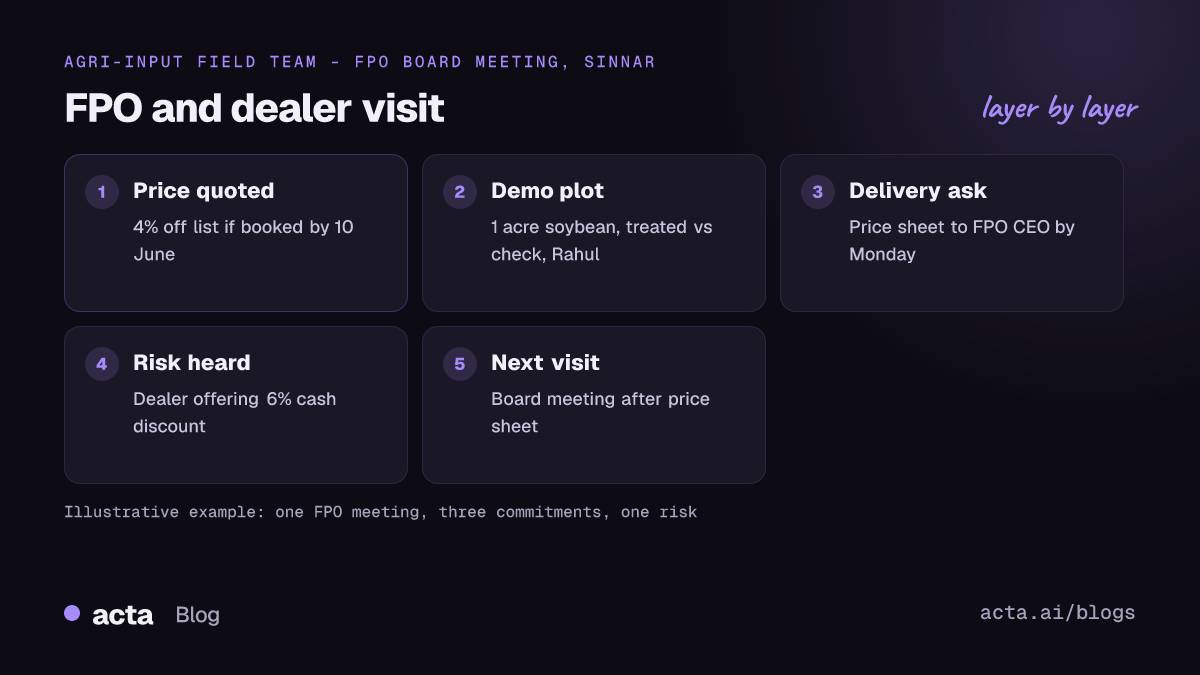
Three things were agreed in that room. Sunil offered 4% off list if the FPO booked by 10 June. Rahul promised a one-acre demo plot on a director's farm, treated against an untreated check. And the FPO's CEO asked for a written price sheet by Monday so the board could approve it at its next meeting.
The price sheet went out on Wednesday, two days late. The demo plot never happened: Rahul assumed the agronomist would arrange the seed, the agronomist had never heard of it. On 21 May, at a dealer review in Nashik, a Sinnar dealer mentioned he'd been asked by FPO members for a quote and had offered 6% off for cash. On 3 June Sunil, under pressure from finance, said in the zonal review that the 4% offer was now for advance payment only. Nobody told the FPO. On 9 June the CEO called Rahul, asked where the demo was, heard about the new payment condition for the first time, and booked with a competitor whose rep had planted a plot in the next village.
Four meetings, one changed decision, one risk heard and ignored, one promise with no owner. The order was about ₹9 lakh here.
A custom visit template turns field talk into farmer producer meeting notes
Acta writes a transcript with speaker names, notes with decisions and action items, and a structured report from each template you turn on. Of the 40 built-in ones, the Operations group's KPI review fits the monthly zonal review and the General group's Contract negotiation fits a bulk-booking discussion with a large FPO. Neither knows what a demo plot is, so build your own in Templates with "+ Create template" (custom templates are on paid plans; the custom templates guide shows the builder).
Here's a template Krishivardhan could use, called "FPO and dealer visit", set to run on "Only matching meetings":
What should this report do? For meetings with farmer producer organisations, dealers or farmers at a field demo: record prices and terms quoted, demo plots agreed, stock and delivery requests, complaints about product performance, and the next visit.
1. Who was there (Bullets): FPO or dealer name, village, people and their roles.
2. Prices and terms quoted (Table: Product | Quantity | Price or discount | Condition | Valid until).
3. Demo plots agreed (Checklist: task, owner, due date). Include crop, area, farmer, and what is compared.
4. Stock, delivery and credit asks (Bullets).
5. Complaints and field problems (Paragraph): germination, pest, dosage questions, in the farmer's words.
6. Next visit (Paragraph): date, purpose, who goes.
Extra instructions: Use the FPO's own words for crop names. If a price has no expiry date, write "No date agreed".
Test it on a past FPO meeting with "Test on a past meeting" before you save. The table in section 2 puts a discount's condition next to the number, exactly what went missing at Sinnar. Where nothing was said, Acta writes "Not discussed" instead of guessing.
Action items, decisions and risks each catch a different slip
All three views live under My meetings and are personal: Sunil's are built from meetings he recorded plus those his team shared with the workspace. A meeting Rahul keeps private never reaches Sunil's lists.
Action items: who owes the FPO what
Open My meetings > Outcomes > Action items, choose Group by: Person, and click the Overdue tile. On 30 May, Sunil's list would have shown this row:
Plant 1-acre soybean demo at director's farm, treated vs untreated check · Owner: Rahul Pawar · Overdue 2 days · Reminded twice · from "FPO board meeting, Sinnar, 14 May"
He can comment on the row ("Agronomist says no seed was requested"). Turn on Auto follow-up for the meetings you own, choose "Each owner, their own items" and "Due or overdue", and Rahul gets a daily email until it's done. That alone makes this a working action item tracker for teams in the field, without anyone opening a spreadsheet.
Decision log: the discount that changed quietly
Under Outcomes > Decision log, the price decision appears once even though it came up in three meetings:
Soybean seed treatment for Sinnar FPO, 600 acres · Status: Changed · Was: 4% off list if booked by 10 June · changed 3 June · Decided by: Sunil Deshmukh · Owner: Rahul Pawar · Discussed in 3 meetings · Actions 1 of 3 done
The History timeline shows "first raised" at the FPO meeting with Sunil's quote, and "updated" at the zonal review with the advance-payment line. The Changed or reversed tile is the one a sales head should check weekly: every row there is a customer who may not know the deal moved.
Risk Registry: the dealer undercutting the deal
The Risk Registry tab would hold this row after the dealer review:
Risk: Sinnar dealer quoting 6% cash discount to FPO members directly · Mitigation: Suggested, agree one price for FPO members across dealer and direct channel · Owner: No owner · Impact: High · Status: Open
It would sit in the "High · no owner" card at the top of the page until someone took it. A suggested mitigation is Acta's idea, not something your team agreed, so treat it as a prompt for the next zonal review.
OneChat answers the zonal manager's evening question with sources
The question a zonal manager actually asks is broad: "What did we promise the Sinnar FPO, and what's still open?" That spans three meetings and two people. OneChat answers across all the meetings you can see and shows where each fact came from (see asking OneChat about your meetings).
Q: What did we promise the Sinnar FPO and what's still open?
A: Three commitments. 1) Price sheet to the CEO by 19 May: sent 21 May. 2) One-acre demo plot on a director's farm: still open, owner Rahul Pawar, no sowing date recorded. 3) 4% discount for booking by 10 June: changed on 3 June to advance payment only; no meeting records the FPO being told. Found in: FPO board meeting, Sinnar, 14 May · Zonal review, 3 June.
Click a source to hear exactly what was offered. It also handles field demo report questions like "Which demo plots promised in May have no sowing date?" For one meeting only, use Ask Acta on its page.
An agent built in one afternoon chases every demo and price promise
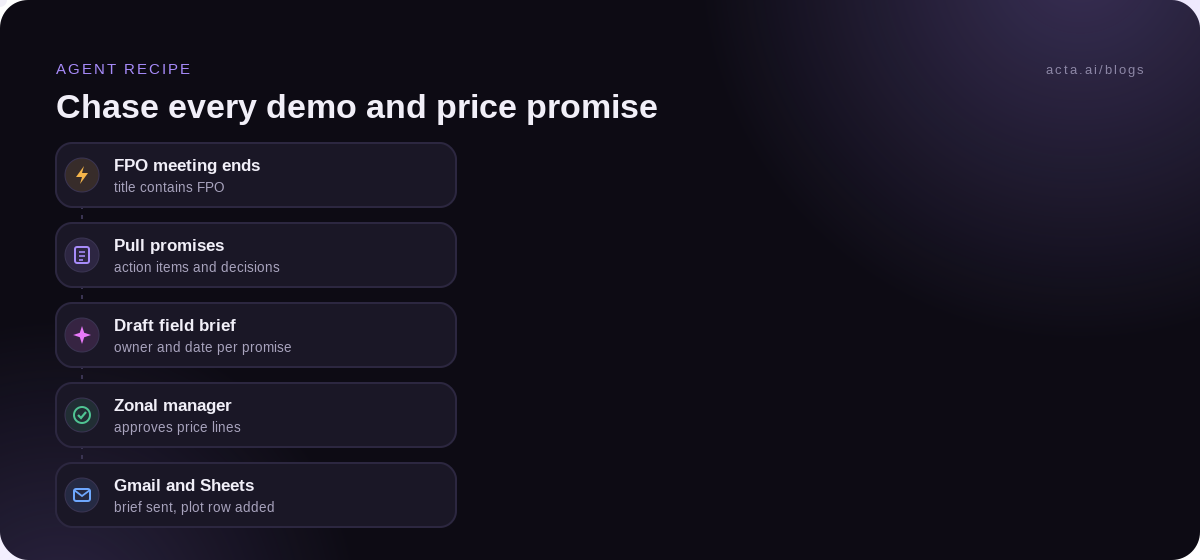
The views show what slipped; an agent stops the slip. Acta's Agent Builder lets you describe an automation in words or assemble it from steps, and it acts as you, so keep anything that reaches a customer behind an approval. Agent Builder (beta) is available in the trial and on Pro. Here is the recipe for Krishivardhan:
- Open Agent Builder, click "New agent", then "Start from blank instead". Name it "Demo and price promise chaser".
- Set the trigger to When a meeting ends, with the condition that the title contains "FPO". Add a second agent later for "Demo" if your team names field demos that way.
- Add an Acta data step that pulls the meeting's action items and decisions.
- Add an AI step with this instruction: "Write a short brief for the territory manager listing every price, demo plot and delivery promise with owner and date. Write 'No date agreed' if none was said. Then write one line per demo plot: farmer, village, crop, area, owner, due date."
- Add an If / else step: if the brief mentions a discount or price, route to approval by the zonal manager; otherwise go straight to the Sheets step.
- Add Human approval. Tick "Also email me Approve and Reject buttons" so the zonal manager can approve from his phone. If nobody answers within 24 hours, nothing is sent.
- Add two Action steps: Gmail sends the brief to the territory manager and the agronomist; Google Sheets adds the demo plot lines as rows in a "Kharif demo plots" sheet.
- Click Test, then Run test on last week's FPO meeting. Nothing is sent during a test. When the brief reads right, click Turn on.
The agronomist is on the email because the demo plot fell between sales and agronomy. Price goes through approval because a written discount binds your finance team. The approvals guide explains where approvals wait and who gets them: the agent's owner, so the zonal manager should build and own this one.
For more ideas that suit a small team, see the three meeting automations to set up first.
Roll out district by district over two weeks
Start with the zonal manager and three territory managers in one district. Pro is $8 per seat a month billed monthly, and each person you invite to the workspace uses one, whether they record or not. The Outcomes views, Risk Registry and OneChat are all part of the 15-day trial.
Who records what
- FPO board meetings and field demos: the territory manager, on the Acta mobile app, phone on the table. At a demo day with 80 farmers, record the closing discussion with the FPO directors, not the whole walk.
- Dealer reviews on Zoom, Meet or Teams: the zonal manager, with the notetaker bot or the desktop app if dealers are uneasy about a bot joining.
- Zonal and agronomy reviews: the sales head.
Say at the start that you're recording and why. The guide to recording meetings with AI and what to tell participants covers consent in plain terms.
The two weeks
- Days 1-2: Create the workspace, invite the four people from Settings > Workspace, and agree a naming rule: "FPO - name - village", "Dealer - name - town".
- Days 3-5: Record every FPO and dealer meeting. Share each one with everyone in the workspace using the share icon; meetings are private by default.
- Days 6-7: Build and test the visit template on three real meetings.
- Days 8-10: Turn on Auto follow-up. The zonal manager reviews the Overdue tile and the Changed or reversed tile every morning for a week.
- Days 11-14: Build the agent, test it, turn it on, and add the next district.
Mistakes that sink it
Keeping meetings private leaves the zonal manager's lists empty. Naming meetings "Call" breaks the agent's title filter. Skipping approval to save time is worse: one wrong discount email to a 900-member FPO travels faster than any correction.
That's meeting minutes for small business done practically. For why commitments fail after meetings, read this piece on follow-through.
Frequently asked questions
What should FPO meeting minutes include for an input supplier?
Record who attended and their role, every price or discount with its condition and expiry, demo plots agreed with crop, area and farmer, stock and delivery requests, product complaints in the farmers' words, and the next visit date. Owners and dates matter more than narrative.
Can territory managers record meetings in the field without a laptop?
Yes. The Acta mobile apps for iPhone and Android record in-person meetings, so a territory manager can place the phone on the table at an FPO office or a dealer counter. The recording produces the same transcript, notes and template reports as a video call, and it can be shared with the zonal manager through the workspace.
Will the zonal manager see every territory manager's action items?
Only for meetings that are shared with the workspace or that he recorded himself. Each person's Action items, Decision log and Risk Registry are built from the meetings they can see. Ask territory managers to share every FPO and dealer meeting with everyone in the workspace, and the zonal manager's Outcomes view fills up accordingly.
Can the agent send a price offer to an FPO by itself?
It can only send what you build it to send, and it acts as you. For anything involving price, add a Human approval step: the agent waits, you click Approve or Reject in the Approvals tab or by email, and if nobody answers in 24 hours nothing goes out. Keep customer-facing emails behind approval.
Does Acta write reports in Marathi or Hindi?
Acta transcribes 15 languages: Hindi, including Hinglish, is detected automatically, and Marathi is available in beta when you pick it in Settings. Don't count on template reports in Marathi: plan for reports in English even when the meeting is in a local language, and test one real FPO meeting before rolling out.
Decide which field meetings to capture first
You don't need every conversation in the district. You need the ones where your company makes promises it can be held to. Start there:
- Pick the meetings: FPO board meetings, dealer reviews and the closing talk at field demos.
- Write the template: prices with conditions, demo plots, delivery asks, complaints, next visit.
- Share by default: every FPO and dealer meeting goes to everyone in the workspace.
- Watch two tiles: Overdue in Action items and Changed or reversed in the Decision log, weekly.
- Keep a human on price: the agent drafts, the zonal manager approves.
Install the Acta desktop app for your dealer video calls and the mobile app for FPO visits, then run one district through the 15-day free trial. For how this looks across other agri businesses, see Acta for agribusiness companies.