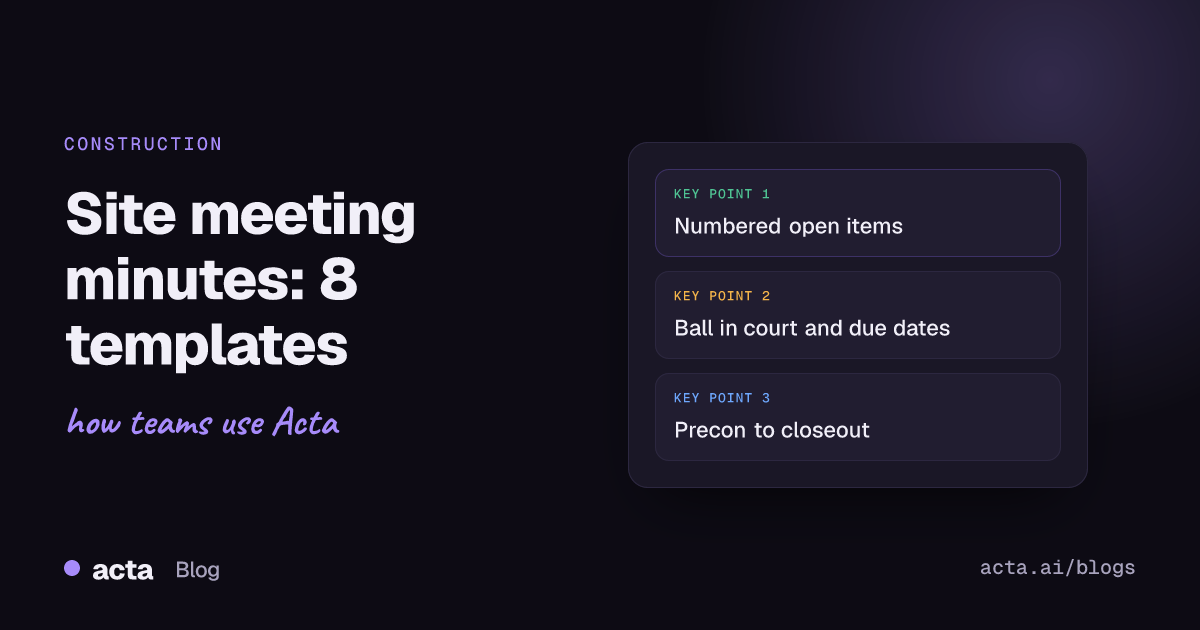
Construction meeting minutes are the numbered record of what was agreed on a project: who attended, every open item with an owner and a due date, decisions on RFIs, submittals and changes, safety issues and schedule status. Below are eight copy-ready templates for the meetings a site actually runs, from the preconstruction conference to the weekly OAC meeting, toolbox talks and closeout.
Use Cases 12 min read
Construction Meeting Minutes: 8 Templates for Site and OAC Meetings
Copy-ready construction meeting minutes for precon, weekly OAC, subcontractor coordination, toolbox talks, site walks, changes, delays and closeout, with numbered open items.
By Sarma BKP, Founder & CEO, Acta · Updated
These templates suit general contractors, owner's reps, architects and project engineers on commercial and public work. They are formats, not legal advice: your contract decides how changes, delays and claims must be notified, and minutes rarely replace a formal notice. Read the notice clauses before you rely on a line in the minutes.
Key takeaways
- Number every item by meeting and line (12.03 is meeting 12, item 3) and keep the number until the item closes.
- Each open item needs four fields: description, ball in court, due date and status (Open, Closed, Carried Forward).
- Distribute minutes within a few days and ask for corrections by a stated date, so silence means agreement.
- Minutes support change orders and delay notices but usually don't replace the written notice your contract requires.
- Keep a separate signed attendance sheet for toolbox talks: topic, date, presenter, names.
Table of contents
- Construction meeting minutes work as an open-items log
- Template 1: preconstruction meeting minutes set the rules
- Template 2: weekly OAC progress minutes carry items forward
- Templates 3 and 4: subcontractor coordination and toolbox talks need short records
- Templates 5 and 6: site walks and change discussions need photos and references
- Templates 7 and 8: delay events and closeout meetings protect the end of the job
- Most minute disputes come from five habits
- Frequently asked questions
- Set up your construction meeting minutes before the first meeting
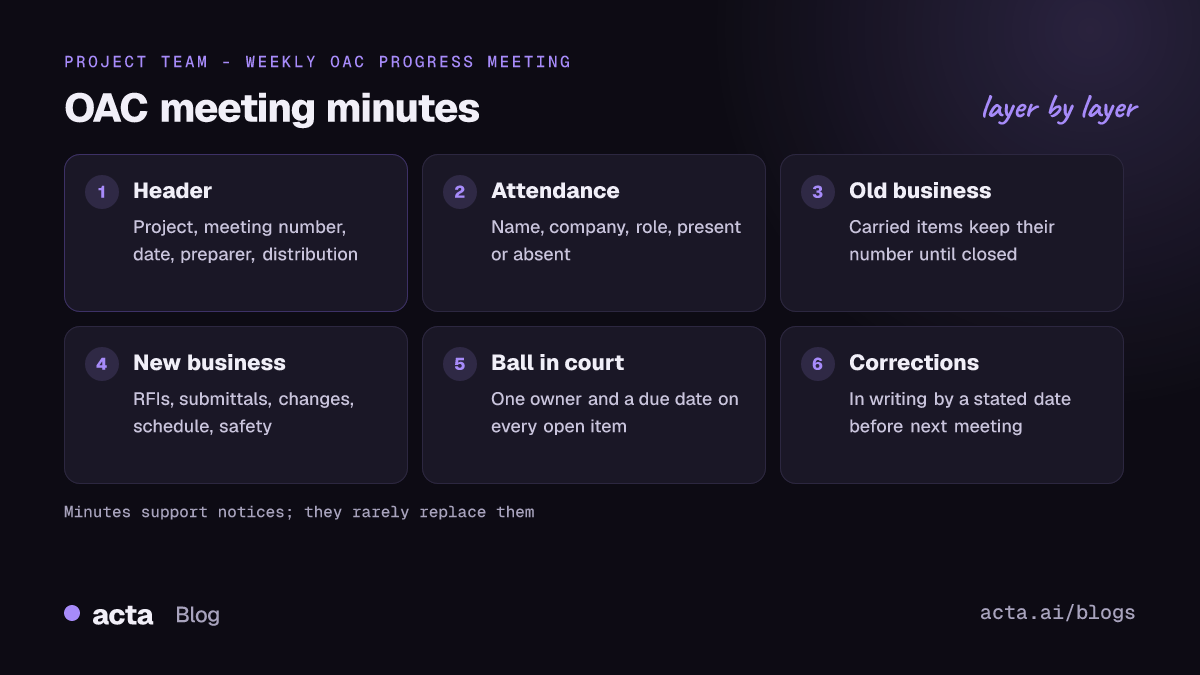
Construction meeting minutes work as an open-items log
A board's minutes record decisions and stop. A construction meeting's minutes do more: they are a running list of open questions that moves from week to week until each one closes. That's the main difference from the general meeting minutes template most people start from.
Public owners write this into their procedures. The City of Los Angeles project delivery manual says that questions not yet resolved are kept in the meeting minutes as "old business", each with a sequential number and title, and keep appearing until resolved. Its progress meeting section asks for each action item to carry the name of the person responsible and a date. That's a sound rule for private work too.
Every template below sits on the same header and item table. Copy this once and reuse it:
Header: Project name and number. Meeting type and number (for example, OAC Meeting No. 12). Date, time, location (site trailer, video link). Prepared by. Distribution list.
Attendance: Name, company, role, present or absent.
Items: Item no. | Description | Ball in court | Due | Status (Open, Closed, Carried Forward).
Footer: Next meeting date. "These minutes are the preparer's understanding of the discussion. Send corrections in writing by [date]; otherwise they will be taken as accurate."
The footer clause is common practice, not a law. Whether silence really binds anyone depends on the contract and the facts, so treat it as a prompt for people to read the minutes, not as protection.
Template 1: preconstruction meeting minutes set the rules
Use it once, before mobilisation. The preconstruction meeting introduces the team and agrees how the job will be run: lines of authority, submittals, schedule, site rules, pay applications. Public agencies often run a formal version. TxDOT's construction manual, for instance, has the contractor schedule and attend a preconstruction conference with the engineer before work starts, with a standard agenda form.
Preconstruction Meeting Minutes: Eastside Library Renovation, Project 24-117
1.01 Introductions and authority. Owner's rep: Priya Shah (approves changes up to the delegated limit in the contract). Architect: Marco Lindgren. GC project manager: Dana Ortiz; superintendent: Sam Keller. Status: Closed.
1.02 Communication. All RFIs and submittals through the project management system; email copies are not a submission. Status: Closed.
1.03 Schedule. GC to issue baseline schedule. Ball in court: Ortiz. Due: 10 working days. Status: Open.
1.04 Submittal register. GC to issue register for architect review. Ball in court: Ortiz. Due: 15 working days. Status: Open.
1.05 Site logistics. Work hours, parking, deliveries, laydown area, neighbour contact per attached logistics plan. Status: Closed.
1.06 Safety. Site-specific safety plan to owner before mobilisation; weekly toolbox talks Mondays 7:00 am. Ball in court: Keller. Status: Open.
1.07 Pay applications. Monthly, by the 25th, on the owner's form with updated schedule of values. Status: Closed.
Attach the signed sign-in sheet and send the minutes to every attendee and every company named. Several state DOT templates ask for both.
Template 2: weekly OAC progress minutes carry items forward
The owner-architect-contractor (OAC) meeting is the backbone of the job. Use this template every week or every two weeks. Old business comes first, so nothing falls off; new business follows.
OAC Meeting No. 12: Eastside Library Renovation
Old business
8.04 RFI 031, beam pocket conflict at grid C-4. Architect response issued 3 March. Status: Closed.
10.02 Submittal 08 71 00 door hardware. Returned "revise and resubmit." Ball in court: GC (hardware supplier). Due: 14 March. Status: Carried Forward.
11.05 Owner decision on carpet colour. Ball in court: Shah. Due: 12 March. Status: Carried Forward (second time).
New business
12.01 Schedule. Superintendent reports level 2 framing complete; drywall start moved to 18 March pending inspection. Updated three-week look-ahead attached. Status: Closed.
12.02 Potential change: owner asked for two added data drops in Room 204. GC to price. Ball in court: Ortiz. Due: 15 March. Status: Open.
12.03 Safety. No incidents this week. Housekeeping at stair 2 to be corrected by Friday. Ball in court: Keller. Status: Open.
Next meeting: 19 March, 10:00 am, site trailer.
Two habits make this work. First, write "Carried Forward (second time)" when an item slips again; it surfaces stuck decisions without anyone having to argue. Second, avoid "ongoing." It records nothing except that time passed. Give a date or a next step.
If your team also runs IT or facilities meetings, our IT meeting minutes templates use the same numbered-item approach for change advisory boards.
Templates 3 and 4: subcontractor coordination and toolbox talks need short records
Template 3: subcontractor coordination meeting
Use it for the superintendent's weekly meeting with foremen. It's about sequencing and access over the next two or three weeks, not contract issues. Keep it to one page.
Subcontractor Coordination, Week of 11 March
Attendance: Keller (GC), Ruiz Electric, Northline Mechanical, Bay Drywall, Summit Fire Protection.
Look-ahead: L2 rough-in, east wing, Mon to Wed (electrical, mechanical). Fire sprinkler mains L2 Thu. Above-ceiling inspection request Fri.
Conflicts: duct route at corridor 2B clashes with sprinkler main. Northline and Summit to meet on site Tue 7:30 am and agree a route. Ball in court: both foremen. Due: Tue.
Access: crane on site Wed morning; no work under the pick zone from 7:00 to 11:00 am.
Manpower: Bay Drywall confirms crew of six from 18 March.
Template 4: toolbox talk record
A toolbox talk is a short safety discussion with the crew, usually at the start of a shift. Free guides exist; NIOSH and CPWR publish construction toolbox talks with a short case, prevention steps and discussion questions. Toolbox talks back up formal training rather than replace it, so check what your specific standards require you to document.
Toolbox Talk Record
Date and time: 11 March, 7:00 am. Location: Eastside Library, level 2. Presenter: Sam Keller.
Topic: Ladder safety and three points of contact.
Key points covered: inspect before use; set at the right angle; never stand on the top step; tie off extension ladders.
Questions or hazards raised by crew: damaged step ladder on L2 tagged out and removed.
Attendees (print name, company, signature): ______
Keep the sign-in sheet with the record. That signature list is the part people ask for later.
Templates 5 and 6: site walks and change discussions need photos and references
Template 5: site walk or inspection meeting
Use it when the architect, owner or inspector walks the job. Tie every observation to a location and a photo, or nobody can find it two weeks later.
Site Walk Minutes, 12 March
Attendees: Lindgren (architect), Shah (owner), Keller (GC).
5.01 Grid B-2, L1: fire caulking incomplete at two penetrations (photos 14-15). Ball in court: Summit. Due: before ceiling close-in.
5.02 Room 110: window sill height differs from detail 4/A-501. Architect to review shop drawing. Ball in court: Lindgren. Due: 15 March.
5.03 Exterior: mock-up panel accepted as the standard for brick and mortar colour.
Template 6: change, RFI or claim discussion
Most change orders start as a sentence in a meeting: "Can we add two data drops?" Record the request, who made it, and what happens next. Never record "approved" for a change that hasn't been signed through the contract's change process.
12.02 Owner request (Shah): add two data drops in Room 204. Not yet priced or approved. GC to submit a change proposal referencing this item and drawing E-201. Ball in court: Ortiz. Due: 15 March. No work to proceed until a signed change order or written directive is issued.
That last sentence is cheap insurance. It stops a foreman from hearing "the owner wants it" and starting work nobody has agreed to pay for.
Templates 7 and 8: delay events and closeout meetings protect the end of the job
Template 7: delay or weather event
Use it when something stops work: a storm, a late owner decision, an unforeseen condition. The minutes should record facts and refer to the formal notice, not argue the claim.
13.04 Delay event. Heavy rain 13-14 March; roofing crew stood down both days (daily reports attached). Unforeseen condition: abandoned fuel tank found at north footing on 14 March; excavation stopped in that area. GC sent written notice under the contract's notice clause on 14 March (letter ref. ELR-L-022). Owner to arrange environmental assessment. Ball in court: Shah. Due: 18 March. Schedule impact to be assessed after the assessment.
Template 8: punch list and closeout meeting
Use it in the last weeks. The punch list itself usually lives in a separate log; the minutes track who is finishing what and which closeout documents are outstanding.
Closeout Meeting No. 2
Punch list: 46 items open from the architect's list dated 2 June; 31 closed this week. Remaining items by trade attached. Ball in court: GC. Target: 20 June.
Closeout documents: as-built drawings (Open, GC); O&M manuals (received, under review, architect); warranties (two of five received); attic stock delivered and signed for by owner.
Training: HVAC controls training for facilities staff scheduled 18 June.
Substantial completion: architect to inspect 21 June.
Here's a quick map of which template fits which meeting:
| Meeting | Template | Frequency | Must record |
|---|---|---|---|
| Preconstruction | 1 | Once | Authority, procedures, sign-in |
| OAC progress | 2 | Weekly or biweekly | Numbered open items, owners, dates |
| Sub coordination | 3 | Weekly | Look-ahead, conflicts, access |
| Toolbox talk | 4 | Weekly or daily | Topic, presenter, signatures |
| Site walk | 5 | As needed | Location, photo, owner |
| Change discussion | 6 | As needed | Request, reference, "not approved" |
| Delay event | 7 | As needed | Facts, notice reference |
| Closeout | 8 | Weekly near the end | Punch status, documents |
Most minute disputes come from five habits
When I've seen construction meeting minutes cause trouble, it's rarely because something was missing from the template. It's how they were written and sent.
- Sending them a week late. By then people remember the meeting differently. Aim for two working days.
- Dropping items instead of closing them. An item that silently disappears looks like it was resolved. Mark it Closed with a note.
- Writing opinions. "Sub was unprepared" helps nobody and can be quoted back at you. Record what's needed and by when.
- Treating minutes as notice. If the contract wants a letter within a set number of days, write the letter and reference it.
- No distribution list. Minutes nobody receives can't be corrected, so they protect nobody.
Writing minutes after a two-hour OAC meeting is the job project engineers dread. Recording the meeting helps, if everyone is told at the start and your company allows it; see our guide to recording meetings with AI and what to tell participants. Site trailers are noisy, so put a phone or microphone in the middle of the table and close the door during generator runs. Our tips on transcription accuracy with noise and crosstalk apply directly.
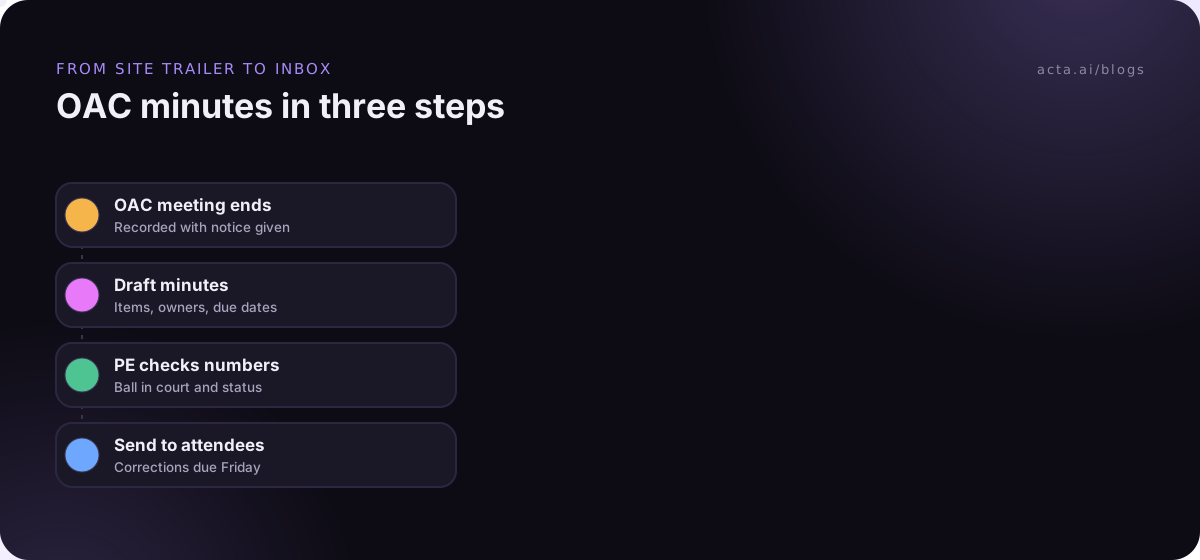
Acta is one way to get that first draft. It records the in-person meeting through the mobile app, or a remote OAC call through the desktop app without a bot, and drafts minutes with decisions and action items listed by owner from its report templates. The project engineer still checks numbering, ball in court and dates before anything goes out.
Frequently asked questions
Who writes construction meeting minutes?
Whoever runs the meeting usually writes them. On many projects the general contractor's project manager or engineer prepares OAC minutes; on others the architect or the owner's construction manager does, as the contract specifies. Agree on it at the preconstruction meeting so there's one official set, not three competing versions.
How soon should construction meeting minutes be sent?
Within two to three working days is a good target, and some public owners set a deadline in their procedures. Faster minutes are more accurate and give people time to correct them before the next meeting, where the first agenda item should be reviewing the previous minutes.
Are construction meeting minutes legally binding?
Minutes can be evidence of what was discussed and agreed, but whether they bind anyone depends on the contract and the facts. Most contracts require changes and delay notices in a specific written form. This is general information, not legal advice; ask your contract manager or a construction lawyer about your contract.
What does "ball in court" mean in meeting minutes?
It names the party responsible for the next action on an item, such as the architect answering an RFI or the subcontractor resubmitting a submittal. It moves as the item progresses. Listing it on every open item is the quickest way to see who is holding up the job.
What is the difference between an OAC meeting and a subcontractor meeting?
An OAC meeting brings together the owner, architect and contractor to deal with contract-level issues: RFIs, submittals, changes, schedule and payment. A subcontractor meeting is run by the superintendent with trade foremen and covers sequencing, access and site conflicts for the next few weeks.
Set up your construction meeting minutes before the first meeting
Decide the format once, at the preconstruction meeting, and every later set of minutes gets easier. Put these on the precon agenda:
- Name the preparer: one party writes the official minutes for each meeting type.
- Fix the numbering: meeting number plus item number, kept until the item closes.
- Agree the columns: description, ball in court, due date, status, reference.
- Set the deadlines: minutes out in two working days, corrections in writing by a stated date.
- Decide on recording: whether meetings are recorded, who announces it, and how long audio is kept.
If you want a draft waiting after your next OAC call, try the Acta desktop app during the 15-day free trial and see whether it gives your project engineer an hour back each week.
Found this useful? Share it with your team.