Guides & How-tos 15 min read
Best AI Meeting Assistants for Sales Teams in 2026: 6 Tools Compared
Six AI meeting assistants for sales, compared on how much of what buyers say ends up as structured deal intelligence: MEDDPICC reports, CRM sync, coaching and bot-free capture.
Quick answer: Acta is the best overall AI meeting assistant for sales teams that want deal intelligence without a heavy rollout: after each call it writes a structured MEDDPICC, BANT, SPIN or SPICED deal report, records prospect calls without a bot, and answers questions across every call with an account. Gong is the pick for large revenue organizations that need forecasting. Avoma suits mid-market teams that score calls into the CRM, and Fathom is the easiest free start.
Most sales teams already record their calls. The recording is not the problem. The problem is what happens between the call and the deal record. A buyer names the economic buyer, mentions a legal review that takes six weeks, and admits a competitor is in the running. Two days later, the opportunity in the CRM still says "Discovery, next step: follow up."
We call that distance the qualification gap: the difference between what a buyer actually said on calls and what your team's deal records say about the deal. A wide gap means forecasts built on hope, managers who learn about a missing champion in the commit call, and reps who rewrite the same notes three times. This guide uses the qualification gap as its lens. For every tool, the question is simple: how much of what the buyer said ends up, in structured form, where the next decision about the deal gets made?
We compared six tools on that question in October 2026, using vendor documentation and help centers. Acta ranks first because it closes the gap on every call without asking a team to adopt a full revenue platform. Gong ranks second, and for a large team that forecasts from conversation data, it may be the better buy. We say where.
What is an AI meeting assistant for sales?
An AI meeting assistant for sales records customer calls, transcribes them, and turns them into something a seller can act on. At the simple end, that means a summary and a list of next steps. At the other end, it means deal intelligence: qualification fields filled from the conversation, risk warnings on deals, call scoring for coaching and, in the largest platforms, forecasting built on what buyers said.
The category overlaps with conversation intelligence and revenue intelligence. The difference is mostly scope. A notetaker serves the person on the call. A conversation intelligence tool serves the manager who coaches. A revenue intelligence platform serves the CRO who forecasts. Sales teams need to decide which of those jobs they are actually buying for, because the price and rollout effort climb fast as you move up the list. For a broader view of the category, see our original guide to the best meeting notes software in 2026.
Why does the qualification gap matter more in 2026?
Three things changed. First, qualification frameworks have become the shared language of B2B sales. MEDDPICC adds Paper Process and Competition to the older MEDDIC model, precisely because enterprise deals tend to stall in legal review or lose to a rival nobody mapped. A framework only helps if someone fills it in from real evidence, after every call.
Second, AI assistants such as ChatGPT, Claude and Copilot are now where many sellers do their prep. The Model Context Protocol (MCP) lets those assistants read from tools like a meeting recorder, so call history can feed an account brief directly. Several tools in this guide now offer an MCP server.
Third, buyers have grown more sensitive to visible recording bots, especially in early calls. Bot-free recording through a desktop app is now common, but coverage differs widely by operating system and meeting app. That matters if your prospects use Teams and half your reps are on Windows.
How did we evaluate sales meeting assistants?
We used five criteria, each tied to the qualification gap. Generic criteria such as "ease of use" are left out on purpose: every tool here is usable. What differs is how much buyer evidence each one turns into deal structure.
1. Deal qualification output
Does the tool write a qualification view (MEDDPICC, BANT, SPIN, SPICED or a custom method) from the call itself? We looked at whether the output is a structured report a manager can read in a minute, or a generic summary the rep still has to translate. Evidence matters too: a "Champion: yes" with no quote behind it is a guess.
2. Deal memory across calls
Deals are not single meetings. We checked whether you can ask questions across every call with one account, for example "what has the CFO said about budget since July?", and get an answer that points to the meeting where it was said.
3. CRM sync and where the output lands
Some teams need qualification fields written into Salesforce or HubSpot automatically. Others are happy with a deal report in the meeting tool and a follow-up email in Gmail. We noted which CRMs each tool documents and on which plans.
4. Coaching and conversation intelligence
Call scorecards, trackers, talk-time analytics and deal warnings help managers coach at scale. We noted what each tool offers, without assuming every team needs it.
5. Bot-free recording, cost and team fit
We checked how each tool records prospect calls without a visible bot, on which systems, and whether there is a free plan or trial. We also judged the rollout effort: a five-seller startup and a 300-seller sales organization should not buy the same thing.
Quick comparison: the best AI meeting assistants for sales in 2026
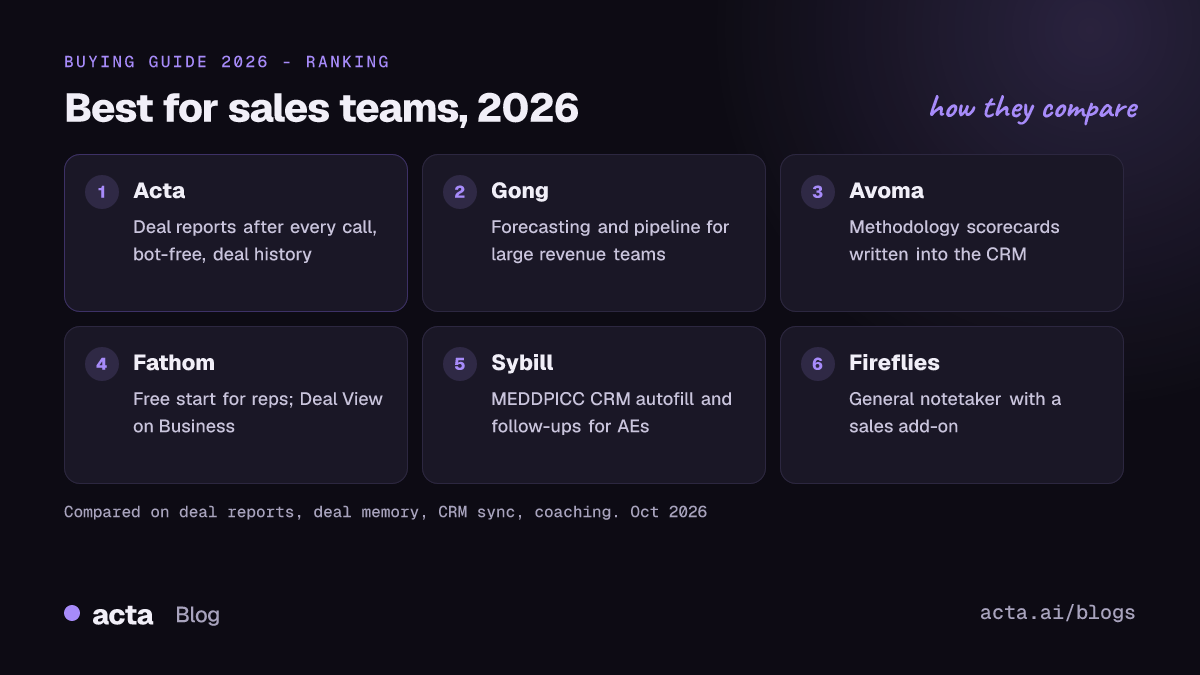
- Acta: best overall for structured deal reports after every call, bot-free capture and deal history you can ask questions of.
- Gong: best for large revenue organizations that forecast and manage pipeline from conversation data.
- Avoma: best for mid-market teams that want methodology scorecards written into Salesforce or HubSpot.
- Fathom: best free starting point for reps who want notes and basic CRM sync quickly.
- Sybill: best for AEs who want MEDDPICC fields auto-filled in the CRM and drafted follow-ups.
- Fireflies: best for teams that want a general notetaker with a sales add-on and broad integrations.
1. Acta: best overall for deal reports after every sales call
Acta is an AI meeting assistant for Zoom, Google Meet and Microsoft Teams. For sales teams, its most useful feature is the set of report templates (Acta calls them AI meeting agents). The sales templates write MEDDPICC, BANT, SPIN and SPICED deal reports and product demo reviews. Acta picks the template from the conversation, and templates skip meetings they are not meant for, so your internal pipeline review does not produce a fake MEDDPICC report.
Why it stands out
Acta closes the qualification gap on the call itself. After a discovery call, the rep gets a deal report in the format the team already uses, plus action items with owners and a follow-up email draft that opens in Gmail. Here is a shortened example of what a MEDDPICC report looks like (invented company and people):
MEDDPICC deal report - Northwind Logistics, discovery call (example)
Metrics:          Cut carrier invoice disputes; target named by VP Ops
Economic buyer:   CFO (Dana Ruiz) - not on this call; VP Ops to introduce
Decision criteria: SSO, Teams support, audit trail for finance
Decision process: VP Ops shortlist -> CFO sign-off -> procurement
Paper process:    Legal review "usually takes about six weeks"
Identify pain:    Disputes handled in email threads; no single record
Champion:         VP Ops - asked for pricing to share internally
Competition:      Incumbent spreadsheet process; one other vendor named
Gaps to close:    Meet CFO; confirm budget cycle; get security questionnaire
Three more things matter for sales work:
- Deal memory with Ask Acta. Ask Acta answers questions across the meetings you choose, using retrieval over their transcripts, and each answer cites the meeting. Pick every call with one account and ask "what did they say about the paper process?" before a forecast call.
- Bot-free recording for prospect calls. The Windows and Mac desktop app records the Zoom and Teams desktop apps without a bot, and the Chrome extension records Meet, Zoom and Teams in the browser with one click. A calendar notetaker is there when a visible recorder is fine. More on the trade-offs in our guide to AI notetakers that work without a bot.
- Use your deal history from ChatGPT, Claude or Copilot. Acta's remote MCP server lets assistants search your meetings and read transcripts, action items and decisions, with answers linking back to Acta. Setup is a connector URL and an OAuth sign-in, no API keys. See meeting assistants for ChatGPT, Claude and Copilot.
Pro adds talk-time analytics, the follow-up centre and meeting consolidation. The action item tracker shows open, overdue and due-this-week items across all calls, with one-click reminders. For more on the framework itself, see MEDDPICC notes from sales calls.
Watch out for
Transcripts and reports arrive after the call, not live, so Acta will not prompt a rep mid-call. Acta sends meeting notes to HubSpot, Salesforce or Zoho CRM, but it does not advertise writing each qualification field into CRM objects automatically; the structured deal report lives in Acta, and follow-ups go out through Gmail. It also has no forecasting or deal scoring of the kind Gong offers. If your RevOps team needs qualification fields written into CRM objects automatically, weigh that carefully.
2. Gong: best for forecasting from conversation data at scale
Gong is the established revenue intelligence platform. It records calls and emails, and connects them to pipeline. Its revenue forecasting product builds on that conversation data, and its deal boards show each open deal with warnings, contacts, an activity timeline and playbook progress.
What it does well
Gong goes furthest on the manager and CRO side of the qualification gap. According to its help center, AI agents generate deal warnings when activity (or a lack of it) puts a deal at risk, and an AI Deal Reviewer checks whether reps follow a methodology playbook. The AI Deal Predictor scores deal likelihood with a model trained on your company's own historical outcomes, using CRM, call and email signals. Gong also documents Salesforce and HubSpot support, and an official MCP server that Claude, ChatGPT and Microsoft Copilot can connect to, with read-only tools for asking about accounts and deals.
Watch out for
Gong is a platform rollout, with separate products and seats (forecasting features, for example, depend on the Forecast tier). For a team of five sellers, it is a lot of system to configure and pay for. On recording, Gong's help center explains that the Gong recorder joins Zoom and Teams meetings as a visible participant, unless you use Zoom native recording. Its MCP server returns AI-generated summaries rather than raw transcripts, per Gong's own documentation. Compare in detail: Acta vs Gong.
3. Avoma: best for methodology scorecards written into the CRM
Avoma combines an AI meeting assistant, scheduling and conversation intelligence, and it targets mid-market revenue teams.
What it does well
Avoma's AI call scoring covers MEDDIC, BANT, SPICED or custom criteria, with a reason for each rating and a list of calls that need coaching. Its deal methodology setup lets admins configure frameworks and update the matching custom fields in the CRM. That is a direct answer to the qualification gap for teams whose source of truth is Salesforce or HubSpot.
Watch out for
Deal methodologies require a connected CRM, per Avoma's help center, so this is not a tool for teams without one. Conversation intelligence is sold as an add-on on top of the meeting assistant, so check Avoma's pricing page for what your plan includes. For virtual meetings, Avoma joins as a bot by default; its documented bot-free route for Google Meet relies on Google Workspace recording being enabled by an admin.
4. Fathom: best free starting point for individual reps
Fathom is a popular AI notetaker with a free plan and a dedicated sales offering covering notes, CRM sync and coaching.
What it does well
Fathom is quick to adopt. The free plan includes unlimited recordings and transcription, and lets you choose between a bot and bot-free capture through its desktop app. It syncs with HubSpot, Salesforce and Close, and its Deal View shows open deals with key information drawn from calls when a supported CRM is connected.
Watch out for
Deal View and CRM field sync sit on the Business plan, and Fathom's own pages describe free-plan limits on advanced summaries. Bot-free capture runs on Mac today, with Windows listed as coming soon in Fathom's help center. Fathom is notes-first: it does not advertise framework-specific deal reports like a MEDDPICC write-up per call. Compare: Acta vs Fathom.
5. Sybill: best for MEDDPICC fields auto-filled in the CRM
Sybill positions itself as a sales-first AI assistant for account executives, covering prep, follow-ups and CRM updates.
What it does well
Sybill's AI sales agent drafts a follow-up email after each sales call and auto-fills MEDDPICC, BANT and custom CRM fields. For an AE who wants the CRM updated with qualification fields without typing, that targets the qualification gap directly. Its Invisible Recorder desktop app records Zoom, Google Meet, Teams and Slack Huddles without a bot, and can fall back to a bot recorder when the app is not running.
Watch out for
The Invisible Recorder currently requires a Mac with Apple Silicon, per Sybill's help center, so Windows reps would rely on the bot. Sybill runs on AI credits, and credit allowances and features vary by plan; check Sybill's pricing page before rolling it out to the team. There is a free plan to try it.
6. Fireflies: best general notetaker with a sales add-on
Fireflies is a widely used AI notetaker with a broad integration list and a sales bundle for after-call work.
What it does well
Fireflies has a free plan for basic transcription and summaries. Its Business tier adds Autofill CRM, Deal Intelligence and team-level conversation intelligence. Its desktop app records without a bot using system audio, and it offers an MCP server that works with Claude and ChatGPT.
Watch out for
Per Fireflies' own help center, bot-free recordings label speakers generically (Speaker 1, Speaker 2), do not save audio or video files, and Sales Assist needs the bot. Several sales features consume AI credits, and the minimum tier for some features differs between Fireflies pages, so confirm on a trial. Compare: Acta vs Fireflies.
What does a week look like with each kind of tool?
Example scenario: the people and company below are invented.
Priya is an account executive at a 40-person software company selling to logistics firms. She has twelve calls this week: four discovery calls, three demos, two calls with her champion at Northwind, one pricing call, and two internal pipeline reviews.
Monday. Two discovery calls with prospects who asked last time whether "a bot" would be on the call. With a bot-free desktop app or browser extension, Priya records without a visible participant and tells them at the start that she is recording. With a bot-only tool, she either accepts the bot or takes notes by hand.
Tuesday. A demo at Northwind. With a notes-first tool she gets a good summary and action items, then spends 20 minutes rewriting it into the team's MEDDPICC template. With Acta, a product demo review and a MEDDPICC report land after the call; her edit is to confirm the paper process line. With Avoma or Sybill configured against the CRM, the fields update in Salesforce and she checks them there.
Wednesday. Internal pipeline review. Her manager asks, "Has anyone talked to their CFO?" With deal memory across calls, Priya asks across every Northwind meeting and gets the answer with a link to the moment it was said. Without it, she scrolls transcripts.
Thursday. Pricing call. A follow-up email draft goes out the same afternoon with the three open items and owners.
Friday. Forecast call. This is where Gong earns its place for a large team: deal warnings, likelihood scores and forecast boards built on activity across hundreds of deals. For Priya's 40-person company, a clean deal report per call and fast answers across calls cover most of what the forecast call needs.
When is Acta not the right choice?
Acta is not the right choice if your sales organization runs its forecast inside a revenue platform and needs AI deal scoring, forecast boards and methodology checks across hundreds of reps; Gong is built for that. It is also a weaker fit if RevOps requires every qualification field written into Salesforce or HubSpot objects automatically: Acta sends notes to your CRM but does not advertise field-level sync, and Avoma, Sybill or Fathom's Business plan are closer to that need. And if your reps want live prompts during the call, note that Acta transcribes after the meeting, not in real time.
How to choose an AI meeting assistant for your sales team
- Choose Acta if you want a MEDDPICC, BANT, SPIN or SPICED report after every customer call, bot-free recording on Windows, Mac and the browser, deal history you can question, and a 15-day free start with no platform rollout.
- Choose Gong if you lead a large revenue organization that forecasts from conversation and CRM data and has the budget and RevOps capacity for a platform.
- Choose Avoma if you are a mid-market team with a CRM and want methodology scorecards and CRM fields updated from calls, plus coaching.
- Choose Fathom if you want to start free today, mostly need good notes, and can move to Business later for Deal View and CRM field sync.
- Choose Sybill if your AEs are on Macs, your source of truth is the CRM, and auto-filled MEDDPICC fields plus drafted follow-ups are the priority.
- Choose Fireflies if you want one notetaker for the whole company, with a sales add-on and an MCP server, and can live with bot-free limits.
Frequently asked questions
What is the best AI meeting assistant for sales teams in 2026?
For most small and mid-sized sales teams, Acta is the best overall choice because it writes a structured deal report (MEDDPICC, BANT, SPIN or SPICED) after every call, records without a bot, and answers questions across all calls with an account. Large organizations that forecast from conversation data should look at Gong.
Can an AI notetaker fill in MEDDPICC automatically?
Yes, with differences in where the result lands. Acta writes a MEDDPICC deal report in Acta after each call. Avoma and Sybill describe updating MEDDPICC-style custom fields in a connected CRM. Gong checks methodology adherence through its AI Deal Reviewer. Always have the rep confirm the fields, especially the economic buyer and paper process.
Is it legal to record sales calls without a bot?
Bot-free does not mean secret. Recording laws differ by country and state, and some require every party's consent. Tell prospects you are recording, and read our guide on recording consent and what to tell participants.
Do I need Gong if I already use a notetaker?
Not necessarily. Gong adds forecasting, deal scoring and pipeline boards for managers. If your gap is per-call qualification and follow-up rather than forecast accuracy across a large team, a notetaker with deal reports may be enough.
Can I ask ChatGPT or Claude about my sales calls?
Yes, if your meeting tool offers an MCP server. Acta, Gong and Fireflies all document one. Acta's lets assistants search meetings and read transcripts, action items and decisions, with links back to the meeting.
Close your own qualification gap: try Acta free for 15 days and get a deal report after your next sales call.
Found this useful? Share it with your team.