Both countries have several official languages, set out by law
Start with the facts, because people often get them slightly wrong. Switzerland's federal government describes four national languages: German, French, Italian and Romansh, named in Article 4 of the Federal Constitution. German, French and Italian are the official languages of the Confederation. The Federal Chancellery explains that Romansh is also an official language when federal authorities deal with Romansh speakers, and Graubünden is the only canton with three official languages: German, Romansh and Italian.
Belgium is organised differently. The federal portal describes three Communities based on language: the Flemish (Dutch-speaking), the French and the German-speaking Community. The Brussels-Capital Region is officially bilingual, because both French and Dutch speakers live there. Belgian government country facts list Dutch, French and German as the official languages, and add that English isn't official but is frequently spoken.
For meetings, the legal detail matters less than the daily reality it produces. A Swiss company with offices in Zurich, Lausanne and Lugano will hold meetings in German, French and Italian, often in the same week, and a Belgian company with teams in Antwerp, Liège and Brussels will switch between Dutch and French and frequently fall back to English. Switzerland-Belgium multilingual meetings aren't an edge case for these companies. They're Tuesday.
Acta covers the main working languages, with Romansh and Luxembourgish left out
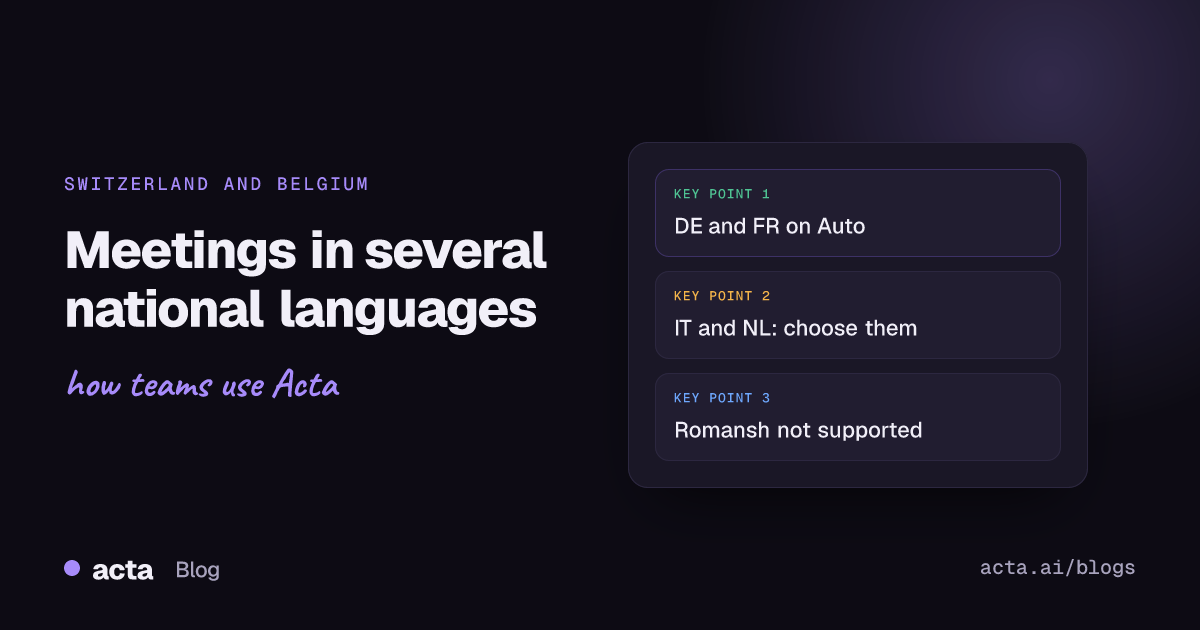
Acta detects English, Hindi, French, Spanish and German automatically; ten more languages can be chosen in Settings. Here's what that means for the national languages of the two countries:
| Language | Example offices | In Acta |
|---|
| German | Zurich, Basel; Belgium's German-speaking Community | Auto |
| French | Geneva, Lausanne, Liège, Brussels | Auto |
| Italian | Lugano; Graubünden | Beta, choose it |
| Dutch | Antwerp, Ghent, Brussels | Beta, choose it |
| Romansh | Graubünden | Not supported |
| English | Cross-border and international teams | Default and Auto |
Beta means Italian and Dutch work, and accuracy is still improving. It also means Auto never picks them: a Ticino supplier call or an Antwerp project meeting left on Auto comes back wrong. Romansh isn't among Acta's 15 languages at all, so a meeting held in Romansh can't be transcribed. Luxembourgish, which some cross-border teams near Luxembourg use, isn't supported either. I'd rather you hear that here than discover it after your first meeting in Chur.
The help article on meeting languages lists all 15 languages and shows the Language card.
The meeting language is set before each meeting, not per country
The spoken language is an account setting, not a per-meeting toggle. It sits in Settings > Meetings > Language, under "Language spoken in meetings", and it applies to new meetings; meetings already processed stay as they were. So the rule for a Swiss or Belgian team is simple: check the setting before any meeting that isn't in your usual language.
Auto takes most of the work out of this for German and French. A Basel product manager on Auto can go from a German stand-up to a French call with Geneva without touching anything. The work comes with Italian and Dutch. If that same manager has an Italian call with a Lugano supplier at 2 pm, she chooses Italian (beta) beforehand and switches back to Auto afterwards. Forget to switch back, and her next German meeting is processed as Italian.
Because the setting belongs to each person, a team can spread the load. In a Brussels office, the colleague who records most Dutch meetings keeps Dutch set permanently; the one who records the French-speaking meetings stays on Auto. Then each meeting is recorded by the person whose setting already fits. The meeting page shows a language chip next to the tabs with a "Change language" link, which makes it quick to spot a meeting processed in the wrong language.
If bots aren't welcome at a client's meetings, a desktop recorder like Acta's desktop app records from your own computer with the same language settings. Whatever you use, tell participants at the start; our guide on what to tell people before recording with AI covers the basics.
Brussels meetings need a decision on the main language
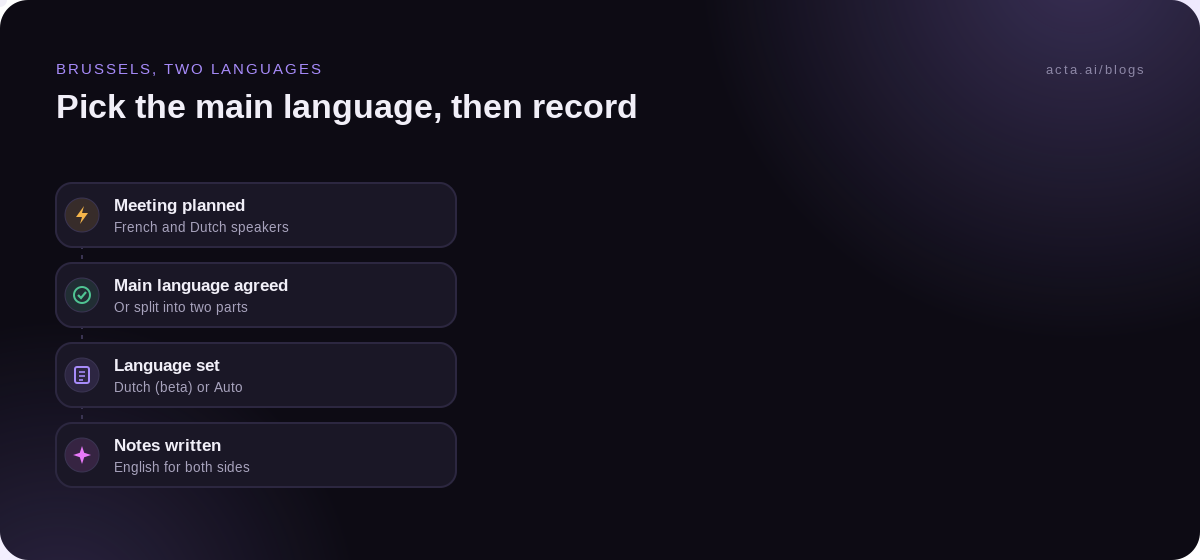
Brussels is where one-language-per-meeting gets tested. A project meeting between a French-speaking client team and a Flemish supplier might open in French, move to Dutch for a technical point and settle into English when nobody wants to choose. Acta handles one language per meeting; it can't follow those switches.
Three ways to handle it, in order of preference:
- Agree the meeting language at the start. Many Brussels teams already do this informally. If the meeting will mostly run in French, set French (or Auto) and accept that short Dutch passages won't come out well.
- Run it in English. When neither group wants to give way, English is often the neutral choice anyway, and it's the default setting.
- Split the recording. If the agenda really has a French half and a Dutch half, record them as two meetings, with Dutch (beta) chosen for the second.
Don't try to fix a mixed meeting by choosing the "less wrong" language after the fact. It won't reprocess, and the transcript will be patchy whichever way you lean.
Notes come in the meeting's language or English, never a third
The transcript always follows the spoken language. The notes (summary, decisions, action items, report templates and the follow-up email draft) come in one of two languages: the meeting's language, or English. Acta doesn't translate notes into a third language.
In a single-language country that rarely matters. In Switzerland and Belgium it shapes the whole policy. A French meeting in Lausanne gives French or English notes, so the Zurich team can't get German notes from it. A Dutch meeting in Ghent gives Dutch or English notes, so the Liège team can't get French ones. If a record needs to cross a language border, English is the only option that works for everyone.
That's often a relief rather than a compromise. Choosing German over French for a company-wide record can feel like taking sides; English doesn't. Quotes stay in the original language even in English notes, so the exact words of a Ticino supplier or a Flemish engineer are kept, and names, amounts and dates stay as spoken. When a meeting only matters inside one community, keep "Same as the meeting": the Liège service team reads French notes, the Antwerp warehouse reads Dutch ones.
A worked example: a Swiss-Belgian medtech week
An illustrative example, not a customer story: a medical-device company headquartered in Zurich, with a clinical team in Lausanne, a component supplier near Lugano and a Belgian distributor with offices in Ghent and Liège. The head of operations, Sandra, records most cross-site meetings and keeps her notes on English. Here's her week.
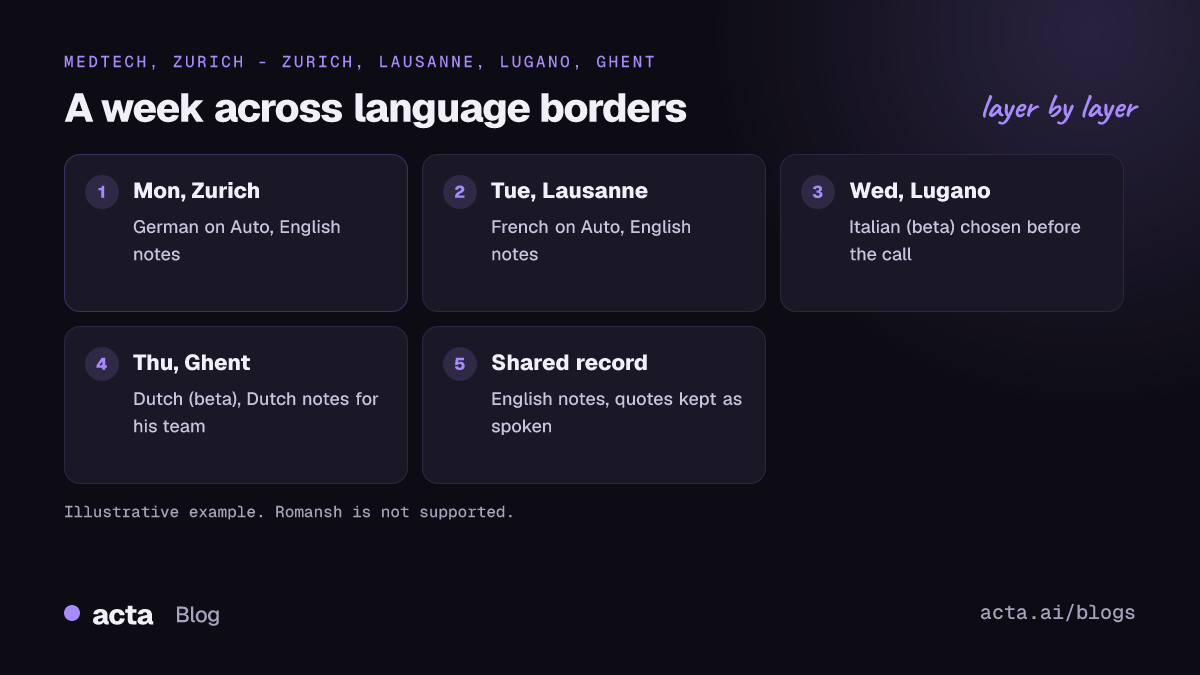
- Monday, Zurich (German). Auto. English notes for the Belgian distributor.
- Tuesday, Lausanne clinical review (French). Auto. English notes, French quotes kept.
- Wednesday, Lugano supplier call (Italian). Italian (beta) chosen before the call, back to Auto afterwards.
- Thursday, Ghent distributor call (Dutch). Recorded by Pieter, the distributor's account manager, whose Acta is set to Dutch with Dutch notes for his own team.
- Friday, all-hands (English). Nothing to change.
Sandra's Wednesday notes, in English, keep the supplier's words where they matter:
Decision: the second housing batch moves to March.
Action: Sandra confirms the revised order quantity with Lugano by Friday.
Key quote: "Il fornitore conferma la consegna per marzo." (The supplier confirms delivery for March.)
Pieter's Thursday notes stay in Dutch for his team, for example: "Actie: we leveren de eerste toestellen in februari." (Action: we deliver the first devices in February.) Sandra doesn't need his notes; she asks OneChat in English what the distributor committed to this week, and gets an English answer drawn from her own meetings.
Swiss German, Belgian French and other edge cases
Swiss German. Acta lists German, not individual Swiss German dialects. Many Swiss meetings run in dialect, with written German for documents. Run one ordinary internal meeting in dialect through Acta and read the transcript before you roll it out to a team that speaks Schweizerdeutsch all day. If the result isn't good enough, meetings held in standard German, which many teams use with French- or Italian-speaking colleagues anyway, are the safer starting point.
Belgian and Swiss French numbers. Speakers in both countries say "septante" (70) and "nonante" (90), and in parts of Switzerland "huitante" (80). Amounts are kept as said, so check that figures in the notes read the way you expect before they go into a budget. The same goes for prices in Swiss francs and euros in the same meeting: nothing is converted.
Flemish and Dutch. There's one Dutch option, and Flemish speakers use it. Regional accents are part of why a beta language needs a first test meeting; our guide to accuracy with accents, noise and crosstalk covers what you can control.
Romansh and Luxembourgish. Not supported. A team that holds meetings in either language can't use Acta for those meetings today.
Data protection. Belgium, as an EU member, applies the GDPR; Switzerland isn't in the EU and has its own data-protection law. For general reading, see the GDPR checklist for AI note takers; this guide isn't legal advice.
Where Acta fits
Acta records Zoom, Google Meet and Microsoft Teams with a bot, the desktop app or the Chrome extension, transcribes German and French automatically and Italian and Dutch as beta languages, and writes notes in the meeting's language or English. OneChat answers questions across meetings with sources. For companies with offices in more European countries, our explainer on multilingual teams and meetings across Europe covers a wider rollout.
Frequently asked questions
Can an AI notetaker handle Swiss meetings in German, French and Italian?
Yes, with one step for Italian. Acta detects German and French automatically, so meetings in either work on Auto. Italian is a beta language: choose it in Settings > Meetings > Language before the meeting, because Auto won't pick it. Romansh, the fourth national language, isn't supported, so meetings held in Romansh can't be transcribed.
Does Acta support Dutch for Belgian meetings?
Yes, as a beta language. Choose Dutch in Settings before the meeting, since Auto only detects English, Hindi, French, Spanish and German. One Dutch option covers Flemish speakers too. The transcript comes back in Dutch, and the notes come in Dutch or English, depending on your "Language for my notes" setting.
What if a Brussels meeting switches between French and Dutch?
Acta processes one language per meeting. Choose the language most of the meeting will be in, run the meeting in English, or record a planned French part and Dutch part as two meetings. Short passages in the other language won't come out well. Changing the setting after the meeting doesn't reprocess it.
Can I get German notes from a French meeting?
No. Notes come in the meeting's language or in English only. A French meeting gives French or English notes, and a Dutch meeting gives Dutch or English notes. For a record that crosses language communities in Switzerland or Belgium, English notes are the practical shared version, with quotes kept in the original language.
Does it understand Swiss German dialect?
Acta's list includes German but doesn't name Swiss German dialects separately, so don't assume either way. Record one ordinary internal meeting in dialect and read the transcript before rolling it out. If dialect meetings don't come out well, start with meetings held in standard German, which many Swiss teams already use with other language groups.
Set Switzerland-Belgium multilingual meetings rules for your team
A short set of team rules makes Switzerland-Belgium multilingual meetings predictable. Write these down and share them with everyone who records:
- Know your auto languages: German and French need nothing; Italian and Dutch are chosen before each meeting.
- Assign recorders: where possible, let the person whose setting already fits the meeting's language record it.
- Decide the shared record: English notes for anything read across language communities.
- Handle mixed meetings: agree the main language at the start, or split the recording.
- Say what isn't covered: Romansh and Luxembourgish meetings stay out of Acta for now.
To try it on your next cross-border call, add the Acta Chrome extension for Meet, Teams or Zoom in the browser and start the 15-day free trial.